


The landscape of U.S. immigration law is constantly evolving, and few areas see as much attention and competition as the H-1B visa program. Designed for specialty occupation workers, the H-1B visa is a vital pathway for talented individuals to contribute to the American economy, particularly in sectors like technology, engineering, medicine, and education. For Fiscal Year 2027, significant changes to the H-1B lottery system have reshaped how employers and prospective beneficiaries approach this highly sought-after visa.
At Imigrar, an immigration law firm based in Orlando, Florida, we understand that these changes can bring both clarity and new challenges. Our mission is to "Keep Families Together" by providing expert legal guidance and support to immigrants and their families nationwide, with a special focus on our community in Central Florida. This comprehensive guide will break down the H-1B visa lottery changes for FY2027, explaining what they mean for you and how to navigate the process effectively for future applications.
We believe in empowering you with accurate, actionable information. Whether you are an employer seeking to sponsor a skilled worker or a foreign national hoping to secure a professional opportunity in the U.S., understanding these new rules is paramount to your success.
Need Help? Our Orlando immigration team is ready to assist. Call +1 786-791-3106 for a free consultation, or message us online. Se Habla Español.
The reporting that sparked this guide
The information and insights presented in this article are informed by recent developments and announcements from official sources concerning immigration policy and procedures. We monitor these updates closely to ensure our clients receive the most current and accurate advice.
H-1B Visa Lottery Changes for FY2027 (Legal News)What This News Means for Immigrants in Orlando and Across Florida
The H-1B visa program is a cornerstone of the U.S. economy, enabling American businesses to hire highly skilled foreign professionals when qualified U.S. workers are unavailable. For immigrants, it represents a crucial pathway to living and working in the United States, often leading to permanent residency. The recent changes to the H-1B lottery system, particularly for Fiscal Year 2027, have significant implications for both employers and prospective employees, especially those residing or planning to reside in Florida.
Why this news is showing up now
The H-1B visa program is subject to an annual cap, meaning there are a limited number of visas available each fiscal year. Due to overwhelming demand, U.S. Citizenship and Immigration Services (USCIS) conducts a lottery to select petitions when the number of registrations exceeds the available visas. The "changes" for FY2027 are primarily a continuation and refinement of the new beneficiary-centric selection process that USCIS implemented for the FY2025 lottery cycle. USCIS formalized this new rule to combat widespread fraud and ensure fairness in the lottery system. As of today, September 4, 2026, the FY2027 lottery registration period (typically March) has already concluded, and selections have been made. The news is "showing up now" because the implications of these changes are still being processed by employers and beneficiaries, and understanding them is crucial for those preparing for the next lottery cycle (FY2028) or managing their current H-1B status. USCIS continues to provide updates and guidance on the implementation and enforcement of these new rules, making it a consistently relevant topic for anyone involved in the H-1B program.
How it can affect Florida residents
Florida, particularly the Orlando and Tampa Bay areas, is a growing hub for technology, aerospace, healthcare, and tourism—industries that heavily rely on H-1B workers. For Central Florida residents, these changes carry direct implications:
- Increased Competition for Legitimate Petitions: While the new rules aim to reduce fraud, the underlying demand for H-1B visas remains high. Legitimate applicants and employers in Orlando and throughout Florida must ensure their registrations are meticulously prepared to stand the best chance in the lottery.
- Employer Compliance: Florida-based employers who sponsor H-1B workers must be acutely aware of the new registration requirements. Failing to comply with the beneficiary-centric rule, even inadvertently, could lead to denial of petitions, investigations, or even debarment from future H-1B programs.
- Impact on Students and Graduates: Many international students graduate from Florida universities (like the University of Central Florida, University of Florida, and Florida State University) and seek H-1B sponsorship. These changes mean they must work with employers who understand and adhere strictly to the new registration process. The integrity of their application is now more critical than ever.
- Planning for Future Cycles: For those who were not selected in the FY2027 lottery, understanding these changes is vital for strategizing for the FY2028 lottery. Early preparation with an experienced immigration attorney in Orlando can make a significant difference.
The Orlando USCIS Field Office and local immigration courts will likely see the ripple effects of these changes, emphasizing the need for robust legal representation for any H-1B-related issues or appeals in the region.
Need Help? Our Orlando immigration team is ready to assist. Call +1 786-791-3106 for a free consultation, or message us online. Se Habla Español.
What H-1B Visa Lottery Changes for FY2027 Is (and Why It Matters)
The H-1B visa program allows U.S. employers to temporarily employ foreign workers in specialty occupations. A specialty occupation generally requires a bachelor's degree or higher in a specific field. Due to the annual cap on the number of H-1B visas, USCIS conducts an electronic lottery when demand exceeds supply. The changes for FY2027 relate to how this lottery is conducted, specifically targeting practices that USCIS deemed fraudulent.
A plain-English definition
Imagine a popular concert where tickets are limited. In the past, people might have used multiple names or accounts to try and get more tickets, hoping to increase their chances. The H-1B lottery used to be a bit like that: an individual (the "beneficiary") could have multiple employers (the "petitioners") register them for the lottery, significantly boosting their statistical odds of selection. This led to concerns about fairness and fraud, as some individuals were being registered by dozens of companies, often shell corporations, without any genuine job offer.
The "H-1B Visa Lottery Changes for FY2027" refers to a new rule implemented by USCIS, starting with the FY2025 lottery, which fundamentally altered this process. Instead of selecting registrations based on the employer, USCIS now selects based on the unique beneficiary. This means that no matter how many employers register the same foreign national, that individual only gets one "ticket" in the lottery pool. If selected, USCIS will then notify all employers who registered that beneficiary. This change aims to ensure a fairer chance for all legitimate applicants and to prevent schemes that artificially inflate selection rates.
This matters because it levels the playing field, making it harder for fraudulent registrations to succeed, and puts the focus back on legitimate job offers and highly skilled individuals. For employers and employees in Orlando and across the country, it means a more transparent and equitable, albeit still highly competitive, H-1B lottery process.
Key terms you need to know
Navigating the H-1B process requires understanding specific terminology. Here are the key terms relevant to the FY2027 changes:
- H-1B Visa: A nonimmigrant visa that allows U.S. employers to temporarily employ foreign workers in specialty occupations.
- Specialty Occupation: An occupation that requires theoretical and practical application of a body of highly specialized knowledge, and a bachelor's or higher degree in the specific specialty (or its equivalent) as a minimum for entry into the occupation.
- Cap-Subject H-1B: H-1B petitions that are subject to the annual statutory cap of 65,000 visas, plus an additional 20,000 for those with a U.S. master's degree or higher. Most H-1B petitions fall under this category.
- Cap-Exempt H-1B: Certain employers, such as institutions of higher education, non-profit organizations affiliated with higher education, or non-profit research organizations, are exempt from the annual cap.
- Beneficiary: The foreign national worker who is seeking the H-1B visa.
- Petitioner: The U.S. employer who is sponsoring the foreign national for the H-1B visa.
- H-1B Registration: An electronic process where prospective petitioners (employers) submit basic information about the company and the beneficiary to USCIS during a designated period. This registration is a prerequisite for entry into the H-1B lottery.
- Lottery Selection: If USCIS receives more registrations than available H-1B visas, it conducts a random selection process. For FY2027, this process is now beneficiary-centric.
- Beneficiary-Centric Selection: The core change. Instead of selecting individual registrations, USCIS selects unique beneficiaries. If a beneficiary is selected, all employers who registered that beneficiary will receive a selection notification and be eligible to file a petition on their behalf.
- Form I-129, Petition for a Nonimmigrant Worker: The primary form filed by the employer once an H-1B registration is selected in the lottery. This form is used for various nonimmigrant classifications, including H-1B.
- LCA (Labor Condition Application): Form ETA-9035. An application filed with the U.S. Department of Labor (DOL) by the employer, attesting that they will pay the H-1B worker the prevailing wage for the occupation in the area of employment and provide working conditions that will not adversely affect other workers. An approved LCA is required before filing Form I-129.
- Fiscal Year (FY): The U.S. government's fiscal year runs from October 1 to September 30. H-1B visas approved for a specific FY become available on October 1 of that year.
- Premium Processing: An optional service offered by USCIS for certain petitions, including H-1B, which guarantees processing within 15 calendar days for an additional fee (Form I-907, Request for Premium Processing Service).
Understanding these terms is fundamental to navigating the H-1B process, especially with the new beneficiary-centric selection rule now firmly in place for FY2027 and future lotteries. For detailed definitions and official guidance, always refer to the USCIS official website.
Current Immigration Law: The Foundation
The H-1B visa program is governed primarily by the Immigration and Nationality Act (INA), specifically Section 101(a)(15)(H)(i)(b) and Section 214(g). These sections establish the framework for specialty occupation visas, including eligibility criteria, duration of stay, and annual numerical limitations (the cap).
Federal requirements
The core federal requirements for an H-1B visa remain consistent, even with the lottery changes:
- Specialty Occupation: The job offered must meet the definition of a specialty occupation. This means the position typically requires a bachelor's degree or higher in a specific field.
- Educational/Experiential Qualification: The beneficiary must possess at least a bachelor's degree (or its equivalent) or hold a license in a specialty occupation field, or have work experience equivalent to a bachelor's degree.
- Employer-Employee Relationship: A valid employer-employee relationship must exist between the petitioner and the beneficiary, as defined by USCIS.
- Labor Condition Application (LCA): The employer must file and have certified by the U.S. Department of Labor (DOL) an ETA Form 9035, Labor Condition Application. This attests that the employer will pay the H-1B worker at least the prevailing wage or the actual wage paid to similarly qualified workers, whichever is higher, and provide adequate working conditions.
- Annual Cap: As stipulated by INA § 214(g), there is an annual numerical limit (cap) of 65,000 H-1B visas, with an additional 20,000 for beneficiaries holding a U.S. master's degree or higher. This cap is the reason for the lottery system.
- Registration Requirement: For cap-subject H-1B petitions, employers must first register the beneficiary electronically with USCIS during a specified annual period. Only selected registrations can proceed to petition filing.
The new beneficiary-centric lottery rule, while not altering the fundamental H-1B eligibility criteria, significantly changes the process for *entering* the lottery and *being selected*. It's a procedural change designed to uphold the integrity of the existing legal framework.
Florida-specific considerations
While immigration law is federal, certain aspects can have a localized impact. For Florida residents and businesses:
- Industry Demand: The H-1B program is particularly vital for Florida's growing tech sector along the I-4 corridor, healthcare systems, hospitality management, and aerospace industries. Employers in these fields, whether in Orlando, Miami, or Tampa, are highly active in the H-1B program and must adapt to the new lottery rules.
- Educational Institutions: Florida is home to numerous universities producing highly skilled graduates, many of whom are international students on F-1 visas seeking H-1B sponsorship. These students, particularly those with U.S. master's degrees, are often eligible for the advanced degree cap, which provides a slightly better chance of selection.
- Local USCIS Presence: The Orlando USCIS Field Office processes various immigration applications, though H-1B petitions are typically processed at regional service centers. However, local offices handle interviews for related processes, such as adjustment of status if an H-1B worker later applies for a green card.
- State Labor Laws: While the LCA addresses federal labor conditions, Florida employers must also ensure compliance with all state labor laws that apply to all employees, including H-1B workers.
Understanding both federal immigration requirements and how they intersect with Florida's unique economic landscape is crucial. Imigrar, located in Orlando, is uniquely positioned to assist clients throughout Florida with these complexities.
For official forms and detailed instructions, visit the USCIS Forms page. The primary form for H-1B petitions is Form I-129, Petition for a Nonimmigrant Worker.
How to Navigate the New H-1B Visa Lottery System: A Complete Step-by-Step Guide
The H-1B cap-subject petition process, especially with the beneficiary-centric lottery system, requires meticulous planning and execution. This guide outlines the essential steps for employers and beneficiaries, reflecting the changes implemented for FY2027 and beyond.
1) Employer Assessment, Prevailing Wage Determination, and LCA Filing
Before any lottery registration, the employer must determine if the position qualifies as a specialty occupation and ascertain the appropriate wage. This is a critical initial step for any employer in Orlando or elsewhere in Florida planning to sponsor an H-1B worker.
- Job Qualification: The employer must confirm that the job offered meets the "specialty occupation" criteria, requiring at least a bachelor's degree in a specific field.
- Beneficiary Qualification: Evaluate the foreign national's qualifications (education, experience) to ensure they meet the job requirements and H-1B eligibility.
- Prevailing Wage Determination: Obtain a prevailing wage determination from the Department of Labor (DOL) for the specific occupation and geographic area of employment. This is crucial for completing the LCA.
- File Labor Condition Application (LCA): The employer must electronically file Form ETA-9035, Labor Condition Application, with the DOL. This form outlines the employer's attestations regarding wages and working conditions. The DOL typically certifies the LCA within 7 business days. Important: An approved LCA is mandatory before filing the H-1B petition, but it is *not* required for the initial lottery registration.
- Required Documents (for this stage):
- Detailed job description and requirements
- Beneficiary's resume/CV and educational credentials
- Employer's EIN (Employer Identification Number)
- Prevailing wage data (if obtained from a private source)
- Completed Form ETA-9035
2) H-1B Registration and Lottery Selection (The New Beneficiary-Centric Rule in Action)
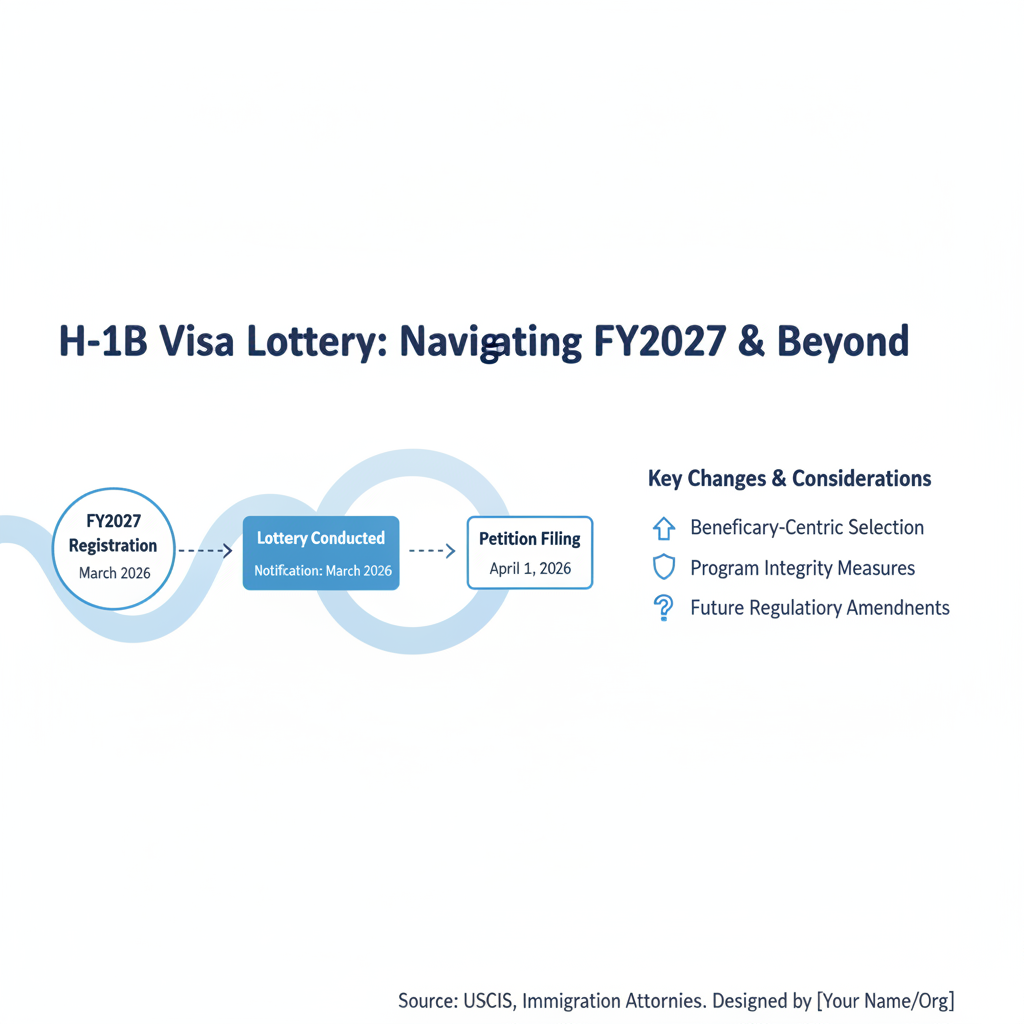
This is where the FY2027 changes are most prominent. The registration period typically opens in early March for about three weeks. For the FY2027 cycle, this happened in March 2026. The next cycle, FY2028, will likely follow a similar timeline in March 2027.
- Create/Access USCIS Online Account: Both the prospective petitioner (employer) and the representative (attorney) must have a USCIS online account.
- Submit H-1B Registration: During the designated registration period, the employer (or their authorized attorney) submits an electronic registration for each beneficiary through the USCIS online system. Each registration requires a $10 fee.
- Key Change: Under the beneficiary-centric rule, each *unique beneficiary* can only have one registration selected, regardless of how many employers registered them. USCIS identifies beneficiaries by their valid passport or travel document information. If a beneficiary is registered by multiple employers, their name still enters the lottery pool only once.
- If selected, USCIS will notify *all* employers who registered that beneficiary that their registration has been selected. This allows the beneficiary to choose which employer they wish to proceed with.
- Lottery Conducted: If USCIS receives more registrations than available cap numbers, a random lottery is conducted. For FY2027, this selection typically occurred by late March/early April 2026.
- Notification of Selection: USCIS notifies selected registrants through their online accounts. The selection notice will include the specific Service Center and filing period for the H-1B petition.
- Required Documents (for this stage):
- Employer's legal name, EIN, and address
- Beneficiary's full name, date of birth, country of birth, country of citizenship, gender, and valid passport number.
- Attorney's G-28 (Notice of Entry of Appearance as Attorney or Accredited Representative) if applicable.
- $10 registration fee per beneficiary.
3) H-1B Petition Filing
Only after a registration is selected can the employer file the actual Form I-129, Petition for a Nonimmigrant Worker.
- Prepare Form I-129 and Supporting Documentation: This is a comprehensive petition requiring detailed information about the employer, the beneficiary, the job, and how it qualifies as a specialty occupation.
- Assemble Supporting Evidence: This includes the certified LCA, beneficiary's educational degrees and transcripts, experience letters, employer financial documents, company brochures, organizational charts, and a detailed letter of support explaining the job, the beneficiary's qualifications, and the need for the H-1B worker.
- File within Designated Period: The H-1B petition, along with all supporting documents and applicable fees, must be filed with the designated USCIS Service Center within the filing window specified in the selection notice (usually a 90-day window, often starting April 1st). Warning: Missing this deadline will result in rejection.
- Required Documents (for this stage):
- Form I-129 and H-1B Data Collection and Filing Fee Exemption Supplement
- Approved Form ETA-9035, Labor Condition Application
- Selection confirmation notice
- Beneficiary's passport, visa, I-94, educational degrees, transcripts, evaluations (if foreign degree), professional licenses, prior work experience letters, and resume
- Employer's financial statements, tax returns, business licenses, articles of incorporation, organizational charts, and detailed support letter
- Employer's fees (filing, ACWIA, Fraud Prevention, Public Law 114-113 fee if applicable)
- Form G-28 (if represented by an attorney)
4) USCIS Processing and Request for Evidence (RFE) Response
Once filed, USCIS reviews the petition. This stage can involve standard processing or premium processing.
- Receipt Notice: USCIS sends a receipt notice (Form I-797C, Notice of Action) confirming receipt of the petition.
- Premium Processing (Optional): Employers can opt for Premium Processing by filing Form I-907, Request for Premium Processing Service, for an additional fee, guaranteeing a 15-calendar-day processing time.
- Request for Evidence (RFE): It is common for USCIS to issue an RFE if they require additional information or clarification. Responding thoroughly and promptly is crucial. This is where experienced legal counsel, like Imigrar, can be invaluable.
- Required Documents (for RFE):
- RFE notice
- Additional evidence requested by USCIS (e.g., further proof of specialty occupation, employer-employee relationship, beneficiary qualifications, or wage compliance).
5) Approval and Visa Stamping/Change of Status
Upon approval, the beneficiary can begin work under H-1B status.
- Approval Notice: If the petition is approved, USCIS issues an I-797A or I-797B Approval Notice. An I-797A includes a new I-94 card, indicating a change of status for beneficiaries already in the U.S.
- Visa Stamping (for those outside the U.S.): Beneficiaries outside the U.S. must attend an interview at a U.S. embassy or consulate in their home country to obtain an H-1B visa stamp in their passport.
- Start Date: H-1B status typically begins on October 1st of the fiscal year for which the petition was approved.
- Required Documents (for visa stamping):
- Valid passport
- DS-160 confirmation page
- Interview appointment confirmation
- Form I-797 Approval Notice
- LCA and supporting documents from the H-1B petition
- Proof of ties to home country (for nonimmigrant intent)
6) Post-Approval Compliance
The employer's obligations do not end with petition approval. Ongoing compliance is essential.
- Public Access File: Employers must maintain a Public Access File (PAF) containing specific documents related to the LCA, available for public inspection.
- Wage and Working Conditions: Continue to pay the H-1B worker at least the prevailing wage and adhere to all working condition attestations made in the LCA.
- Amendments: Any significant changes to the H-1B worker's employment (e.g., job duties, work location within the same metropolitan area, or employer change) may require filing an amended H-1B petition.
- Required Documents (for compliance):
- Certified LCA
- Wage documentation
- Actual wage memorandum
- Beneficiary's qualifications
- Copy of Form I-129 and supporting documents
Practical Steps You Can Take Today
Preparing for the H-1B lottery, especially with the refined rules for FY2027 and beyond, requires proactive planning. Here are practical steps you can take now, whether you're an employer in Orlando or a prospective H-1B beneficiary:
Actionable checklist
- Consult an Experienced Immigration Attorney: This is arguably the most crucial step. An attorney specializing in business immigration, like the team at Imigrar, can assess eligibility, guide you through the new beneficiary-centric lottery rules, and prepare a robust petition. This is especially vital for Orlando and Central Florida businesses navigating the H-1B landscape.
- Educate Your Team (Employers): Ensure that HR, recruiting, and management teams understand the H-1B process and the new lottery rules to avoid inadvertently violating regulations or submitting fraudulent registrations


