

Navigating the complex world of U.S. immigration law can be challenging, especially when significant updates are announced. For skilled professionals seeking to work in the United States, the H-1B visa program represents a crucial pathway. As we approach the registration period for Fiscal Year 2027 (FY2027), it’s vital for both prospective beneficiaries and sponsoring employers to understand the latest changes to the H-1B visa lottery process. These modifications, designed to enhance fairness and combat fraud, have a direct impact on who gets selected and how applications are processed. At Imigrar, your trusted immigration law firm in Orlando, Florida, we are committed to providing clarity and expert guidance through these evolving regulations.
Need Help? Our Orlando immigration team is ready to assist. Call +1 786-791-3106 for a free consultation, or message us online. Se Habla Español.
The reporting that sparked this guide:
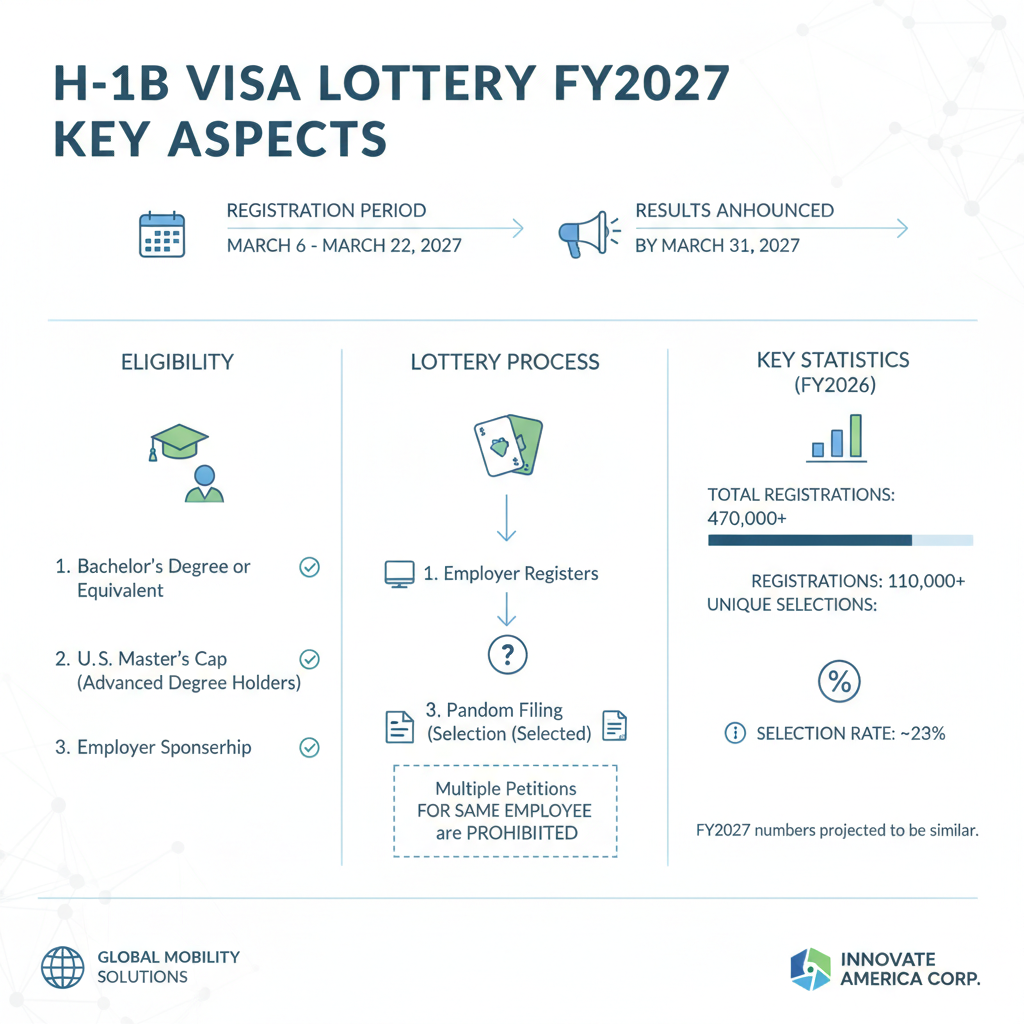
H-1B Visa Lottery Changes for FY2027 (Legal News)
What This News Means for Immigrants in Orlando and Across Florida
The H-1B visa program is a lifeline for many highly skilled foreign nationals and the U.S. companies that rely on their expertise. From the vibrant tech sector along the I-4 corridor to specialized industries throughout Florida, the demand for H-1B workers remains consistently high. The recent modifications to the H-1B lottery system are not just procedural tweaks; they represent a significant shift in how applications are processed and selected, with a primary focus on ensuring that each eligible beneficiary has a fair chance.
Why this news is showing up now
The reporting on H-1B visa lottery changes for FY2027 is timely because the U.S. Citizenship and Immigration Services (USCIS) typically announces policy updates and procedural changes well in advance of the annual registration period. While the most substantial structural changes, particularly the beneficiary-centric selection process and enhanced integrity measures, were initially introduced for the FY2025 lottery, they are now fully established and will govern the upcoming FY22027 lottery. This means that these "new rules" are now the standard operating procedure, and understanding their full implications is critical as we approach the registration window, typically in March of the preceding fiscal year (March 2027 for FY2027 petitions). This proactive communication from USCIS and subsequent legal news reporting allows employers and prospective employees ample time to prepare their strategies and ensure compliance, ultimately aiming to Keep Families Together by securing legitimate employment opportunities.
How it can affect Florida residents
Florida, particularly Central Florida and the Orlando metropolitan area, is a growing hub for technology, aerospace, healthcare, and tourism, all sectors that frequently sponsor H-1B visa holders. The changes to the H-1B lottery directly impact:
- Skilled Professionals Living in Florida: Individuals currently on F-1 OPT/STEM OPT, L-1, or other nonimmigrant visas who are seeking to transition to H-1B status will find the new beneficiary-centric selection process to be a significant advantage. This change aims to prevent multiple employers from registering the same individual, thereby reducing fraud and increasing the odds for genuinely interested candidates.
- Florida Employers: Tech companies, universities (like the University of Central Florida), and other businesses in Orlando, Tampa, Miami, and Jacksonville that rely on foreign talent must adapt their H-1B sponsorship strategies. They need to ensure their registration processes are compliant with the new rules, focusing on genuine job offers and avoiding practices that could be flagged as fraudulent. This includes rigorous internal checks to ensure each beneficiary is registered only once by their organization.
- Families in Florida: For many families, the H-1B visa is the cornerstone of their ability to live and work in the U.S. These changes, by promoting a fairer lottery, increase the chances of a successful H-1B petition for legitimate candidates, thereby helping Keep Families Together and providing stability for those building their lives in Florida.
- The Orlando USCIS Field Office: While the lottery is centrally managed, the eventual processing of petitions or interviews for specific cases might involve local offices. Understanding the federal requirements ensures smoother local interactions.
For Central Florida residents and businesses, staying informed about these changes is not just about compliance; it's about optimizing their chances for success in a highly competitive program.
What H-1B Visa Lottery Changes for FY2027 Is (and Why It Matters)
The H-1B visa program allows U.S. employers to temporarily employ foreign workers in specialty occupations. These occupations generally require a bachelor's degree or higher in a specific field. Due to high demand, USCIS conducts an annual lottery to select eligible registrations when the number of registrations exceeds the annual cap. The "changes" for FY2027 refer to the comprehensive adjustments made to the lottery system, primarily the shift to a beneficiary-centric selection process and enhanced fraud detection measures, which were introduced for FY2025 and are now fully integrated into the H-1B program.
A plain-English definition
Imagine a highly sought-after job opening where thousands apply, but only a few hundred spots are available. To decide fairly, the employer uses a lottery system. The H-1B visa program is similar: the U.S. government allows a limited number of foreign professionals (65,000 general cap, plus 20,000 for those with U.S. master's degrees or higher) to work in "specialty occupations" each year. Because demand far exceeds this annual limit (the "cap"), USCIS holds an electronic lottery. The H-1B Visa Lottery Changes for FY2027 mean that instead of employers being able to register the *same person* multiple times through different companies to boost their chances, the lottery now focuses on the *individual person* (the beneficiary). Each unique person gets only one chance in the lottery, regardless of how many employers register them. This makes the system fairer and significantly reduces the ability to game the system through multiple submissions, aiming to give genuine candidates a better shot.
Key terms you need to know
Understanding these terms is crucial for navigating the H-1B process:
- H-1B Visa: A nonimmigrant visa that allows U.S. employers to temporarily employ foreign workers in specialty occupations.
- Specialty Occupation: An occupation that generally requires a bachelor's degree or higher in a specific specialty as a minimum for entry into the occupation. Examples include IT professionals, engineers, doctors, scientists, and architects.
- Annual Cap: The statutory limit on the number of H-1B visas issued each fiscal year. Currently, it's 65,000 for the regular cap and an additional 20,000 for the U.S. master's cap (often called the "advanced degree exemption").
- Fiscal Year (FY): The U.S. government's fiscal year runs from October 1st to September 30th. H-1B visas approved in a lottery typically become effective on October 1st of the relevant fiscal year (e.g., October 1, 2026, for FY2027).
- H-1B Lottery (or Selection Process): The electronic process USCIS conducts when the number of eligible registrations exceeds the annual cap.
- H-1B Registration: The online process where prospective petitioners (employers) submit basic information about the company and the prospective H-1B worker (beneficiary) to be entered into the lottery. This occurs before the full petition is filed.
- Beneficiary: The foreign national who seeks to obtain an H-1B visa.
- Petitioner: The U.S. employer filing the H-1B petition on behalf of the beneficiary.
- Form I-129, Petition for a Nonimmigrant Worker: The primary form filed by the employer once an H-1B registration is selected in the lottery.
- Labor Condition Application (LCA) / Form ETA-9035: A certification from the U.S. Department of Labor (DOL) that the employer will pay the H-1B worker at least the prevailing wage for the occupation in the area of employment and will provide working conditions that will not adversely affect other workers. This must be certified before filing Form I-129.
- Beneficiary-Centric Selection: The key change for FY2027. Instead of selecting registrations based on the employer, USCIS now selects registrations based on the unique beneficiary. If a beneficiary has multiple registrations submitted by different employers, they are still only entered into the lottery once. If selected, all employers who registered that beneficiary are notified, and only one employer can then proceed to file a petition. This prevents multiple lottery entries for the same individual.
- Anti-Fraud Measures: USCIS has implemented new measures to detect and deter fraud, including scrutinizing multiple registrations for the same beneficiary and increasing site visits.
Current Immigration Law: The Foundation
The H-1B visa program is governed by provisions within the Immigration and Nationality Act (INA), specifically Section 101(a)(15)(H)(i)(b) which defines the H-1B nonimmigrant classification, and Section 214(g) which establishes the annual cap. Regulations further detailing the program are found in Title 8 of the Code of Federal Regulations (8 CFR Part 214.2(h)). These laws and regulations outline the eligibility criteria for both the employer and the beneficiary, the petitioning process, and the limitations of the visa. The recent changes to the lottery process were implemented under USCIS’s existing regulatory authority to manage the H-1B cap and enhance program integrity.
Federal requirements
For an H-1B petition to be approved, both the employer (petitioner) and the foreign worker (beneficiary) must meet specific federal requirements:
Employer Requirements:
- Bona Fide Job Offer: The employer must have a genuine job offer for a specialty occupation position.
- Employer-Employee Relationship: A valid employer-employee relationship must exist, meaning the employer has the right to control the work of the beneficiary.
- Prevailing Wage: The employer must agree to pay the H-1B worker at least the prevailing wage for the occupation in the area of employment or the actual wage paid to similarly qualified employees, whichever is higher. This is certified through the Labor Condition Application (LCA) / Form ETA-9035.
- Employer Identification Number (EIN): The employer must have a valid federal EIN.
- Specialty Occupation: The job itself must qualify as a specialty occupation, requiring a minimum of a bachelor's degree in a specific field.
Beneficiary Requirements:
- Specialty Occupation Qualifications: The beneficiary must possess a bachelor's degree or its equivalent, or a license in a specialty occupation field, or work experience equivalent to a bachelor's degree.
- Job Match: The beneficiary’s qualifications must match the requirements of the specialty occupation offered by the employer.
- Nonimmigrant Intent: Although H-1B is a "dual intent" visa, meaning you can have immigrant intent while holding an H-1B, the initial application still requires demonstrating intent to depart after temporary employment, unless seeking permanent residency concurrently.
All H-1B petitions are filed using Form I-129, Petition for a Nonimmigrant Worker, along with extensive supporting documentation. You can find detailed information and all required forms on the USCIS official website.
Florida-specific considerations
While the H-1B visa is a federal program, its impact and application have unique considerations in Florida:
- High Demand in Tech and Healthcare: Florida, particularly the Orlando-Kissimmee-Sanford metropolitan area, has a booming tech industry, robust healthcare sector, and a significant presence of aerospace and defense companies. These industries frequently sponsor H-1B visas for software developers, engineers, data scientists, medical professionals, and researchers.
- University Sponsorship: Major universities across Florida, such as the University of Central Florida in Orlando, University of Florida, and University of South Florida, are significant H-1B sponsors for researchers, professors, and other academic staff. These institutions are often cap-exempt, meaning they are not subject to the annual lottery.
- Economic Impact: H-1B workers contribute significantly to Florida's economy, filling critical skill gaps and fostering innovation. The state's economic development relies on access to global talent.
- Local Legal Expertise: Given Florida's diverse population and significant immigrant communities, having local legal counsel, like Imigrar in Orlando, who understand both the federal nuances and the local context, is invaluable. We understand the specific needs of businesses and individuals operating along the I-4 corridor and across the state.
How to Navigate the H-1B Visa Process Under the New Rules: A Complete Step-by-Step Guide
The H-1B visa process, particularly with the lottery, can be intricate. Under the new beneficiary-centric rules for FY2027, meticulous preparation and understanding of each step are more critical than ever.
1) Employer Sponsorship & Eligibility Assessment
The journey begins with a U.S. employer identifying a need for a specialty occupation worker and determining their eligibility to sponsor an H-1B visa. This is not a process an individual can initiate on their own; it requires a sponsoring employer.
- Employer Action: The employer must confirm they have a genuine job opening that qualifies as a specialty occupation. They must also verify they meet the financial and operational requirements to sponsor a foreign worker. This includes having a valid Federal Employer Identification Number (FEIN).
- Beneficiary Action: The prospective employee should ensure their educational background and work experience align with the specialty occupation requirements. They should also provide their potential employer with all necessary personal information for the registration process.
- Legal Guidance: Imigrar can assist employers in assessing job qualifications, ensuring the position meets the "specialty occupation" definition, and verifying the employer-employee relationship.
Required Documents (for initial assessment):
- Employer's FEIN
- Detailed job description
- Beneficiary's resume/CV
- Beneficiary's educational degrees and transcripts (evaluated if from foreign institutions)
2) H-1B Registration Period
This is the critical first stage for cap-subject H-1B visas, typically occurring in March for the fiscal year starting the following October 1st (e.g., March 2027 for FY2027). Under the new rules, this step is particularly important due to the beneficiary-centric selection.
- Employer Action: The employer creates a registrant account on the USCIS official website if they don't already have one. For each prospective H-1B employee, the employer submits an electronic registration containing basic information about the company and the beneficiary. Each unique beneficiary can only have one registration submitted on their behalf by a single employer. However, a beneficiary can have multiple registrations submitted by *different* employers, but it's important to understand the selection mechanism now focuses on the beneficiary, not the number of entries.
- Beneficiary Action: Ensure all personal information provided to the employer for registration is accurate and up-to-date, including passport details and educational background.
- Important: USCIS charges a non-refundable registration fee (which was $10 for FY2025 but is expected to increase to $215 for FY2027, as per the fee rule changes effective April 1, 2024).
Required Information for Registration:
- Employer's legal name, FEIN, and mailing address
- Employer's authorized signatory information
- Beneficiary's full name, date of birth, country of birth, country of citizenship, passport number
- Beneficiary's gender
- Whether the beneficiary holds a U.S. master's degree or higher (for the advanced degree cap)
- Beneficiary's unique identification number (e.g., passport number or foreign ID)
3) Lottery Selection & Notification
After the registration period closes, USCIS conducts the lottery. Under the beneficiary-centric approach, USCIS pools all registrations by unique beneficiary. If a beneficiary has multiple registrations from different employers, they are still only counted as one entry in the lottery. If that unique beneficiary is selected, *all* employers who submitted a registration for that beneficiary will be notified that their registration has been selected. This is a crucial change.
- USCIS Action: Conducts the electronic lottery, first for the U.S. master's cap, then for the regular cap.
- Notification: USCIS notifies selected registrants through their online accounts. Typically, notifications are sent by the end of March.
- Employer Action: If a registration for their beneficiary is selected, the employer receives a notification. They then have a designated filing period (usually 90 days) to submit the full H-1B petition. If a beneficiary was selected via multiple employers, the employers are notified, and only one employer can proceed with filing.
- Beneficiary Action: Communicate with all potential employers if you have multiple selections, to decide which employer will file the petition.
4) Petition Filing (Form I-129)
Once an H-1B registration is selected, the employer proceeds to file the full H-1B petition with USCIS. This step involves substantial documentation and legal preparation.
- Employer Action:
- File and obtain a certified Labor Condition Application (LCA) / Form ETA-9035 from the Department of Labor. This must be done *before* filing Form I-129.
- Prepare and submit Form I-129, Petition for a Nonimmigrant Worker, along with the LCA, required fees, and extensive supporting documentation to USCIS within the 90-day filing window.
- The petition must demonstrate that the position is a specialty occupation and that the beneficiary is qualified for it.
- Legal Guidance: This is where Imigrar’s expertise is invaluable. We ensure all forms are correctly filled, supporting documents are complete and compelling, and the petition meets all federal requirements, minimizing the risk of Requests for Evidence (RFEs) or denials.
Required Documents for Form I-129 Petition (examples):
- Certified LCA (Form ETA-9035)
- Beneficiary's educational documents (degrees, transcripts, foreign evaluations)
- Beneficiary's resume/CV
- Letters of experience from previous employers
- Copies of beneficiary's passport, visa, I-94 record
- Employer's company profile, financial statements, business licenses
- Detailed letter from employer supporting the petition
- Copies of any relevant contracts or work orders (especially for IT consulting firms)
- Organizational charts
- Photographs of the workplace
5) USCIS Processing & RFE/Approval
After filing, USCIS reviews the petition. Processing times can vary significantly (check USCIS Processing Times for current estimates).
- USCIS Action: Reviews the filed petition and supporting documents.
- Request for Evidence (RFE): If USCIS needs more information or clarification, they will issue an RFE. This is a common occurrence.
- Approval/Denial: Upon satisfactory review, USCIS will either approve or deny the petition.
- Legal Guidance: Imigrar can help prepare a robust response to any RFE, ensuring all requested evidence is submitted clearly and persuasively, significantly increasing the chances of approval.
Warning: Ignoring an RFE or providing an incomplete response can lead to denial.
6) Change of Status or Visa Stamping
If the H-1B petition is approved, the next step depends on whether the beneficiary is already in the U.S. or abroad.
- For Beneficiaries in the U.S. (Change of Status): If the beneficiary is already in the U.S. in a valid nonimmigrant status (e.g., F-1 OPT, L-1, H-4), the approved Form I-129 may include an automatic change of status to H-1B, usually effective October 1st.
- For Beneficiaries Outside the U.S. (Consular Processing/Visa Stamping): If the beneficiary is abroad, they must attend an interview at a U.S. embassy or consulate in their home country to obtain an H-1B visa stamp in their passport. The U.S. Department of State (U.S. Department of State) handles this process.
Required Documents (for visa stamping):
- Original passport
- DS-160 confirmation page
- Appointment confirmation
- I-797 H-1B approval notice
- LCA
- Company letter, job description, salary details
- Educational documents
- Evidence of ties to home country (for nonimmigrant intent)
7) Start Date
For cap-subject H-1B visas, the earliest a beneficiary can begin employment in H-1B status is October 1st of the fiscal year for which the petition was approved. For FY2027, this means October 1, 2026.
- Employer Action: Ensure all onboarding procedures are complete for the October 1st start date.
- Beneficiary Action: Confirm start date with employer and plan any necessary relocation.
Reminder: It is illegal to begin H-1B employment before the effective start date on the approval notice.
Need Help? Our Orlando immigration team is ready to assist. Call +1 786-791-3106 for a free consultation, or message us online. Se Habla Español.

Practical Steps You Can Take Today
Proactive preparation is paramount for a successful H-1B application, especially with the competitive nature of the lottery and the new integrity measures. Here’s how you can prepare for FY2027:
Actionable Checklist:
- Identify Potential Sponsoring Employers Early: If you are a prospective beneficiary, start networking and applying for jobs with companies known to sponsor H-1B visas well in advance. For employers, identify your staffing needs and potential H-1B candidates.
- Gather All Necessary Documents: Begin compiling your educational degrees, transcripts, professional licenses, and work experience letters. Ensure foreign degrees are evaluated by a credential evaluation service for U.S. equivalency. For employers, gather company financials, business registrations, and detailed job descriptions.
- Understand the New Beneficiary-Centric Rules: Both employers and beneficiaries must fully grasp that selection is now based on the unique individual. Employers should not submit multiple registrations for the same individual, but a beneficiary can accept registrations from multiple *different* employers, knowing only one will proceed if selected.
- Consult with an Experienced Immigration Attorney: This is perhaps the most crucial step. An attorney can assess eligibility, guide through documentation, ensure compliance with all new rules, and prevent costly mistakes.
- Budget for Costs: Be aware of the various fees involved: registration fee, filing fees, legal fees, and potentially premium processing fees. Discuss with your employer who will cover which costs.
- Prepare for Potential RFEs: Even with a strong initial petition, RFEs are common. Having an attorney on board from the start ensures a swift and comprehensive response if one is issued.
Document Preparation Guidance:
- Accuracy is Key: Double-check all personal details, dates, and names across all documents. Any discrepancies can cause delays or denials.
- Translations: Ensure all non-English documents are accompanied by certified English translations.
- Organizational Structure: For employers, prepare clear organizational charts and detailed descriptions of the beneficiary’s role within the company, especially if they will be working at a third-party client site.
- Evidence of Specialty Occupation: Collect letters from experts, industry standards, or university curriculum details to strongly demonstrate that the position requires a bachelor's degree in a specific field.
Timeline Expectations (General for FY2027):
- Fall 2026: Employers and beneficiaries begin preparing, consulting with attorneys.
- March 2027 (Early March): H-1B electronic registration period opens for approximately 2-3 weeks.
- Late March 2027: Lottery conducted, results announced.
- April 1, 20


