


The landscape of U.S. immigration law is ever-evolving, and few areas garner as much attention and anxiety as the H-1B visa program. Designed to allow U.S. employers to temporarily employ foreign workers in specialty occupations, the H-1B visa is a vital pathway for skilled professionals seeking opportunities in the United States. Given the overwhelming demand, the H-1B program operates a highly competitive lottery system each year. As we look towards the Fiscal Year 2027 (FY2027) lottery, significant changes are on the horizon, building upon recent reforms designed to enhance fairness and integrity.
At Imigrar, your trusted immigration law firm in Orlando, Florida, we understand that these changes can feel complex and daunting. Our mission is to "Keep Families Together" by providing clear, actionable guidance to immigrants and their families nationwide. We are here to help you navigate these updates, ensuring you are well-prepared for the upcoming H-1B lottery season.
Navigating H-1B Changes? Don't face the complex H-1B lottery changes alone. Our Orlando immigration team is ready to assist with expert legal guidance. Call +1 786-791-3106 for a free consultation, or message us online. Se Habla Español.
The reporting that sparked this guide
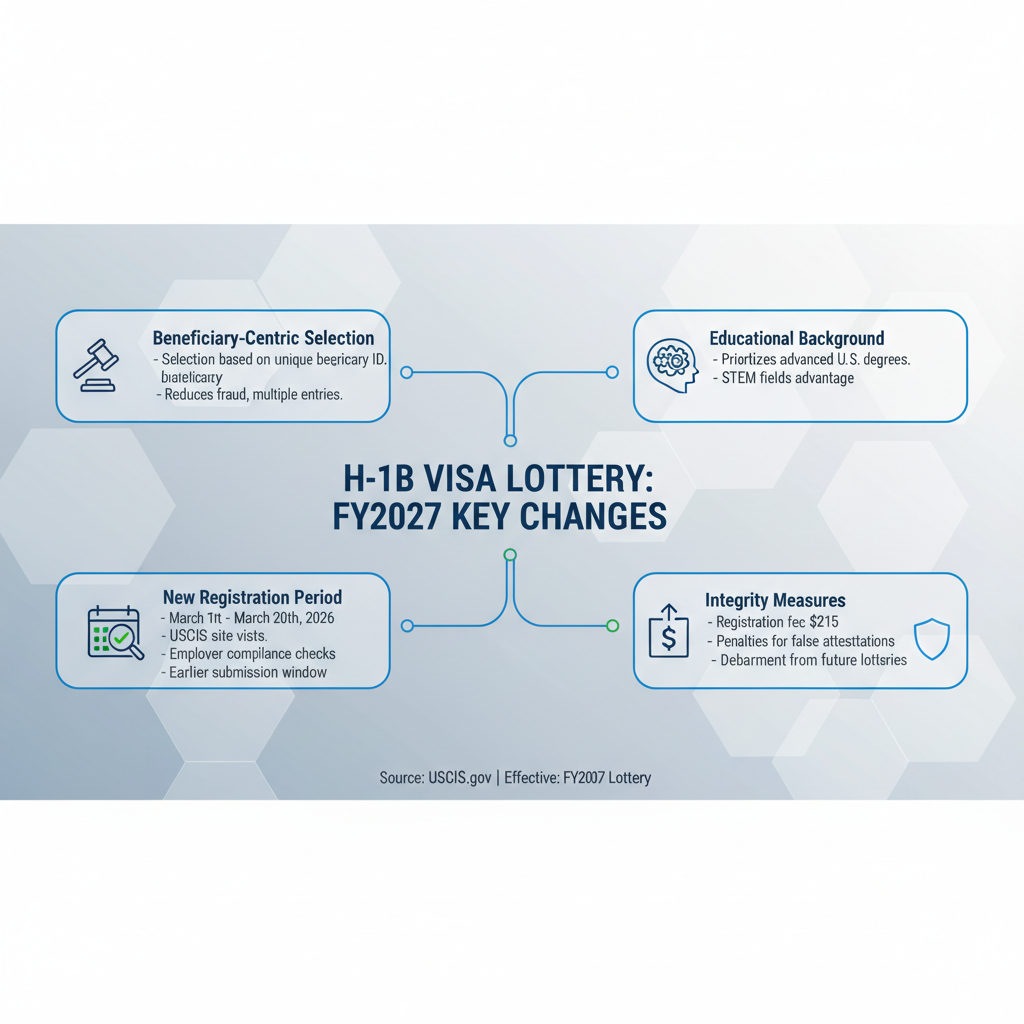
Our insights into the upcoming H-1B visa lottery changes for FY2027 are informed by continuous monitoring of official government announcements and expert legal analysis of the latest immigration policies. The core of these discussions stems from the U.S. Citizenship and Immigration Services (USCIS) efforts to refine the H-1B cap lottery process. The most recent significant regulatory changes were implemented for the FY2205 lottery, which saw a shift to a beneficiary-centric selection process and increased scrutiny on multiple registrations. As we approach FY2027, ongoing discussions and potential further refinements are expected to solidify and enhance these reforms, aiming to curb fraud and ensure a more equitable distribution of these highly coveted visas. For more general immigration law news, you can refer to:
H-1B Visa Lottery Changes for FY2027 (Legal News)
What This News Means for Immigrants in Orlando and Across Florida
Understanding the implications of H-1B visa lottery changes is crucial for anyone seeking to work in a specialty occupation in the U.S., particularly for those living in or planning to move to Florida. These changes don't just affect abstract policies; they have direct, tangible impacts on individuals, families, and businesses across the state.
Why this news is showing up now
The H-1B visa process operates on a fiscal year (FY) cycle, which begins on October 1st. For example, the FY2026 lottery registration occurred in March 2026, with petitions filed starting April 1, 2026, for employment beginning October 1, 2026. Given this timeline, discussions and proposed changes for the *next* cycle, FY2027, typically emerge in the preceding months. USCIS often announces final rules or policy updates in late fall or early winter of the year prior to the registration period (e.g., late 2025/early 2026 for the March 2027 registration). This allows employers and beneficiaries sufficient time to prepare. The recent changes, particularly the shift to a beneficiary-centric lottery and increased registration fees, were significant and have prompted ongoing legal and public discourse. As USCIS continues to fine-tune the system to combat fraud and ensure fairness, the "trending news" for FY2027 reflects the anticipation of further clarifications, minor adjustments, or even new proposals building upon these established reforms. The agency is committed to improving the integrity of the H-1B program, making these ongoing discussions highly relevant for anyone planning to participate in the upcoming lottery.
How it can affect Florida residents
Florida, with its booming tech industry, robust healthcare sector, and thriving tourism and aerospace industries, is a significant destination for H-1B visa holders. Cities like Orlando, Tampa, Miami, and Jacksonville attract a diverse array of skilled professionals. The H-1B visa lottery changes for FY2027 will directly impact:
- Tech Professionals: Orlando's "Silicon Swamp" and other tech hubs along the I-4 corridor rely heavily on H-1B talent in software development, engineering, and IT. Changes to the lottery process, especially those aimed at reducing fraud, could mean a fairer chance for legitimate applicants.
- Healthcare Workers: Florida's large and growing elderly population, coupled with its status as a medical tourism destination, creates high demand for doctors, nurses, and medical researchers. H-1B visas are crucial for staffing hospitals and research facilities across the state.
- Academic and Research Institutions: Universities like the University of Central Florida (UCF) in Orlando, the University of Florida, and Florida State University often sponsor H-1B visas for professors, researchers, and post-doctoral fellows. Any changes affect their ability to attract top global talent.
- Families: The H-1B visa often serves as a stepping stone for individuals and their families to establish a life in the U.S. Uncertainty or increased complexity in the lottery process can cause significant stress for families planning their future in Central Florida and beyond.
- Employers: Florida businesses, from startups to multinational corporations, depend on H-1B visas to fill critical skill gaps. Navigating new rules and increased compliance requirements will be essential for their talent acquisition strategies.
For Central Florida residents, understanding these changes means being better equipped to plan your career trajectory, seek appropriate legal counsel, and prepare your application with precision. The stakes are high, and accurate information is your best ally.
Confused by H-1B Updates? Imigrar helps clients in Orlando and nationwide understand complex immigration rules. Get your questions answered. Call us at +1 786-791-3106 for a free consultation. Se Habla Español.
What H-1B Visa Lottery Changes Is (and Why It Matters)
The H-1B visa program is one of the most sought-after non-immigrant work visas in the United States. Its competitive nature and annual cap make any regulatory adjustments critical news for aspiring immigrants and U.S. employers alike. The "changes" for FY2027 refer to USCIS's ongoing efforts to refine the lottery system, primarily building upon the significant reforms introduced for the FY2025 cycle.
A plain-English definition
The H-1B visa is a non-immigrant visa that allows U.S. employers to temporarily employ foreign workers in specialty occupations. These occupations generally require a bachelor's degree or higher in a specific field, such as IT, engineering, medicine, architecture, or accounting. The "lottery changes" refer to modifications in the selection process used by USCIS when the number of H-1B petitions exceeds the annual cap. Since the demand for H-1B visas far outstrips the supply, USCIS conducts an electronic lottery to select eligible registrations. The changes for FY2027 are expected to further solidify and enhance the recent shift to a beneficiary-centric selection process, meaning each unique beneficiary has an equal chance of selection, regardless of how many employers register them. This aims to deter fraud and give every eligible individual a fair shot.
Key terms you need to know
Navigating the H-1B process requires familiarity with specific terminology:
- H-1B Visa: A non-immigrant visa for temporary workers in specialty occupations.
- USCIS: U.S. Citizenship and Immigration Services, the government agency that administers immigration benefits. (USCIS official website)
- Petitioner: The U.S. employer who sponsors the foreign worker for the H-1B visa.
- Beneficiary: The foreign worker who is seeking the H-1B visa.
- Specialty Occupation: An occupation that requires a theoretical and practical application of a body of highly specialized knowledge, and a bachelor's or higher degree in the specific specialty (or its equivalent) as a minimum for entry into the occupation in the United States.
- Cap-Subject H-1B: H-1B petitions that are subject to the annual numerical cap. Most H-1B visas fall under this category.
- Cap-Exempt H-1B: H-1B petitions that are exempt from the annual cap, typically for beneficiaries employed by institutions of higher education, non-profit organizations affiliated with higher education, or non-profit research organizations, or governmental research organizations.
- Annual Cap: The statutory limit on the number of H-1B visas issued each fiscal year. Currently, it is 65,000 visas, plus an additional 20,000 for those with a U.S. master's degree or higher (the "master's cap").
- H-1B Lottery/Selection Process: The electronic random selection process conducted by USCIS when the number of eligible registrations exceeds the annual cap.
- H-1B Registration: The online process where employers (or their attorneys) submit basic information about the prospective H-1B beneficiary and the employer during a designated period. This is the first step to enter the lottery.
- Labor Condition Application (LCA): Form ETA 9035/9035E. An application filed with the U.S. Department of Labor (DOL) by the employer, attesting to certain conditions of employment, including prevailing wage and working conditions. Must be certified before filing the H-1B petition.
- Form I-129: Petition for a Nonimmigrant Worker. The primary form filed by the employer with USCIS after a registration is selected in the lottery.
- Form I-907: Request for Premium Processing Service. Allows for expedited processing of certain petitions, including H-1B, for an additional fee.
- Fiscal Year (FY): The U.S. government's fiscal year runs from October 1st to September 30th. H-1B visas are allocated based on this cycle.
- Prevailing Wage: The average wage paid to similarly employed workers in a specific occupation in the area of intended employment. Employers must pay H-1B workers at least the prevailing wage or the actual wage paid to other employees with similar experience and qualifications, whichever is higher.
The "changes" for FY2027 are expected to reinforce the integrity of the lottery, building on the beneficiary-centric selection process introduced in FY2025. This means that instead of multiple employers registering the same person, leading to an artificially inflated chance of selection, each *individual* beneficiary will be entered into the lottery only once, regardless of how many employers sponsor them. This aims to prevent abuse of the system and ensure a more level playing field for all legitimate applicants.
Current Immigration Law: The Foundation
The H-1B visa program is governed by specific sections of the Immigration and Nationality Act (INA) and federal regulations. Understanding this legal framework is essential for anyone involved in the application process.
Federal requirements
The H-1B visa program is authorized under Section 101(a)(15)(H)(i)(b) of the Immigration and Nationality Act (INA). The annual cap on H-1B visas is established by INA Section 214(g), which sets the general numerical limit at 65,000, with an additional 20,000 visas reserved for those holding a U.S. master's degree or higher. Further regulatory details can be found in Title 8 of the Code of Federal Regulations, specifically at 8 CFR 214.2(h).
Key federal requirements for an H-1B petition include:
- Specialty Occupation: The job must qualify as a specialty occupation, meaning it requires a bachelor's degree or higher in a specific field. The foreign national must hold such a degree or its equivalent.
- Employer-Employee Relationship: A valid employer-employee relationship must exist between the petitioner and the beneficiary, as defined by USCIS.
- Labor Condition Application (LCA): The employer must file and have certified by the U.S. Department of Labor (DOL) a Form ETA 9035/9035E, attesting that they will pay the H-1B worker at least the prevailing wage for the occupation in the area of employment or the actual wage paid to other employees with similar experience and qualifications, whichever is higher. The LCA also attests to providing working conditions that will not adversely affect other employees.
- Prevailing Wage: The employer must demonstrate that the wage offered to the H-1B worker meets or exceeds the prevailing wage for the occupation in the geographic area of employment.
- Education and Qualifications: The beneficiary must possess the required educational qualifications (a U.S. bachelor's degree or its foreign equivalent, or a license, or work experience equivalent to a bachelor's degree) for the specialty occupation.
- Cap-Subject vs. Cap-Exempt: Most H-1B petitions are subject to the annual cap. However, certain employers (e.g., universities, non-profit research organizations) are cap-exempt.
The recent changes for FY2025 (which set the precedent for FY2027) focused on improving the integrity of the H-1B lottery system. This involved shifting to a beneficiary-centric selection process, where each unique beneficiary is entered into the lottery only once, regardless of the number of registrations submitted on their behalf. This aims to prevent the manipulation of the lottery by employers submitting multiple registrations for the same individual, thereby increasing their chances of selection. USCIS has also been increasing scrutiny on potential fraud and misrepresentation during the registration and petition filing phases.
For more detailed information on specific requirements and forms, always refer to the USCIS official website and the USCIS Forms page.
Florida-specific considerations
While federal law governs the H-1B program, the practical impact and demand vary by state. Florida's vibrant economy creates unique considerations for H-1B applicants:
- High Demand Industries: Florida is a hub for technology, aerospace, healthcare, and hospitality. These sectors frequently seek skilled foreign professionals, leading to a high volume of H-1B petitions originating from Florida-based employers.
- Orlando's Tech Growth: Orlando, in particular, has seen significant growth in its tech sector, with companies along the I-4 corridor actively recruiting talent in software development, simulation, and cybersecurity. This means a competitive landscape for H-1B applicants targeting Orlando jobs.
- Local USCIS Presence: For those in Central Florida, the Orlando USCIS Field Office may handle certain aspects of immigration cases, though H-1B petitions are processed by service centers. However, understanding the local context and legal support available is key.
- Diverse Workforce: Florida's diverse population means a robust pool of international students graduating from local universities (like UCF) who often seek H-1B sponsorship to remain and work in the state.
Imigrar, based in Orlando, is uniquely positioned to assist clients throughout Florida and nationwide with these specific considerations, leveraging our local knowledge and extensive experience.

How to Navigate the H-1B Lottery Changes: A Complete Step-by-Step Guide
The H-1B visa process, especially with the lottery, can be complex. The changes for FY2027 reinforce the need for meticulous preparation and strategic planning. Here’s a detailed step-by-step guide to help you and your employer navigate the process successfully.
1) Employer Assessment and Labor Condition Application (LCA) Filing
Before any H-1B registration can take place, the prospective employer must determine if the position qualifies as a specialty occupation and if they meet the necessary employer requirements. This initial assessment is critical.
- Job Qualification: The employer must ensure the job duties require a bachelor's degree or higher in a specific field.
- Beneficiary Qualification: The beneficiary must possess the required degree or its equivalent.
- Prevailing Wage Determination: The employer must determine the appropriate prevailing wage for the occupation in the specific geographic area of employment. This is usually done through Department of Labor (DOL) wage data.
- LCA Filing: Once the job and beneficiary qualifications are confirmed, the employer files a Labor Condition Application (LCA), Form ETA 9035/9035E, with the U.S. Department of Labor. The LCA attests that the employer will pay the H-1B worker at least the prevailing wage and provide working conditions that meet federal standards. The LCA must be certified by the DOL before an H-1B petition can be filed.
Required Documents (Employer):
- Employer's Federal Employer Identification Number (FEIN)
- Detailed job description, including duties, responsibilities, and minimum educational requirements
- Proposed salary and benefits information
- Occupational classification and wage level determination
Timeline Expectation: LCA processing typically takes 7-10 business days, but can sometimes be longer. It's crucial to file this well in advance of the H-1B registration period.
2) H-1B Registration for the Lottery
This is the gateway to the H-1B process for cap-subject petitions. The H-1B registration period for FY2027 will likely take place in March 2027.
- Online Registration: The employer, or their authorized attorney, must electronically register the beneficiary through the USCIS online H-1B registrant account.
- Beneficiary-Centric Selection: Under the new rules, each unique beneficiary can only be entered into the lottery once. If multiple employers register the same beneficiary, USCIS will consolidate these registrations and the beneficiary will still only have one entry. This change significantly reduces the incentive for fraudulent multiple registrations.
- Registration Fee: A non-refundable registration fee (which was $10 for FY2025 but has been proposed to increase significantly for future cycles, so expect a higher fee for FY2027) must be paid for each registration.
Required Information for Registration:
- Employer's name, FEIN, and address
- Employer's authorized signatory information
- Beneficiary's full name, date of birth, country of birth, country of citizenship
- Beneficiary's passport number or other valid travel document number (this is a critical new requirement to ensure unique beneficiary identification)
- Beneficiary's gender
- Whether the beneficiary holds a U.S. master's degree or higher (for the master's cap)
Important: Ensure all information is accurate and consistent with the beneficiary's passport. Any discrepancies could lead to issues later on.
3) Lottery Selection Notification
After the registration period closes, USCIS conducts the lottery. This typically happens within a few days or weeks after the registration window closes.
- Notification: USCIS will notify petitioners (or their attorneys) electronically through their online accounts if their registration has been selected. Notifications are usually sent by the end of March.
- Selection Status: The status in the online account will change to "Selected" if chosen. Unselected registrations will typically show "Not Selected."
- Filing Window: If selected, USCIS provides a specific 90-day window within which the H-1B cap-subject petition (Form I-129) must be filed.
Warning: Only selected registrations can proceed to the petition filing stage. Do NOT file a petition if your registration was not selected, as it will be rejected.
4) H-1B Petition Filing (Form I-129)
If your registration is selected, the employer must then prepare and file the full H-1B petition with USCIS. This is the most document-intensive step.
- Prepare Form I-129: Complete Form I-129, Petition for a Nonimmigrant Worker, along with all required supplements and addenda.
- Assemble Supporting Documents: Gather all necessary evidence to prove eligibility for the H-1B visa and the specialty occupation.
- Calculate and Pay Fees: Pay the required USCIS filing fees, which include the I-129 base fee, American Competitiveness and Workforce Improvement Act (ACWIA) fee, Fraud Prevention and Detection fee, and Public Law 114-113 fee (if applicable). These fees have increased significantly for FY2025 and may be adjusted further for FY2027.
- Mail the Petition: Send the complete petition package to the appropriate USCIS service center within the designated filing window.
Required Documents (Beneficiary & Employer):
- Certified LCA (Form ETA 9035/9035E)
- Copy of the H-1B selection notice
- Original or certified copies of the beneficiary's academic degrees, transcripts, and diplomas (foreign degrees must include an evaluation of U.S. equivalency)
- Letters of experience from previous employers, if applicable
- Beneficiary's resume/CV
- Copy of beneficiary's passport (biographic page, visa stamps, I-94 record)
- Employer's financial statements, tax returns, and business license to demonstrate ability to pay the proffered wage
- Detailed letter from the employer explaining the specialty occupation, the necessity of the H-1B worker, and the terms of employment
- Any prior USCIS approval notices (e.g., OPT EAD, previous H-1B)
Reminder: Ensure all foreign language documents are accompanied by certified English translations.
5) USCIS Processing and Request for Evidence (RFE) Response
After filing, USCIS will process the petition. This can take several months, or it can be expedited.
- Normal Processing: USCIS publishes current processing times online.
- Premium Processing: The employer can opt for Premium Processing (Form I-907) for an additional fee, guaranteeing a decision within 15 calendar days.
- Requests for Evidence (RFEs): USCIS may issue an RFE if they need more information or clarification. Responding thoroughly and promptly to an RFE is critical. An RFE might ask for more evidence on the specialty occupation, employer-employee relationship, or beneficiary qualifications.
- Approval/Denial: If approved, USCIS sends an I-797 Approval Notice. If denied, USCIS sends a denial letter explaining the reasons.
Practical Tip: If you receive an RFE, work closely with your immigration attorney to gather and present the requested evidence effectively. This is often the make-or-break point for many petitions.
6) Visa Interview (Consular Processing) or Change of Status
Once the H-1B petition is approved, the next step depends on the beneficiary's current location.
- Consular Processing (Outside


