

In the intricate landscape of U.S. immigration law, the ability to reunite with loved ones stands as a cornerstone principle. For countless families in Orlando, across Florida, and throughout the nation, the dream of living together permanently in the United States is a powerful motivator. Understanding the process of family-based immigration petitions is not just about filing forms; it's about navigating a path that keeps families together, fulfilling the very mission of our firm, Imigrar.
Today, we delve into a comprehensive guide on family petitions, drawing insights from current discussions and the timeless importance of family reunification in immigration policy.
The reporting that sparked this guide: Family-Based Immigration Petition Guide (Immigration)
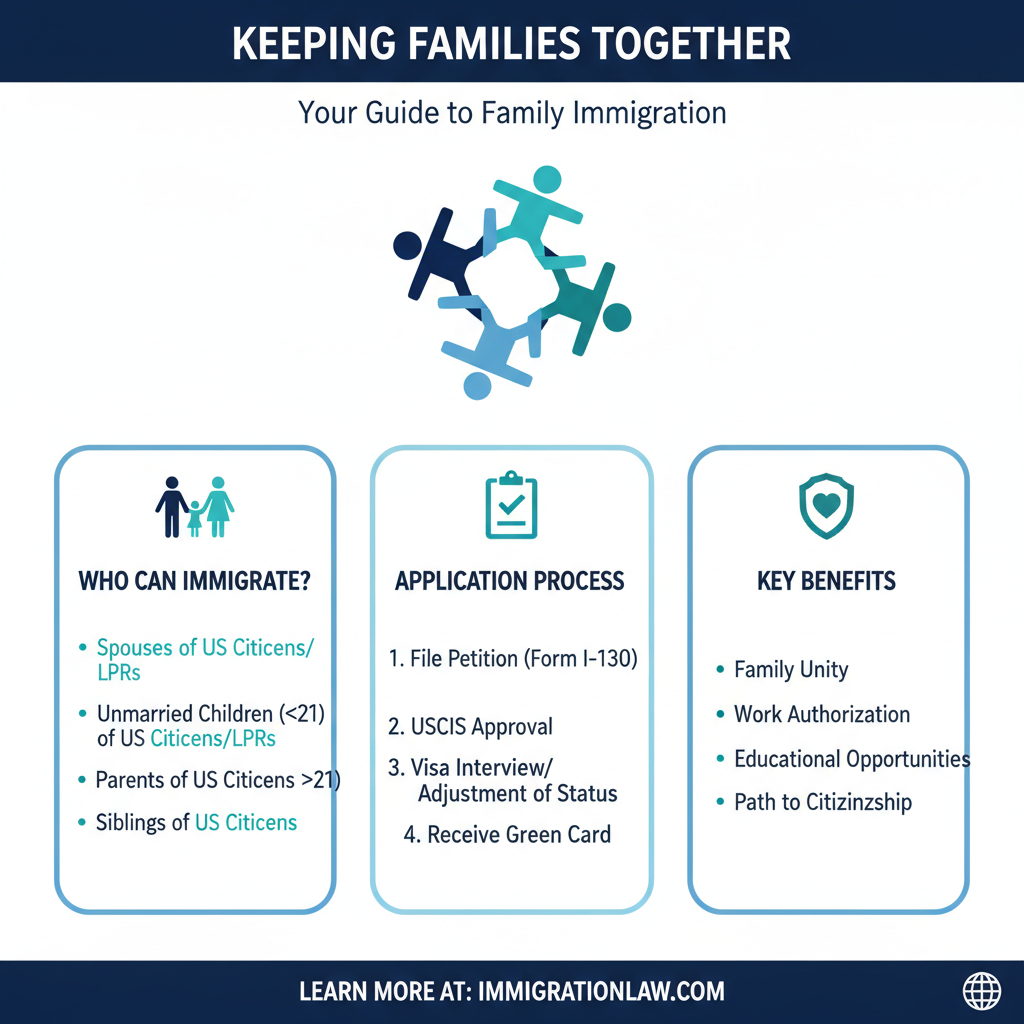
What This News Means for Immigrants in Orlando and Across Florida
The news cycle frequently highlights various aspects of immigration, from border policies to visa backlogs. However, the fundamental process of family-based immigration remains a constant and critical area of focus for individuals and policymakers alike. The ongoing discussion around simplifying processes, reducing wait times, and ensuring fair treatment for all applicants directly impacts the lives of millions.
Why this news is showing up now
The concept of family reunification has always been central to U.S. immigration law. This topic frequently resurfaces in public discourse and policy discussions because it touches upon fundamental human rights and the social fabric of the nation. As immigration policies evolve and administrative procedures are refined, updates and discussions on family petitions become timely and relevant. Furthermore, with significant backlogs and processing delays often making headlines, there's a constant public and legal interest in how these essential pathways to permanent residency can be made more efficient and accessible.
The current environment often sees renewed calls for clarity and accessibility in immigration processes, especially as families continue to face challenges related to global events, economic shifts, and policy changes. Providing clear, step-by-step guidance, as we aim to do, directly addresses the need for actionable information amidst these ongoing conversations.
How it can affect Florida residents
Florida, particularly Central Florida and the greater Orlando area, is home to a vibrant and diverse immigrant population. This makes family-based immigration a profoundly significant issue for countless residents of Orange County and beyond. Any news or guidance on family petitions directly impacts:
- New Arrivals: Families hoping to sponsor relatives to join them in the Sunshine State.
- Current Residents: U.S. citizens and Lawful Permanent Residents (LPRs) who are actively seeking to bring their spouses, children, or parents to Orlando or other Florida cities.
- Local Economy: The integration of new family members into communities contributes to the economic and cultural vitality of areas like the I-4 corridor.
- Legal Services: There is a consistent demand for expert legal guidance to navigate the complexities of federal immigration law, which is why firms like Imigrar play a crucial role for individuals and families in Orlando.
Understanding these processes is not just theoretical; it's about practical steps that can bridge distances and unite families living in or hoping to move to Florida.
Need Help? Our Orlando immigration team is ready to assist. Call +1 786-791-3106 for a free consultation, or message us online. Se Habla Español.
What Family-Based Immigration Petitions Are (and Why It Matters)
At its core, family-based immigration is the primary pathway for U.S. citizens and lawful permanent residents (Green Card holders) to help eligible family members obtain permanent residency in the United States. This system prioritizes the reunification of families, allowing individuals to live, work, and eventually become citizens in the U.S.
A plain-English definition
A family-based immigration petition is essentially a formal request made to the U.S. government, specifically U.S. Citizenship and Immigration Services (USCIS), by a U.S. citizen or a lawful permanent resident (the petitioner) on behalf of an eligible foreign national relative (the beneficiary). The ultimate goal of this petition is for the beneficiary to obtain a Green Card, which grants them Lawful Permanent Resident status, allowing them to live and work permanently in the United States. This process is a testament to the nation's commitment to keeping families together.
Key terms you need to know
Navigating the immigration process requires understanding specific terminology. Here are some essential terms related to family-based petitions:
- Petitioner: The U.S. citizen or Lawful Permanent Resident who files the immigration petition for their relative. They are the sponsor.
- Beneficiary: The foreign national family member who is seeking to immigrate to the U.S. based on their relationship with the petitioner.
- Form I-130, Petition for Alien Relative: The initial form filed by the petitioner to establish the qualifying relationship with the beneficiary. This is the cornerstone of almost all family-based immigration cases.
- Green Card (Form I-551): The identification card issued to Lawful Permanent Residents, signifying their authorized permanent residence in the United States.
- Lawful Permanent Resident (LPR): An individual who has been granted the privilege of residing permanently in the United States. Also known as a Green Card holder.
- Adjustment of Status (AOS): The process of applying for a Green Card from *within* the United States without having to return to one's home country. This usually involves filing Form I-485.
- Consular Processing: The process of applying for an immigrant visa (which leads to a Green Card) at a U.S. Embassy or Consulate *outside* the United States. This is for beneficiaries who are not in the U.S. or are ineligible for AOS.
- Priority Date: The date USCIS receives your properly filed Form I-130. This date is crucial for family preference categories, as it determines a beneficiary's place in the visa queue. For "Immediate Relatives," the priority date is less relevant as visas are always immediately available.
- Visa Bulletin: A monthly publication from the U.S. Department of State that summarizes the availability of immigrant visas for the various family preference categories and employment-based categories. It indicates which priority dates are "current," meaning beneficiaries with that priority date or earlier can move forward with their Green Card application. U.S. Department of State Visa Bulletin
- Immediate Relatives: A special category of family members who are not subject to annual visa quotas, meaning visas are always available for them. This includes:
- Spouses of U.S. citizens.
- Unmarried children under 21 years old of U.S. citizens.
- Parents of U.S. citizens (if the U.S. citizen petitioner is 21 years or older).
- Family Preference Categories: Other relatives who are subject to annual visa quotas, leading to potentially long wait times. These categories are:
- First Preference (F1): Unmarried sons and daughters (21 years of age or older) of U.S. citizens.
- Second Preference (F2A): Spouses and unmarried children (under 21) of Lawful Permanent Residents.
- Second Preference (F2B): Unmarried sons and daughters (21 years of age or older) of Lawful Permanent Residents.
- Third Preference (F3): Married sons and daughters of U.S. citizens.
- Fourth Preference (F4): Brothers and sisters of U.S. citizens (if the U.S. citizen petitioner is 21 years or older).
- Affidavit of Support (Form I-864): A legally binding document filed by the petitioner (and sometimes a joint sponsor) to demonstrate that the beneficiary will not become a "public charge" and that the sponsor has sufficient financial resources to support the immigrant.
Current Immigration Law: The Foundation
Family-based immigration is governed by the Immigration and Nationality Act (INA), which is the body of law that governs immigration to the United States. Specifically, INA Section 201 defines "Immediate Relatives" and exempts them from numerical limitations, while INA Section 203 establishes the various "Family Preference Categories" and allocates a limited number of visas to each category annually. These statutes form the legal backbone of the family petition process.
Federal requirements
To successfully petition for a family member, both the petitioner and the beneficiary must meet specific federal requirements:
- Petitioner Requirements:
- Must be a U.S. citizen or a Lawful Permanent Resident (Green Card holder). The type of relative they can sponsor depends on their status.
- Must be at least 18 years old to file Form I-130, and at least 21 years old to sponsor parents or siblings.
- Must have a domicile in the United States or intend to establish one before the beneficiary immigrates.
- Must demonstrate the financial ability to support the beneficiary by filing Form I-864, Affidavit of Support, meeting specific income thresholds (usually 125% of the federal poverty guidelines).
- Beneficiary Requirements:
- Must have a qualifying relationship with the petitioner (e.g., spouse, child, parent, sibling). This relationship must be proven with official documents.
- Must be "admissible" to the United States. This means they must not fall under any grounds of inadmissibility, such as certain criminal convictions, health issues, prior immigration violations, or security risks. In some cases, waivers for certain inadmissibility grounds may be available.
- Must undergo a medical examination by a USCIS-approved civil surgeon (for Adjustment of Status) or a panel physician (for Consular Processing).
- Must undergo biometrics (fingerprints, photos, signature) for background checks.
The entire process is overseen by the Department of Homeland Security, primarily through USCIS, and the Department of State, which handles consular processing through its embassies and consulates abroad. Always refer to the USCIS official website for the most current forms, fees, and instructions.
Florida-specific considerations
While U.S. immigration law is federal, the practical application often has local implications. For residents of Central Florida, including Orlando and surrounding areas, there are a few points to consider:
- USCIS Field Office: If you are applying for Adjustment of Status from within the U.S., your interview (if required) will likely take place at the Orlando USCIS Field Office. Understanding local procedures and wait times for this office can be beneficial.
- Local Resources: Florida has a robust network of immigration legal services. For those in Orlando, Orange County, or along the I-4 corridor, having local counsel can provide invaluable assistance, from preparing documents to representing you at interviews.
- Community Impact: Florida's diverse population means a higher volume of family-based petitions. This can sometimes influence processing times or the specific types of questions encountered during interviews, emphasizing the need for thorough preparation.

How to Keep Your Family Together: A Complete Step-by-Step Guide to Family Petitions
The journey to obtaining a Green Card through family sponsorship can seem daunting, but breaking it down into manageable steps can make it clearer. Here's a comprehensive guide to the family-based immigration petition process:
1) Determine Eligibility and Category
Before any forms are filed, the first crucial step is to determine if both the petitioner and beneficiary meet the eligibility requirements and to identify the correct visa category. This will dictate the processing timeline and specific requirements.
- Petitioner Status: Are you a U.S. citizen or a Lawful Permanent Resident (Green Card holder)? Your status dictates who you can sponsor.
- Relationship: What is your precise relationship to the beneficiary (spouse, unmarried child under 21, parent, etc.)?
- Beneficiary Location: Is the beneficiary currently in the U.S. (legally) or abroad? This determines whether they will likely pursue Adjustment of Status or Consular Processing.
- Immediate Relative vs. Family Preference:
- Immediate Relatives (spouses, unmarried children under 21, and parents of U.S. citizens) have visas immediately available.
- Family Preference Categories (all other eligible relatives) are subject to annual quotas and can have significant wait times based on the Priority Date and country of origin.
- Required Documents for Eligibility:
- Proof of Petitioner's U.S. Citizenship: U.S. birth certificate, U.S. passport, Naturalization Certificate, or Certificate of Citizenship.
- Proof of Petitioner's LPR Status: Copy of Green Card (Form I-551).
- Proof of Relationship:
- Spouse: Marriage Certificate, proof of prior divorces (if any).
- Child: Child's birth certificate (showing both parents), marriage certificate of parents (if applicable).
- Parent: Petitioner's birth certificate (showing both parents), marriage certificate of parents (if applicable).
- Sibling: Petitioner's birth certificate and sibling's birth certificate (showing at least one common parent), marriage certificates of parents (if applicable).
- Any name change documents (e.g., marriage certificates, court orders) for either petitioner or beneficiary.
2) File **Form I-130**, Petition for Alien Relative
This is the foundational step for nearly all family-based Green Card applications. The petitioner files Form I-130 with USCIS to establish the legitimate familial relationship with the beneficiary.
- Purpose: To prove to USCIS that a qualifying relationship exists between the U.S. citizen/LPR petitioner and the foreign national beneficiary.
- Filing Location: Generally filed by mail to a USCIS Lockbox facility, but some categories may allow online filing. Always check the latest instructions on the USCIS Form I-130 page.
- Filing Fee: There is a mandatory filing fee for Form I-130, which must be paid at the time of submission. Fees can change, so verify the current amount on the USCIS website.
- Required Documents (to be submitted with Form I-130):
- Completed and signed Form I-130.
- Copy of petitioner's proof of U.S. citizenship or LPR status (e.g., U.S. birth certificate, U.S. passport, Naturalization Certificate, Green Card).
- Proof of bona fide relationship (as determined in Step 1). This is critical, especially for marriage-based petitions, where extensive evidence of a genuine marriage is required (e.g., joint bank statements, utility bills, leases, insurance, photos, affidavits from friends/family).
- Passport-style photos of both the petitioner and the beneficiary.
- Copy of marriage certificates for petitioner and beneficiary (if applicable) and divorce decrees/death certificates for any prior marriages.
- Birth certificates for both petitioner and beneficiary.
- Filing fee (check or money order payable to "U.S. Department of Homeland Security").
- Any other supporting documentation requested in the form instructions.
Important: All foreign language documents must be accompanied by a complete English translation certified by a translator.
Need Help? Our Orlando immigration team is ready to assist. Call +1 786-791-3106 for a free consultation, or message us online. Se Habla Español.
3) Wait for **Form I-130** Approval and Priority Date
After filing, USCIS will send a receipt notice (Form I-797C, Notice of Action) acknowledging they received your petition. This notice will include your Priority Date. Then begins the waiting period for USCIS


