


The journey to obtaining a Green Card, or lawful permanent residency in the United States, is a significant milestone for countless individuals and families. For many, this path culminates in a pivotal moment: the Green Card interview with U.S. Citizenship and Immigration Services (USCIS). This interview is your opportunity to demonstrate your eligibility and intent, and it’s a step that requires thorough preparation.
At Imigrar, an immigration law firm based in Orlando, Florida, we understand the anxieties and complexities surrounding this crucial appointment. Our mission is to "Keep Families Together," and a successful Green Card interview is often a key part of that mission. This comprehensive guide is designed to equip you with the knowledge and confidence you need to navigate your interview successfully, whether you’re in Orlando, Central Florida, or anywhere across the nation.
The reporting that sparked this guide
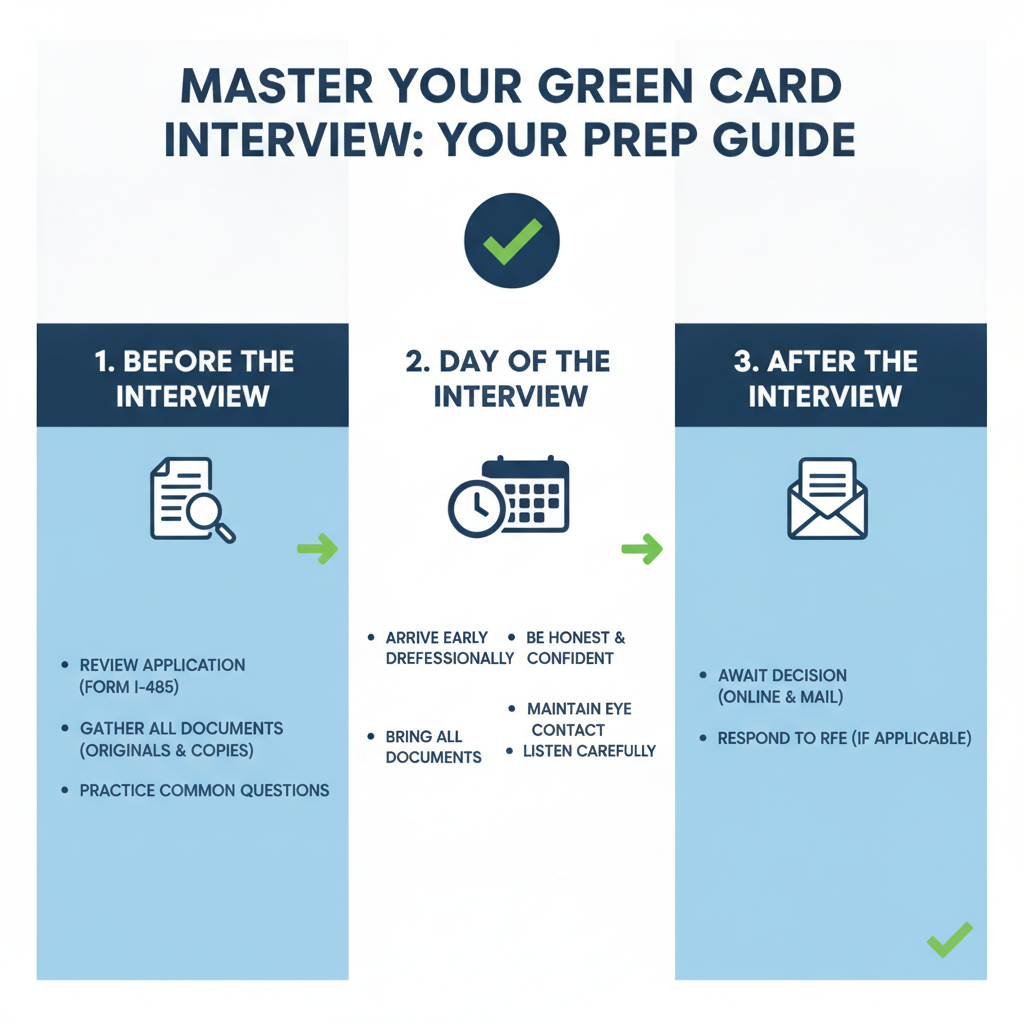
Recent discussions within the Green Card Interview Preparation Tips (Immigration Law) emphasize the enduring importance of thorough preparation for these interviews. Immigration law practitioners and news outlets consistently highlight that while the process may seem daunting, being well-prepared is the single most effective way to ensure a positive outcome. This ongoing focus underscores the need for clear, actionable advice for applicants, which is precisely what we aim to provide.
What This News Means for Immigrants in Orlando and Across Florida
The Green Card interview remains a cornerstone of the immigration process for most applicants seeking permanent residency. While some cases, particularly those involving children or certain employment-based categories, may have interviews waived, the vast majority of family-based and many employment-based applications still require an in-person meeting with a USCIS officer.
Why this news is showing up now
As of mid-2026, USCIS continues to work through backlogs that accumulated during the pandemic, while also striving to modernize its processes. This means that while some processing times have improved, the integrity and importance of the interview process have not diminished. In fact, with ongoing efforts to streamline and secure immigration benefits, the interview becomes an even more critical juncture for officers to verify information, assess credibility, and ensure compliance with immigration laws. The focus on interview preparation is consistently highlighted because it directly impacts efficiency and approval rates, reducing the need for Requests for Evidence (RFEs) or denials due to insufficient information.
How it can affect Florida residents
Florida is one of the most diverse states in the U.S., home to a vibrant immigrant community, including a significant population in Orlando and along the I-4 corridor. For Central Florida residents, the Green Card interview typically takes place at the **Orlando USCIS Field Office**. The high volume of applications processed in Florida means that officers are highly experienced in a wide range of case types. This also means that they expect applicants to be well-prepared and organized. Local nuances, such as specific document preferences at the Orlando office or familiarity with common issues affecting local immigrant communities (e.g., specific country conditions), can sometimes play a subtle role. Being prepared for your interview not only expedites your personal case but also contributes to the overall efficiency of the local USCIS office, potentially benefiting other applicants in the community.
Need Help Preparing? Don't face your Green Card interview alone. Our Orlando immigration team is ready to assist. Call +1 786-791-3106 for a free consultation, or message us online. Se Habla Español.
What Your Green Card Interview Is (and Why It Matters)
The Green Card interview is a mandatory step for most individuals seeking **lawful permanent residency** in the United States. It's an opportunity for a USCIS officer to verify the information provided in your application, confirm your eligibility, and ensure you meet all legal requirements for a Green Card.
A plain-English definition
Think of your Green Card interview as a conversation with a government official (a USCIS officer) who needs to confirm that you qualify for a Green Card. They will ask questions about your application, your background, and your relationship (if it’s a family-based petition). This interview is crucial because it's the officer's chance to assess your credibility and the authenticity of your claims. For family-based petitions, especially marriage-based ones, the officer will be looking to ensure that the marriage is genuine and not entered into solely for immigration purposes.
Key terms you need to know
- Adjustment of Status (AOS): This is the process of applying for a Green Card while you are physically present in the United States. The interview for AOS typically takes place at a USCIS Field Office, like the one in Orlando.
- Consular Processing: This is the process of applying for a Green Card from outside the United States, typically through a U.S. embassy or consulate in your home country. The interview for Consular Processing occurs abroad.
- Petitioner: The U.S. citizen or lawful permanent resident who files an immigration petition (e.g., **Form I-130**, Petition for Alien Relative) on behalf of an immigrant.
- Beneficiary: The immigrant who is seeking a Green Card based on the petition filed by the petitioner. Also referred to as the **primary applicant**.
- Derivative Beneficiary: A spouse or child who may be included in the primary applicant's Green Card application.
- Form I-485: Application to Register Permanent Residence or Adjust Status. This is the main form you file if you are applying for a Green Card while in the U.S.
- Form I-130: Petition for Alien Relative. Filed by a U.S. citizen or Green Card holder to establish a relationship with a foreign relative who wishes to immigrate to the U.S.
- Form I-864: Affidavit of Support. A legally binding document signed by a petitioner (sponsor) to accept financial responsibility for the applicant.
- Form I-693: Report of Medical Examination and Vaccination Record. Required for most Green Card applicants to demonstrate they are not inadmissible on health-related grounds.
- Public Charge Rule: A policy that allows USCIS to deny a Green Card to individuals deemed likely to become primarily dependent on government assistance for subsistence. While the 2019 rule was rescinded, the underlying inadmissibility ground based on public charge remains part of immigration law.
- Priority Date: The date your immigration petition (e.g., **Form I-130** or **Form I-140**) was properly filed with USCIS. This date determines when your Green Card becomes available, especially for categories with annual limits.
Current Immigration Law: The Foundation
The legal framework for Green Card eligibility and the interview process is primarily found in the **Immigration and Nationality Act (INA)**. This comprehensive body of law outlines who is eligible for various immigration benefits, the grounds for inadmissibility (reasons why someone might be denied a Green Card), and the procedures for applying. Specifically, **INA Section 245(a)** governs the **Adjustment of Status** process, allowing eligible individuals already in the U.S. to obtain permanent residency. **INA Section 212(a)** details the various grounds of inadmissibility, which an officer will assess during your interview.
Federal requirements
To be eligible for a Green Card through **Adjustment of Status**, you must generally meet several federal requirements:
- Lawful Admission or Parole: You must have been lawfully admitted into the U.S. or paroled into the U.S. (with some exceptions).
- Valid Immigrant Petition: You must be the beneficiary of an approved immigrant petition (e.g., **Form I-130** for family-based, **Form I-140** for employment-based).
- Visa Availability: An immigrant visa must be immediately available to you at the time you file your **Form I-485** and at the time of your interview. This is determined by your **Priority Date** and the Visa Bulletin published by the U.S. Department of State.
- Admissibility: You must be admissible to the U.S., meaning you do not fall under any of the grounds of inadmissibility (e.g., certain criminal convictions, health issues, prior immigration violations, or being a **public charge**).
- Medical Examination: You must undergo a medical examination by a USCIS-approved civil surgeon and submit **Form I-693**.
- Financial Support: For most family-based and some employment-based categories, a sponsor must sign an **Affidavit of Support (Form I-864)**, demonstrating they can financially support you.
You can find more detailed information and specific forms on the USCIS official website.
Florida-specific considerations
While the federal laws are uniform, the implementation and specific procedures can sometimes vary slightly between USCIS field offices. For applicants in Orlando and the surrounding Central Florida region, your interview will likely be scheduled at the **Orlando USCIS Field Office**. Officers at this office are well-versed in the diverse backgrounds of Florida’s immigrant population. They are particularly experienced with marriage-based Green Card applications given the high number of families in the area. It's crucial to be aware of the local office's specific instructions, which may sometimes be included in your interview notice or communicated by your attorney. For example, some offices might prefer documents organized in a particular way.
Confused by Immigration Law? Our expert attorneys at Imigrar can clarify the legal requirements for your Green Card. Get peace of mind with a free consultation. Call +1 786-791-3106 today! Se Habla Español.
How to Prepare for Your Green Card Interview: A Complete Step-by-Step Guide
Preparation is the cornerstone of a successful Green Card interview. Follow these steps meticulously to ensure you're ready for every aspect of your appointment.
1) Understand Your Interview Notice (Form I-797C)
Your interview notice, typically **Form I-797C**, is your official invitation and contains critical information. Do not ignore it!
- Review Immediately: Check the date, time, and location of your interview. Make sure you know exactly where the **Orlando USCIS Field Office** is and how to get there.
- Attendees: The notice will specify who must attend (e.g., you, your petitioner, an attorney, an interpreter).
- Required Documents: Pay close attention to any specific documents requested on the notice. While we provide a general list below, the notice's list takes precedence.
- Biometrics: Confirm if new biometrics are required or if your previous appointment covers it.
- Rescheduling: Understand the strict rules for rescheduling. It’s generally advised only for emergencies and with legal counsel.
Important: If you receive your notice and have any doubts or find discrepancies, contact your attorney immediately.
2) Gather ALL Required Documents
This is arguably the most critical step. Organize your documents systematically. Create a binder or folder with dividers for easy access. Bring originals and at least one copy of everything. USCIS officers often prefer to see originals and keep copies.
General Documents for ALL Applicants:
- Interview Notice (Form I-797C).
- Your Passport(s) and travel documents (current and expired).
- Birth Certificate (Original and Certified Translation if not in English).
- Marriage Certificate (Original and Certified Translation if applicable).
- Divorce Decrees or Death Certificates (Originals and Certified Translations if applicable) for any previous marriages of you or your petitioner.
- Medical Examination Report (Form I-693) in a sealed envelope (if not already submitted).
- Four (4) Passport-style photos (taken within the last 30 days).
- Employment Authorization Document (EAD card) and **Advance Parole document** (if you have them).
- Originals of ALL documents previously submitted with your application (Form I-485, Form I-130, Form I-864, etc.). This includes all supporting evidence.
- Proof of current immigration status (e.g., **Form I-94** arrival/departure record, visa stamp).
Additional Documents for Family-Based Petitions (especially Marriage-Based):
- Proof of Bona Fide Marriage: This is crucial. Bring as much evidence as possible to demonstrate your marriage is real.
- Joint bank statements (current and historical).
- Joint utility bills (electricity, water, internet) showing shared residence.
- Lease agreements or mortgage statements showing joint tenancy.
- Joint tax returns (IRS transcripts are often preferred).
- Birth certificates of children born to the marriage.
- Insurance policies showing each other as beneficiaries (life, health, auto).
- Photos together (dating, engagement, wedding, family events, travel) with dates.
- Affidavits from friends and family testifying to the legitimacy of your marriage.
- Any other co-mingled financial documents or joint assets.
- Petitioner's Documents:
- Proof of U.S. Citizenship or Green Card (e.g., U.S. passport, birth certificate, naturalization certificate, Green Card).
- **Form I-864, Affidavit of Support** (if not already filed) along with supporting financial documents (tax returns, W-2s, pay stubs, employment verification letter).
Additional Documents for Employment-Based Petitions:
- Employment Verification Letter from your sponsoring employer.
- Pay stubs (recent 3-6 months).
- Offer Letter and Employment Contract.
- Educational Degrees and Transcripts (Originals and Certified Translations).
- Professional Licenses or Certifications.
Reminder: For the **Orlando Field Office**, organization is key. Use tabs and label sections clearly. This shows respect for the officer’s time and helps your case.
External Resource: For a comprehensive list of forms, visit USCIS Forms.
3) Review Your Application (Form I-485 and supporting petitions)
You must be intimately familiar with every detail of your submitted application forms and supporting documents. The officer will refer to these.
- Read Everything: Go through your entire application package (including **Form I-130**, **Form I-485**, **Form I-864**, etc.) line by line.
- Consistency: Ensure your answers during the interview are consistent with what you submitted on paper. If there have been any changes since filing (e.g., new address, new job, new child), be prepared to explain them and bring updated evidence.
- Dates and Details: Memorize important dates (marriage date, entry dates, birth dates, employment dates) and specific details (addresses, names of family members).
Warning: Inconsistencies or inability to recall information from your own application can raise red flags for the interviewing officer.
4) Practice Answering Questions
While you can't predict every question, you can prepare for common lines of inquiry. Practice with a friend, family member, or your attorney.
Common Interview Questions:
- About You: "What is your full name? Date of birth? Where were you born? What is your current address? What is your occupation?"
- About Your Immigration History: "When did you first enter the U.S.? What type of visa did you have? Have you ever been out of status? Have you ever been arrested or convicted of a crime? Have you ever been deported or removed from the U.S.?"
- About Your Petitioner (if applicable): "What is your petitioner’s full name? Date of birth? Where do they work? What is their relationship to you?"
- For Marriage-Based Interviews (Petitioner and Beneficiary often interviewed together or separately):
- "How did you meet? When did you get married? Where was the wedding? Who attended?"
- "Describe a typical day in your life together."
- "What did you do last weekend?"
- "Who handles the finances? Who cooks? Who cleans?"
- "What are your spouse’s hobbies? What are their parents' names?"
- "Do you have joint bank accounts? Joint bills? Do you live together?"
- Inadmissibility Questions: Questions related to criminal history, health issues, prior immigration violations, and the **public charge rule**.
Tip: Answer truthfully, clearly, and concisely. If you don't understand a question, politely ask the officer to rephrase it. Do not guess or provide false information.
5) Prepare for the Interview Day
Logistics and presentation matter. Plan ahead to reduce stress.
- Dress Code: Dress professionally, as if for a job interview. It shows respect for the process and the officer.
- Arrive Early: Aim to arrive at the **Orlando USCIS Field Office** at least 30-45 minutes before your scheduled time. This accounts for traffic (especially on the I-4 corridor!), parking, security checks, and finding the correct waiting area.
- Bring ALL Documents: Even if you think a document isn't needed, bring it. Better to have it and not need it than need it and not have it.
- Bring Your Attorney: Having an experienced immigration attorney from Imigrar by your side can provide immense reassurance and ensure your rights are protected. Your attorney can clarify questions, object to improper inquiries, and help you present your case effectively.
- Interpreter: If you or your petitioner do not speak English fluently, you must bring a certified interpreter. The notice should specify this. Do NOT rely on family members or children to interpret unless specifically instructed by USCIS. Imigrar offers services in both English and Spanish (**Se Habla Español**), and we can help arrange a certified interpreter if needed.
6) What to Expect During the Interview
Understanding the flow of the interview can help you feel more at ease.
- Swearing In: The interview will begin with you (and your petitioner, if present) being sworn in to tell the truth.
- Review of Application: The officer will typically go through your application forms, confirming the information you provided.
- Questions: They will ask questions about your background, your eligibility, and for family-based cases, the authenticity of your relationship.
- Document Review: The officer will review your original documents and may ask for copies. This is why organized documents are crucial.
- Decision: Sometimes, the officer can make a decision on the spot. More often, they will inform you that a decision will be mailed to you within a few weeks. They may also issue a **Request for Evidence (RFE)** if they need more information.
Important: Remain calm, polite, and honest. Avoid volunteering unnecessary information. Answer the question asked, and then stop.
7) Post-Interview Steps
Your journey doesn't necessarily end when you leave the office.
- If Approved: Congratulations! You will typically receive an approval notice, followed by your Green Card in the mail within a few weeks.
- If RFE Issued: This means the officer needs more evidence or clarification. Respond promptly and thoroughly, ideally with the help of your attorney.
- If Denied: A denial is not necessarily the end. You may have options to appeal or refile, depending on the reason for denial. This is where expert legal counsel is critical.
External Resource: Check USCIS Processing Times for general estimates, but remember individual cases vary.
Practical Steps You Can Take Today
Don't wait until the last minute to prepare for your Green Card interview. Here are actionable steps you can start today:
- Compile a Master Document Checklist: Create a detailed list of every document you need, both general and specific to your case.
- Start Gathering Originals and Copies: Don't underestimate how long it takes to locate birth certificates, old passports, or financial statements.
- Organize Your Evidence Binder: Purchase a binder with dividers and begin sorting your documents. Label each section clearly.
- Review Your Application Forms: Sit down with your filed applications and read every question and your answer. Make notes of any changes or updates.
- Practice Interview Questions: Ask a trusted friend or family member to quiz you on common questions, focusing on clarity and consistency.
- Schedule a Consultation with Imigrar: Even if you initially filed your application yourself, a pre-interview consultation with an experienced attorney can identify potential issues and strengthen your case.
- Plan Your Travel to the Orlando Field Office: Map out your route, consider potential traffic, and identify parking options.
Document Preparation Guidance:
For each document, ensure you have:
- The original.
- A high-quality photocopy.
- A certified English translation, if the original is not in English.
- For digital evidence (e.g., photos), print them out, label them with dates and descriptions, and arrange them chronologically.
Timeline Expectations:
The duration from filing your application to receiving an interview notice can vary significantly based on your visa category, country of origin, and the specific USCIS field office. As of 2026, processing times for **Adjustment of Status** cases can range from 12 to 24 months or even longer in some complex cases. The interview itself typically lasts between 20 minutes to an hour. A decision may be rendered immediately, or it could take several weeks to a few months to receive a final notice. Patience is key, but proactive follow-up through your attorney is also important if delays are excessive.
How Imigrar Helps Immigrants in Orlando
At Imigrar, we are dedicated to guiding individuals and families through the intricate U.S. immigration system. Our firm, located in Orlando, Florida, serves clients nationwide, offering personalized and compassionate legal representation.
Our Experience and Expertise: Our team of highly skilled immigration attorneys has extensive experience with Green Card applications and interviews. We understand the specific requirements of the **Orlando USCIS Field Office** and can provide tailored advice based on local practices. We have successfully represented countless clients in diverse Green Card categories, including family-based, employment-based, and asylum-based adjustments.
We help you by:
- Thorough Document Review: We meticulously review your entire application and all supporting documents to ensure accuracy and completeness.
- Pre-Interview Preparation: We conduct mock interviews, preparing you for potential questions and helping you articulate your story clearly and confidently.
- Representation at the Interview: An Imigrar attorney can accompany you to your interview at the **Orlando USCIS Field Office**, providing legal counsel, clarifying issues, and protecting your rights throughout the process.
- Responding to RFEs: If USCIS issues a **Request for Evidence**, we help you gather and submit the necessary documents promptly and effectively.
- Post-Interview Follow-Up: We monitor your case status and follow up with USCIS as needed.
We believe that "Keep Families Together" is more than just a tagline – it's our guiding principle. We are committed to making your Green Card journey as smooth and stress-free as possible.
Free Consultation Offer: We offer a free initial consultation to discuss your Green Card case and assess your needs. This is an opportunity for you to understand your options and how Imigrar can support you. Call us today to schedule your appointment.
Se Habla Español: Our team is fully bilingual, ensuring that you can communicate comfortably and effectively in your preferred language.
Ready for Your Interview? Let Imigrar's Orlando team guide you. Call us at +1 786-791-3106 for a free, no-obligation consultation. We speak English and Se Habla Español.

Frequently Asked Questions
Q: What if I have a criminal record? Will this affect my Green Card eligibility?
A: A criminal record can significantly impact your Green Card eligibility. Certain criminal offenses are considered "grounds of inadmissibility" under **INA Section 212(a)** and can lead to a denial. The impact depends on the nature of the crime, its severity, and when it occurred. It is crucial to disclose all arrests and convictions, even if expunged or minor. In some cases, waivers may be available, but this is a complex area of law. You should


