


Securing a Green Card is a monumental step towards building a permanent life in the United States. For many, the final hurdle before achieving this dream is the Green Card interview with U.S. Citizenship and Immigration Services (USCIS). This interview is a critical stage where an immigration officer verifies the information provided in your application and determines your eligibility for permanent residency.
At Imigrar, an immigration law firm based in Orlando, Florida, we understand the anxieties and questions that arise when preparing for such a pivotal moment. Our mission, "Keep Families Together," drives us to provide clear, actionable guidance to help you navigate this process successfully.
The reporting that sparked this guide:
The ongoing importance of thorough preparation for immigration processes, particularly the Green Card interview, is a constant theme in immigration law news. Staying informed about best practices and legal requirements is vital for all applicants.
Green Card Interview Preparation Tips (Immigration Law)
What This News Means for Immigrants in Orlando and Across Florida
The Green Card interview remains a cornerstone of the immigration process, and its significance is consistently highlighted in legal discussions and news. This ongoing focus underscores the need for applicants to approach their interviews with meticulous preparation and a clear understanding of what’s expected. For immigrants in Orlando, across Central Florida, and indeed nationwide, this means that diligence in preparation is not just advisable—it's essential.
Why this news is showing up now
The Green Card interview is a standard procedure for most family-based Green Card applications and many employment-based applications. USCIS continually refines its interview procedures to enhance efficiency, ensure the integrity of the immigration system, and detect potential fraud. Recent trends and policy adjustments often lead to renewed emphasis on specific aspects of interviews, such as the authenticity of relationships for marriage-based petitions or the validity of employment offers. Therefore, discussions around interview preparation are perennially relevant, reflecting USCIS's commitment to thorough vetting and the applicant's need to meet evolving evidentiary standards. The focus on immigration law in general continues to be a trending topic, making expert advice on critical stages like the interview highly sought after.
How it can affect Florida residents
For individuals residing in Florida, particularly those in the Orlando area, the Green Card interview process will typically be conducted at the local USCIS Field Office. The Orlando USCIS Field Office serves a vast and diverse population across Central Florida, including Orange County and surrounding areas along the I-4 corridor. While federal law governs the interview process nationwide, local field offices may have specific nuances in scheduling, officer caseloads, or preferred document organization. For instance, the sheer volume of applications processed in Florida means that officers are highly experienced in various types of cases, requiring applicants to be exceptionally well-prepared. Being familiar with the local office's procedures and understanding the common questions posed in this region can provide a distinct advantage. Furthermore, Florida's diverse immigrant communities mean that many applicants may require interpreters, making preparation for such needs crucial. Imigrar, based in Orlando, is uniquely positioned to assist Central Florida residents with these specific local considerations.
Need Help Preparing for Your Green Card Interview? Don't face this critical step alone. Our Orlando immigration team is ready to assist you with comprehensive preparation. Call +1 786-791-3106 for a free consultation, or message us online. Se Habla Español.
What the Green Card Interview Is (and Why It Matters)
The Green Card interview is a mandatory step for most individuals seeking lawful permanent residency in the United States, particularly those applying through Adjustment of Status while already present in the U.S. It serves as an opportunity for a USCIS officer to personally meet you, review your application and supporting documents, and verify the information you’ve provided under oath. This face-to-face meeting is crucial for the officer to assess your eligibility, confirm the authenticity of your claims (especially in marriage-based cases), and ensure that no grounds of inadmissibility exist that would prevent you from becoming a lawful permanent resident.
A plain-English definition
Think of the Green Card interview as your final exam for permanent residency. It’s a meeting with a USCIS officer who will ask you questions about your application, your life, and your relationship (if applicable). Their goal is to make sure everything you’ve stated in your forms is true, that you meet all the legal requirements for a Green Card, and that you don't have any issues that would prevent you from getting one. It's your chance to present your case clearly and honestly, supported by your documents. It's not meant to trick you, but to ensure the integrity of the immigration system.
Key terms you need to know
- Green Card (Form I-551): The common name for a Permanent Resident Card, which proves you are authorized to live and work permanently in the United States.
- Adjustment of Status (AOS): The process of applying for a Green Card while you are physically present in the United States. This is contrasted with Consular Processing, where you apply from outside the U.S.
- Consular Processing: The process of applying for an immigrant visa at a U.S. consulate or embassy abroad, which then allows you to enter the U.S. as a permanent resident. While this guide focuses on AOS interviews, many preparation tips are transferable.
- Principal Applicant: The main person applying for the Green Card.
- Petitioner: The U.S. citizen or lawful permanent resident who files an immigrant petition (like Form I-130) on behalf of a relative, or the employer filing for an employee.
- Beneficiary: The foreign national who is being petitioned for.
- Affidavit of Support (Form I-864): A legally binding document signed by a petitioner (or joint sponsor) to accept financial responsibility for the immigrant. This ensures the immigrant won't become a public charge.
- Inadmissibility: Specific reasons under U.S. immigration law that can prevent someone from entering the U.S. or obtaining a Green Card, such as certain criminal convictions, health issues, or prior immigration violations.
- Priority Date: The date USCIS receives your immigrant petition (e.g., Form I-130 or Form I-140). It establishes your place in line for a visa in numerically limited categories and is used to determine when you can file for Adjustment of Status.
- USCIS Field Office: A local office of U.S. Citizenship and Immigration Services where interviews are conducted. For Central Florida residents, this is often the Orlando USCIS Field Office.
Current Immigration Law: The Foundation
The legal framework for obtaining a Green Card and undergoing the interview process is primarily governed by the Immigration and Nationality Act (INA), along with associated federal regulations. Understanding these foundational laws is key to comprehending the requirements and the purpose of the interview.
Federal requirements
The Green Card interview process is rooted in the INA, particularly sections related to eligibility for permanent residency and grounds of inadmissibility. For individuals applying for Adjustment of Status from within the U.S., the primary legal authority is INA § 245. This section outlines who is eligible to adjust their status to lawful permanent resident. Key federal requirements include:
- Admissibility: Applicants must be admissible to the United States, meaning they must not have any grounds of inadmissibility (e.g., certain criminal records, health issues, immigration fraud) under INA § 212. If grounds of inadmissibility exist, a waiver may be required, adding complexity to the case.
- Proper Basis: The applicant must have a valid basis for a Green Card, such as an approved Form I-130 (Petition for Alien Relative) for family-based cases, or an approved Form I-140 (Immigrant Petition for Alien Worker) for employment-based cases.
- Lawful Entry (for most AOS): Generally, applicants for Adjustment of Status must have been inspected and admitted or paroled into the U.S. However, there are exceptions, such as for those covered by Section 245(i) of the INA.
- Bona Fide Relationship (for marriage-based): For marriage-based Green Cards, the law requires proof of a legitimate, "bona fide" marriage, meaning it was entered into in good faith and not solely for immigration purposes. This is a primary focus during the interview.
- Financial Support: The applicant must demonstrate they will not become a "public charge." This is typically satisfied through an Affidavit of Support (Form I-864) from the petitioner and/or a joint sponsor.
During the interview, the USCIS officer's role is to apply these federal requirements to your specific case, verifying all facts and ensuring compliance with the INA. The burden of proof rests on the applicant to demonstrate eligibility.
Florida-specific considerations
It's important to clarify that immigration law in the United States is federal law. This means that the requirements for obtaining a Green Card and preparing for your interview are the same whether you apply in Orlando, Florida, or San Francisco, California. There are no "Florida-specific immigration laws" that dictate eligibility for federal Green Cards.
However, practical considerations for Florida residents, particularly those in Central Florida, include:
- Orlando USCIS Field Office: Your interview will likely be scheduled at the Orlando USCIS Field Office. Familiarity with its location, parking, and general procedures can ease your interview day stress.
- Local Officer Experience: The high volume of immigration cases in Florida means officers are experienced with a wide range of situations, including complex cases. This underscores the need for thorough and accurate preparation.
- Language Access: Florida's diverse population means that many applicants may require interpreters. While USCIS provides interpreters, bringing your own certified interpreter (if allowed and necessary) can be beneficial, especially if your English proficiency is limited.
For more detailed information on federal immigration laws and regulations, always refer to the USCIS official website.
Overwhelmed by Immigration Law? Imigrar's expert attorneys can help you navigate the complexities of federal requirements and ensure your application is sound. Contact us today for a free consultation at +1 786-791-3106. Se Habla Español.
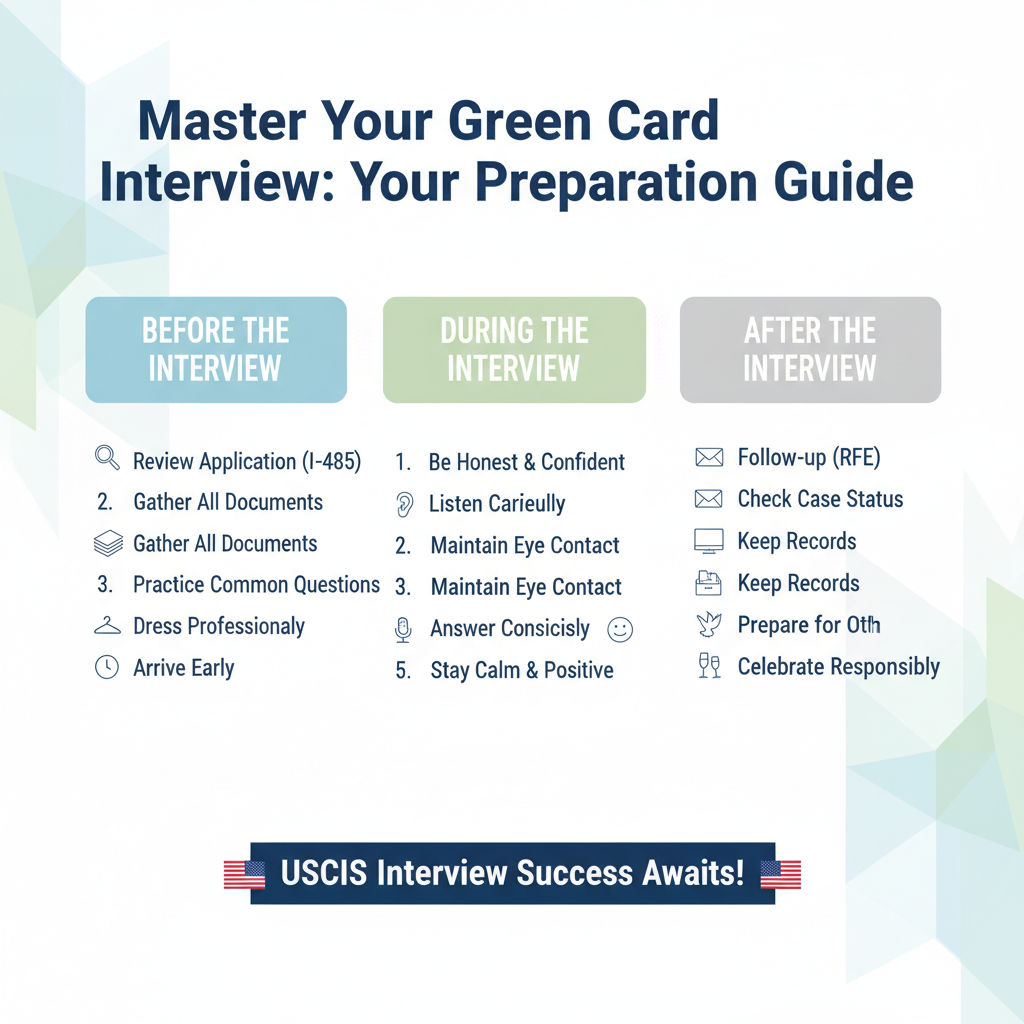
How to Prepare for Your Green Card Interview: A Complete Step-by-Step Guide
The Green Card interview is the culmination of months, or even years, of effort. Approaching it with a clear, step-by-step preparation strategy can significantly boost your confidence and your chances of success. Here’s a comprehensive guide to help you get ready.
1) Understand Your Case Type and Review Your Application
Before anything else, you must fully understand the basis of your Green Card application. Is it family-based (e.g., marriage to a U.S. citizen, parent-child relationship), or employment-based? Each category has specific requirements and common lines of questioning. Your preparation should be tailored to your specific case.
- Review Every Form: Go through your entire application package, including Form I-130 (if applicable), Form I-485, Form I-864, and any other forms you submitted. Read every question and every answer you provided.
- Cross-Reference Evidence: Ensure that the information in your forms matches the evidence you submitted. For example, if your application states you were married on a certain date, your marriage certificate must reflect that exact date.
- Identify Potential Discrepancies: If you find any errors or inconsistencies, even minor ones, make a note of them. Be prepared to explain them honestly and clearly to the officer. Sometimes, simple typos can cause confusion.
- Understand the "Why": Why are you eligible for a Green Card? What specific laws and criteria apply to your situation? This foundational knowledge will empower you during the interview.
Required Documents for this Step (for review, not submission):
- A complete copy of your filed Form I-130, Petition for Alien Relative (if applicable).
- A complete copy of your filed Form I-485, Application to Register Permanent Residence or Adjust Status.
- Copies of all supporting documents and evidence submitted with your application (e.g., birth certificates, marriage certificates, tax returns, proof of cohabitation).
- Any other forms filed, such as Form I-765 (Employment Authorization) or Form I-131 (Travel Document).
2) Gather and Organize ALL Original Documents
This is arguably the most critical logistical step. You must bring *all* original documents that were submitted as copies with your application, plus any new documents that have become available or are requested in your interview notice. Organize everything meticulously.
- The Interview Notice: This is your entry ticket. Do not forget it.
- Identification: Valid passport, driver's license (especially if you're a Florida resident and it's your primary ID).
- Birth Certificates: Original birth certificates for yourself, your petitioner, and any dependent children.
- Marriage Certificate: If applicable, your original marriage certificate.
- Divorce Decrees/Death Certificates: Original final divorce decrees or death certificates for any prior marriages for both you and your petitioner.
- Medical Exam (Form I-693): If you haven't already submitted it, bring the original sealed envelope containing your medical exam report. Do NOT open it.
- Affidavit of Support (Form I-864) Package:
- Original Form I-864, signed by the petitioner/joint sponsor.
- Petitioner's/Joint Sponsor's most recent federal income tax returns (IRS transcripts preferred).
- Proof of income (pay stubs, employment verification letter).
- Proof of U.S. citizenship or lawful permanent residency for the sponsor.
- Evidence of Bona Fide Marriage (if applicable): This is vital for marriage-based Green Cards. Bring *originals* of as many of these as possible:
- Joint bank statements, credit card statements.
- Joint lease agreements, mortgage statements, property deeds.
- Utility bills in both names.
- Health, life, and auto insurance policies showing both names.
- Birth certificates of children born to the marriage.
- Photos together (wedding, vacations, family events). Organize them chronologically and label them.
- Affidavits from friends/family attesting to the relationship.
- Any other proof of commingled lives and shared responsibilities.
- Criminal Records: If you have any arrests or convictions, bring certified court dispositions for *each* offense, even if they were dismissed or expunged.
- Photos: Passport-style photos if requested (check your interview notice).
- Any Other Documents: Any document mentioned in your interview notice or that you believe supports your case.
Important: Organize your documents in a binder with tabbed sections. Have originals easily accessible, and keep a complete set of copies for your own records.
3) Prepare for Interview Questions
The type of questions you face will depend heavily on your Green Card category. However, some general themes apply. Honesty, consistency, and a calm demeanor are paramount.
- Personal Background: Name, date of birth, place of birth, parents' names, previous addresses, education, employment history.
- Immigration History: How you entered the U.S., previous visas, any prior immigration applications, any past immigration violations.
- Criminal History: Even minor infractions, arrests, or traffic violations must be disclosed and discussed.
- For Family-Based (especially marriage-based):
- How did you meet your spouse?
- When and where was your first date?
- What did you do on your wedding day?
- Where do you live? Who pays the rent/mortgage?
- What are your spouse's habits? Do you share hobbies?
- Details about your daily life together (who cooks, cleans, manages finances).
- Plans for the future (children, career, retirement).
- For Employment-Based:
- Details about your job offer, employer, and duties.
- Your qualifications and experience.
- Your employer's business operations.
Practical Advice:
- Review Your Application Again: The officer will ask questions directly from your submitted forms. Your answers must be consistent with what you wrote.
- Practice with a Friend or Attorney: Conduct mock interviews. This helps you get comfortable articulating your answers clearly and concisely.
- Be Honest: Never lie or mislead an officer. If you don't know an answer, say so. If you need to correct a previous answer, do so respectfully.
- Don't Volunteer Unnecessary Information: Answer the question asked, and then stop. Do not elaborate or offer information that wasn't requested.
4) Address Potential Issues and Inadmissibility Grounds
If you have any issues that could make you inadmissible to the U.S. (e.g., certain criminal convictions, past immigration violations, or health issues), it's crucial to address these proactively. Sometimes, a waiver (such as Form I-601, Application for Waiver of Grounds of Inadmissibility, or Form I-212, Application for Permission to Reapply for Admission into the United States After Deportation or Removal) may be required. These waivers are complex and usually require substantial evidence and legal arguments.
- Consult an Attorney: If you suspect any inadmissibility issues, consult an experienced immigration attorney immediately. They can help you determine if a waiver is needed and prepare the strongest possible case.
- Gather Supporting Evidence for Waivers: This might include rehabilitation evidence, medical records, or proof of extreme hardship to a qualifying relative.
- Be Prepared to Discuss: The officer will inevitably question you about any known issues. Have your explanations and supporting documents ready.
5) Attend the Interview
The day of the interview requires punctuality, professionalism, and a calm demeanor.
- Arrive Early: Plan to arrive at the Orlando USCIS Field Office at least 30-45 minutes before your scheduled appointment. This allows time for parking, security screening, and finding the correct waiting area.
- Dress Appropriately: Dress in clean, neat, and conservative attire, similar to what you would wear for a job interview. This demonstrates respect for the process.
- Bring Your Attorney: While not mandatory, having an experienced immigration attorney from Imigrar accompany you can be incredibly beneficial. Your attorney can provide legal guidance, clarify questions, object to improper questioning, and ensure your rights are protected.
- Be Respectful and Polite: Address the officer respectfully. Answer questions clearly and confidently.
- Listen Carefully: Pay close attention to each question. If you don't understand a question, ask for clarification.
- Take Your Time: Don't feel rushed to answer. Take a moment to formulate your thoughts.
- Remain Calm: It's natural to be nervous, but try to remain composed. A calm demeanor helps you think clearly and present your best self.
- If You Need an Interpreter: If you are bringing your own interpreter, ensure they are fluent in both English and your native language, and that they are not a party to the case (e.g., your spouse or petitioner). USCIS also provides interpreters, but having your own can offer an added layer of comfort.
6) Follow Up After the Interview
The interview is often the final step, but not always the end of the process.
- If Approved: The officer might tell you on the spot that your Green Card is approved. You will then typically receive your physical Green Card in the mail within a few weeks.
- Request for Evidence (RFE): If the officer needs more information or documents, they will issue an RFE. Respond promptly and thoroughly by the deadline provided.
- Notice of Intent to Deny (NOID): This is a more serious notice, indicating USCIS intends to deny your application unless you can provide compelling reasons why they should not. This often requires immediate legal intervention.
- Denial: If your application is denied, you will receive a written explanation. You may have options to appeal or refile, depending on the reason for denial.
- Keep Copies: Always keep copies of everything you submit, including any responses to RFEs.
7) Seek Legal Counsel
Throughout this entire process, from initial application to interview and post-interview follow-up, the guidance of an experienced immigration attorney is invaluable. An attorney can review your application, help you gather and organize documents, conduct mock interviews, identify and address potential issues, and represent you at the interview. For residents of Orlando and Central Florida, Imigrar is here to provide that essential support.
Practical Steps You Can Take Today
Preparing for your Green Card interview can feel overwhelming, but by breaking it down into manageable steps, you can approach it with confidence. Here’s an actionable checklist to get you started today:
- Review Your Entire Application Package: Go through every form (Form I-130, Form I-485, Form I-864, etc.) and all supporting evidence you submitted. Ensure you remember every detail and can explain any discrepancies or updates.
- Gather ALL Original Documents and Copies: Start compiling originals of every document you submitted as a copy, as well as any new documents that have emerged since your submission. This includes birth certificates, marriage certificates, divorce decrees, passports, and especially all evidence of a bona fide marriage if applicable.
- Organize Your Documents Systematically: Invest in a binder with dividers. Label each section clearly (e.g., "Interview Notice," "Passports & IDs," "Birth Certificates," "Marriage Evidence," "Financial Documents"). Place originals at the front of each section, followed by copies. This will save you and the officer time during the interview.
- Practice Answering Common Interview Questions: Have a friend, family member, or your attorney conduct a mock interview. Focus on answering truthfully, clearly, and concisely, without volunteering excessive information. Practice explaining any complex parts of your history or application.
- Check USCIS Processing Times: Visit the USCIS Processing Times page regularly to get an estimate of how long similar cases are taking at the


