

The reporting that sparked this guide: Green Card Interview Preparation Tips (Immigration Law)
What This News Means for Immigrants in Orlando and Across Florida
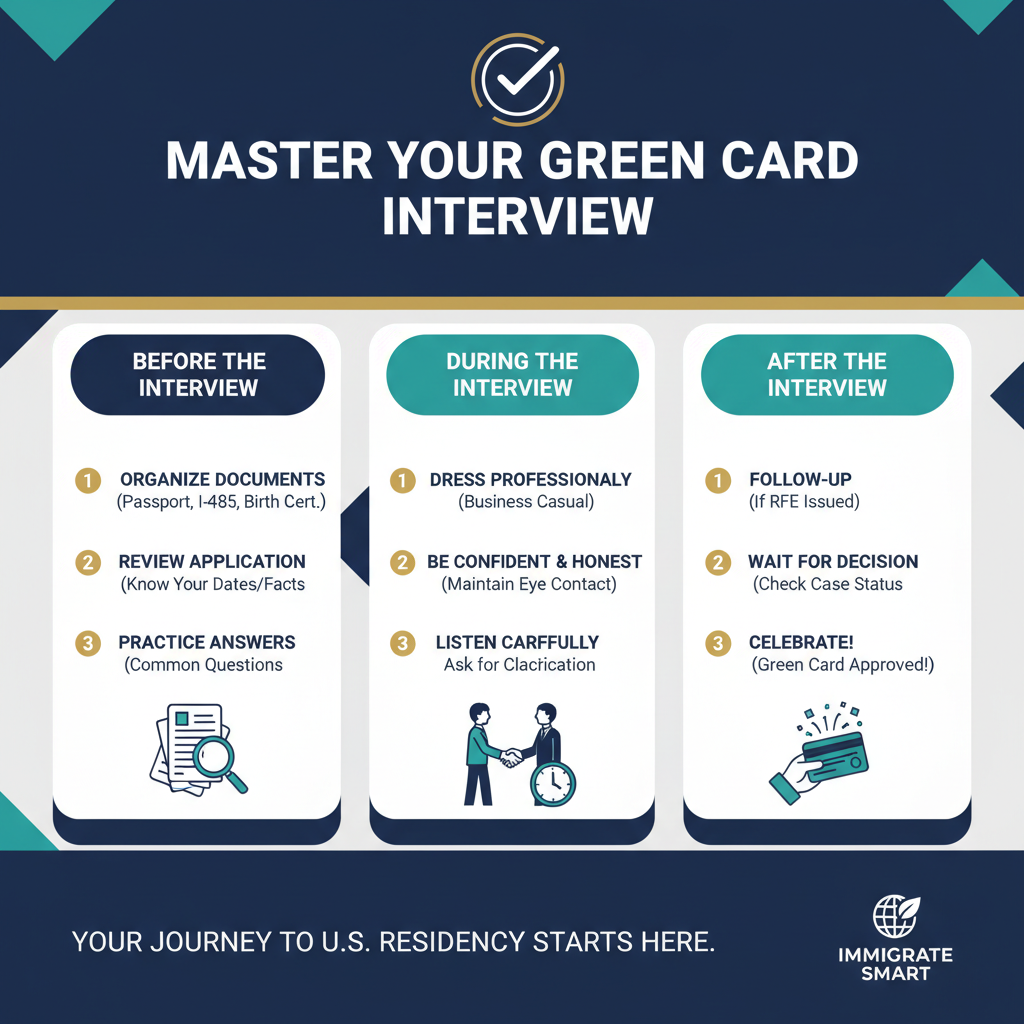
Navigating the U.S. immigration system can feel like a labyrinth, and for many, the Green Card interview is one of the most crucial steps. Recent discussions and information circulating in immigration law circles, as highlighted by various legal news outlets, consistently emphasize the enduring importance of thorough preparation for this pivotal interview. While the interview process itself isn't new, the ongoing stream of advice and case studies underscores its critical role in determining an applicant's future in the United States.
Why this news is showing up now
The Green Card interview remains a cornerstone of the immigration process for individuals seeking lawful permanent residency in the United States, whether through family-based petitions, employment-based petitions, or other categories. There's no single "new" policy driving this discussion; rather, it's a perpetual and vital topic because the interview is often the final hurdle before approval. USCIS officers are tasked with verifying information, assessing eligibility, and ensuring the legitimacy of relationships or claims made in applications. As processing times fluctuate and immigration policies evolve, albeit subtly, the need for applicants to be meticulously prepared remains constant. Furthermore, with an ever-increasing volume of applications, USCIS continues to refine its interview procedures, making it essential for applicants to stay informed and well-prepared.
How it can affect Florida residents
For immigrants and their families residing in Orlando, Central Florida, and throughout the Sunshine State, the Green Card interview is a tangible and often local experience. If you've applied for Adjustment of Status from within the U.S., your interview will likely take place at a USCIS Field Office. For many Central Florida residents, this means an appointment at the Orlando USCIS Field Office. The specific challenges and opportunities for Florida residents can include:
- Local Processing Times: While federal, USCIS processing times can vary by field office. Understanding the local context for interview scheduling is key.
- Access to Legal Support: Orlando is a hub for immigration legal services, including Imigrar, offering invaluable local expertise for preparing for interviews at the Orlando office.
- Community Resources: Florida has diverse immigrant communities, which can be a source of support, but also highlights the need for accurate information tailored to various backgrounds and languages.
- Travel Logistics: For those living along the I-4 corridor or in surrounding counties like Orange, Seminole, Osceola, or Lake, planning travel to the Orlando Field Office is a practical consideration.
The core message is clear: regardless of where you are in Florida, a well-prepared interview can significantly increase your chances of a successful outcome. At Imigrar, we understand the unique needs of our Orlando and Florida clients, and our goal is to empower you with the knowledge and support needed to face your Green Card interview with confidence.
Need Help? Our Orlando immigration team is ready to assist. Call +1 786-791-3106 for a free consultation, or message us online. Se Habla Español.
What Green Card Interviews Are (and Why They Matter)
A Green Card interview is a mandatory step for most individuals seeking to become Lawful Permanent Residents (LPRs) of the United States. This interview serves as a critical opportunity for U.S. Citizenship and Immigration Services (USCIS) or a Consular Officer (if applying from abroad) to verify the information provided in your application, confirm your eligibility for a Green Card, and ensure that you meet all legal requirements. It’s not merely a formality; it’s a detailed examination of your case.
A plain-English definition
Simply put, a Green Card interview is a meeting with an immigration officer who reviews your application for permanent residency. During this meeting, the officer will ask you questions about your application, your background, your relationship (if it’s a family-based petition), and your intentions for living in the U.S. They will also review all the documents you submitted and any new evidence you bring. The goal is for the officer to determine if you genuinely qualify for a Green Card under U.S. immigration law and if there are any reasons why you should not be granted permanent residency.
Key terms you need to know
Understanding the terminology is crucial for navigating the Green Card process:
- Lawful Permanent Resident (LPR): An individual who has been granted the privilege of permanently residing in the United States. This status is often referred to as holding a "Green Card."
- Green Card: The official identification card (Form I-551) issued by USCIS to LPRs, proving their status.
- Adjustment of Status (AOS): The process by which an eligible foreign national already in the United States can apply for LPR status without having to leave the U.S. This is primarily for those who entered legally and maintain their status. The key form for this is Form I-485, Application to Register Permanent Residence or Adjust Status.
- Consular Processing: The process by which an eligible foreign national applies for an immigrant visa at a U.S. embassy or consulate in their home country (or country of last residence) and then enters the U.S. as a Lawful Permanent Resident. This is handled by the U.S. Department of State.
- Petitioner: The U.S. citizen or LPR who files an immigration petition (e.g., Form I-130, Petition for Alien Relative) on behalf of an eligible foreign national.
- Beneficiary: The foreign national seeking immigration benefits, such as a Green Card, who is named in an immigration petition.
- Priority Date: The date USCIS receives your immigration petition (e.g., Form I-130 or Form I-140). This date determines your place in the visa queue, especially for categories with annual visa limits.
- Affidavit of Support (Form I-864): A legally binding contract an individual signs to accept financial responsibility for the intending immigrant. This ensures the immigrant will not become a "public charge" and relies on public assistance.
- Public Charge: A person who is likely to become primarily dependent on the government for subsistence, as demonstrated by the receipt of public cash assistance for income maintenance or long-term institutionalization at government expense.
- Notice of Intent to Deny (NOID): A letter from USCIS indicating that they intend to deny your application unless you provide additional information or clarification within a specified timeframe.
- Request for Evidence (RFE): A letter from USCIS asking for more information or documents to support your application.
Understanding these terms will help you comprehend the various stages and requirements of your Green Card application journey, especially as you prepare for the interview. The interview is where all these pieces come together for final review.
Current Immigration Law: The Foundation
The framework for Green Card interviews and eligibility is rooted in the Immigration and Nationality Act (INA), the comprehensive body of law governing immigration to the United States. The INA, along with subsequent amendments and regulations, dictates who can immigrate, through what categories, and the processes involved.
Federal requirements
At the federal level, the INA outlines the general eligibility criteria for various Green Card categories. The most common pathways leading to an interview include:
- Family-Based Immigration (INA § 201, 203, 204): This category allows U.S. citizens and Lawful Permanent Residents to petition for certain family members. Immediate Relatives (spouses, unmarried children under 21, and parents of U.S. citizens) generally have visas immediately available. Other family preference categories (e.g., adult children, siblings) are subject to annual quotas and Visa Bulletin priority dates. Key forms include Form I-130, Petition for Alien Relative, and for those adjusting status in the U.S., Form I-485, Application to Register Permanent Residence or Adjust Status.
- Employment-Based Immigration (INA § 203): This category is for foreign nationals whose skills, education, or investments are deemed beneficial to the U.S. economy. It includes five preference categories (EB-1 to EB-5), each with specific requirements and annual limits. While many employment-based cases undergo an interview, some may be waived for certain categories. Key forms include Form I-140, Immigrant Petition for Alien Worker, and Form I-485.
- Other Categories: This includes diversity visa lottery winners, asylum/refugee status adjusters, and certain special immigrants.
Regardless of the category, all applicants must demonstrate they are admissible to the United States. Grounds of inadmissibility (INA § 212) can include health-related issues, criminal history, security risks, public charge concerns, immigration violations, and misrepresentation. If an applicant is found inadmissible, they may need to apply for a waiver (e.g., Form I-601, Application for Waiver of Grounds of Inadmissibility).
The interview itself is governed by federal regulations, which mandate that USCIS officers conduct interviews to verify identity, eligibility, and the bona fides of the application. The officer has the authority to request additional evidence or to deny the application if statutory requirements are not met.
You can find detailed information and all necessary forms on the USCIS official website. We strongly recommend using only official government sources for information, such as USCIS Forms and USCIS Processing Times.
Florida-specific considerations
While the laws are federal, their implementation has a local face. For residents of Orlando and Central Florida applying for Adjustment of Status, your Green Card interview will most likely be scheduled at the Orlando USCIS Field Office. This office serves a wide geographical area, encompassing counties like Orange, Seminole, Osceola, Volusia, Brevard, and others. Key considerations include:
- Jurisdiction: Ensure your address falls within the jurisdiction of the Orlando Field Office. If you move, it’s crucial to update your address with USCIS immediately using Form AR-11, Alien’s Change of Address Card.
- Local Officers: While all officers follow federal guidelines, each field office can have its own nuances in terms of interview flow and general atmosphere. An attorney familiar with the Orlando office can offer valuable insights.
- Logistics: Plan your travel to the Orlando Field Office well in advance. Consider traffic, especially along the I-4 corridor, and parking. Arriving late can have serious consequences.
Important: The Green Card interview is a serious legal proceeding. While the laws are federal, the local environment of the interview can impact your experience. Having legal representation from a firm like Imigrar, with experience in the Orlando area, can provide a significant advantage.
How to Prepare for Your Green Card Interview: A Complete Step-by-Step Guide
The Green Card interview is a critical juncture in your immigration journey. Proper preparation is not just recommended; it is essential. This comprehensive guide will walk you through the necessary steps to ensure you are ready for your interview day.
1) Understand Your Case & Review Your Application
Before anything else, you must thoroughly understand your application and the specific immigration category you are pursuing. This is the foundation of your preparation.
- Review Every Form: Go back through every form you submitted (e.g., Form I-130, Form I-485, Form I-864, Form I-765 for employment authorization, Form I-131 for travel document). Read them line by line.
- Know Your Answers: Ensure you remember every answer you provided, especially dates, addresses, employment history, and personal details. Inconsistencies, even minor ones, can raise red flags.
- Understand Your Eligibility: Be clear on the specific legal basis for your Green Card application (e.g., marriage to a U.S. citizen, sponsored by an employer, asylum status).
- Identify Potential Issues: Think about any potential issues in your case, such as past immigration violations, criminal history, or gaps in employment/residence. Be prepared to address these honestly and with supporting documentation.
Required Documents for this step (for review):
- Complete copies of all forms submitted to USCIS (e.g., Form I-130, Form I-485, Form I-864, Form G-325A).
- All supporting evidence previously submitted (e.g., birth certificates, marriage certificates, photos, joint financial documents).
2) Gather and Organize All Required Documents
This is perhaps the most crucial practical step. You must bring all original documents, along with copies, to your interview. Organize them meticulously.
- Interview Notice: Your original Form I-797C, Notice of Action, containing the interview date, time, and location.
- Identification:
- Valid passport (original and copy).
- Driver's license or state ID (original and copy).
- Birth certificate (original and certified translation, if applicable, plus copies).
- Proof of Immigration Status:
- Original and copies of your current visa, I-94 arrival/departure record, EAD card (Form I-766), or Advance Parole document (Form I-512L).
- Previous immigration documents (e.g., old I-20s, DS-2019s, previous visa stamps).
- Marriage-Based Petitions (if applicable):
- Original marriage certificate and copies.
- Original birth certificates for any children you share.
- Proof of bona fide marriage (original and copies):
- Joint bank accounts (statements for the last 12-24 months).
- Joint utility bills (electricity, water, internet) in both names.
- Joint leases or mortgage statements.
- Joint health, auto, or life insurance policies.
- Photos together (dating back to the start of the relationship, wedding photos, family events, vacations).
- Affidavits from friends/family attesting to the marriage (Form I-130A, if applicable, or sworn statements).
- Any other evidence of commingled finances, shared responsibilities, or joint life.
- Divorce decrees or death certificates for any prior marriages of both petitioner and beneficiary.
- Financial Support:
- Original Form I-864, Affidavit of Support, signed by the petitioner (and joint sponsor, if applicable).
- Petitioner's (and joint sponsor's) most recent three years of federal tax returns (IRS transcripts preferred) and W-2s/1099s.
- Recent pay stubs or employment verification letter for petitioner (and joint sponsor).
- Proof of assets (bank statements, property deeds) if income is insufficient.
- Medical Examination: Original Form I-693, Report of Medical Examination and Vaccination Record, sealed in an envelope (if not already submitted).
- Police Records: Original certified copies of any arrest records, court dispositions, or police clearances, even for minor infractions.
- Educational/Employment Records: Diplomas, transcripts, employment letters, if relevant to your application or to establish background.
- Photographs: Two recent, passport-style color photographs.
Warning: Bring originals for all documents, especially vital records like birth and marriage certificates. Have copies prepared for the officer, but be ready to present the originals for verification.
3) Prepare for the Interview Questions
The questions can range from simple biographical details to very specific inquiries about your relationship or employment. Be ready for anything.
- Basic Biographical Questions: Name, date of birth, place of birth, parents' names, addresses, educational history, employment history.
- Immigration History: How you entered the U.S., previous visas, any past immigration applications, any arrests or encounters with law enforcement.
- Relationship Questions (Marriage-Based):
- How and when did you meet your spouse?
- Who proposed? When and where?
- Details of your wedding ceremony.
- Where do you live? Describe your home.
- Who handles finances?
- What do you do together on weekends?
- How do you celebrate holidays?
- When was the last time you saw your spouse's family?
- What are your spouse's hobbies?
- What did you do this morning?
- Employment-Based Questions: Details about your job, employer, duties, salary, qualifications, and how you obtained the position.
- Admissibility Questions: Questions related to criminal history, health issues, involvement in certain organizations, or past immigration violations.
Practice: Have a trusted friend or family member conduct a mock interview with you. Practice answering clearly, concisely, and truthfully.
4) Practice Your English (If Applicable) and Interpreter Needs
If you are not fluent in English, you have the right to an interpreter.
- Bring Your Own Interpreter: If you bring an interpreter, they must be fluent in both English and your native language, at least 18 years old, and not your attorney or a witness for your case. They will need to bring valid photo ID.
- Request a USCIS Interpreter: You can request a USCIS interpreter in advance, but this is not always guaranteed. It's generally safer to bring your own.
- Practice English: Even if you bring an interpreter, demonstrating some English comprehension can be beneficial. Try to answer simple questions in English if you feel comfortable.
5) Plan Your Interview Day Logistics
The day of the interview can be stressful. Minimize stress by planning ahead.
- Location: Confirm the address of the Orlando USCIS Field Office (or other designated location).
- Travel: Plan your route, considering traffic (especially on the I-4 corridor) and parking. Aim to arrive at least 30-45 minutes before your scheduled time.
- Attire: Dress professionally, as you would for a job interview. This demonstrates respect for the process.
- Food/Drink: Bring water and a small snack if you anticipate a long wait.
- Children: If possible, arrange childcare. While children can attend, it can be distracting. If they must attend, bring quiet activities for them.
- Legal Counsel: Decide whether your attorney will accompany you. This is highly recommended, especially for complex cases or if you are nervous.
Reminder: The Executive Office for Immigration Review (EOIR) oversees immigration courts, which is a different setting than a USCIS field office interview, but the seriousness of the proceedings is similar.
6) What to Do During the Interview
Your demeanor and responses during the interview are just as important as your documentation.
- Be Truthful: Always tell the truth. Providing false information can lead to severe penalties, including deportation and permanent bars from the U.S.
- Be Respectful: Address the officer respectfully.
- Listen Carefully: Listen to each question fully before answering. If you don't understand a question, ask for clarification.
- Answer Directly: Answer only the question asked. Do not volunteer extra information unless it's directly relevant and helps your case.
- Stay Calm: It's normal to be nervous, but try to remain calm and composed.
- Review Documents: If the officer asks you to identify a document, take your time to review it before confirming.
- Signatures: You may be asked to sign documents under oath. Read them carefully before signing.
- Legal Representation: If your attorney is present, they can provide clarification, object to improper questions, and ensure your rights are protected.
7) Follow-Up After the Interview
The interview is not always the final step. Be prepared for potential follow-up actions.
- Decision: You may receive a decision immediately, or the officer may tell you that a decision will be mailed.
- Request for Evidence (RFE): If the officer needs more information, they will issue an RFE. Respond promptly and thoroughly.
- Notice of Intent to Deny (NOID): If USCIS intends to deny your application, they will issue a NOID, giving you a chance to respond. This is a critical point where legal counsel is invaluable.
- Approval: If approved, you will typically receive your Green Card (Form I-551) by mail within a few weeks.
- Conditional Green Card (CR1/CR6): If you received a Green Card based on marriage and were married for less than two years at the time of approval, you will receive a 2-year conditional Green Card. You will need to file Form I-751, Petition to Remove Conditions on Residence, within the 90-day window before your conditional Green Card expires.
Important: Keep copies of everything USCIS sends you and everything you send to USCIS. Maintain a well-organized file of your entire immigration case.
Need Help? Our Orlando immigration team is ready to assist. Call +1 786-791-3106 for a free consultation, or message us online. Se Habla Español.

Practical Steps You Can Take Today for a Successful Interview
Don't wait until you receive your interview notice to start preparing. Proactive steps can significantly reduce stress and improve your chances of success.
Actionable Checklist:
- Review Your Application Now: Pull out copies of all forms you submitted and read through them. Identify any potential discrepancies or areas that might need clarification.
- Start Gathering Originals: Even if your interview isn't scheduled, begin collecting all original documents (birth certificates, marriage certificates, divorce decrees, passports, etc.). Don't wait until the last minute.
- Organize Your Files: Create a well-organized folder or binder for your immigration documents. Use dividers for different categories (e.g., "Personal ID," "Marriage Evidence," "Financial," "Medical").
- Update Your Evidence (Marriage-Based): Continuously collect new evidence of your bona fide marriage – new joint bills, photos, updated bank statements, joint insurance policies. This shows your relationship is ongoing and genuine.
- Check USCIS Processing Times: Monitor USCIS Processing Times for your specific field office (e.g., Orlando USCIS Field Office) and form type (e.g., Form I-485). This helps manage expectations.
- Consult an Attorney: Schedule a consultation with an experienced immigration attorney. They can review your case, identify potential issues, and help you strategize.
- Address Inadmissibility Issues: If you have any past issues (criminal history, prior immigration violations), discuss them with an attorney immediately to see if a waiver is needed or if your eligibility is affected.
Document preparation guidance
- Copies and Originals: Always bring both originals and copies of every document. The officer will want to see the original but often keeps the copies for their file.
- Translations: Any document not in English must be accompanied by a complete English translation and a certification from the translator stating that they are competent to translate and that the translation is accurate.
- Chronological Order: Organize documents logically, perhaps chronologically for things like bank statements or photos. This makes it easier for both you and the officer.
- Tab and Label: Use tabs or labels for different sections of your document binder.
- Avoid Over-Documentation: While thorough, don't overwhelm the officer with unnecessary documents. Focus on quality and relevance.
Timeline expectations
The Green Card interview timeline can vary significantly based on the type of petition, the USCIS field office (e.g., Orlando USCIS Field Office), and current processing backlogs. However, here’s a general sequence:
- Petition Filing: After filing Form I-130 (for family) or Form I-140 (for employment) and its approval, or concurrent filing with Form I-485.
- Biometrics Appointment: Typically within a few weeks to months after filing Form I-485.
- Work Permit/Travel Document (EAD/AP): If you filed Form I-765 and Form I-131 concurrently, you might receive these before your interview, allowing you to work and travel while your Green Card application is pending.
- Interview Notice: You will receive Form I-797C, Notice of Action, notifying you of your interview date and time. This can be anywhere from a few months to over a year after filing Form I-485, depending on the category and field office.
- Interview: The actual interview with a USCIS officer.
- Decision and Card Production: If approved, you may receive an immediate verbal approval, or


