

The journey to obtaining a Green Card, or lawful permanent residency, is a pivotal moment for countless individuals and families seeking to build a life in the United States. While the application process itself can be complex, the Green Card interview often stands as one of the most significant and nerve-wracking steps. It's your opportunity to demonstrate your eligibility and integrity directly to a U.S. Citizenship and Immigration Services (USCIS) officer.
Understanding what to expect, how to meticulously prepare, and what pitfalls to avoid can dramatically increase your chances of a successful outcome. At Imigrar, we believe in empowering our clients with accurate, up-to-date information and unwavering support to navigate these crucial stages.
The reporting that sparked this guide
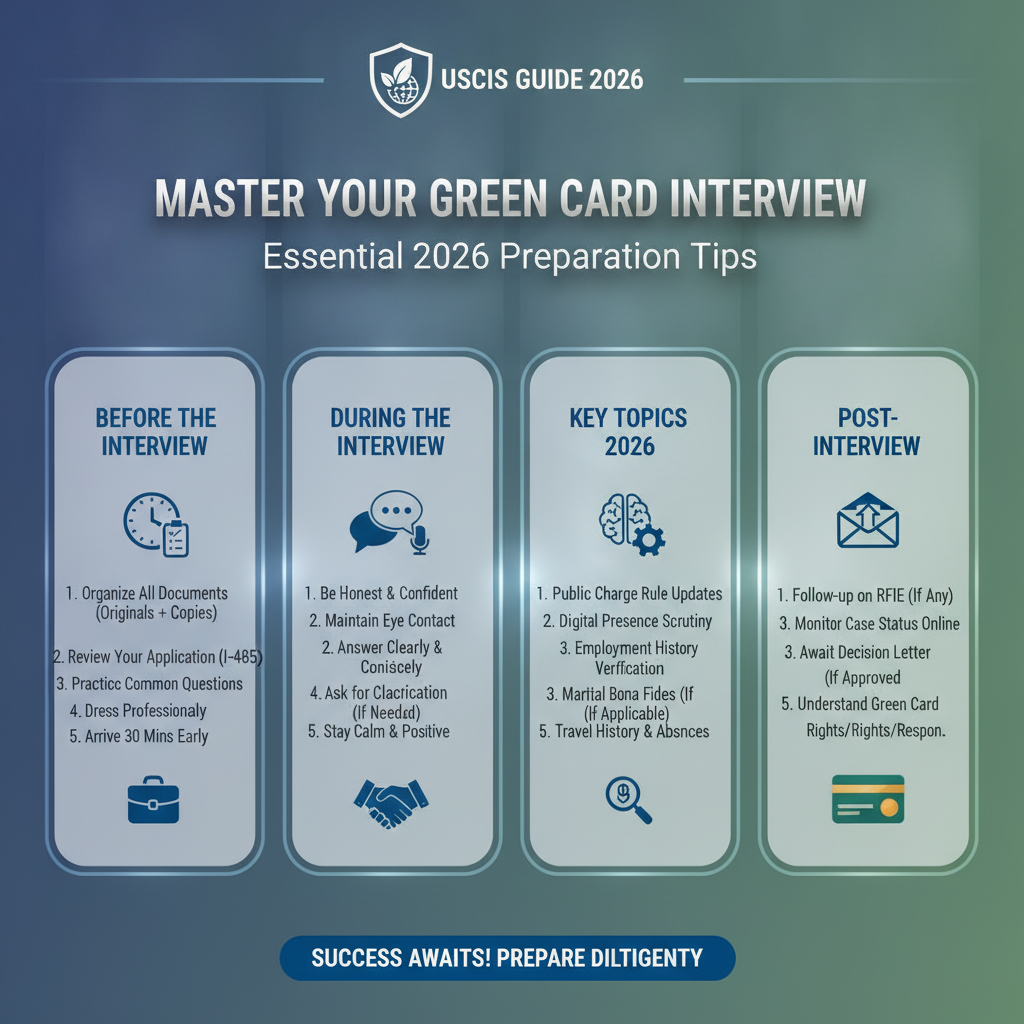
The ongoing discussion around immigration procedures, especially the interview process for Green Cards, consistently highlights the need for thorough preparation. As of late 2026, immigration news continues to emphasize the importance of these interviews as a cornerstone of the U.S. immigration system. This guide is inspired by the continuous flow of information and advice found in general immigration law news, underscoring the enduring relevance of being well-prepared for your interview.
Green Card Interview Preparation Tips (Immigration Law)
What This News Means for Immigrants in Orlando and Across Florida
For immigrants residing in Orlando, Central Florida, and throughout the Sunshine State, the focus on Green Card interview preparation is not just general news; it has direct, tangible implications for your future. Florida is a vibrant hub for diverse immigrant communities, and the Orlando USCIS Field Office, along with others across the state, processes thousands of Green Card applications annually.
Why this news is showing up now
The emphasis on Green Card interview preparation is a perpetual topic because the interview remains a critical, non-negotiable step for most applicants seeking lawful permanent residency. While policies and processing times may fluctuate, the fundamental requirement of an interview to verify information, assess eligibility, and confirm the bona fides of relationships or employment remains constant. In 2026, USCIS continues its commitment to efficiency and integrity, which means that well-prepared applicants facilitate smoother processing, benefiting everyone involved. News outlets frequently cover tips and common issues because applicants consistently seek guidance for this high-stakes meeting.
How it can affect Florida residents
For individuals and families in Florida, particularly those around the I-4 corridor and greater Orlando area, this means that your local USCIS Field Office will be conducting these interviews. The Orlando USCIS Field Office serves Orange County and surrounding areas, and understanding their specific procedures and expectations, while generally aligned with national standards, can be beneficial. Being unprepared can lead to delays, Requests for Evidence (RFEs), or even denials, forcing you to restart parts of the process or face more complex legal challenges. Conversely, a well-prepared applicant can often experience a smoother, less stressful interview, leading to a quicker decision on their Green Card application. Given Florida's large immigrant population, competition for interview slots and the volume of cases can sometimes be high, making it even more crucial to present a clear, compelling case from the outset.
Need Help? Our Orlando immigration team is ready to assist. Call +1 786-791-3106 for a free consultation, or message us online. Se Habla Español.
What Green Card Interviews Are (and Why They Matter)
The Green Card interview is a mandatory step for most individuals applying for lawful permanent residency in the United States. It's a face-to-face meeting with a USCIS officer (for those adjusting status within the U.S.) or a Consular Officer at a U.S. Embassy or Consulate abroad (for those undergoing consular processing). The primary purpose of this interview is to verify the information provided in your application, confirm your eligibility for a Green Card, and ensure that you meet all legal requirements under U.S. immigration law.
This interview is not merely a formality; it's a critical examination of your case. For family-based petitions, it's particularly important for the officer to ascertain the bona fides (genuineness) of the relationship between the petitioner (U.S. citizen or Green Card holder) and the beneficiary (the immigrant applicant). For employment-based petitions, the focus will be on your qualifications, the job offer, and the petitioning employer.
A plain-English definition
Think of the Green Card interview as your opportunity to tell your story and present your evidence directly to the government official who will decide your future in the U.S. It's a conversation where the officer asks questions based on your submitted forms and supporting documents, aiming to ensure everything is truthful, consistent, and meets immigration laws. It’s their chance to confirm you are who you say you are, your relationship is real (if applicable), and you qualify for the Green Card category you applied under.
Key terms you need to know
- Green Card: Also known as a Permanent Resident Card, it is proof of your authorization to live and work permanently in the United States.
- Adjustment of Status (AOS): The process of applying for a Green Card while physically present in the United States. This typically involves filing Form I-485.
- Consular Processing: The process of applying for a Green Card through a U.S. Embassy or Consulate abroad. This is for individuals who are outside the U.S. or ineligible for Adjustment of Status.
- Petitioner: The U.S. citizen or lawful permanent resident who files an immigration petition (e.g., Form I-130, Petition for Alien Relative) on behalf of an eligible relative. For employment-based cases, it's the U.S. employer.
- Beneficiary: The foreign national who is seeking an immigration benefit, such as a Green Card.
- Form I-130, Petition for Alien Relative: The initial form filed by a U.S. citizen or LPR to establish a qualifying family relationship with a foreign national.
- Form I-485, Application to Register Permanent Residence or Adjust Status: The primary application form for those seeking a Green Card while in the U.S. (Adjustment of Status).
- Form I-864, Affidavit of Support: A legally binding contract submitted by the petitioner (and sometimes a joint sponsor) to demonstrate their financial ability to support the beneficiary and prevent them from becoming a public charge.
- Form I-693, Report of Medical Examination and Vaccination Record: A document completed by a USCIS-approved civil surgeon, certifying that the applicant is not inadmissible on public health grounds.
- Priority Date: The date USCIS receives your immigrant petition (e.g., Form I-130 or Form I-140). This date determines your place in the visa queue, especially for categories with annual numerical limitations.
- Request for Evidence (RFE): A notice from USCIS asking for additional documents or information to support your application.
- Notice of Intent to Deny (NOID): A notice from USCIS indicating their intent to deny your application unless you provide specific information or evidence to overcome the grounds for denial.
Current Immigration Law: The Foundation
The framework for Green Card eligibility and the interview process is primarily governed by the Immigration and Nationality Act (INA), specifically sections related to immigrant visas and adjustment of status. The INA, along with its implementing regulations, outlines who is eligible for a Green Card, the various categories available (family-based, employment-based, diversity lottery, etc.), and the requirements for each. Understanding the legal basis of your application is crucial for your interview.
Federal requirements
At the federal level, the core requirements for obtaining a Green Card generally include:
- Eligibility for a Specific Green Card Category: You must qualify under one of the many categories, such as immediate relative of a U.S. citizen (spouse, unmarried child under 21, parent), family preference categories (e.g., married children of U.S. citizens, siblings of U.S. citizens), employment-based categories, or special immigrant categories.
- Admissibility: You must be admissible to the United States. This means you must not fall under any grounds of inadmissibility, such as certain criminal convictions, health-related issues, immigration violations, or being deemed a "public charge" (someone likely to depend on government benefits). Waivers may be available for some grounds of inadmissibility.
- Properly Filed Petitions and Applications: All required forms, such as Form I-130 (for family-based petitions) and Form I-485 (for Adjustment of Status) or DS-260 (for Consular Processing), must be accurately completed and filed with all necessary supporting documentation.
- Medical Examination: Applicants for Adjustment of Status or immigrant visas must undergo a medical examination by a USCIS-approved civil surgeon (or panel physician abroad) to ensure they do not have certain communicable diseases or other health-related grounds of inadmissibility. The results are submitted on Form I-693.
- Affidavit of Support: For most family-based Green Cards and some employment-based categories, a sponsor (usually the petitioner) must file Form I-864, Affidavit of Support, demonstrating their financial ability to support the applicant and ensuring they will not become a public charge.
These requirements are meticulously reviewed by the USCIS officer during your interview. Discrepancies, omissions, or misrepresentations can lead to serious consequences, including denial of your application or findings of misrepresentation that could affect future immigration benefits. Always refer to the official USCIS official website for the most current information.
Florida-specific considerations
While U.S. immigration law is federal, the practical application often involves local USCIS Field Offices. For Central Florida residents, your interview will likely be scheduled at the Orlando USCIS Field Office. While the legal requirements remain the same nationwide, understanding the specific logistical details and common practices of your local office can be helpful. For instance, knowing the office's operating hours, parking situation, and security procedures can reduce stress on the day of your interview. The USCIS Orlando Field Office is committed to processing applications efficiently, but the sheer volume of cases in Florida means that thorough preparation is paramount to avoid delays.
Need Help? Our Orlando immigration team is ready to assist. Call +1 786-791-3106 for a free consultation, or message us online. Se Habla Español.
How to Prepare for Your Green Card Interview: A Complete Step-by-Step Guide
The Green Card interview is the culmination of months, sometimes years, of preparation. Approaching it strategically and methodically is key to success. Here’s a comprehensive step-by-step guide to help you get ready.
1) Understand Your Case and Application
Before anything else, you must have a deep understanding of every form you and your petitioner (if applicable) have submitted. This includes Form I-130, Form I-485, Form I-864, and any other supporting documents. The USCIS officer will have these forms in front of them and will be asking questions directly from them.
- Review all submitted forms: Read through every question and answer on your applications. Ensure you remember the details of your previous addresses, employment history, travel dates, and any significant life events.
- Know your immigration history: Be clear on all your previous entries into the U.S., visa types, and any prior immigration applications or issues.
- Understand your Green Card category: Whether it's family-based, employment-based, or another category, know the specific requirements for your type of Green Card and how you meet them.
- Family-based applicants: Both the petitioner and beneficiary should be familiar with the details of their relationship, including how and when they met, significant dates (marriage, birth of children), and shared life events. Consistency is vital.
Required Documents for Review:
- Complete copies of all forms submitted to USCIS (Form I-130, Form I-485, Form I-864, etc.).
- All previously submitted supporting documents and evidence.
- Any RFEs and your responses.
2) Gather and Organize All Required Documents
This is arguably the most critical step. You must bring all original documents, along with copies, that were submitted with your application, plus any new evidence that has become available since you filed. Create a well-organized binder or folder system.
- Originals and Copies: Bring the original of every document you submitted, plus a complete set of photocopies. USCIS will often review the originals and keep the copies.
- Translations: Any document not in English must be accompanied by a certified English translation. The translator must certify that they are competent to translate and that the translation is accurate.
- Passport and Travel Documents: Your current passport, travel history (I-94 records), and any previous passports with U.S. visas.
- Birth Certificates: Your original birth certificate and, for family-based cases, the petitioner's birth certificate.
- Marriage Certificate (if applicable): Original marriage certificate and any divorce decrees or death certificates for prior marriages of either spouse.
- Financial Documents: Current tax returns, W-2s, pay stubs, and bank statements for the petitioner and any joint sponsors (Form I-864 package).
- Medical Examination Report: If you haven't already submitted it, bring the sealed envelope containing your Form I-693 from the civil surgeon. If you submitted it, bring a copy for your records.
- Police Certificates/Court Records: If you have any criminal history, bring certified court dispositions and police records.
- Proof of Relationship (for family-based): This is crucial. Bring ALL evidence of your bona fide relationship: joint bank accounts, joint leases/mortgages, utility bills in both names, insurance policies, photos together over time, affidavits from friends/family, travel itineraries, communication records (texts, emails). The more, the better.
- Employment-based documents: Original job offer letter, educational degrees, professional licenses, employment verification letters, and any required certifications.
- Photos: Passport-style photos if instructed.
Important: Do not bring more documents than necessary, but ensure you have everything required. Organize them logically, perhaps by the form they support, or by category (personal, financial, relationship). For Central Florida residents attending the Orlando Field Office, ensure all documents are easily accessible for the officer.
3) Practice Common Interview Questions
While every interview is unique, certain themes and questions frequently arise. Practicing your answers can help you feel more confident and ensure consistency.
- Personal History: Questions about your full name, date of birth, place of birth, parents' names, and addresses.
- Immigration History: When and how you entered the U.S., previous visas, any past immigration applications, and any travel outside the U.S.
- Relationship Questions (Family-based):
- How did you meet your spouse/petitioner?
- When did you get married?
- What does your spouse/petitioner do for a living?
- Details about your daily life together (e.g., who cooks, who pays bills, what you do on weekends).
- Questions about your spouse's family, and vice versa.
- Employment History: Current and previous jobs, employers' names, dates of employment, and job duties.
- Criminal History: Even minor infractions must be disclosed and discussed. Be truthful and bring all relevant court documents.
- Security Questions: Standard questions about affiliations, past activities, and any involvement with terrorism or other prohibited groups.
Tip: Practice with your petitioner (if applicable) and have a mock interview. Ensure both of you give consistent answers to questions about your relationship or joint history. An attorney can conduct a mock interview to identify areas needing improvement.
4) Prepare for the Interview Day Logistics
The day of the interview can be stressful. Planning ahead for logistics can alleviate some anxiety.
- Dress Code: Dress professionally, as you would for an important job interview. It shows respect for the process.
- Arrival Time: Arrive at least 30 minutes before your scheduled appointment. Allow for traffic, especially if traveling on the I-4 corridor to the Orlando USCIS Field Office, and security checks.
- What to Bring: Only bring essential documents, your appointment notice, identification, and a small bag. Leave unnecessary items at home.
- Interpreter: If you are not fluent in English, you have the right to bring an independent, certified interpreter. Inform USCIS in advance if you need one. Your attorney can also act as a translator if they are qualified.
- Attorney Presence: You have the right to have your immigration attorney accompany you to the interview. This can provide immense support and ensure your rights are protected.
Reminder: Check the USCIS website or your appointment notice for any specific instructions or items prohibited at the interview location.
5) Know Your Rights and What to Expect
Understanding the interview process and your rights can help you remain calm and confident.
- The Officer's Role: The USCIS officer's job is to verify information and assess credibility. They are trained to identify inconsistencies and potential fraud.
- Oath: You will be asked to swear under oath to tell the truth.
- Questioning: The officer will ask questions based on your applications and supporting documents. They may also ask follow-up questions to clarify information or explore inconsistencies.
- Right to Counsel: You have the right to have an attorney present. Your attorney can clarify questions, object to inappropriate inquiries, and provide legal advice.
- Right to Remain Silent: While it’s generally advisable to answer all questions truthfully, if you are unsure about an answer or feel uncomfortable, you can consult with your attorney.
- After the Interview: The officer may make a decision immediately, but often they will need more time to review the case. They might issue an RFE, a NOID, or send a decision by mail. Do not pressure the officer for an immediate decision.
Warning: Be truthful at all times. Providing false information or making misrepresentations can lead to severe penalties, including a permanent bar from the U.S.
6) Address Potential Issues Proactively
If your case has complexities, it’s vital to address them head-on, ideally with legal counsel, before the interview.
- Criminal History: If you have any arrests, charges, or convictions, even if they were dismissed or expunged, bring all certified court documents. Consult an attorney about potential waivers or inadmissibility issues.
- Previous Immigration Issues: Past visa overstays, previous denials, or deportation orders need to be fully disclosed and explained.
- Complex Family Situations: Prior marriages, children from previous relationships, or complex family trees should be clearly documented and explained.
- Gaps in Documentation: If you are missing crucial documents (e.g., a birth certificate from a country without reliable records), you must provide secondary evidence and an explanation for the missing primary document.
Important: Never try to hide information. USCIS has access to various databases and will likely uncover any inconsistencies. Honesty, combined with proper legal guidance, is always the best approach.
7) Follow Up After the Interview
The interview is not always the final step. Be prepared for potential follow-up actions.
- Requests for Evidence (RFE): If the officer needs more information, they will send an RFE. Respond promptly and thoroughly by the deadline.
- Notice of Intent to Deny (NOID): If USCIS intends to deny your application, they will issue a NOID, giving you an opportunity to submit additional evidence or arguments to overcome the grounds for denial. This is a critical juncture where legal counsel is almost always necessary.
- Decision by Mail: Most decisions are mailed to you. It could be an approval notice, a denial notice, or a notice for further action.
- Green Card Delivery: If approved, your Green Card will be mailed to your address. Ensure your address on file with USCIS is current.
Timeline Expectation: Processing times vary widely depending on the USCIS Field Office, the complexity of the case, and the Green Card category. You can check current processing times at USCIS Processing Times. While some decisions are made on the spot, it’s not uncommon to wait several weeks or even months for a final decision.
Practical Steps You Can Take Today
Don't wait until you receive your interview notice to start preparing. Proactive steps can make a significant difference.
- Review Your Application Package: Pull out copies of everything you submitted. Re-read every form and every piece of evidence. Make notes of any questions you have or areas where your memory might be fuzzy.
- Start Gathering Originals: Begin collecting all original documents that you submitted as copies. This includes birth certificates, marriage certificates, divorce decrees, passports, and any other official records.
- Organize Your Evidence: Create a system for organizing your documents. A binder with tabs for each category (personal, financial, relationship, medical, etc.) is highly recommended. This allows you to quickly retrieve any document the officer requests.
- Update Your Relationship Evidence (Family-based): If your interview is months away, continue to gather new evidence of your bona fide relationship. This could include recent joint bank statements, new photos, updated utility bills, or travel tickets from recent trips together.
- Verify USCIS Address: Ensure USCIS has your current mailing address. If you've moved, file a Change of Address (Form AR-11) immediately.
- Check USCIS Processing Times: Monitor the USCIS Processing Times page for your specific form and field office (e.g., Orlando) to get an estimate of when your interview might be scheduled.
- Consult with an Immigration Attorney: This is perhaps the most important step. An experienced attorney can review your entire application, conduct a mock interview, identify potential issues, and prepare you for specific questions related to your case. They can also represent you at the interview.
Document preparation guidance
When preparing your documents:
- Create a Master Checklist: List every document you need, both originals and copies.
- Label Clearly: Use sticky notes or tab dividers to label each section of your binder.
- Keep it Tidy: Presenting a neat, organized set of documents reflects positively on your attention to detail.
- Do Not Alter Documents: Never alter or tamper with official documents. This is a serious offense.
Timeline expectations
After filing your Form I-485 (for Adjustment of Status), you typically receive an interview notice several months later. The exact timeline depends on the USCIS Field Office workload and your Green Card category. For example, immediate relatives of U.S. citizens often have shorter waiting times than some preference categories. Once you receive your interview notice, you usually have a few weeks to prepare. Post-interview, decisions can range from immediate approval to several months of waiting, sometimes with an RFE in between. Patience is key, but proactive preparation can help minimize delays.
Need Help? Our Orlando immigration team is ready to assist. Call +1 786-791-3106 for a free consultation, or message us online. Se Habla Español.
How Imigrar Helps Immigrants in Orlando
At Imigrar, located conveniently in Orlando, Florida, we understand the immense significance of your Green Card interview. Our mission, "Keep Families Together," drives our dedicated approach to immigration law. We serve clients not only in Central Florida – from Orange County to the surrounding areas – but also nationwide, bringing extensive experience and a personalized touch to every case.
Our team of experienced immigration attorneys provides comprehensive support throughout the Green Card interview process:
- Thorough Application Review: We meticulously review your entire application package to ensure accuracy and completeness, identifying and addressing any potential issues before the interview.
- Personalized Interview Preparation: We conduct mock interviews, providing you with tailored advice and helping you anticipate questions specific to your case. We ensure you feel confident and prepared to articulate your story effectively.
- Document Organization: We guide you in gathering and organizing all necessary original documents and updated evidence, ensuring nothing is overlooked.
- Legal Representation at the Interview: An Imigrar attorney can accompany you to your Green Card interview at the Orlando USCIS Field Office or other locations, providing crucial legal support, clarifying questions, and protecting your rights.
- Addressing Complexities: If your case involves a criminal history, previous immigration issues, or other complexities, we develop robust strategies to address these challenges and present your case in the best possible light.
- Post-Interview Follow-Up: We assist with responding to RFEs, NOIDs, and navigating any subsequent steps until a final decision is reached on your Green Card.
Our commitment is to guide you through every step of this critical process with clarity, empathy, and expertise. We speak your language – Se Habla Español – ensuring clear communication and understanding.
Don't face your Green Card interview alone. Let Imigrar be your trusted partner in securing your future in the United States.

Frequently Asked Questions
Q: Do all Green Card applicants need an interview?
A: While most Green Card applicants, particularly those applying for Adjustment of Status (Form I-485) or Consular Processing, are required to attend an interview, there are exceptions. USCIS may waive the interview requirement for some applicants, especially for certain employment-based categories or for children under a certain age. However, it's safer to assume an interview will be required and prepare accordingly. Always check your official USCIS notices for


