


The reporting that sparked this guide: Green Card Interview Preparation Tips (Immigration Law)
What This News Means for Immigrants in Orlando and Across Florida
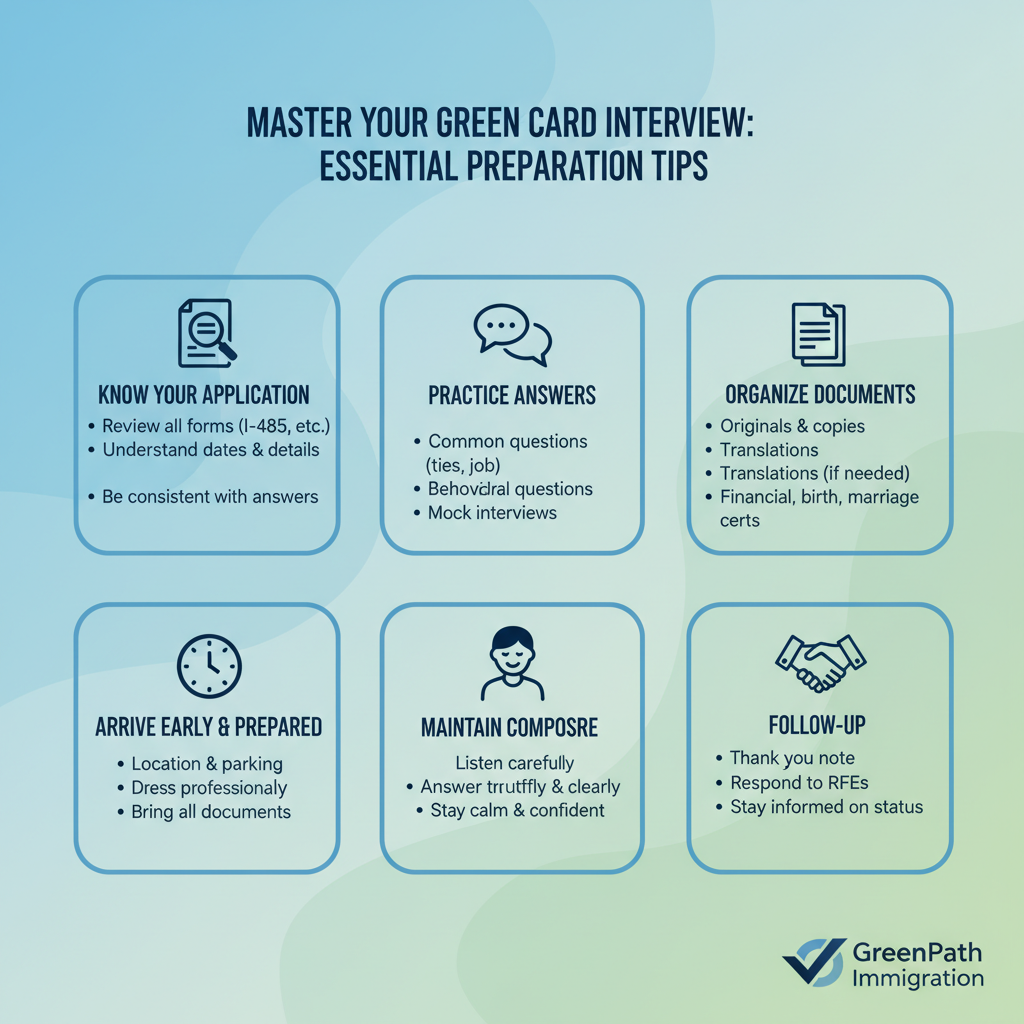
The journey to obtaining a Green Card, or lawful permanent residency in the United States, is a monumental step for countless individuals and families. While the application process itself is complex, a critical juncture often awaits many applicants: the Green Card interview. This interview, conducted by a U.S. Citizenship and Immigration Services (USCIS) officer, is a pivotal moment where you must demonstrate your eligibility for permanent residency and verify the information provided in your application.
Why this news is showing up now
Discussion around Green Card interview preparation is perennially relevant in immigration law, but specific policy shifts and processing backlogs can bring it into sharper focus. USCIS frequently updates its interview procedures, document requirements, and adjudicatory standards. For instance, in recent years, there has been an increased emphasis on interview integrity, particularly for marriage-based Green Cards, to combat fraud. Furthermore, as USCIS works through application backlogs, more interviews are being scheduled, making comprehensive preparation more critical than ever. The ongoing nature of immigration policy changes and the dynamic environment of USCIS operations mean that staying informed about best practices for interview preparation is a constant necessity for anyone pursuing a Green Card.
How it can affect Florida residents
For immigrants residing in Florida, particularly those in the Orlando and Central Florida areas, understanding and preparing for the Green Card interview is paramount. Florida has a significant immigrant population, and many residents will interact with the Orlando USCIS Field Office or other field offices across the state, such as in Miami or Tampa. The policies and procedures discussed here apply uniformly across the nation, but local field offices may have specific nuances in their interview scheduling or officer approaches. Preparing thoroughly means you are ready for any interview environment, whether your case is handled in Orlando, Miami, or through consular processing abroad. Given Florida's diverse communities, many applicants may also face language barriers or cultural differences, making professional legal guidance even more valuable. The stress of an interview can be amplified if you're unfamiliar with the local process, making proactive preparation essential for Florida residents seeking to keep their families together.
Need Help? Navigating the Green Card interview process can be daunting. Our Orlando immigration team at Imigrar is ready to assist you every step of the way. Call +1 786-791-3106 for a free consultation, or message us online. Se Habla Español.
What Green Card Interviews Are (and Why They Matter)
A Green Card interview is a formal meeting with a USCIS officer (for those applying from within the U.S. via Adjustment of Status) or a Consular Officer at a U.S. Embassy or Consulate abroad (for those applying via Consular Processing). The primary purpose of this interview is to verify the information you submitted in your application, confirm your eligibility for a Green Card, and ensure you are not inadmissible to the United States under current immigration law. It's an opportunity for the government to assess your credibility, the legitimacy of your claims (especially in family-based petitions), and your understanding of U.S. immigration laws.
This interview is a critical step because it is often the final hurdle before a decision is made on your Green Card application. A successful interview can lead directly to approval, while missteps, inconsistencies, or a lack of preparation can lead to delays, requests for more evidence, or even denial. For many, it represents the culmination of years of waiting and significant investment, making preparation not just important, but absolutely essential.
A plain-English definition
Think of the Green Card interview as a comprehensive check-up on your immigration application. An immigration officer will sit down with you (and your petitioner, if applicable, like your spouse or parent) and ask questions based on the forms and documents you've already submitted. They want to make sure everything you've said is true, that you qualify for a Green Card under the law, and that there are no reasons why you shouldn't be allowed to live permanently in the U.S. It's a formal conversation, but it's also your chance to clarify anything and present your case clearly and confidently.
Key terms you need to know
- Green Card: The common term for Form I-551, Permanent Resident Card, which proves you are a lawful permanent resident of the United States.
- Adjustment of Status (AOS): The process of applying for a Green Card from within the United States. This is handled by USCIS.
- Consular Processing: The process of applying for a Green Card from outside the United States at a U.S. Embassy or Consulate. This is handled by the U.S. Department of State.
- USCIS (U.S. Citizenship and Immigration Services): The government agency that oversees lawful immigration to the United States, including Green Card applications and interviews for Adjustment of Status.
- NVC (National Visa Center): Part of the U.S. Department of State, the NVC collects and processes visa applications (including immigrant visas leading to Green Cards) before they are sent to U.S. Embassies or Consulates abroad for interviews.
- Petitioner: The U.S. citizen or lawful permanent resident who files an immigration petition (e.g., Form I-130) on behalf of an eligible foreign national relative.
- Beneficiary: The foreign national who is seeking an immigration benefit (e.g., a Green Card) based on a petition filed on their behalf.
- Priority Date: The date USCIS or the NVC receives your petition. This date determines your place in the visa queue for numerically limited categories.
- Affidavit of Support (Form I-864): A legally binding document signed by the petitioner (and sometimes a joint sponsor) to accept financial responsibility for the immigrant.
- Inadmissibility: Grounds under U.S. immigration law that can prevent an individual from being granted a Green Card, such as certain criminal convictions, health issues, or past immigration violations.
- Conditional Green Card: A Green Card valid for two years, typically issued to spouses of U.S. citizens or permanent residents if they have been married for less than two years at the time the Green Card is approved. It requires filing Form I-751 to remove the conditions.
Current Immigration Law: The Foundation
The requirement for a Green Card interview stems from various provisions within the Immigration and Nationality Act (INA) and its implementing regulations in the Code of Federal Regulations (CFR). These laws empower USCIS and consular officers to conduct interviews to ensure applicants meet all statutory requirements for admission as lawful permanent residents and are not inadmissible under any grounds.
Federal requirements
The core legal framework for Green Card interviews is found in the Immigration and Nationality Act. Specifically:
- INA Section 245 (8 U.S.C. § 1255) governs Adjustment of Status from within the United States. This section grants the Attorney General (through USCIS) the discretion to adjust the status of an eligible alien to that of a lawful permanent resident, provided they meet certain conditions and are not inadmissible. Interviews are a key part of this discretionary process.
- INA Section 222(e) (8 U.S.C. § 1202(e)) and INA Section 203(e) relate to the application for immigrant visas and the requirement for a personal interview by a consular officer for those undergoing Consular Processing abroad.
- 8 CFR Part 245 provides the regulatory details for Adjustment of Status procedures, including the authority for USCIS officers to interview applicants. Similarly, 22 CFR Part 40 and Part 42 detail the regulations for immigrant visa processing by the Department of State.
These laws mandate that officers must be satisfied that the applicant is eligible and not inadmissible. The interview is a crucial tool for officers to gather information, observe the applicant's demeanor, and assess the veracity of the evidence submitted. For family-based petitions, especially marriage-based ones, the officer must determine if the marriage is bona fide (entered into in good faith) and not solely for immigration purposes, as per INA Section 204(c).
Key forms involved in this process include:
- Form I-130, Petition for Alien Relative: Filed by a U.S. citizen or LPR to establish a qualifying relationship with an alien relative.
- Form I-485, Application to Register Permanent Residence or Adjust Status: Filed by an alien physically present in the U.S. to apply for a Green Card.
- Form DS-260, Immigrant Visa Application: The online application form used for Consular Processing.
- Form I-864, Affidavit of Support: Submitted by the petitioner to demonstrate financial ability to support the immigrant.
For detailed information on these forms and the legal requirements, always refer to the USCIS official website.
Florida-specific considerations
While federal law governs the Green Card process, the practicalities for Florida residents often involve interacting with local USCIS Field Offices. The Orlando Field Office, located at 5449 Forbes Pl, Orlando, FL 32812, is a primary location for interviews for Central Florida residents. Applicants from other parts of Florida may be scheduled for interviews at the Miami or Tampa Field Offices. While the legal standards are the same, interview wait times, officer caseloads, and specific local office procedures can vary. For instance, the Orlando office serves a vast and diverse population, which means officers are experienced with a wide range of cultural backgrounds and case complexities. Having an attorney who understands the local office's procedures and common interview styles can be a distinct advantage for applicants in Orange County and surrounding areas along the I-4 corridor.
Overwhelmed by Immigration Law? Imigrar provides clarity and peace of mind. Our experienced attorneys are here to guide you through every legal requirement. Call us at +1 786-791-3106 for a free consultation. We serve clients nationwide from our Orlando office. Se Habla Español.
How to Prepare for Your Green Card Interview: A Complete Step-by-Step Guide
Preparing for your Green Card interview is crucial for a successful outcome. This comprehensive guide will walk you through the essential steps to ensure you are ready for this pivotal moment.
1) Understand Your Interview Notice and Case Type
The first step is to carefully review your interview notice (Form I-797C, Notice of Action from USCIS, or a letter from the NVC/Consulate). This document contains critical information:
- Date and Time: Mark your calendar and set reminders.
- Location: Note the exact address of the USCIS Field Office (e.g., Orlando USCIS Field Office) or U.S. Embassy/Consulate.
- Required Documents: The notice will list specific documents you must bring. This is not exhaustive; you should always bring all original documents related to your case.
- Interview Type: Understand whether it's a marriage-based, family-based (other than spouse), employment-based, or asylum-based interview, as the focus of questions will vary.
Important: Arrive at least 30 minutes before your scheduled interview time. Security checks can take time, and being late can result in rescheduling or even denial.
2) Gather and Organize All Required Documents
This is arguably the most critical step. You must bring originals, copies, and translations (if applicable) of every document related to your case. Organize them neatly in a folder or binder, ideally in the order they appear on your application or the interview notice.
General Documents to Bring:
- Your interview notice.
- Your passport and any other travel documents (e.g., I-94 arrival/departure record).
- Your birth certificate (and those of any children).
- Your marriage certificate (if applicable).
- Divorce decrees or death certificates for any previous marriages of you or your petitioner.
- Medical examination report (Form I-693) in a sealed envelope, if not already submitted or if it has expired.
- Form I-864, Affidavit of Support, with all supporting financial documents (tax returns, W-2s, pay stubs, bank statements) from the petitioner and any joint sponsor.
- Proof of petitioner's U.S. citizenship or lawful permanent residency (e.g., birth certificate, naturalization certificate, Green Card).
- All original documents submitted with your Form I-130, Form I-485, or Form DS-260.
- Any EAD (Employment Authorization Document) or Advance Parole documents you currently hold.
- Police clearance certificates from all countries where you have lived for 6 months or more since age 16 (for consular processing).
- Translations of any foreign-language documents, certified by a competent translator.
- Two passport-style photos, even if you submitted them with your application.
For Marriage-Based Green Cards (Crucial Evidence):
- Joint bank accounts (statements, voided checks).
- Joint leases or mortgages (deeds, property titles).
- Joint utility bills (electricity, water, internet).
- Joint insurance policies (health, auto, life) naming each other as beneficiaries.
- Birth certificates of children born to the marriage.
- Photos of you and your spouse together over time (wedding, vacations, holidays, with family/friends).
- Affidavits from friends/family attesting to the bona fides of your marriage.
- Correspondence (letters, emails, text messages, social media posts).
- Travel itineraries and tickets from trips taken together.
- Any other documents demonstrating commingling of finances, shared responsibilities, and a genuine marital relationship.
Warning: Do NOT bring only copies; you must bring original documents. The officer may review the originals and keep the copies.
3) Review Your Application Forms and Submitted Information
Before the interview, thoroughly review every form you submitted (Form I-130, Form I-485, Form I-765, Form I-131, Form DS-260, etc.). The interviewing officer will have these forms in front of them and will ask questions based on the information you provided. You must be consistent with your answers. If there are any discrepancies or errors, be prepared to explain them truthfully and clearly.
- Know all dates (birthdates, marriage dates, entry dates, travel dates).
- Recall addresses where you have lived.
- Remember your employment history.
- Be familiar with your educational background.
- Understand your immigration history (previous visas, entries, departures).
- For marriage-based cases, know details about your relationship: how you met, proposal, wedding, daily life, future plans. Your spouse (petitioner) should also review these details.
4) Practice Answering Common Interview Questions
Anticipate the types of questions you might be asked. Practice answering them truthfully, concisely, and confidently. If you have an attorney, they can conduct mock interviews with you.
Common Questions for All Applicants:
- "What is your full name?"
- "What is your date of birth?"
- "What is your country of birth?"
- "When did you last enter the U.S.?"
- "What visa did you use to enter?"
- "Have you ever been arrested or convicted of a crime?"
- "Have you ever violated immigration law?"
- "Do you support the U.S. Constitution?"
- "Are you willing to perform work of national importance under civilian direction if required by law?"
Common Questions for Marriage-Based Applicants (asked to both spouses, sometimes separately):
- "How and when did you meet?"
- "When did you get married?"
- "Where do you live?" "Describe your home."
- "Who wakes up first?" "What do you eat for breakfast?"
- "What are your spouse's hobbies?"
- "What did you do last weekend?"
- "What gifts have you exchanged?"
- "What are your future plans together?"
- "Do you have joint bank accounts/leases/bills?" (Be prepared to show evidence).
Reminder: Always tell the truth. If you don't know an answer, say so. If you don't understand a question, ask the officer to repeat or rephrase it. If an interpreter is present, speak clearly and allow them to translate fully.
5) Prepare for the Interview Day Logistics and Demeanor
The interview day itself requires careful planning and a professional approach.
- Attire: Dress professionally, as if for a job interview. This shows respect for the process and the officer.
- Arrival: Arrive early (30-45 minutes ahead) to account for parking, security, and finding the correct office. For Central Florida residents, navigating traffic to the Orlando USCIS Field Office can be unpredictable.
- Accompanying Persons: Your attorney is permitted to accompany you. For marriage-based cases, your petitioning spouse MUST attend. Do not bring other family members or friends unless they are specifically requested or are acting as a USCIS-approved interpreter.
- Interpreter: If you are not fluent in English, USCIS may provide an interpreter, or you may need to bring your own USCIS-approved interpreter. Confirm this with your attorney or the interview notice.
- Demeanor: Be polite, respectful, and calm. Maintain eye contact. Answer questions directly and honestly. Do not volunteer unnecessary information. Let your attorney speak on your behalf when appropriate.
- Children: If you have minor children who are also adjusting status, they may need to attend, especially if they are over a certain age (e.g., 14). Check your interview notice carefully.
6) Understand Post-Interview Steps
The interview is not always the final step. Be prepared for potential outcomes:
- Approval: The officer may approve your case on the spot, or you may receive an approval notice (Form I-797, Notice of Action) and your Green Card (Form I-551) by mail within a few weeks.
- Request for Evidence (RFE): If the officer needs more documents or information, they will issue an RFE (Form I-797E). You will have a deadline (usually 30-90 days) to respond.
- Notice of Intent to Deny (NOID): If the officer believes your case should be denied, they will issue a NOID, giving you a chance to respond and explain why your case should be approved. This is a serious step and requires immediate legal counsel.
- Continuance: The interview may be continued to another date if the officer needs more time, information, or if there are issues to resolve.
Important: Keep copies of everything you submit, including your application forms, supporting documents, and any correspondence from USCIS.
Ready for Your Interview? Don't face it alone. Imigrar offers expert legal support for Green Card interviews, ensuring you're fully prepared. Contact us today for a free consultation: +1 786-791-3106. Se Habla Español.
Practical Steps You Can Take Today for Interview Success
Proactive preparation can significantly reduce stress and increase your chances of a successful Green Card interview. Here's an actionable checklist:
- Organize Your Documents: Create a dedicated folder or binder for all original documents and their copies. Use tabs to separate sections (e.g., identity, marriage, financial, medical). This is a task you can start immediately upon receiving your interview notice, or even earlier if you anticipate an interview.
- Review Your Entire Application: Read through every form you submitted. Highlight any areas where you might anticipate questions or where clarity might be needed. Ensure consistency in all your answers.
- Gather Additional Evidence (Especially for Marriage-Based Cases): If you're applying based on marriage, continuously collect evidence of your bona fide relationship. Joint bills, new photos, travel tickets, and updated bank statements are always valuable. The more proof you have, the stronger your case.
- Seek Legal Counsel from Imigrar: An experienced immigration attorney can review your application, conduct mock interviews, identify potential issues, and accompany you to the interview. This is invaluable, especially if your case has complexities or you feel nervous.
- Understand Your Rights: Know that you have the right to have an attorney present. You also have the right to decline to answer questions that are not relevant to your eligibility or that make you uncomfortable, though it's best to consult with your attorney on such matters.
- Arrange for an Interpreter if Needed: If English is not your primary language, confirm if USCIS will provide one, or if you need to bring your own. If bringing your own, ensure they are certified and not an interested party (e.g., your petitioner or family member).
- Plan Your Travel to the Interview Location: For Orlando residents, confirm the best route to the Orlando USCIS Field Office, account for traffic, and identify parking options. Aim to arrive at least 30-45 minutes early.
- Prepare a List of Questions for the Officer: While the officer will primarily ask questions, you may have a few legitimate questions about the process or next steps. Keep them concise.
- Stay Calm and Confident: While easier said than done, a calm demeanor helps you think clearly and present yourself effectively. Remember, the officer is primarily looking to verify facts and confirm eligibility.
Document preparation guidance
When preparing your documents, remember these key guidelines:
- Originals and Copies: Always bring the original document plus a clear, legible photocopy. The officer will examine the original and usually keep the copy for the file.
- Translations: Any document not in English must be accompanied by a complete and accurate English translation. The translator must certify that they are competent to translate and that the translation is accurate. This certification must include the translator's name, address, and signature.
- Financial Documents: For Form I-864, bring the most recent federal income tax returns (usually the last three years), W-2s, 1099s, and recent pay stubs (last 6 months). If using a joint sponsor, they must also provide these documents.
- Evidence of Relationship: For marriage-based cases, continuous evidence is best. Don't just bring wedding photos; bring photos from throughout your relationship, showing holidays, family gatherings, and daily life.
Timeline expectations
The timeline for receiving an interview notice varies significantly based on your case type, the USCIS Field Office workload (e.g., the Orlando office's current processing times), and national backlogs. You typically receive an interview notice several weeks or months after your application is considered "interview ready."
- Notice Period: USCIS generally sends interview notices at least 30 days in advance of the scheduled date.
- Processing Times: Check the USCIS Processing Times website for current estimates for your specific form and field office. These times can fluctuate wildly.
- Post-Interview: A decision can be made on the spot, or it may take several weeks or months, especially if an RFE or NOID is issued.
Important: Do not make irreversible plans (like quitting a job or selling property) based on interview dates or anticipated approval. Always await final approval.
How Imigrar Helps Immigrants in Orlando Prepare for Their Interview
At Imigrar, we understand that the Green Card interview is a high-stakes event. Our mission is to "Keep Families Together," and we do this by providing unparalleled legal support and guidance to immigrants throughout Florida and nationwide. Based in Orlando, we are uniquely positioned to assist clients who will be interviewing at the local USCIS Field Office, leveraging our familiarity with local procedures and personnel.
Our experience and expertise
Our team of dedicated immigration attorneys possesses extensive experience in all facets of Green Card applications and interviews. We have successfully guided countless clients through this critical stage, from initial application review to post-interview follow-up. Our expertise covers:
- Comprehensive Application Review: Before your interview, we meticulously review your entire application package (Form I-130, Form I-485, Form I-864, etc.) to identify any potential inconsistencies or weaknesses.
- Document Preparation and Organization: We help you gather, organize, and present all necessary supporting documents, ensuring you have both originals and copies, along with certified translations.
- Personalized Mock Interviews: We conduct realistic mock interviews, asking questions tailored to your specific case. This helps you practice your answers, understand the types of questions to expect, and build confidence.
- Addressing Complex Issues: If your case involves previous immigration violations, criminal history, or other complexities, we strategize how to address these with the officer truthfully and effectively.
- Attorney Representation at the Interview: One of our experienced attorneys can accompany you to your interview at the Orlando USCIS Field Office (or other locations). Having legal counsel present provides peace of mind, ensures your rights are protected, and allows for immediate intervention if procedural issues arise.
- Post-Interview Follow-Up: We assist with responding to Requests for Evidence (RFEs) or Notices of Intent to Deny (NOIDs), advocating on your behalf until a final decision is reached.
We pride ourselves on providing clear, actionable advice and compassionate support, ensuring you feel prepared and empowered. Our commitment is to your success and to keeping your family united.
Free consultation offer
We invite you to take advantage of our free consultation. This is an opportunity to discuss your Green Card interview, understand your specific needs, and learn how Imigrar can provide tailored assistance. There's no obligation, just expert advice to help you navigate this important process. Call us today to schedule your consultation.
Se Habla Español. Our bilingual team ensures that language is never a barrier to receiving top-tier legal representation.
Frequently Asked Questions About Green Card Interviews
Q: Who needs to attend the Green Card interview?
A: Typically, the Green Card applicant (beneficiary) must attend. If it's a family-based petition, the petitioner (e.g., your U.S. citizen or LPR spouse, parent, or child) must also attend. If you have an attorney, they are also permitted to attend. Children under a certain age (often 14) may not be required to attend, but always check your specific interview notice.
Q: What kind of questions will the USCIS officer ask?
A: The questions will primarily focus on verifying the information in your application forms (e.g., your biographical data, immigration history, employment, addresses) and confirming your eligibility for the Green Card. For marriage-based cases, officers will ask detailed questions about


