


The journey to obtaining a Green Card, or Lawful Permanent Resident status, is a significant milestone for many immigrants and their families. While the application process itself can be complex, the Green Card interview is often one of the most anticipated and sometimes nerve-wracking stages. This crucial step allows U.S. Citizenship and Immigration Services (USCIS) to verify the information provided in your application and ensure you meet all eligibility requirements.
At Imigrar, an immigration law firm based in Orlando, Florida, we understand the importance of thorough preparation. Our mission is to "Keep Families Together," and a successful Green Card interview is a vital part of that commitment. We serve clients nationwide, and our team is proficient in both English and Spanish (Se Habla Español) to ensure clear communication and comprehensive support.
Need Expert Green Card Interview Guidance? Don't face your interview alone. Our Orlando immigration team is ready to assist you with personalized preparation. Call +1 786-791-3106 for a free consultation, or message us online. Se Habla Español.
The reporting that sparked this guide
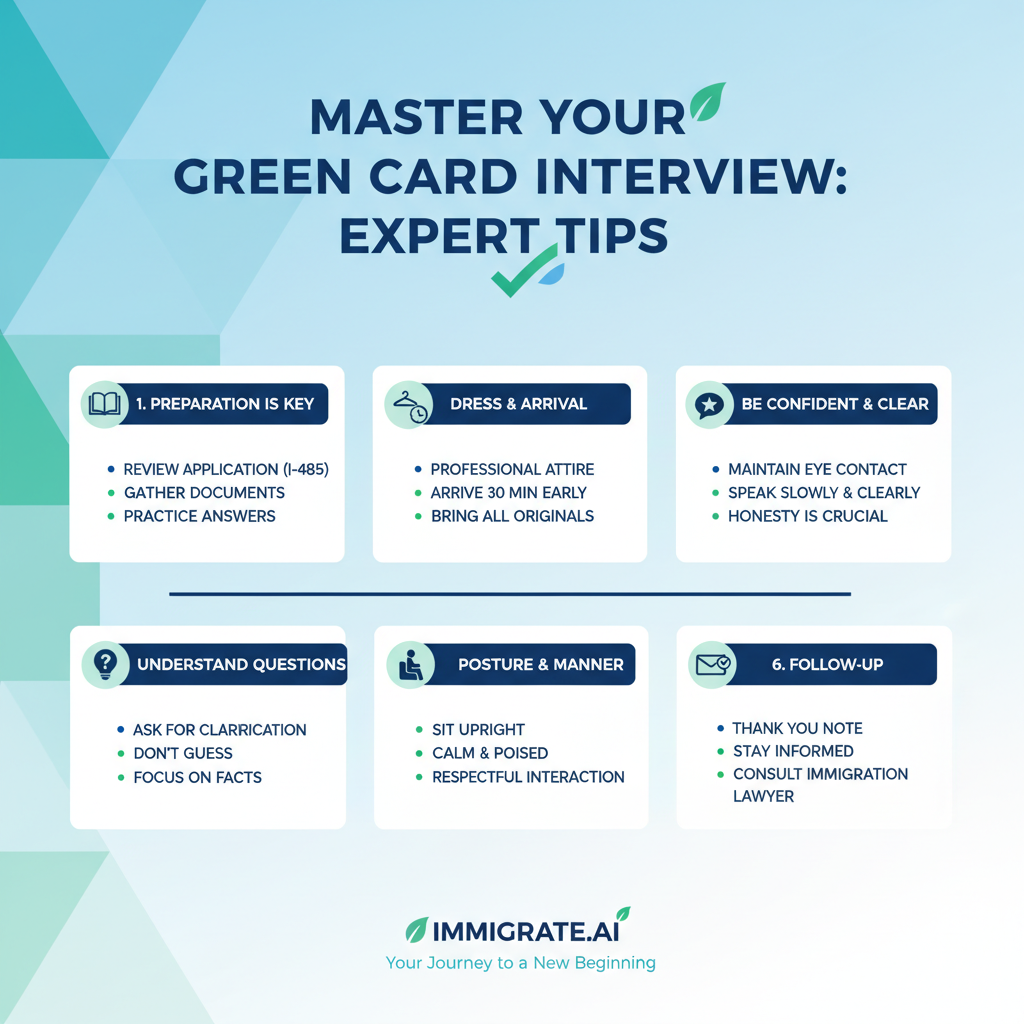
The ongoing conversation surrounding immigration law, particularly the intricate processes involved in securing a Green Card, consistently highlights the importance of being fully prepared for every stage. While specific news headlines about Green Card interviews may fluctuate, the fundamental need for applicants to understand and prepare for this critical step remains a constant focus within the immigration community. This evergreen topic is continuously discussed across legal forums, news outlets, and government advisories, emphasizing that thorough preparation is key to a successful outcome.
Green Card Interview Preparation Tips (Immigration Law)
What This News Means for Immigrants in Orlando and Across Florida
While the concept of a Green Card interview is not "new" in the traditional sense, its ongoing relevance in immigration discussions underscores a crucial point: preparation is paramount. For immigrants navigating the complex U.S. immigration system, especially those seeking permanent residency, understanding and mastering the interview stage is a timeless and critical skill.
Why this news is showing up now
The emphasis on Green Card interview preparation is a perpetual topic in immigration law. Each year, thousands of individuals apply for Green Cards, and a significant portion of these applications culminates in an interview with a USCIS officer. As immigration policies and processing times evolve, the importance of presenting a clear, consistent, and well-documented case at the interview remains a constant. Legal experts, immigration advocates, and government agencies consistently reiterate the necessity of thorough preparation to avoid delays, requests for evidence (RFEs), or even denials. The "news" here isn't a new policy, but rather the enduring and critical advice that applicants must be meticulously ready for this pivotal moment in their immigration journey. Furthermore, with an ever-increasing backlog in immigration cases, ensuring your interview goes smoothly helps to prevent further unnecessary delays.
How it can affect Florida residents
For individuals residing in Florida, particularly those in Central Florida and the Orlando metropolitan area, the Green Card interview process is a tangible reality. The Orlando USCIS Field Office (located at 5449 Forbes Pl, Orlando, FL 32812) serves a vast population, and interviews are a daily occurrence. What this means for Florida residents is that local preparation is key. Understanding the nuances of the local field office, typical interview procedures, and the specific documents required for your case can significantly impact your outcome. Whether you're seeking an Adjustment of Status within the U.S. or undergoing Consular Processing abroad with eventual entry through a Florida port of entry, the interview is a universal hurdle. Florida's diverse population means many families are pursuing Green Cards through various avenues, including family-based petitions, employment-based petitions, and asylum adjustments. The advice in this guide is directly applicable to those living and working along the I-4 corridor and throughout the Sunshine State, helping them navigate the process with confidence and clarity.
What Green Card Interviews Are (and Why They Matter)
The Green Card interview is a critical step in the process of becoming a Lawful Permanent Resident (LPR) of the United States. It's an opportunity for a USCIS officer to personally meet with you (and your petitioning relative, if applicable) to verify the information in your application, assess your eligibility, and ensure you meet all legal requirements for permanent residency.
A plain-English definition
Simply put, a Green Card interview is a formal meeting with an immigration officer. During this meeting, the officer will review your application forms and supporting documents, ask you questions about your personal history, your relationship (if applying through a spouse or family member), your reasons for wanting to live permanently in the U.S., and your admissibility to the country. It's a chance for the government to ensure that you genuinely qualify for a Green Card and that your application is truthful and complete. The outcome of this interview often determines whether your Green Card application is approved or denied.
Key terms you need to know
- Green Card (Form I-551): The identification card issued to lawful permanent residents of the United States. It signifies your authorized right to live and work permanently in the U.S.
- Adjustment of Status (AOS): The process of applying for a Green Card while physically present in the United States. This is typically done by filing Form I-485, Application to Register Permanent Residence or Adjust Status.
- Consular Processing: The process of applying for an immigrant visa through a U.S. embassy or consulate abroad. Once approved, the applicant enters the U.S. as a permanent resident.
- USCIS (U.S. Citizenship and Immigration Services): The government agency responsible for administering immigration and naturalization benefits.
- USCIS Officer / Immigration Officer: The official who conducts your Green Card interview and makes a recommendation on your case.
- Petitioner: The U.S. citizen or Lawful Permanent Resident who files an immigrant petition (e.g., Form I-130) on behalf of a foreign national.
- Beneficiary: The foreign national who is seeking a Green Card based on a petition filed on their behalf.
- Form I-130, Petition for Alien Relative: The initial form filed by a U.S. citizen or LPR to establish a qualifying relationship with a foreign relative.
- Form I-485, Application to Register Permanent Residence or Adjust Status: The primary application for an Adjustment of Status to a Green Card.
- Affidavit of Support (Form I-864): A legally binding contract signed by a sponsor (usually the petitioner) to accept financial responsibility for the immigrant.
- Notice of Interview (Form I-797C): The official document from USCIS informing you of your interview date, time, and location, along with required documents.
- Priority Date: The date your immigrant petition (e.g., Form I-130) was properly filed. This date determines when an immigrant visa number becomes available for certain visa categories.
- Grounds of Inadmissibility: Legal reasons why a person might be denied entry or a Green Card, such as certain criminal convictions, health issues, or immigration violations.
Overwhelmed by Immigration Terminology? Imigrar breaks down complex legal jargon into understandable advice. For assistance with your Green Card application and interview, contact our Orlando office at +1 786-791-3106 for a free consultation. Se Habla Español.
Current Immigration Law: The Foundation for Your Green Card Interview
Your Green Card interview is conducted under the authority of the Immigration and Nationality Act (INA), which is the body of law governing immigration to the United States. The USCIS officer's role is to ensure that you meet all statutory requirements for permanent residency and are not subject to any grounds of inadmissibility.
Federal requirements
The core legal framework for Green Card eligibility is established by federal law. Key sections of the INA that are relevant to your interview include:
- INA Section 201 and 203: These sections define who is eligible for immigrant visas, including family-sponsored preferences and employment-based preferences, and establish annual limits for most categories.
- INA Section 204: Governs the filing and approval of immigrant petitions, such as Form I-130, Petition for Alien Relative. The officer will verify the validity of the underlying petition during your interview.
- INA Section 212: Outlines the "grounds of inadmissibility." These are conditions that can make an individual ineligible for a Green Card, even if they otherwise qualify. Common grounds include certain health-related issues, criminal history, security concerns, public charge concerns (relying on government assistance), and previous immigration violations. The officer will assess whether any of these apply to you.
- INA Section 245: Specifically addresses "Adjustment of Status" for individuals already in the U.S. This section outlines the criteria for adjusting from a nonimmigrant status to Lawful Permanent Resident status. You must have been inspected and admitted or paroled into the U.S., be eligible for an immigrant visa, have a visa immediately available, and be admissible to the U.S.
- INA Section 213A: Requires an Affidavit of Support (Form I-864) for most family-based immigrants and some employment-based immigrants, ensuring they will not become a public charge. The officer will verify the sponsor's income and ability to support the applicant.
During the interview, the USCIS officer will refer to these legal provisions to determine your eligibility. They will ask questions designed to confirm the bona fides of your relationship (for family-based petitions), your employment history (for employment-based petitions), and your overall admissibility to the United States.
You will have filed various USCIS forms as part of your application package. These typically include:
- Form I-130, Petition for Alien Relative (filed by the petitioner)
- Form I-485, Application to Register Permanent Residence or Adjust Status (filed by the beneficiary, if adjusting status)
- Form I-864, Affidavit of Support (filed by the financial sponsor)
- Form I-693, Report of Medical Examination and Vaccination Record (completed by a USCIS-approved civil surgeon)
- Form I-765, Application for Employment Authorization (often filed concurrently with Form I-485)
- Form I-131, Application for Travel Document (often filed concurrently with Form I-485)
Understanding the purpose of each form and the information you provided on them is crucial for your interview.
For detailed information on all forms and current requirements, always refer to the USCIS official website.
Florida-specific considerations
While federal law dictates the requirements, the practical application happens at your local USCIS Field Office. For Central Florida residents, this is typically the Orlando USCIS Field Office. While the legal standards are the same nationwide, understanding the local office's procedures and common practices can be beneficial. For example, knowing the parking situation, security protocols, and typical wait times can help reduce stress on the day of your interview. The officers at the Orlando office are highly trained to enforce federal immigration law, and they expect applicants to arrive fully prepared with all requested documents and a clear understanding of their case.
If your case involves a complex history or unique circumstances, such as prior overstays, criminal records, or specific health waivers, it is even more critical to prepare thoroughly and potentially seek legal counsel from an Orlando immigration attorney familiar with local procedures and federal law.
How to Prepare for Your Green Card Interview: A Complete Step-by-Step Guide
A successful Green Card interview hinges on meticulous preparation. Follow these steps to ensure you are ready for your big day.
1) Understand Your Interview Notice (Form I-797C)
Action: Upon receiving your Form I-797C, Notice of Interview, read it carefully and completely. This document is your official invitation and provides crucial details.
- Location: Note the exact address of the USCIS Field Office. For most Central Florida residents, this will be the Orlando USCIS Field Office.
- Date and Time: Mark your calendar immediately. Punctuality is extremely important.
- Required Documents: The notice will list specific original documents and copies you must bring. This list is critical and varies by case type. Do not overlook this section.
- Who Must Attend: It will specify who needs to be present (e.g., the applicant, the petitioner, an attorney, an interpreter).
Reminder: If you cannot attend the interview on the scheduled date, you must notify USCIS immediately and request a reschedule. Rescheduling can significantly delay your case.
2) Gather All Original Documents and Copies
Action: This is arguably the most important step. Organize your documents methodically. You will need to bring both the originals and high-quality photocopies of everything. Create a neatly organized folder or binder.
- Interview Notice (Form I-797C)
- Government-Issued Photo ID: Passport, driver's license, or state ID.
- Birth Certificates: For you, your spouse, and any children (original and certified English translations if applicable).
- Marriage Certificate: If applying based on marriage (original and certified English translation if applicable).
- Divorce Decrees or Death Certificates: For any prior marriages of you or your spouse (original and certified English translations if applicable).
- Medical Examination Report (Form I-693): If not already submitted or if USCIS requested an updated one. This must be in a sealed envelope from the civil surgeon.
- Affidavit of Support (Form I-864) and Supporting Financial Documents:
- Petitioner's most recent federal income tax returns (e.g., Form 1040, W-2s, 1099s).
- Proof of petitioner's current employment and income (e.g., employment letter, recent pay stubs).
- Proof of assets, if needed to meet income requirements.
- Proof of Bona Fide Marriage (for spousal petitions): This is crucial evidence demonstrating your marriage is real and not solely for immigration purposes. Bring as much as possible, including:
- Joint bank accounts statements.
- Joint credit card statements.
- Joint lease agreements or mortgage statements.
- Utility bills in both names.
- Birth certificates of any children you have together.
- Photographs of your wedding, vacations, and daily life together.
- Affidavits from friends and family attesting to your relationship.
- Life insurance policies, health insurance, or wills naming each other as beneficiaries.
- Correspondence (letters, emails, text messages) between you.
- Proof of Legal Entry into the U.S.: Your passport with visa stamp, Form I-94 (Arrival/Departure Record), or other entry documents.
- Previous Immigration Documents: Any approval notices (e.g., for Form I-130, Form I-140), previous visa stamps, employment authorization cards (EADs), or advance parole documents.
- Police Records/Court Dispositions: If you have ever been arrested or charged with a crime, even if charges were dropped or expunged. You must bring certified copies of all related documents.
- Proof of Name Change: If applicable.
- Translation Certificates: Any document not in English must be accompanied by a certified English translation.
Important: Do not submit original documents unless specifically requested by USCIS. Always bring both originals and copies to the interview.
3) Review Your Application Forms (Form I-130, Form I-485, etc.)
Action: Thoroughly review every form you submitted to USCIS. You must be familiar with every answer you provided.
- Understand Your Own Answers: The USCIS officer will refer directly to your submitted forms (Form I-130, Form I-485, Form I-864, etc.) and ask questions based on them. Any inconsistencies between your answers at the interview and your written application can raise red flags.
- Know All Dates and Addresses: Be able to recall exact dates of entry, marriage, employment, and all previous addresses.
- Familiarize Yourself with the Petitioner's Information: If applicable, understand the information provided by your petitioner on Form I-130 and Form I-864.
Tip: Print out a copy of your entire application package and review it multiple times. Highlight key dates, names, and addresses.
4) Prepare for Interview Questions
Action: Anticipate the types of questions you will be asked and practice your answers. The questions will vary depending on your Green Card category, but some are universal.
- General Questions: Your name, date of birth, country of origin, how and when you entered the U.S., current address, employment history, educational background.
- Admissibility Questions: Questions related to criminal history, immigration violations, health issues, involvement in certain organizations, or whether you have ever sought to unlawfully obtain public benefits. Be truthful and concise.
- For Family-Based Petitions (especially marriage-based):
- How and when did you meet your spouse?
- Details about your wedding (date, location, attendees).
- Daily life together (who cooks, who cleans, what you do on weekends).
- Information about your spouse's family and friends.
- Joint financial responsibilities (bank accounts, bills).
- Future plans together.
The officer is looking for genuine signs of a shared life and commitment.
- For Employment-Based Petitions:
- Your job duties and responsibilities.
- Your employer's business.
- Your qualifications for the position.
Warning: Always tell the truth. Providing false information or misrepresenting facts can lead to a denial, a finding of fraud, and even future bans from entering the U.S.
5) Arrange for an Interpreter (If Needed)
Action: If you are not fluent in English, you must bring a certified interpreter. USCIS does not provide interpreters for Green Card interviews.
- Qualifications: Your interpreter must be fluent in both English and your native language. They cannot be your attorney, the petitioner, or a witness in your case.
- Preparation: Inform your interpreter about your case in advance. They should understand the legal terminology and the importance of accurate, literal translation.
- Role: The interpreter's role is strictly to translate. They should not offer advice, elaborate on your answers, or answer questions on your behalf.
Reminder: Imigrar's team includes Spanish-speaking professionals (Se Habla Español) who can assist you with understanding the process, though they would serve as your legal representative, not merely an interpreter at the interview itself.
6) Dress Appropriately and Plan Your Travel
Action: Present yourself professionally and ensure you arrive on time.
- Attire: Dress in conservative business or business-casual attire. This shows respect for the process and the officer.
- Travel Logistics: Plan your route to the Orlando USCIS Field Office well in advance. Account for traffic, parking, and security checks. Aim to arrive at least 30-45 minutes before your scheduled interview time.
- Childcare: If possible, arrange for childcare. While children can attend, it's often easier for you to focus without distractions.
Important: Being late can lead to your interview being canceled and significantly delay your case.
7) Know What Happens After the Interview
Action: Understand the possible outcomes and next steps.
- Immediate Decision: In some cases, the officer may tell you at the end of the interview that your Green Card is approved. You might receive a stamp in your passport as temporary proof of LPR status.
- Decision Pending: More commonly, the officer will state that a decision will be mailed to you. This is normal and does not necessarily mean there is a problem.
- Request for Evidence (RFE): If the officer needs more information or documents, they will issue an RFE. You will have a specific deadline to respond.
- Notice of Intent to Deny (NOID): If USCIS intends to deny your application, they will send a NOID, giving you a chance to provide additional evidence or arguments.
- Denial: If your application is denied, you will receive a written explanation. You may have options to appeal or refile, depending on the reason for denial.
Timeline: Processing times vary widely. You can check the USCIS Processing Times website for general estimates, but individual cases can differ.
Don't Risk Delays or Denials. Imigrar provides expert interview preparation, ensuring you're confident and ready. Call our Orlando office at +1 786-791-3106 for a free consultation. Se Habla Español.
Practical Steps You Can Take Today for Interview Success
Beyond the detailed guide, here's an actionable checklist to implement immediately:
- Review Your Entire Application Package: Read through every form, every answer, and every document you submitted. Ensure you remember all dates, addresses, and details.
- Organize Your Documents: Create a physical binder or folder with distinct sections for originals and copies. Use tabs to label categories (e.g., "Personal IDs," "Marriage Proof," "Financial Documents"). This makes it easy to quickly find any document the officer requests.
- Practice Interview Questions: Have a friend or family member role-play the interview with you. Practice answering clearly, concisely, and truthfully. Focus on potential difficult questions related to your background or application.
- Prepare Your "Story": Especially for marriage-based cases, be ready to tell the story of your relationship from meeting to marriage, including significant dates and events. Ensure your spouse (petitioner) can tell a consistent story.
- Confirm Your Medical Exam Status: Ensure your Form I-693 is current and still valid (typically valid for two years from the civil surgeon's signature date). If it's expired or you haven't submitted it, schedule an appointment with a USCIS-approved civil surgeon immediately.
- Check USCIS Processing Times: While not precise, checking the USCIS Processing Times for the Orlando Field Office can give you a general idea of how long decisions are taking after interviews.
- Consult with an Attorney: If you have any concerns about your eligibility, past immigration history, or simply want professional guidance, schedule a consultation with an experienced immigration attorney at Imigrar.
Document preparation guidance
The key to document preparation is organization and completeness. Do not just bring a pile of papers. * **Binder/Folder System:** Use a three-ring binder with dividers. Label each divider clearly (e.g., "Interview Notice," "Passports/IDs," "Birth Certificates," "Marriage Evidence," "Financial Documents," "Medical Exam," "Prior Applications"). * **Originals vs. Copies:** Keep originals in a separate, secure section, and have a corresponding set of copies readily available. The officer will typically review originals and keep the copies. * **Translations:** Any document not in English must be accompanied by a complete and accurate English translation, along with a certification by the translator that they are competent to translate and that the translation is accurate. * **Photographs:** For marriage-based cases, organize photos chronologically, perhaps in a small album or clearly labeled sheets. Include descriptions (dates, locations, people) for context.
Timeline expectations
While every case is unique, here's a general timeline for the interview stage:
- Interview Notice (Form I-797C): Typically received several weeks to a few months before your scheduled interview date.
- Interview Day: The interview itself can last anywhere from 15 minutes to over an hour, depending on the complexity of your case.
- Decision After Interview:
- Immediate Approval: Possible but not common. You might receive a temporary stamp in your passport.
- Decision by Mail: Most common. You will typically receive a written decision (approval or RFE/NOID/denial) within a few weeks to several months after the interview.
- Green Card Production: If approved, your physical Green Card is usually mailed within 2-4 weeks after approval.
Warning: These are general estimates. USCIS processing times can fluctuate significantly based on workload and policy changes. Always monitor your case status online using your receipt number on the USCIS official website.
How Imigrar Helps Immigrants in Orlando Prepare for Their Green Card Interview
At Imigrar, we understand that the Green Card interview can be daunting. Our goal is to empower you with the knowledge, resources, and confidence needed to succeed. Based in Orlando, Florida, we proudly serve clients not only across the state but nationwide, always committed to our mission: "Keep Families Together."
Our experience and expertise
Our team of dedicated immigration attorneys possesses extensive experience in all facets of Green Card applications, including detailed interview preparation. We stay up-to-date on the latest immigration laws, policies, and procedural changes, particularly those relevant to the Orlando USCIS Field Office and federal immigration courts. We have successfully guided countless individuals and families through their interviews, navigating complex cases, and ensuring all legal requirements


