


The journey to becoming a Lawful Permanent Resident (LPR) in the United States is a significant milestone for many immigrants and their families. One of the most crucial steps in this process is the Green Card interview. This interview, conducted by a United States Citizenship and Immigration Services (USCIS) officer, is designed to verify the information provided in your application, confirm your eligibility, and ensure you meet all legal requirements for permanent residency.
At Imigrar, an immigration law firm based in Orlando, Florida, we understand the anxieties and complexities that can surround the Green Card interview. Our mission is to "Keep Families Together" by providing expert legal guidance and support to make this process as smooth and successful as possible. This comprehensive guide will walk you through everything you need to know to prepare for your Green Card interview, offering practical advice, timelines, document checklists, and insights from experienced immigration professionals.
Need Help? Our Orlando immigration team is ready to assist. Call +1 786-791-3106 for a free consultation, or message us online. Se Habla Español.
The reporting that sparked this guide: Green Card Interview Preparation Tips (Immigration Law)
What This News Means for Immigrants in Orlando and Across Florida
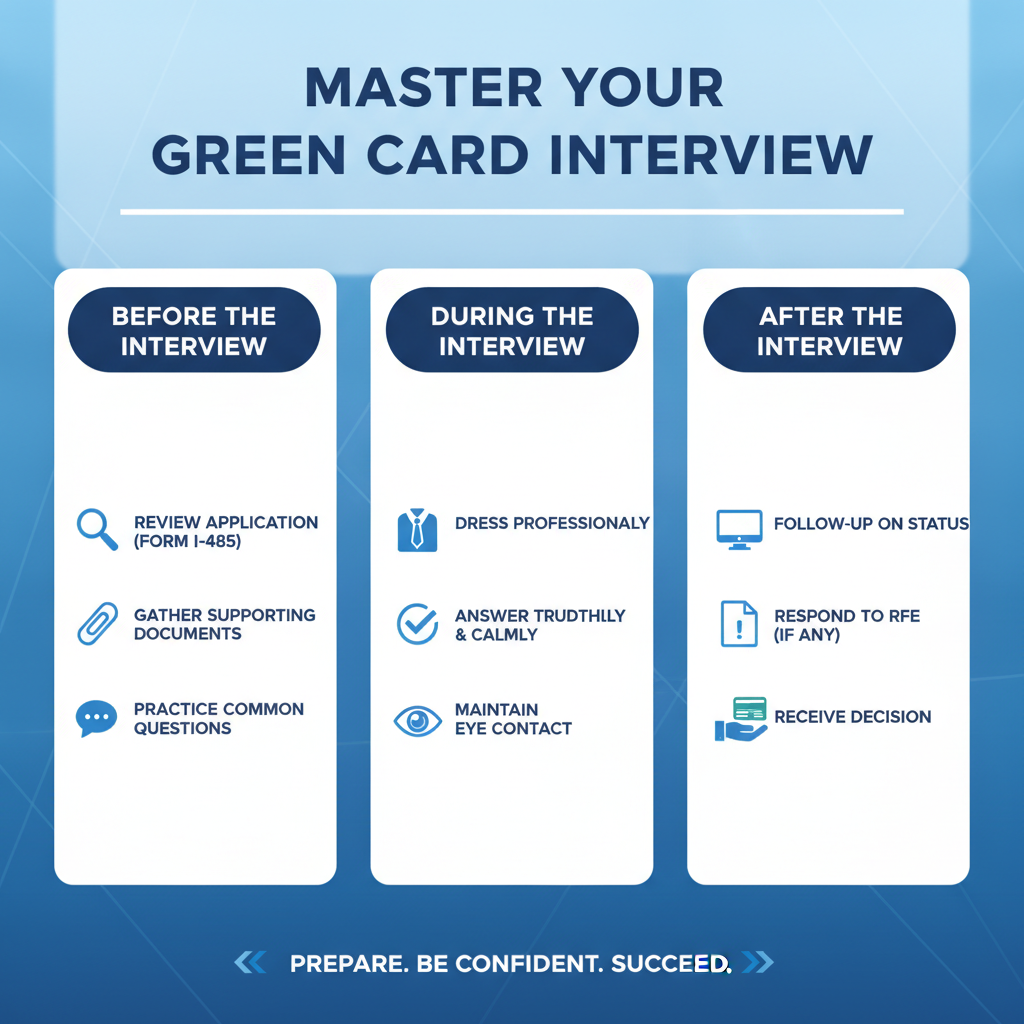
Why this news is showing up now
The topic of Green Card interview preparation is not new, but its consistent appearance in immigration news sources highlights its enduring importance and the continuous need for immigrants to be thoroughly prepared. USCIS procedures and policies can evolve, and the level of scrutiny in interviews can shift based on current immigration priorities. As of 2026, there's an ongoing emphasis on verifying the legitimacy of relationships for family-based petitions and ensuring applicants do not pose a public charge risk, even with the recent changes to the public charge rule. Furthermore, processing backlogs and increased demand mean that when an interview is finally scheduled, it's critical to make the most of that opportunity to avoid further delays or potential denials. This sustained focus underscores that meticulous preparation is not just advisable; it's essential for success in today's immigration landscape.
How it can affect Florida residents
Florida is a vibrant and diverse state, home to a large immigrant population, particularly in areas like Orlando, Miami, and Tampa. For Central Florida residents, the **Orlando USCIS Field Office** is the primary location for most Green Card interviews conducted through the **Adjustment of Status (AOS)** process. The advice and requirements discussed in this guide are directly applicable to individuals living in Orange County, along the I-4 corridor, and throughout Florida.
The sheer volume of immigration applications in Florida means that USCIS field offices in the state are often busy. Proper preparation can help your case stand out and avoid unnecessary complications that could lead to delays in an already backlogged system. Florida's diverse communities, including significant Spanish-speaking populations, also mean that issues like language proficiency during interviews are particularly relevant. Imigrar, with its Orlando base and "Se Habla Español" services, is acutely aware of these local nuances and is dedicated to guiding Florida residents through their Green Card interview with confidence.
What the Green Card Interview Is (and Why It Matters)
The Green Card interview is a mandatory step for most individuals seeking lawful permanent residency in the United States, whether through **Adjustment of Status (AOS)** within the U.S. or through **Consular Processing** at a U.S. embassy or consulate abroad. It serves as a final verification stage where a USCIS officer (for AOS) or a Consular Officer (for consular processing) reviews your application, supporting documents, and personal testimony to determine your eligibility for a Green Card.
A plain-English definition
Simply put, the Green Card interview is your chance to meet face-to-face with an immigration officer who will ask you questions about your application. They want to confirm that all the information you provided in your forms is true, that your relationship (if it's a family-based petition) is genuine, and that you meet all the legal requirements to live permanently in the U.S. Think of it as a final check to ensure everything is in order before they make a decision on your Green Card application.
Key terms you need to know
- Green Card: The common name for the identification card issued to **Lawful Permanent Residents (LPRs)** of the United States. It signifies your authorized right to live and work permanently in the U.S.
- Lawful Permanent Resident (LPR): An individual who has been granted the privilege of permanently residing in the United States.
- Adjustment of Status (AOS): The process of applying for lawful permanent resident status (a Green Card) while physically present in the United States.
- Consular Processing: The process of applying for an immigrant visa (Green Card) through a U.S. embassy or consulate in your home country.
- USCIS (U.S. Citizenship and Immigration Services): The federal agency that oversees lawful immigration to the United States. They conduct interviews for AOS cases.
- Department of State (DOS): The federal department responsible for U.S. foreign policy, which oversees U.S. embassies and consulates abroad, where consular processing interviews are held.
- Sponsor (Petitioner): The U.S. citizen or LPR who files an immigrant petition (e.g., **Form I-130**) on behalf of an eligible relative.
- Beneficiary (Applicant): The foreign national who is seeking a Green Card based on a petition filed on their behalf.
- Affidavit of Support (Form I-864): A legally binding document signed by the petitioner/sponsor to accept financial responsibility for the immigrant.
- Form I-130, Petition for Alien Relative: The initial form filed by a U.S. citizen or LPR to establish a qualifying family relationship with an eligible immigrant.
- Form I-485, Application to Register Permanent Residence or Adjust Status: The primary form filed by an immigrant to apply for a Green Card while in the U.S.
The Green Card interview matters immensely because it is often the final hurdle in a long and complex immigration process. A successful interview leads to permanent residency, allowing families to stay together, work freely, and build a stable life in the U.S. Conversely, a poorly prepared interview can lead to delays, requests for additional evidence, or even a denial of the application, potentially forcing difficult decisions or appeals.
Current Immigration Law: The Foundation for Your Green Card Interview
The Green Card interview process is governed by the intricate framework of U.S. immigration law, primarily the **Immigration and Nationality Act (INA)**. Understanding the legal basis for your application is crucial for successful preparation.
Federal requirements
The core eligibility requirements for a Green Card are outlined in various sections of the INA. For most family-based **Adjustment of Status** cases, the key provisions are:
- INA Section 245(a): This section allows certain foreign nationals who are physically present in the United States to adjust their status to that of a lawful permanent resident if an immigrant visa is immediately available to them, and they are otherwise admissible.
- INA Section 201: Defines immediate relatives (spouses of U.S. citizens, unmarried children under 21 of U.S. citizens, and parents of U.S. citizens who are at least 21 years old), who do not have to wait for a visa number to become available.
- INA Section 203: Establishes the preference categories for family-sponsored and employment-sponsored immigrants, who are subject to visa availability limits.
A critical aspect of the interview is determining admissibility. **INA Section 212(a)** lists various grounds of inadmissibility, which can prevent an applicant from receiving a Green Card. These grounds include:
- Health-related grounds: Certain communicable diseases, failure to get required vaccinations.
- Criminal grounds: Convictions for certain crimes, drug trafficking, moral turpitude.
- Security-related grounds: Terrorism, espionage, or activities deemed a threat to U.S. security.
- Public charge grounds: The likelihood of an individual becoming primarily dependent on the government for subsistence. While the 2019 Public Charge Rule was largely rescinded, applicants must still demonstrate they are not likely to become a public charge under the historical interpretation of the rule.
- Illegal entry and prior immigration violations: Unlawful presence, misrepresentation, previous deportations.
To demonstrate eligibility and admissibility, applicants typically file several forms with USCIS. The most common forms involved in the Green Card process include:
- Form I-130, Petition for Alien Relative: Filed by a U.S. citizen or LPR to establish the qualifying family relationship.
- Form I-485, Application to Register Permanent Residence or Adjust Status: The primary application for the Green Card itself.
- Form I-864, Affidavit of Support: A legally binding contract where the sponsor promises to financially support the applicant, preventing them from becoming a public charge.
- Form I-693, Report of Medical Examination and Vaccination Record: Completed by a USCIS-approved civil surgeon to ensure the applicant meets health-related admissibility requirements.
For detailed information on these forms and the laws governing immigration, always refer to the USCIS official website.
Florida-specific considerations
While immigration law is federal, applying uniformly across the United States, there are practical considerations for Florida residents. All Green Card interviews for **Adjustment of Status** applicants in Central Florida, including Orlando, generally take place at the **Orlando USCIS Field Office**. This office handles a high volume of cases, and understanding its specific procedures for scheduling and document submission can be beneficial.
Florida does not have its own state-specific immigration laws that directly impact federal Green Card eligibility or the interview process. However, local resources, community support networks, and access to legal services like Imigrar are vital. For instance, knowing the local civil surgeons approved by USCIS for **Form I-693** is a practical tip for residents of Orange County and surrounding areas. Our firm, based in Orlando, is intimately familiar with the local USCIS office's operations and can provide tailored advice based on regional practices.
Feeling overwhelmed by the legal requirements? Let Imigrar guide you. Our experienced Orlando immigration attorneys simplify the process. Call +1 786-791-3106 for a free consultation. Se Habla Español.

How to Prepare for Your Green Card Interview: A Complete Step-by-Step Guide
Thorough preparation is the single most important factor for a successful Green Card interview. Here’s a comprehensive, step-by-step guide to help you navigate this critical stage.
1) Understand Your Case Type and Interview Purpose
Before you even begin gathering documents, take time to understand the specifics of your Green Card application. Are you applying based on marriage to a U.S. citizen, through a parent, or an employment petition? Each case type has unique aspects that an officer will scrutinize. For instance, marriage-based interviews (often the most common for AOS) focus heavily on verifying the "bona fides" (genuineness) of your marriage. The purpose of the interview is always to verify the information you submitted, assess your eligibility, and ensure you are not inadmissible to the U.S.
- Required Documents for this step (for review):
- Your original **Form I-797C, Notice of Action** (Interview Appointment Notice).
- Copies of all previously submitted forms: **Form I-130**, **Form I-485**, **Form I-864**, **Form I-765** (EAD), **Form I-131** (Advance Parole), and any **Request for Evidence (RFE)** responses.
2) Gather and Organize All Original Documents (and Copies!)
This is arguably the most labor-intensive, yet crucial, step. You must bring all original documents related to your application, plus a complete set of photocopies. USCIS officers will review the originals and may keep the copies. Organize everything in a logical manner (e.g., by application form, or by document type) in a binder or clearly labeled folders. Use tabs for easy navigation.
- Essential Documents to Bring (Originals and Copies):
- Interview Appointment Notice (Form I-797C).
- Valid Passport(s) and National Identity Card(s).
- Birth Certificate (applicant and petitioner).
- Marriage Certificate (if applicable).
- Divorce Decrees or Death Certificates for all prior marriages (applicant and petitioner).
- Previous U.S. Visas and Entry Stamps.
- Most recent **Form I-94** (Arrival/Departure Record).
- Employment Authorization Document (EAD) and Advance Parole (AP) document (if you have them).
- Driver's License or State ID.
- **Form I-693, Report of Medical Examination and Vaccination Record** (in a sealed envelope, if not already submitted).
- Police Clearance Certificates from all countries you have lived in for 6+ months since age 16 (if applicable, especially for consular processing).
- Evidence of financial support:
- **Form I-864, Affidavit of Support** (original, signed by sponsor).
- Sponsor's federal income tax returns (most recent 3 years) with W-2s or 1099s.
- Sponsor's pay stubs, employment verification letter, bank statements.
- For Marriage-Based Petitions (Evidence of Bona Fide Marriage):
- Joint bank account statements.
- Joint credit card statements.
- Joint lease agreements or mortgage statements.
- Joint utility bills (electricity, water, internet).
- Joint car titles/registrations.
- Joint health, life, and auto insurance policies.
- Birth certificates of any children born to the marriage.
- Photos together (dating, engagement, wedding, family events, travel).
- Affidavits from friends and family attesting to the marriage's authenticity.
- Travel itineraries or tickets from joint trips.
- Communication records (emails, texts, call logs - use sparingly and only if truly illustrative).
- Any other documents proving commingling of finances, shared responsibilities, and a shared life.
- Any other documents specifically requested by USCIS in an RFE or interview notice.
3) Review Your Filed Application Forms Thoroughly
You must be intimately familiar with every answer you provided on **Form I-130**, **Form I-485**, and **Form I-864**. Go through each form line by line. The interviewing officer will compare your verbal answers to the information on these forms. Any inconsistencies, even minor ones, can raise red flags and lead to further questioning or delays. Pay close attention to dates (birth dates, marriage dates, entry dates, employment dates), addresses, and responses to questions about criminal history, immigration violations, and organizational memberships.
Warning: Never guess an answer. If you genuinely don't remember a specific date or detail, it's better to politely state that you don't recall than to provide incorrect information. Honesty is paramount.
4) Practice Answering Potential Interview Questions
Anticipate the types of questions you might be asked. While the specific questions vary, officers generally cover common ground. For marriage-based cases, expect detailed questions about your relationship, such as:
- How and when did you meet?
- What was your first date like?
- When did you realize you were in love?
- Who proposed? How and where?
- What are your spouse's parents' names? Siblings?
- Describe your daily routine together.
- Who handles household chores? Who pays which bills?
- What did you do last weekend?
- What gifts have you exchanged?
- Do you have pets? What are their names?
General questions for all applicants may include:
- Why do you want a Green Card?
- Have you ever been arrested, cited, or detained?
- Have you ever been deported or removed from the U.S.?
- Have you ever claimed to be a U.S. citizen?
- Have you ever participated in any organizations, associations, or groups?
- What are your current and past addresses and employers?
- What is your highest level of education?
Practice with your spouse, a friend, or your attorney. The goal isn't to memorize answers but to be comfortable speaking about your case truthfully and confidently.
5) Attend Your Medical Examination (Form I-693)
The medical examination is a mandatory part of the Green Card process. It must be performed by a USCIS-approved civil surgeon. Schedule this well in advance of your interview, but not too early, as the validity period of **Form I-693** is typically two years from the civil surgeon's signature date (always check current USCIS policy). The civil surgeon will conduct a physical examination, review your vaccination records, and test for certain communicable diseases. They will then seal the completed **Form I-693** in an envelope, which you must bring unopened to your interview (unless you submitted it with your initial application).
- Required Documents for the Medical Exam:
- Valid photo identification (e.g., passport, driver's license).
- Vaccination records (e.g., MMR, Polio, Tdap, Varicella, Flu).
- List of


