


The journey to obtaining a Green Card, or lawful permanent residency, in the United States is a significant milestone for many immigrants and their families. For a vast number of applicants, this journey culminates in a crucial step: the Green Card interview. This interview, conducted by a U.S. Citizenship and Immigration Services (USCIS) officer, is designed to verify the information provided in your application, confirm your eligibility, and ensure you meet all legal requirements for permanent residency.
Understanding what to expect, how to prepare, and what to bring to this interview is paramount to a successful outcome. At Imigrar, an immigration law firm based in Orlando, Florida, we understand the anxieties and hopes tied to this process. Our mission is to "Keep Families Together," and a well-prepared Green Card interview is a vital part of achieving that goal.
This comprehensive guide, informed by the latest immigration news and our extensive experience, will walk you through everything you need to know to approach your Green Card interview with confidence, whether you're in Orlando, across Florida, or anywhere nationwide.
The reporting that sparked this guide:
The ongoing discussions and detailed advice found in various legal publications, including insights from Green Card Interview Preparation Tips (Immigration Law), consistently highlight the critical nature of the Green Card interview. These reports frequently emphasize the need for thorough preparation, accurate documentation, and a clear understanding of the process to avoid common pitfalls and ensure a smooth path to permanent residency. Our guide synthesizes this vital information with our practical expertise to offer you the most actionable advice.
What This News Means for Immigrants in Orlando and Across Florida
The focus on Green Card interview preparation is not just a general immigration topic; it has direct and significant implications for individuals and families residing in Florida, particularly in bustling immigration hubs like Orlando.
Why this news is showing up now
The emphasis on Green Card interview preparation is a perpetual concern within immigration law, but it frequently gains renewed attention for several reasons. Firstly, USCIS continually refines its interview procedures and focuses on specific areas of scrutiny, such as bona fide marriages or employment qualifications, requiring applicants to stay updated. Secondly, as processing times fluctuate, and the volume of applications changes, there's always a fresh wave of individuals approaching their interview dates, seeking current and reliable guidance. Finally, with the dynamic nature of immigration policy, ensuring applicants are thoroughly prepared is more critical than ever to navigate any potential shifts in interpretation or focus from immigration officers. The legal landscape is always evolving, making timely and accurate preparation tips invaluable.
How it can affect Florida residents
For individuals living in Florida, especially Central Florida, understanding the nuances of Green Card interview preparation is particularly relevant. Florida is home to a diverse immigrant population, with a significant number of family-based petitions and employment-based applications being processed annually. If your case is in Orlando, your interview will likely be scheduled at the Orlando USCIS Field Office. This office, like others across the country, has specific local procedures and a particular pace of operations. Being well-prepared means you can navigate the local office environment more effectively and respond to questions tailored to your application type with greater confidence. For Central Florida residents, proximity to the Orlando office means direct interaction, making personalized preparation even more critical. Delays or denials due to inadequate preparation can have profound impacts, disrupting family unity and career plans. Furthermore, for those along the I-4 corridor or in surrounding Orange County, understanding the local context of processing times and potential officer approaches can provide a strategic advantage.
Need Help? Our Orlando immigration team is ready to assist. Call +1 786-791-3106 for a free consultation, or message us online. Se Habla Español.
What Green Card Interviews Are (and Why They Matter)
The Green Card interview is arguably the most crucial step in the process of becoming a Lawful Permanent Resident (LPR) in the United States. It's your opportunity to directly present your case, answer questions, and clarify any ambiguities in your application to a USCIS officer.
A plain-English definition
Simply put, a Green Card interview is a formal meeting with an immigration officer who reviews your application for permanent residency. During this meeting, the officer will ask you questions about the information you provided in your forms, examine your original documents, and assess your eligibility for a Green Card. The primary goal is for USCIS to confirm that you meet all legal requirements and are not inadmissible to the U.S. It's a verification step, ensuring that the details in your submitted paperwork accurately reflect your situation and that your claim for a Green Card is legitimate.
Key terms you need to know
- Green Card: Formally known as a Permanent Resident Card, it is an identification document that proves you are a lawful permanent resident of the United States.
- Lawful Permanent Resident (LPR): An individual who has been granted the privilege of residing permanently in the United States.
- USCIS: U.S. Citizenship and Immigration Services, the federal agency responsible for administering the country's naturalization and immigration system.
- Adjustment of Status (AOS): The process of applying for lawful permanent resident status (a Green Card) while physically present in the United States. This is the pathway that typically involves a USCIS interview within the U.S.
- Consular Processing: The process of applying for an immigrant visa at a U.S. embassy or consulate abroad. This is for individuals outside the U.S. and also involves an interview, but at a consulate, not a USCIS field office.
- Petitioner: The U.S. citizen or lawful permanent resident who files an immigration petition (e.g., Form I-130) on behalf of a relative.
- Beneficiary: The foreign national seeking immigration benefits, such as a Green Card, through a petition filed by a petitioner.
- Affidavit of Support (Form I-864): A legally binding document signed by a petitioner (sponsor) to accept financial responsibility for the immigrant.
- Inadmissibility: Grounds under immigration law that can prevent an individual from entering the U.S. or adjusting status (e.g., certain criminal convictions, health issues, prior immigration violations).
- Priority Date: The date USCIS receives your immigrant visa petition (e.g., Form I-130). It establishes your place in line for a visa, especially for categories with annual quotas.
Current Immigration Law: The Foundation
The Green Card interview process is deeply rooted in U.S. immigration law, primarily governed by the Immigration and Nationality Act (INA). Understanding the legal framework helps applicants grasp the purpose and scope of the interview.
Federal requirements
The authority for granting lawful permanent residency stems from various sections of the INA. For family-based immigration, which accounts for a large percentage of Green Card interviews, key provisions include:
- INA Section 201 (8 U.S.C. § 1151): Defines the worldwide level of immigrant visas.
- INA Section 203 (8 U.S.C. § 1153): Establishes preference categories for family-sponsored and employment-based immigrants.
- INA Section 204 (8 U.S.C. § 1154): Outlines the procedures for petitioning for immigrant status.
- INA Section 245 (8 U.S.C. § 1255): Governs the Adjustment of Status process for those applying from within the U.S. This section details eligibility criteria, such as having been inspected and admitted or paroled, and not being inadmissible.
Eligibility for a Green Card interview typically follows the filing and approval of an underlying petition, such as Form I-130, Petition for Alien Relative, or Form I-140, Immigrant Petition for Alien Worker. Following the petition approval, the applicant then files Form I-485, Application to Register Permanent Residence or Adjust Status (for those in the U.S.), or proceeds with Consular Processing (for those abroad).
The interview serves to ensure that the applicant meets all statutory requirements for the specific visa category they are applying under, and critically, that they are not subject to any grounds of inadmissibility under INA Section 212 (8 U.S.C. § 1182). These grounds can include health-related issues, criminal history, security concerns, public charge considerations (requiring the Affidavit of Support via Form I-864), and prior immigration violations.
For more detailed information on immigration laws and regulations, always refer to the USCIS official website.
Florida-specific considerations
While immigration law is federal, meaning the core requirements are the same nationwide, the practical application can vary slightly depending on the local USCIS Field Office. Florida does not have its own state-specific immigration laws that impact Green Card eligibility or the interview process. However, the Orlando USCIS Field Office (and others in Florida like Miami, Tampa, and Jacksonville) will have its own scheduling patterns, officer workloads, and perhaps slight differences in how efficiently they process cases. For example, local offices may prioritize certain types of interviews or have varying wait times for interview scheduling or case decisions. It's also worth noting that officers in specific regions may become more familiar with certain types of cases prevalent in that area.
Reminder: No matter where you are in Florida, the federal requirements remain the same. The key is to be prepared for the federal standards, regardless of the local office processing your case.
Need Help? Our Orlando immigration team is ready to assist. Call +1 786-791-3106 for a free consultation, or message us online. Se Habla Español.
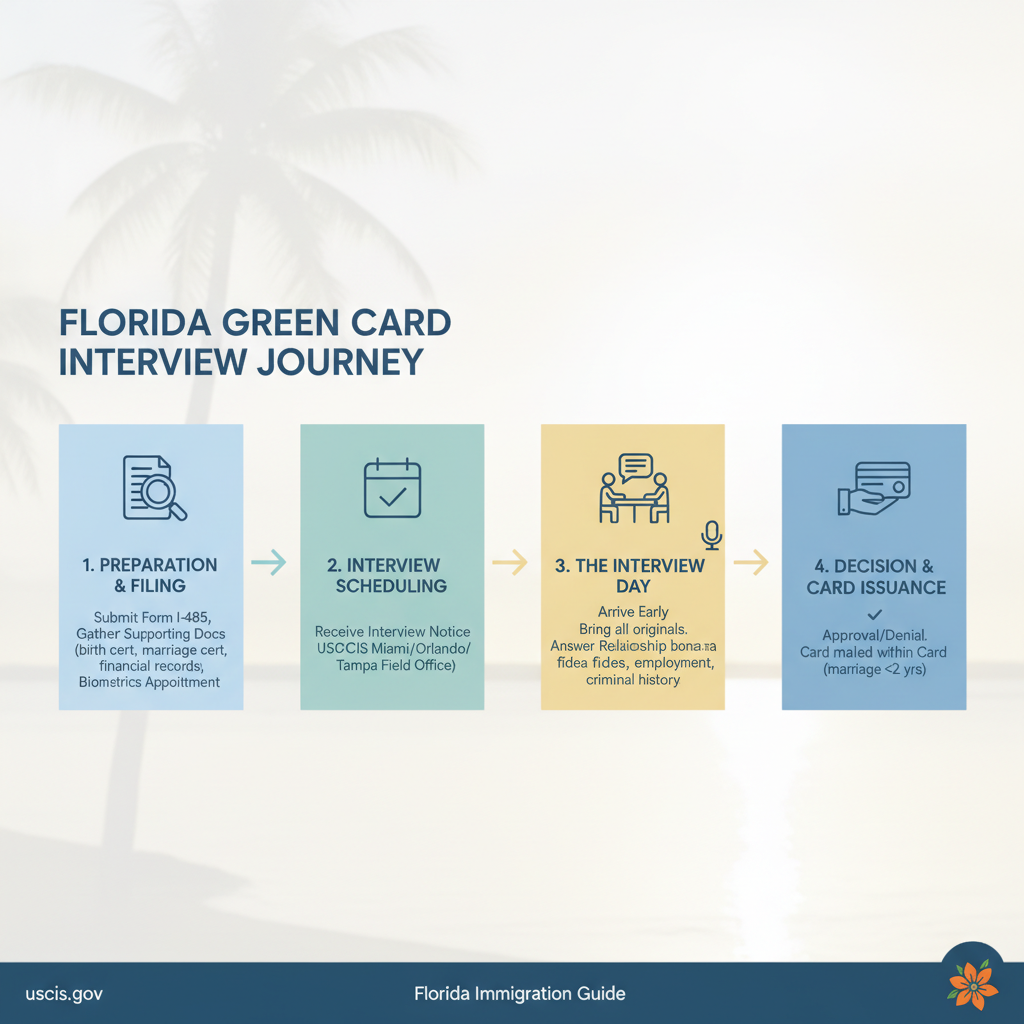
How to Prepare for Your Green Card Interview: A Complete Step-by-Step Guide
Preparation is the cornerstone of a successful Green Card interview. This detailed guide breaks down the process into actionable steps to ensure you are ready for every aspect of your meeting with USCIS.
1) Understand Your Case & Review Your Application
Before anything else, you must have a deep understanding of your own application. This means reviewing every form you submitted, every answer you gave, and every piece of evidence you provided.
- Thoroughly Review All Submitted Forms: Go through your entire application package, including Form I-130, Form I-485, Form I-864, and any supporting documents. Pay close attention to dates, addresses, employment history, and any "Yes/No" questions.
- Important: Ensure you remember all the details, especially any that might seem minor but could be questioned.
- Know Your Story: Be prepared to articulate your immigration journey clearly and consistently with your application. For family-based petitions, especially marriage-based ones, this includes how you met, your relationship timeline, and shared life experiences.
- Identify Potential Red Flags: Think about any areas in your application that might raise questions. This could be discrepancies, previous immigration issues, criminal history (even minor ones), or gaps in employment. Prepare honest and clear explanations for these.
2) Gather & Organize All Required Documents
This is perhaps the most critical logistical step. You must bring all original documents that you submitted copies of, plus any additional documents requested in your interview notice or that have become available since you filed.
- The Interview Notice: This is your official invitation. Bring it!
- All Passports and Travel Documents: Current and expired passports, I-94 arrival/departure records, visas, and any other travel documents.
- Original Birth Certificates: For both the applicant, petitioner, and any dependent children.
- Original Marriage Certificate (if applicable): If applying based on marriage.
- Original Divorce Decrees or Death Certificates (if applicable): For all prior marriages of both applicant and petitioner.
- Financial Documents (Form I-864 & Supporting Evidence):
- Original Form I-864, Affidavit of Support, signed by the petitioner/sponsor.
- Federal income tax returns (IRS transcripts or tax forms like Form 1040) for the most recent three years for the sponsor.
- Proof of income (pay stubs, employment verification letter, W-2s).
- Proof of assets (bank statements, property deeds) if income is insufficient.
- Medical Examination Report (Form I-693): If you haven't already submitted it, bring the sealed envelope from the civil surgeon. Ensure it's not expired (valid for 2 years from civil surgeon's signature).
- Police Certificates/Criminal Records (if applicable): For any arrests or convictions, even if expunged.
- Evidence of Bona Fide Marriage (for marriage-based Green Cards): This is crucial. Bring as much as possible, even if you submitted copies.
- Joint bank accounts (statements, joint credit cards).
- Joint leases or mortgage statements.
- Utility bills in both names.
- Life insurance policies, wills, or retirement accounts listing spouse as beneficiary.
- Birth certificates of children born to the marriage.
- Photos of you together over time (wedding, vacations, holidays with family/friends).
- Affidavits from friends/family attesting to the marriage.
- Joint tax returns.
- Employment-Based Documents (if applicable):
- Original job offer letter, employment verification letter.
- Educational degrees, transcripts, professional licenses.
- Letters from previous employers.
- Translated Documents: Any document not in English must be accompanied by a certified English translation.
- Copies: Bring a complete set of copies of all documents, even if you have the originals. This can speed up the process if the officer needs to retain a copy.
Important: Organize your documents in a clear, logical manner (e.g., in a binder with tabs) for easy access during the interview. Do not staple documents together unless they were originally stapled.
3) Practice Answering Questions
Knowing what questions to expect can significantly reduce stress and help you provide clear, concise answers.
- Common Questions:
- Questions about your biographical information (name, date of birth, place of birth).
- Questions about how you entered the U.S. and your immigration history.
- For marriage-based cases: How you met, when you decided to marry, details about your wedding, daily life together, future plans.
- Questions about your employment history and education.
- Questions from the "Yes/No" sections of Form I-485 (e.g., criminal history, involvement in certain organizations, past immigration violations). Understand why you answered "Yes" or "No" to each.
- Questions about the petitioner (for family-based cases) – their background, employment, finances.
- Mock Interview: Practice with a friend, family member, or ideally, your immigration attorney. This helps you articulate your answers clearly and identify areas where you might hesitate or provide inconsistent information.
- Be Truthful: Always tell the truth. Inconsistent answers or attempts to mislead an officer can lead to serious consequences, including denial and accusations of misrepresentation.
4) Dress Appropriately & Arrive Early
Your appearance and punctuality can set a positive tone for the interview.
- Dress Code: Dress in clean, neat, and comfortable business casual attire. This demonstrates respect for the process and the officer. Avoid overly casual clothing.
- Arrive Early: Plan to arrive at the USCIS office at least 30-45 minutes before your scheduled interview time. This allows for security checks, finding parking (which can be challenging in Orlando), and settling in without rushing. Being late can lead to rescheduling or even denial.
- Plan Transportation: Especially for Central Florida residents, consider traffic patterns along the I-4 corridor if traveling to the Orlando USCIS Field Office. Have a backup plan for transportation.
5) During the Interview: Be Honest & Respectful
The interview itself is a formal, yet often conversational, process.
- Listen Carefully: Pay close attention to each question asked. If you don't understand a question, politely ask the officer to repeat or rephrase it.
- Answer Truthfully and Concisely: Provide direct answers to the questions. Avoid volunteering unnecessary information unless asked. If a simple "Yes" or "No" suffices, give it, then elaborate if prompted.
- Maintain Eye Contact: This shows confidence and honesty.
- Be Respectful: Address the officer respectfully. Avoid arguing or becoming defensive.
- Bring an Interpreter (if needed): If you are not fluent in English, you have the right to bring a certified interpreter. If you use one, ensure they are professional and only translate, not interject their own opinions.
- Your Attorney Can Be Present: If you have retained an immigration attorney, they can accompany you to the interview. They can clarify legal points and ensure your rights are protected, though they typically won't answer questions for you.
- Remain Calm: It's natural to be nervous, but try to remain calm and composed.
6) Post-Interview Follow-Up
The interview doesn't always end with an immediate decision.
- Request for Evidence (RFE): The officer might issue an RFE if they need additional documents or information. Respond promptly and thoroughly by the deadline given.
- Notice of Intent to Deny (NOID): In some cases, USCIS might issue a NOID, explaining why they intend to deny your application and giving you an opportunity to respond. This is a critical juncture where legal counsel is highly advisable.
- Decision Notification: USCIS will mail you a written decision. This can take anywhere from a few days to several months. You can check your case status online using your receipt number on the USCIS Case Status website.
- Green Card Delivery: If approved, your Green Card will be mailed to you within a few weeks.
7) Seek Legal Counsel (if applicable)
While not every case requires an attorney, having an experienced legal professional by your side can be invaluable.
- Pre-Interview Consultation: An attorney can review your application, identify potential issues, and conduct a mock interview.
- Representation at Interview: An attorney can accompany you to the interview, providing peace of mind and ensuring your rights are protected.
- Post-Interview Support: If an RFE or NOID is issued, an attorney can help you formulate a strong response.
- Complex Cases: If you have a complex immigration history, prior denials, or criminal records, legal representation is highly recommended.
Warning: Never attend an interview with a history of immigration violations or criminal issues without first consulting an attorney. The consequences can be severe.
Practical Steps You Can Take Today
Don't wait until the last minute. Here are actionable steps you can start taking right now to prepare for your Green Card interview, especially if you're in Orlando or anywhere in Florida:
- Locate Your Interview Notice: As soon as you receive it, confirm the date, time, and location (e.g., the Orlando USCIS Field Office). Make sure you understand any specific instructions or documents requested in the notice.
- Create a Document Checklist: Based on the "Gather & Organize" section above and your specific case, create a comprehensive checklist of every original document you need to bring.
- Start Gathering Originals: Begin collecting all original documents immediately. If you need new copies of birth certificates, marriage certificates, or tax transcripts, request them now. Remember to check the validity of your medical exam (Form I-693).
- Review Your Application Packet: Read through every single form you submitted (Form I-130, Form I-485, Form I-864, etc.) multiple times. Familiarize yourself with every answer.
- Prepare for Relationship Questions (Marriage-Based): For marriage-based applications, compile additional evidence of your bona fide marriage that has accumulated since you filed (new photos, bills, joint accounts). Discuss with your spouse how you met, key dates, and daily life to ensure consistent answers.
- Address Any "Red Flags": If you know there are areas of concern in your application (e.g., a past arrest, a period out of status), gather all relevant documentation and prepare a clear, honest explanation.
- Plan Your Trip to the USCIS Office: If your interview is at the Orlando USCIS Field Office, research parking, traffic conditions (especially if you're traveling during rush hour on I-4), and security procedures.
- Consider a Legal Consultation: Even if you plan to attend alone, a consultation with an experienced immigration attorney can provide invaluable peace of mind, help you prepare, and identify any potential issues.
Document Preparation Guidance
- Originals vs. Copies: Always bring the original of every document you submitted a copy of. The officer will want to inspect the originals. Also, bring an extra set of copies for the officer to keep if needed.
- Translations: If any document is not in English, you must provide a complete and accurate English translation, certified by a competent translator. The translator must also include a statement that they are fluent in both languages and that the translation is accurate.
- Affidavits: If you are relying on affidavits from friends or family (e.g., for marriage-based cases), ensure they are notarized and include the affiant's full contact information.
- Organization: Use a binder, folders, or document protectors to keep everything neatly organized and easily accessible. Label sections clearly.
Timeline Expectations
The timeline for Green Card interviews can vary significantly based on the USCIS Field Office, the type of application, and current workloads. You can check typical processing times for your specific application and field office at the USCIS Processing Times website.
- Interview Notice: Typically, you will receive your interview notice (Form I-797C, Notice of Action) several weeks to a few months after your Form I-485 is filed or becomes current.
- Interview Scheduling: After biometrics, the interview can be scheduled anywhere from a few months to over a year later, depending on the office backlog. For Central Florida residents at the Orlando office, these times can fluctuate.
- Decision: Some officers may give you an immediate verbal indication of approval, but a formal written decision and Green Card production usually follow within a few weeks to several months. If an RFE is issued, the decision will be delayed until you respond.
Important: Remain patient and continue to check your case status online. Avoid making travel plans outside the U.S. until you have your Green Card in hand, as leaving the country while your Adjustment of Status is pending can abandon your application unless you have valid Advance Parole.
Need Help? Our Orlando immigration team is ready to assist. Call +1 786-791-3106 for a free consultation, or message us online. Se Habla Español.

How Imigrar Helps Immigrants in Orlando
At Imigrar, we understand that the Green Card interview is a high-stakes moment. Our commitment is to "Keep Families Together" by providing expert legal guidance and support throughout this critical process.
Our experienced immigration attorneys in Orlando offer personalized assistance to clients across Florida and nationwide. We pride ourselves on our deep knowledge of immigration law and our compassionate approach to every case. When you choose Imigrar, you gain a dedicated partner who will:
- Thoroughly Review Your Case: We meticulously examine your entire application packet, identifying any potential issues or areas of concern that an immigration officer might scrutinize.
- Prepare You for the Interview: We conduct comprehensive mock interviews, simulating the actual experience to help you feel confident and prepared. We go over common questions, specific questions related to your application, and strategies for answering clearly and honestly.
- Organize Your Documents: We help you compile and organize all necessary original documents and supporting evidence, ensuring nothing is missed.
- Accompany You to the Interview: Our attorneys can attend the Green Card interview with you at the Orlando USCIS Field Office, providing legal support, clarifying questions, and protecting your rights. This presence can offer immense peace of mind.
- Address Post-Interview Challenges: Should you receive a Request for Evidence (RFE) or a Notice of Intent to Deny (NOID), we will help you craft a robust and timely response.
- Provide Ongoing Support: From the initial consultation to the final decision, we are here to answer your questions and guide you through every step.
Don't face this important interview alone. Let the trusted professionals at Imigrar provide the expertise and support you need for a successful outcome. We are proud to serve the diverse communities of Orlando, Orange County, and the entire state of Florida.
Se Habla Español. We are committed to ensuring our services


