The journey to obtaining a Green Card, or lawful permanent residency, is a significant milestone for countless individuals and families seeking to build a new life in the United States. For many, this path culminates in a crucial step: the Green Card interview. This interview, whether conducted by U.S. Citizenship and Immigration Services (USCIS) for Adjustment of Status applicants or by a consular officer for those undergoing Consular Processing abroad, is designed to verify the information provided in your application and ensure you meet all eligibility requirements.
Understanding what to expect and how to thoroughly prepare can significantly reduce anxiety and increase your chances of a successful outcome. At Imigrar, we understand the stakes involved, especially for our clients in Orlando and across Florida, who are often balancing the complexities of immigration law with their daily lives.
Need Help Preparing for Your Green Card Interview? Our Orlando immigration team is ready to assist. Call +1 786-791-3106 for a free consultation, or message us online. Se Habla Español.
The reporting that sparked this guide
Green Card Interview Preparation Tips (Immigration Law)
What This News Means for Immigrants in Orlando and Across Florida
Why this news is showing up now
The topic of Green Card interview preparation is perennially relevant in immigration law, but its prominence often fluctuates with changes in processing times, policy updates, and shifts in USCIS priorities. As of 2026, we continue to see a strong emphasis on thorough vetting by immigration authorities. USCIS has been working to manage backlogs and streamline processes, but this often means that interviews, when required, are more focused and comprehensive. The demand for clear, actionable guidance remains consistently high because the interview is often the final hurdle before Green Card approval. Furthermore, with the ongoing evolution of digital systems and security protocols, applicants need up-to-date advice on document submission, interview decorum, and how to navigate potential challenges. The fundamental importance of this interview means that any news or discussion around immigration law inevitably brings interview preparation back into focus as a critical component of a successful application.
How it can affect Florida residents
For immigrants residing in Florida, particularly in bustling areas like Orlando, Tampa, and Miami, the implications of Green Card interview readiness are particularly acute. Florida is home to a vast and diverse immigrant population, and consequently, USCIS field offices across the state, including the Orlando USCIS Field Office, handle a significant volume of Green Card applications. This high volume can sometimes lead to longer processing times or specific procedural nuances that applicants should be aware of. For Central Florida residents, understanding the local office's typical operations and interview styles can be an advantage. The Orlando USCIS Field Office, like others, prioritizes efficiency, and a well-prepared applicant can help ensure their interview proceeds smoothly, avoiding delays or requests for additional evidence (RFEs). Moreover, Florida's diverse communities mean that language barriers can sometimes be a concern, making professional legal representation and interpretation services even more vital. Being prepared means not just knowing the federal requirements, but also understanding the practicalities of navigating the immigration system within your local context.
What a Green Card Interview Is (and Why It Matters)
A plain-English definition
Think of the Green Card interview as your final "check-in" with the U.S. government to confirm your eligibility for lawful permanent residency. It’s a face-to-face meeting with an immigration officer who will ask you questions about your application, your background, and your relationship (if applicable, for family-based Green Cards). The purpose is to verify the information you’ve provided in your forms, ensure all requirements are met, and address any potential concerns or discrepancies. It’s a critical step because the officer makes the final recommendation on whether your Green Card application should be approved or denied. It's an opportunity for you to present yourself and your case clearly and honestly.
Key terms you need to know
- Green Card: Officially known as a Permanent Resident Card, it proves you have been granted authorization to live permanently in the United States.
- Adjustment of Status (AOS): The process of applying for a Green Card while already present in the United States. The interview for AOS typically takes place at a USCIS field office.
- Consular Processing: The process of applying for an immigrant visa (which leads to a Green Card) through a U.S. embassy or consulate in your home country. The interview takes place abroad.
- Sponsor: The U.S. citizen or lawful permanent resident who files an immigrant petition (e.g., Form I-130) on behalf of a relative. They are often also the financial sponsor.
- Beneficiary: The immigrant who is applying for the Green Card based on the petition filed by the sponsor.
- Petitioner: Another term for the sponsor, typically the U.S. citizen or LPR filing the initial petition.
- Affidavit of Support: A legally binding document (Form I-864) signed by the sponsor, promising to financially support the immigrant if they become a public charge.
- Inadmissibility: Grounds under U.S. immigration law that can prevent an individual from entering or remaining in the U.S. (e.g., certain criminal convictions, health issues, immigration violations).
- Priority Date: The date your immigrant petition (e.g., Form I-130) was properly filed with USCIS. This date determines your place in line for a visa in numerically limited categories.
- Request for Evidence (RFE): A letter from USCIS asking for more documentation or information to support your application.
- Notice of Intent to Deny (NOID): A letter from USCIS indicating their intention to deny your application and giving you an opportunity to respond before a final decision is made.
Understanding these terms is crucial as you navigate your immigration journey, particularly when preparing for your interview. They form the bedrock of immigration law and will frequently arise in discussions with your legal team and during the interview itself.
Current Immigration Law: The Foundation
The Green Card interview is rooted in the Immigration and Nationality Act (INA), which is the primary body of law governing immigration to the United States. The specific legal framework depends on the type of Green Card you are seeking, but generally, it involves proving your eligibility under various sections of the INA.
Federal requirements
At a federal level, all Green Card applicants must meet certain criteria. These include:
- Eligibility for the specific Green Card category: Whether it's through family (e.g., immediate relative of a U.S. citizen under INA Section 201(b), or family preference categories under INA Section 203(a)), employment (INA Section 203(b)), asylum/refugee status, or other special categories.
- Admissibility: Applicants must not be inadmissible to the U.S. under INA Section 212(a). This is a broad section covering grounds related to health, criminal history, security, public charge, illegal immigration, and more. The interview serves as a critical point for the officer to assess these grounds.
- Good Moral Character: While not explicitly required for all Green Card categories, demonstrating good moral character is often an underlying expectation, particularly when assessing inadmissibility grounds.
- Proper documentation: All applications must be supported by appropriate evidence, including birth certificates, marriage certificates, police clearances, medical exam results, and financial documents.
For family-based Green Cards, which often involve interviews, the core legal requirements revolve around establishing a bona fide (real) relationship between the petitioner and beneficiary, and ensuring the petitioner can financially support the beneficiary to prevent them from becoming a "public charge." This is where the Affidavit of Support (Form I-864) becomes vital, demonstrating that the sponsor's income meets or exceeds 125% of the Federal Poverty Guidelines.
The main forms involved in an Adjustment of Status case include:
- Form I-130, Petition for Alien Relative: Filed by the U.S. citizen or LPR petitioner to establish the family relationship.
- Form I-485, Application to Register Permanent Residence or Adjust Status: The primary application for the Green Card itself, filed by the beneficiary.
- Form I-765, Application for Employment Authorization: Often filed concurrently with Form I-485 to allow the applicant to work while their Green Card application is pending.
- Form I-131, Application for Travel Document: Often filed concurrently with Form I-485 to allow the applicant to travel internationally while their Green Card application is pending (Advance Parole).
- Form I-864, Affidavit of Support: Filed by the petitioner (and sometimes a joint sponsor) to demonstrate financial ability to support the applicant.
- Form I-693, Report of Medical Examination and Vaccination Record: Completed by a USCIS-approved civil surgeon.
For detailed information on these forms and requirements, always refer to the USCIS official website.
Florida-specific considerations
While there are no unique "Florida-specific" immigration laws that differ from federal statutes, the practical application of federal law can vary slightly by location. For those undergoing interviews at the Orlando USCIS Field Office, or other Florida offices like those in Hialeah or Tampa, understanding the local administrative nuances can be beneficial. The officers at these offices are highly trained in federal immigration law, but their approach may be influenced by the types of cases they frequently handle (e.g., a high volume of family-based petitions in Florida). They are adept at identifying potential fraud and inconsistencies, particularly in marriage-based Green Card cases. This underscores the need for meticulous preparation, consistent documentation, and clear, honest communication during your interview, regardless of your specific location within the state.
Is your Green Card interview approaching? Don't face it alone. Imigrar's experienced team in Orlando can guide you through every step. Call +1 786-791-3106 today for a free consultation. Se Habla Español.
How to Prepare for Your Green Card Interview: A Complete Step-by-Step Guide
Thorough preparation is the single most important factor for a successful Green Card interview. Follow this detailed guide to ensure you're ready.
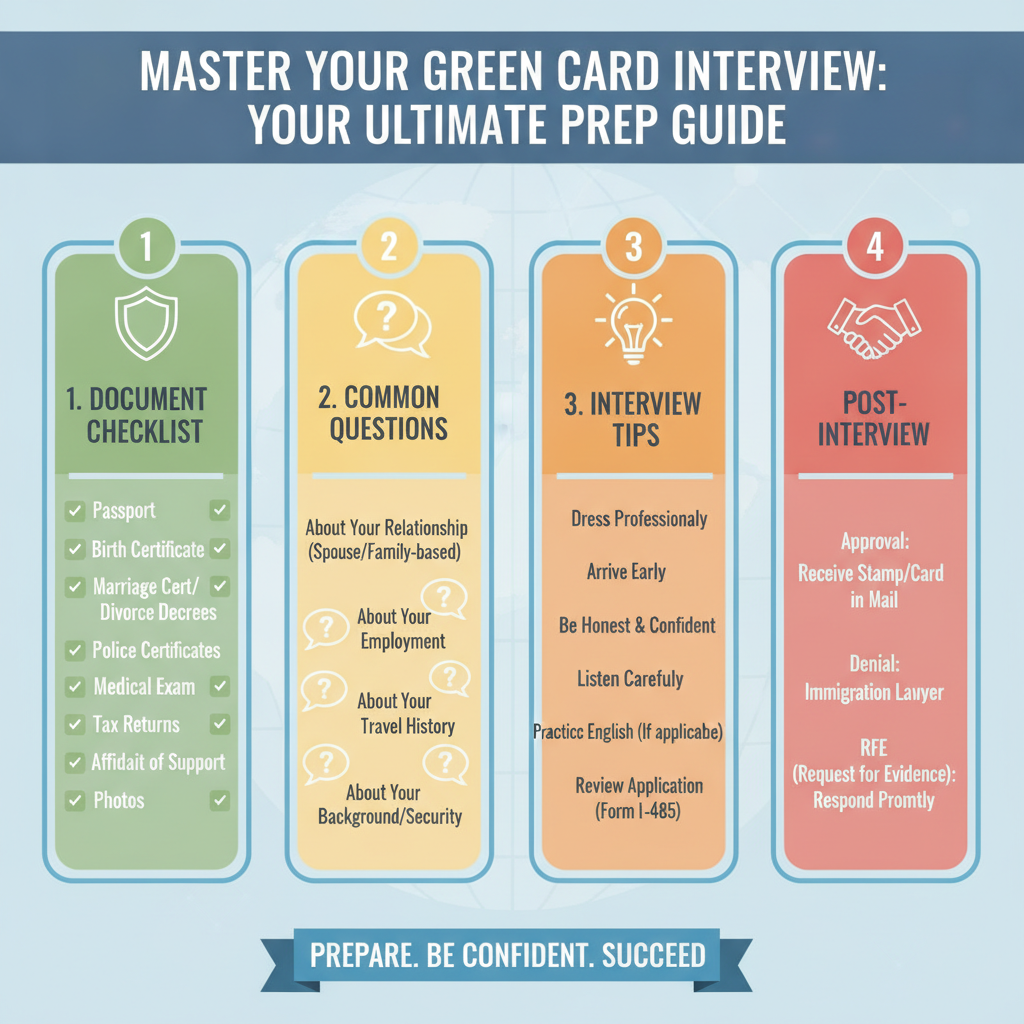
1) Review Your Application and All Submitted Documents
Action: Before anything else, meticulously review every form and document you submitted to USCIS, especially your Form I-485 (Application to Adjust Status) and Form I-130 (Petition for Alien Relative), along with all supporting evidence.
Why it matters: The interviewing officer will have these documents in front of them and will ask questions based on the information provided. Any inconsistencies between your spoken answers and your written application can raise red flags. You need to be intimately familiar with every date, address, name, and answer you provided.
- Required Documents for Review:
- Your complete copy of Form I-485, Form I-130, and all other forms (I-765, I-131, I-864, etc.)
- All supporting documents that were submitted (e.g., birth certificates, marriage certificates, divorce decrees, passports, photos, affidavits, financial records, medical exam results).
- Any Requests for Evidence (RFEs) or Notices of Intent to Deny (NOIDs) and your responses to them.
- Tip: Create a binder with copies of everything in the order it was submitted. Highlight key dates and information.
2) Gather All Original Documents and Prepare Copies
Action: Collect all original documents you submitted copies of, plus any new documents that have become available since filing. Organize them neatly in a binder or folder.
Why it matters: The officer will often ask to see the original versions of documents you submitted as copies. Failing to present an original when requested can lead to delays or even denial. You should also bring copies of everything, as the officer might keep copies for their file.
- Essential Original Documents to Bring:
- Government-issued photo identification (passport, driver's license).
- Original birth certificates (for both applicant and petitioner, if applicable).
- Original marriage certificate (if applicable).
- Original divorce decrees or death certificates for any previous marriages (for both applicant and petitioner, if applicable).
- Original school records/transcripts (if applicable, especially for employment-based or student visa related cases).
- Original police clearance certificates (if applicable).
- Original medical exam results (Form I-693), if not already submitted or if sealed results were returned to you.
- Original work authorization cards (EAD) and travel documents (Advance Parole) if you have them.
- All original passports (current and expired) for the applicant.
- Original Form I-94 Arrival/Departure Record.
- Original Form I-864, Affidavit of Support, and supporting financial documents (tax transcripts, pay stubs, employment verification letters) for the sponsor.
- For marriage-based Green Cards: Original joint documents proving your marriage is bona fide (e.g., joint bank statements, utility bills, lease agreements, insurance policies, tax returns, photos together, letters from friends/family).
- Any new updated documents since filing (e.g., new job letter, new child's birth certificate).
- Important: Bring at least two copies of every original document.
3) Practice Answering Potential Interview Questions
Action: Mentally (or verbally) go through common interview questions. If you have an attorney, they will often conduct a mock interview with you.
Why it matters: While you should never memorize answers, practicing helps you articulate your responses clearly, concisely, and consistently. It also helps reduce nervousness.
- Common Question Categories:
- Personal Background: Name, date of birth, place of birth, parents' names, previous addresses, education, employment history.
- Immigration History: How and when you entered the U.S., previous visas, any prior immigration applications, any arrests or deportations.
- Marriage/Relationship (for family-based): How you met, when you started dating, proposal, wedding details, daily life together, shared finances, future plans.
- Sponsor's Information: Relationship to sponsor, sponsor's employment, financial details.
- Inadmissibility Questions: Questions about criminal history, health issues, past immigration violations, or misrepresentations.
- Tip: Be honest and straightforward. If you don't know an answer, say so. If you need clarification on a question, ask.
4) Understand the Interview Process and Role of Your Attorney
Action: Familiarize yourself with the typical flow of an interview and decide whether to have an attorney accompany you.
Why it matters: Knowing what to expect can significantly reduce anxiety. Having an attorney present provides crucial legal guidance, ensures your rights are protected, and can help clarify complex questions.
- Interview Day Flow:
- Arrive at the USCIS field office (e.g., Orlando USCIS Field Office) or consulate.
- Check-in at the reception desk.
- Wait for your name to be called.
- Be sworn in (you will promise to tell the truth).
- The officer will review your documents and ask questions.
- Your attorney (if present) can clarify questions, object to inappropriate ones, and ensure the process is fair.
- At the end, the officer may tell you a decision or state that they need more time.
- Reminder: If you bring an attorney, inform the officer at the beginning of the interview. Your attorney's role is primarily to observe and advise, not to answer questions on your behalf.
5) Dress Appropriately and Arrive Early
Action: Plan your attire and departure time to ensure you are well-presented and punctual.
Why it matters: First impressions matter. Dressing professionally conveys respect for the process and the interviewing officer. Arriving early allows for unexpected delays and helps you settle your nerves.
- Appearance:
- Dress in clean, conservative, business-casual attire (e.g., slacks and a collared shirt, a dress or skirt and blouse).
- Avoid overly casual clothing, ripped jeans, t-shirts with offensive slogans, or excessive jewelry.
- Punctuality:
- Aim to arrive at least 30-45 minutes before your scheduled interview time, especially if your case is in Orlando, where traffic and parking around federal buildings can be challenging.
- Factor in time for security checks, which can be extensive at government facilities.
- Know the exact address of the Orlando USCIS Field Office and plan your route.
- Important: Bring your interview notice, as you may need it to enter the building.
6) During the Interview: Be Honest, Calm, and Respectful
Action: When speaking with the officer, maintain composure, answer truthfully, and be respectful.
Why it matters: Your demeanor and honesty are crucial. Any attempt to mislead or provide inconsistent information can lead to severe consequences, including denial and accusations of immigration fraud.
- Key Behaviors:
- Listen carefully to each question before answering.
- Answer truthfully and directly. If you don't understand a question, politely ask the officer to repeat or rephrase it.
- Do not volunteer extra information unless asked. Keep answers concise.
- Maintain eye contact and a respectful tone.
- If you are unsure of an answer, state that you do not recall or are unsure, rather than guessing.
- If your spouse is with you (for marriage-based interviews), ensure both of you provide consistent answers.
- Do not argue with the officer.
- If you have an attorney, let them interject if necessary.
- Warning: Lying or intentionally misrepresenting facts during an immigration interview is a serious offense and can result in permanent bars to immigration benefits.
7) Follow-Up After the Interview
Action: Understand the next steps and follow up as necessary.
Why it matters: The interview may not always result in an immediate decision. Knowing how to follow up can prevent unnecessary delays.
- Post-Interview Actions:
- The officer might give you a decision on the spot, or they might say they need more time.
- If they request additional documents (often called a "Notice of Intent to Deny" or "Request for Evidence"), respond promptly within the given timeframe.
- Monitor your case status online using the USCIS Case Status tool.
- If you don't hear anything within a reasonable timeframe (check USCIS Processing Times for your office), consider contacting USCIS or your attorney to inquire about your case.
- If approved, you will typically receive a welcome notice and your Green Card in the mail within a few weeks.
- Important: Keep copies of everything you submit, even after the interview.
Practical Steps You Can Take Today
The path to your Green Card requires diligence. Here’s a checklist of practical steps you can start taking right now to prepare for your interview.
- Actionable Checklist:
- Locate Your Application Copies: Dig out every form and supporting document you submitted. If you don't have copies, contact your previous attorney or request them from USCIS (though this can take time).
- Start a "Green Card Interview" Binder: Organize all your documents into clearly labeled sections. Use tabs for originals, copies, and new evidence.
- Review Your Immigration History: Write down all your entry and exit dates to the U.S., previous visa types, and any interactions with immigration authorities. This helps ensure consistency.
- Gather Current Joint Documents (Marriage-Based): If your Green Card is marriage-based, start collecting recent utility bills, bank statements, lease agreements, credit card statements, and photos that show your life together since you first filed. Aim for documents dated within the last 90-day window.
- Request Updated Financial Documents: Ask your sponsor to provide recent pay stubs, an updated employment verification letter, and their most recent tax transcripts (available from the IRS).
- Check Passport Validity: Ensure your passport is valid for at least six months beyond your interview date. Renew if necessary.
- Inform Your References: If you submitted affidavits or letters from friends/family, let them know they might be contacted for verification (though this is rare for interviews, it's good practice).
- Consult with an Immigration Attorney: Schedule a consultation with an experienced immigration lawyer to review your case, identify potential issues, and prepare you for the interview. This is especially crucial for complex cases or if you have any past immigration violations.
- Plan Your Logistics: If your interview is in Orlando, research parking options and traffic patterns for the specific time of your appointment. Ensure you have reliable transportation.
- Practice Your English (if applicable): If English is not your first language and you plan to speak for yourself, practice conversational English, especially immigration-related terms. If you need an interpreter, make arrangements in advance with USCIS or bring your own certified interpreter (your attorney can advise on this).
- Document Preparation Guidance:
- Organization is Key: A well-organized binder makes a strong impression and helps you quickly find documents during the interview.
- Label Everything: Clearly label each section and document.
- Translations: Any document not in English must be accompanied by a certified English translation.
- Copies: Always bring at least two copies of every document, in addition to the originals.
- Chronological Order: Arrange financial documents, joint bills, and photos in chronological order to show the progression of your relationship or financial history.
- Timeline Expectations:
- Interview Scheduling: After your initial application (e.g., Form I-485) is filed and biometrics are taken, it can take several months to over a year to receive an interview notice, depending on your USCIS field office and visa category. Check USCIS Processing Times for an estimate.
- Interview Notice: You typically receive an interview notice (Form I-797C) by mail 3-6 weeks before the interview date.
- Decision Post-Interview: Some officers may approve your case on the spot, while others may take a few days or weeks to issue a decision. If an RFE is issued, the timeline will extend.
- Green Card Delivery: Once approved, your Green Card is usually mailed within 2-4 weeks.
- Conditional Green Card: If you received a marriage-based Green Card and your marriage was less than two years old on the day of approval, you will receive a 2-year conditional Green Card. You must file Form I-751, Petition to Remove Conditions on Residence, within the 90-day window before its expiration.
How Imigrar Helps Immigrants in Orlando
At Imigrar, we understand that the Green Card interview can be one of the most stressful parts of the immigration process. Our mission, "Keep Families Together," drives us to provide compassionate, expert legal support to individuals and families in Orlando, Central Florida, and nationwide. We specialize in transforming complex legal challenges into clear, manageable steps, ensuring our clients feel confident and prepared.
Our experienced immigration attorneys offer comprehensive services tailored to your specific needs:
- Thorough Case Review: We meticulously review your entire application package, identifying any potential issues or inconsistencies that an officer might question.
- Document Preparation and Organization: We guide you in gathering and organizing all necessary original documents and supporting evidence, ensuring nothing is overlooked.
- Personalized Interview Coaching: We conduct mock interviews, simulating the actual experience, asking common and challenging questions, and providing constructive feedback to help you articulate your answers clearly and confidently.
- Attorney Representation at Interview: Our attorneys can accompany you to your interview at the Orlando USCIS Field Office, providing crucial support, clarifying questions, and protecting your rights throughout the process.
- Responding to RFEs and NOIDs: Should USCIS request additional evidence or express an intent to deny, we will expertly prepare and submit a robust response on your behalf.
- Post-Interview Follow-up: We monitor your case status and follow up with USCIS as needed, advocating for a timely decision.
With Imigrar, you gain not just legal representation, but a dedicated partner committed to your success. Our deep understanding of immigration law, combined with our local knowledge of the Orlando and Florida immigration landscape, positions us uniquely to serve your needs.
Se Habla Español. We are proud to serve our Spanish-speaking community, ensuring clear communication and understanding every step of the way.
Don't leave your Green Card approval to chance. Let Imigrar's Orlando team provide the expert guidance you need for a successful interview. Contact us for a free consultation at +1 786-791-3106. Se Habla Español.