

Navigating the U.S. immigration system can be a complex journey, with the green card interview standing as one of its most critical milestones. For many, this interview is the final hurdle before achieving permanent residency in the United States. At Imigrar, an immigration law firm based in Orlando, Florida, we understand the anxieties and questions that surround this pivotal moment. Our mission is to provide clear, actionable guidance to help you approach your interview with confidence and clarity.
The reporting that sparked this guide
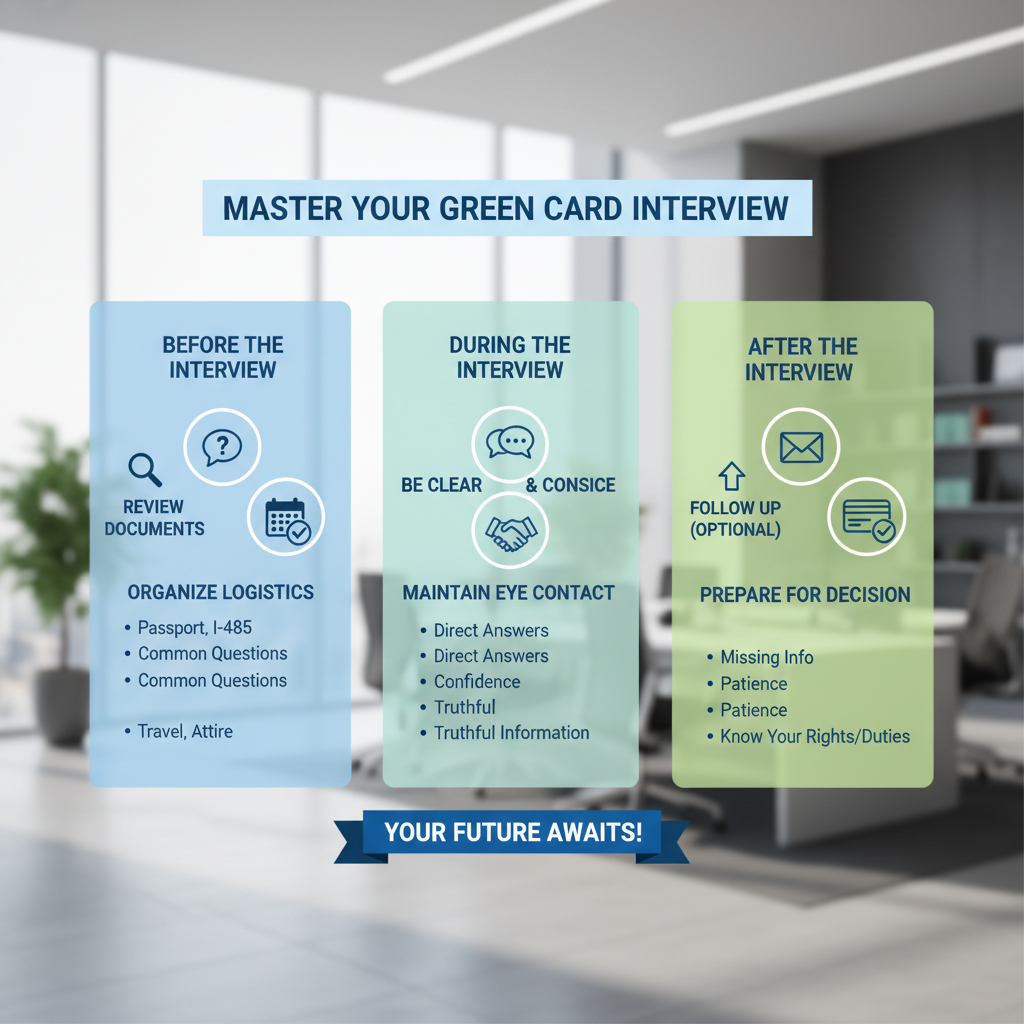
The ongoing discussion and frequent updates in Green Card Interview Preparation Tips (Immigration Law) consistently highlight the interview's enduring importance. News sources and legal discussions frequently revisit best practices for interviews, underscoring that while the process is standard, individual preparation is paramount to success. This sustained focus from immigration law reporting emphasizes that the interview remains a central, often decisive, component of the green card application process, making thorough preparation not just advisable, but essential.
What This News Means for Immigrants in Orlando and Across Florida
The consistent attention on green card interview preparation is not new, but its continued prominence in immigration law discussions signifies its unwavering importance. For immigrants in Orlando and throughout Florida, this news serves as a critical reminder: meticulous preparation for your green card interview is non-negotiable.
Why this news is showing up now
The topic of green card interview preparation is perennially relevant because the interview itself is a universal and critical step for most individuals seeking permanent residency through Adjustment of Status or Consular Processing. While the core legal framework remains stable, USCIS processing times, interview backlogs, and specific interviewing procedures can evolve. This constant flux means that advice on preparation needs to be regularly updated and reinforced. Furthermore, as technology advances, the ways applicants interact with the system (e.g., online filing, digital evidence submission) also change, prompting new considerations for interview readiness. The current environment, marked by high application volumes and ongoing efforts by USCIS to streamline processes, keeps the spotlight on effective preparation to avoid delays or denials.
How it can affect Florida residents
Florida is home to one of the largest and most diverse immigrant populations in the United States. For residents in Orlando, Miami, Tampa, and across the state, the implications of a poorly prepared green card interview can be significant. The Orlando USCIS Field Office, along with others in Florida, handles a vast number of green card applications annually. This high volume means that officers are often working through many cases, and a well-organized, thoroughly prepared applicant can help ensure a smoother, more efficient interview process. Florida's transient population, proximity to international borders, and diverse economic landscape also mean that applicants often have unique circumstances that require careful documentation and explanation. Whether you're a family seeking to reunite in Orange County, an entrepreneur building a business along the I-4 corridor, or a professional contributing to the state's economy, understanding the nuances of interview preparation is vital to securing your future in the Sunshine State.
Important: The stakes are incredibly high. A successful interview moves you closer to permanent residency, allowing you to live and work in the U.S. without fear. An unsuccessful one can lead to Requests for Evidence (RFEs), delays, or even denial, causing immense stress and uncertainty. That's why having expert legal guidance from a firm like Imigrar is invaluable.
Need Help? Our Orlando immigration team is ready to assist. Call +1 786-791-3106 for a free consultation, or message us online. Se Habla Español.
What a Green Card Interview Is (and Why It Matters)
The green card interview is a formal meeting with an immigration officer from U.S. Citizenship and Immigration Services (USCIS) or, in some cases, a consular officer from the U.S. Department of State. Its primary purpose is to verify the information provided in your application, confirm your eligibility for a Green Card (lawful permanent resident status), and ensure you are not inadmissible to the United States.
A plain-English definition
Think of the green card interview as the final check-up for your application. You've submitted many forms and documents, but this is the chance for an immigration officer to speak with you directly. They want to make sure everything you've said in your application is true, that your relationship (if it's a family-based application) is genuine, and that you meet all the legal requirements to become a permanent resident. It’s a serious but routine step designed to protect the integrity of the U.S. immigration system.
Key terms you need to know
- Green Card: Also known as a Permanent Resident Card, it proves you have been granted authorization to live permanently in the United States.
- Adjustment of Status (AOS): The process of applying for a Green Card while physically present in the United States. The interview typically takes place at a USCIS Field Office, such as the one in Orlando.
- Consular Processing: The process of applying for a Green Card through a U.S. embassy or consulate in your home country. The interview takes place abroad.
- USCIS Field Office: A local office of U.S. Citizenship and Immigration Services where interviews for Adjustment of Status are conducted. For Central Florida residents, this is usually the Orlando USCIS Field Office.
- Sponsor/Petitioner: The U.S. citizen or lawful permanent resident who files a petition on behalf of an immigrant, often a relative (e.g., filing Form I-130).
- Beneficiary/Applicant: The immigrant seeking a Green Card.
- Affidavit of Support (Form I-864): A legally binding document signed by the sponsor, promising to financially support the immigrant if needed, ensuring they do not become a "public charge."
- Priority Date: The date USCIS receives your petition (e.g., Form I-130 or Form I-140). This date determines when your immigrant visa becomes available, especially for family-preference categories and employment-based categories.
- Inadmissibility: Grounds under immigration law that can prevent an individual from entering or remaining in the U.S., such as certain criminal convictions, health issues, or past immigration violations.
The green card interview matters immensely because it's often the final opportunity for you and your sponsor to present your case directly. It’s where an immigration officer assesses your credibility, the authenticity of your relationship (if applicable), and your eligibility under U.S. law. A successful interview leads to approval, while missteps can lead to delays, requests for additional evidence, or even denial.
Current Immigration Law: The Foundation
The framework for green card eligibility and interviews is rooted in the Immigration and Nationality Act (INA), primarily codified under Title 8 of the U.S. Code. This comprehensive body of law outlines who is eligible for permanent residency, the application processes, and the grounds for inadmissibility. The interview serves as a mechanism to ensure compliance with these laws.
Federal requirements
At the federal level, the legal basis for green card eligibility is complex and depends heavily on the specific category under which you are applying (e.g., family-based, employment-based, asylum/refugee status, diversity lottery). Key sections of the INA that govern these processes include:
- INA § 201-204: Define immigrant visa categories, numerical limitations, and petition requirements (e.g., Form I-130 for family-based petitions).
- INA § 212: Outlines the grounds of inadmissibility, which are reasons an individual might be barred from entering or remaining in the U.S. These grounds cover health, criminal activity, security, public charge concerns, and prior immigration violations. The interview is a critical step for officers to evaluate these factors.
- INA § 245: Governs Adjustment of Status for individuals already present in the U.S. It sets forth specific conditions, such as lawful admission or parole, and requires that the applicant be admissible to the U.S. and have an immigrant visa immediately available.
- INA § 221-222: Pertain to immigrant visas issued abroad through Consular Processing.
During your interview, the USCIS or consular officer will be assessing your application against these federal statutes. They will confirm:
- Your identity and nationality.
- The validity of your underlying petition (e.g., Form I-130 or Form I-140).
- The legitimacy of your qualifying relationship (for family-based cases).
- Your financial ability to support yourself or that of your sponsor (via Form I-864, Affidavit of Support).
- That you have undergone and passed a medical examination (Form I-693).
- That you are not subject to any grounds of inadmissibility.
Florida-specific considerations
While immigration law is federal, its application can have local nuances. For residents of Florida, the interview will typically be conducted at the Orlando USCIS Field Office (or other field offices within the state, depending on your address). While the legal requirements remain the same nationwide, local offices may have slightly different scheduling patterns, interview officer styles, or preferred ways of organizing documents. For example, the volume of cases in a populous state like Florida can impact processing times and interview scheduling. It's also common for Florida residents to have diverse backgrounds, including those with previous visas, various entries into the U.S., or complex family histories, all of which may require meticulous documentation and explanation during the interview. Understanding these local factors, alongside the federal law, can be beneficial.
All official forms and detailed instructions are available on the USCIS official website. Key forms you'll encounter include:
- Form I-130, Petition for Alien Relative
- Form I-485, Application to Register Permanent Residence or Adjust Status
- Form I-864, Affidavit of Support
- Form I-693, Report of Medical Examination and Vaccination Record
- Form I-765, Application for Employment Authorization (often filed concurrently with Form I-485)
- Form I-131, Application for Travel Document (often filed concurrently with Form I-485)
Need Help? Our Orlando immigration team is ready to assist. Call +1 786-791-3106 for a free consultation, or message us online. Se Habla Español.
How to Prepare for Your Green Card Interview: A Complete Step-by-Step Guide
Preparing for your green card interview is a process that requires diligence, organization, and a clear understanding of what to expect. This comprehensive guide will walk you through the essential steps to ensure you are fully ready.
1) Understand Your Case Type and Eligibility
Before diving into document gathering, ensure you fully understand the specifics of your green card application. Are you applying through a family member (e.g., spouse, parent, child), an employer, or another special category? Your eligibility criteria and the types of questions you'll face will vary significantly based on your case type.
- Family-Based Adjustment of Status: Most common for spouses, parents, and children of U.S. citizens or lawful permanent residents. Focus is on the authenticity of the relationship.
- Employment-Based Adjustment of Status: Requires a qualifying job offer and often an approved Form I-140 (Immigrant Petition for Alien Worker). Focus is on your qualifications and the legitimacy of the employment.
- Consular Processing: If you are outside the U.S. or cannot adjust status, your interview will be at a U.S. embassy or consulate abroad.
Documents to review:
- Your original petition (e.g., Form I-130, Form I-140) and its approval notice.
- Your visa category and Priority Date to confirm visa availability.
- Copies of all submitted applications, especially Form I-485.
2) Gather and Organize ALL Required Documents
This is arguably the most critical step. You must bring originals and copies of every document you submitted, plus any new evidence. Organize them meticulously in a binder with tabs for easy access. Do not wait until the last minute.
- Identity and Travel Documents:
- Passport (current and expired).
- Birth Certificates (for you, your spouse, children).
- National identity cards.
- Previous U.S. visas and entry stamps.
- Form I-94 Arrival/Departure Record.
- Marriage certificate (if applicable).
- Divorce decrees or death certificates for any previous marriages (for both applicant and sponsor).
- Financial Documents (for both applicant and sponsor, if applicable):
- Form I-864, Affidavit of Support, and all supporting documents (tax returns for the past three years - Form 1040, Form W-2, Form 1099, pay stubs, employment verification letter, bank statements).
- Proof of assets (property deeds, stock certificates, etc.).
- Relationship Evidence (for family-based cases):
- Marriage certificate.
- Birth certificates of any children born to the marriage.
- Joint financial accounts (bank statements, credit card statements).
- Joint leases or property deeds.
- Joint insurance policies (health, auto, life).
- Utility bills in both names.
- Photos together (over time, with family/friends, from significant events).
- Correspondence (emails, texts, cards).
- Affidavits from friends/family attesting to the relationship.
- Medical Examination:
- Form I-693, Report of Medical Examination and Vaccination Record, in a sealed envelope (if not already submitted).
- Police and Court Records:
- Certified copies of any arrest records, court dispositions, or police reports, even for minor incidents.
- Proof of rehabilitation if applicable.
- Academic and Professional Documents (for employment-based cases):
- Diplomas, transcripts, professional licenses.
- Employment letters, resume, offer letters.
- Photographs:
- Two U.S. passport-style photos meeting USCIS specifications.
- Interview Notice:
- The official appointment letter (Form I-797C).
Reminder: Bring ALL originals and a complete set of copies. For any documents not in English, you must provide a certified English translation.
3) Review Your Submitted Applications Thoroughly
Read through every line of your Form I-485, Form I-130, and any other forms you submitted. You must be familiar with every answer you provided. The officer will compare your interview responses to your written application. Inconsistencies, even minor ones, can raise red flags and lead to further scrutiny, delays, or even accusations of misrepresentation.
- Pay special attention to dates, addresses, employment history, travel history, and answers to eligibility questions.
- If there are any errors or changes since you filed, prepare an explanation and supporting documentation.
4) Practice Answering Interview Questions
While you can't predict every question, many are standard. Practice answering them truthfully, clearly, and concisely. Your attorney can conduct mock interviews with you.
- Common Questions:
- "Why do you want a Green Card?"
- "When and how did you enter the U.S.?"
- "Have you ever been arrested or convicted of a crime?"
- "Have you ever violated immigration laws?"
- "What is your relationship with your petitioner/spouse?" (For family-based: "When and where did you meet?" "What do you do together?" "What are your spouse's parents' names?")
- "Do you have children? Where do they live?"
- "What is your current employment?"
- "Have you ever been deported or removed from the U.S.?"
- Key Interview Principles:
- Always tell the truth.
- Answer only the question asked; do not volunteer extra information unless it's directly relevant.
- If you don't understand a question, ask for clarification.
- If you don't know the answer, say so honestly.
5) Prepare for the Interview Day Logistics
The interview day itself requires careful planning to avoid unnecessary stress.
- Location: Confirm the address of the Orlando USCIS Field Office or consulate. Plan your route, considering traffic (especially in Central Florida) and parking.
- Time: Arrive at least 30 minutes before your scheduled appointment. Being late can lead to rescheduling, which causes significant delays.
- Attire: Dress professionally, as you would for an important job interview. This shows respect for the process and the officer.
- Who to bring:
- The applicant (beneficiary) must attend.
- The petitioner (sponsor) must attend for family-based cases.
- Your attorney (highly recommended, like Imigrar).
- A certified interpreter if you are not fluent in English (USCIS does not provide one for green card interviews).
- Do not bring extra family members or friends unless they are specifically required.
- What to bring: Your organized document binder, appointment notice, photo ID.
6) What to Expect During the Interview
Knowing the typical flow can help ease anxiety.
- Check-in: You'll check in at the front desk, present your appointment notice and ID.
- Waiting Area: You'll wait until your name is called.
- Oath: The officer will lead you into their office and ask you to swear an oath to tell the truth.
- Questions: The officer will review your application, ask questions about your background, eligibility, relationship (if applicable), and any potential grounds of inadmissibility. They will compare your answers to your submitted documents.
- Document Review: The officer will likely ask for original documents to verify what you've submitted in copies.
- Attorney's Role: Your Imigrar attorney will be present to observe, clarify questions, ensure your rights are protected, and address any legal issues that arise.
7) Post-Interview Procedures
The outcome of your interview is not always immediate.
- Immediate Decision: Sometimes, the officer may approve your case on the spot, or tell you a decision will be mailed.
- Request for Evidence (RFE): If the officer needs more information, they will issue an RFE, providing a deadline (e.g., 87 days) for you to submit additional documents.
- Notice of Intent to Deny (NOID): If the officer believes your case should be denied, they will issue a NOID, giving you a chance to respond and provide arguments against denial.
- Approval: If approved, you will typically receive your physical Green Card in the mail within a few weeks.
- Denial: If your case is denied, you may have options for appeal or to refile, but this is a complex situation that requires immediate legal counsel.

Practical Steps You Can Take Today
Don't wait until you receive your interview notice to start preparing. Proactive steps can make all the difference.
Actionable Checklist:
- Consult an Immigration Attorney: This is the single most important step. An experienced attorney from Imigrar can review your case, identify potential issues, help you gather documents, and prepare you thoroughly.
- Begin Document Gathering Early: Start collecting originals and copies of all necessary documents, including birth certificates, marriage licenses, financial records, and relationship evidence. Don't underestimate the time it takes to get official copies or translations.
- Review Your Entire Application Package: Obtain a copy of everything you submitted to USCIS. Read it carefully to refresh your memory and ensure consistency.
- Organize Your Documents: Purchase a binder with dividers and label sections for each category of documents (e.g., "Identity," "Financial," "Relationship Evidence"). This will make a strong impression and help you quickly find documents during the interview.
- Practice Interview Questions: Have a friend, family member, or your attorney ask you common interview questions. Practice answering clearly and concisely, focusing on honesty.
- Address Any Red Flags: If you have a complex immigration history, prior arrests, or any other issues that might raise concerns, discuss these with your attorney immediately. They can help you prepare explanations and gather mitigating evidence.
- Check USCIS Processing Times: While not precise, checking the USCIS Processing Times for your field office can give you a general idea of when to expect your interview. This allows for better planning.
Document Preparation Guidance:
- Originals vs. Copies: Always bring the original document AND a clear photocopy of each. The officer will typically review the original and keep the copy.
- Translations: Any document not in English must be accompanied by a complete and accurate English translation, along with a certification from the translator stating their competence and the accuracy of the translation.
- Photos: Ensure all photos (e.g., passport-style photos, relationship photos) meet USCIS guidelines.
- No Staples/Paperclips (unless necessary): USCIS prefers documents unstapled. Use paperclips for grouping, but be prepared to remove them.
Timeline Expectations:
The time from filing your application to receiving an interview notice can vary significantly. For Adjustment of Status cases, it can range from several months to over a year, depending on your visa category, the specific USCIS field office (e.g., Orlando USCIS Field Office), and current backlogs. Once your interview is scheduled, you typically receive notice about 4-6 weeks in advance. It's crucial to utilize this time wisely for final preparations.
Warning: Do not travel outside the U.S. after filing for Adjustment of Status without an approved


