


The journey to obtaining a Green Card, or lawful permanent residency in the United States, is often complex and filled with anticipation. For many, the culminating step is the Green Card interview with U.S. Citizenship and Immigration Services (USCIS). This interview is a critical moment where you present your case directly to an immigration officer, answer questions about your application, and provide supporting documentation. Being well-prepared is not just an advantage; it's essential for a successful outcome.
Need Help? Our Orlando immigration team is ready to assist. Call +1 786-791-3106 for a free consultation, or message us online. Se Habla Español.
The reporting that sparked this guide
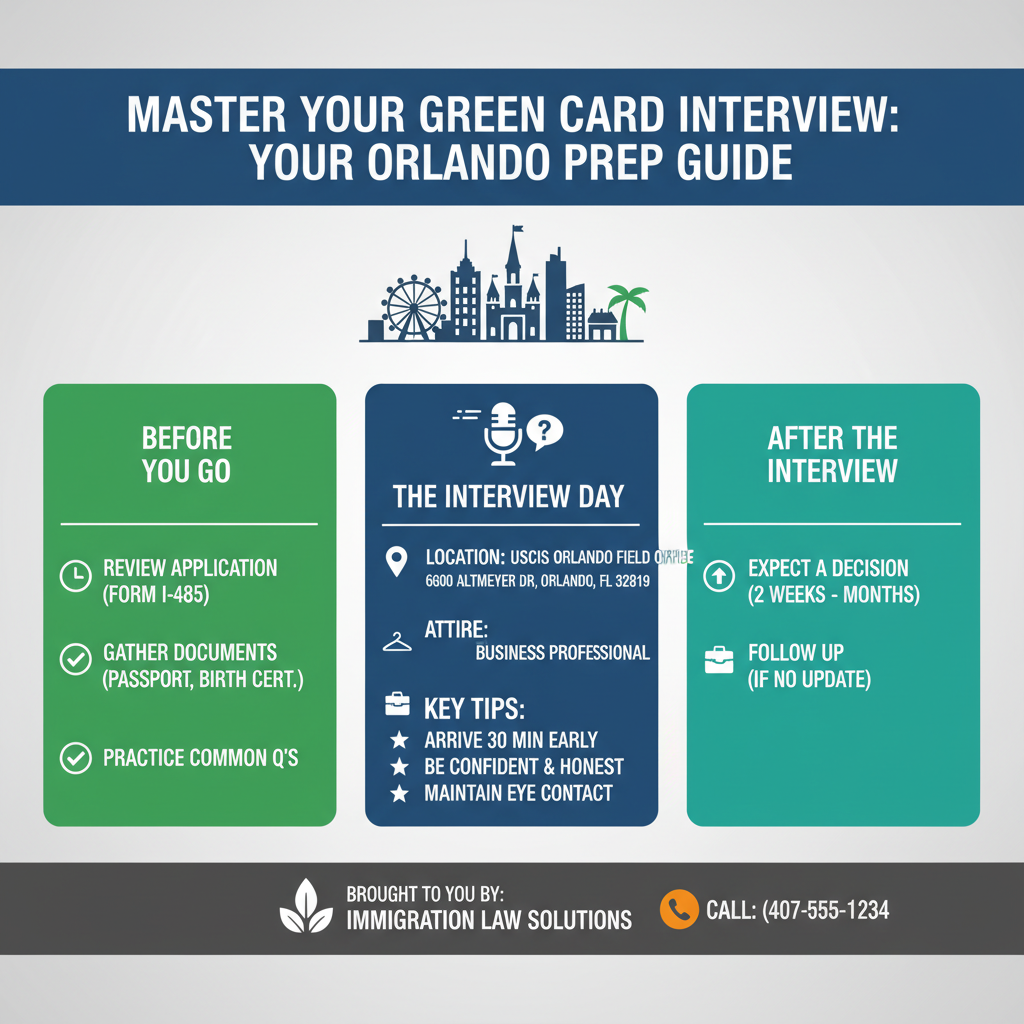
Recent discussions and articles from various legal news outlets consistently highlight the importance of thorough preparation for immigration interviews. This focus is particularly relevant for Green Card applicants, as errors or omissions during the interview can lead to delays or even denials. Understanding the process, knowing what to expect, and organizing your evidence are recurring themes in expert advice, underscoring the need for a comprehensive preparation strategy.
You can find more on this topic through general legal news sources:
Green Card Interview Preparation Tips (Immigration Law)
What This News Means for Immigrants in Orlando and Across Florida
The emphasis on Green Card interview preparation is not just a national trend; it has direct implications for the vibrant immigrant communities in Orlando and throughout Florida. Our state is a melting pot, with hundreds of thousands of individuals and families pursuing their American dreams through the immigration system.
Why this news is showing up now
The need for robust Green Card interview preparation is an evergreen topic in immigration law. USCIS processes millions of applications annually, and each interview is a crucial step in verifying eligibility and ensuring the integrity of the immigration system. While there may not be a sudden policy change causing this renewed focus, the continuous flow of applicants means that best practices for interview success are always relevant. Furthermore, as application volumes fluctuate and processing times evolve, the importance of making every step count – especially the interview – becomes even more pronounced. For applicants in 2026, navigating the current landscape with efficiency and accuracy is paramount.
How it can affect Florida residents
Florida is home to a massive immigrant population, with significant communities in Orlando, Miami, Tampa, and other major cities. Many of these residents are on the path to obtaining a Green Card, either through family-based petitions, employment-based petitions, or other avenues. For those whose cases are processed through the Orlando USCIS Field Office, or other field offices across the state, understanding the intricacies of the Green Card interview is vital. The Orlando USCIS Field Office serves a wide area, including Orange County and much of Central Florida along the I-4 corridor. A well-prepared applicant can significantly reduce stress, avoid potential pitfalls, and expedite their journey to permanent residency. Conversely, a lack of preparation can lead to Request for Evidence (RFE), delays, or even a Notice of Intent to Deny (NOID), adding significant time and cost to the process. Given the high volume of cases in Florida, being ready for your interview helps streamline the entire system, benefiting all applicants.
What Green Card Interview Preparation Is (and Why It Matters)
The Green Card interview is a formal meeting with a USCIS officer to review your application for lawful permanent residence. It's a mandatory step for most individuals seeking to adjust their status to a lawful permanent resident while residing in the United States (Adjustment of Status) and for those applying through a U.S. embassy or consulate abroad (Consular Processing). The purpose of the interview is for the immigration officer to verify the information provided in your application forms, confirm your eligibility, and ensure that you are not inadmissible to the U.S. under any immigration laws.
This interview matters because it's your opportunity to present your case directly, clarify any ambiguities, and demonstrate your credibility. It's often the final hurdle before a decision is made on your Green Card application. A strong, confident, and well-supported interview can lead to a quick approval, while a weak or inconsistent presentation can raise red flags and delay your case.
A plain-English definition
Simply put, the Green Card interview is like a final exam for your immigration application. You've submitted all your homework (your forms and documents), and now you meet with the "teacher" (the USCIS officer) to discuss everything. They want to make sure all your answers are true, that you meet all the requirements, and that there are no reasons why you shouldn't get a Green Card. It's a chance for them to ask questions and for you to provide any missing information or explanations.
Key terms you need to know
- Adjustment of Status (AOS): The process of applying for lawful permanent resident status (a Green Card) while physically present in the United States. This is distinct from Consular Processing, where the application is handled by a U.S. consulate abroad.
- USCIS Officer: The government official from U.S. Citizenship and Immigration Services who conducts your interview and makes a recommendation or decision on your case.
- Petitioner: The U.S. citizen or lawful permanent resident who files an immigration petition (e.g., Form I-130, Petition for Alien Relative) on behalf of a foreign national.
- Beneficiary: The foreign national who is seeking an immigration benefit, such as a Green Card, based on a petition filed by a Petitioner.
- Prima Facie: A legal term meaning "on its face" or "at first sight." It refers to evidence that is sufficient to establish a fact or raise a presumption unless disproved or rebutted. Your application needs to be "prima facie" approvable.
- Affidavit of Support (Form I-864): A legally binding document signed by a Petitioner (and sometimes a joint sponsor) to accept financial responsibility for the immigrant. It ensures the immigrant will not become a public charge.
- Public Charge: A ground of inadmissibility for individuals who are likely to primarily depend on the government for subsistence. The Affidavit of Support helps overcome this concern.
- Notice of Interview (Form I-797C): The official document from USCIS informing you of your interview date, time, and location, and listing required documents.
- Request for Evidence (RFE): A notice from USCIS asking for additional documents or information to support your application.
- Notice of Intent to Deny (NOID): A notice from USCIS indicating their intention to deny your application, providing a reason and giving you a chance to respond.
- Inadmissibility: Legal grounds that prevent someone from entering or remaining in the U.S., such as certain criminal convictions, health issues, or immigration violations.
Current Immigration Law: The Foundation
The legal framework for obtaining a Green Card is primarily established by the Immigration and Nationality Act (INA), which is codified in Title 8 of the United States Code. This comprehensive body of law dictates who is eligible for a Green Card, the procedures for applying, and the grounds for inadmissibility.
Federal requirements
At the federal level, the requirements for a Green Card vary significantly depending on the category under which you are applying. The most common categories include:
- Family-Based Immigration: Governed by INA Sections 201, 203, and 204. This includes immediate relatives of U.S. citizens (spouses, unmarried children under 21, and parents) and various preference categories for other family members. Key requirements include a valid relationship, a sponsor meeting income guidelines (via Form I-864, Affidavit of Support), and the beneficiary not being subject to grounds of inadmissibility.
- Employment-Based Immigration: Covered by INA Sections 203(b) and 204. This includes categories for individuals with extraordinary abilities, professionals, skilled workers, and investors. Requirements often involve a job offer from a U.S. employer, a labor certification (PERM), and specific educational or professional qualifications.
- Refugees and Asylees: After one year of residence in the U.S. as a refugee or asylee, individuals can apply for Adjustment of Status under INA Section 209.
- Diversity Visa Lottery: INA Section 203(c) provides up to 50,000 immigrant visas annually to individuals from countries with historically low rates of immigration to the U.S.
Regardless of the category, all applicants must undergo background checks, medical examinations, and an interview. The interview is designed to ensure compliance with INA Section 212 (General Classes of Aliens Ineligible to Receive Visas and Inadmissible to the United States), which outlines various grounds of inadmissibility, including health-related grounds, criminal grounds, security grounds, public charge grounds, and misrepresentation grounds.
The primary forms involved in the Adjustment of Status process include:
- Form I-130, Petition for Alien Relative (filed by a U.S. citizen or LPR for a family member).
- Form I-485, Application to Register Permanent Residence or Adjust Status (the core Green Card application).
- Form I-864, Affidavit of Support (financial sponsorship).
- Form I-693, Report of Medical Examination and Vaccination Record.
- Form I-765, Application for Employment Authorization (optional, for work permit while AOS is pending).
- Form I-131, Application for Travel Document (optional, for advance parole while AOS is pending).
For detailed information on these forms and requirements, always refer to the USCIS official website.
Florida-specific considerations
While immigration law is federal, the practicalities of your case will often be handled by the USCIS Field Office with jurisdiction over your residence. For most Central Florida residents, this is the Orlando USCIS Field Office. It's crucial to be aware of local procedures, such as specific parking instructions, security protocols, and typical interview scheduling patterns for the Orlando office. Although the legal requirements remain the same nationwide, the local office will be the site of your interview and where you submit any last-minute documents. Understanding the local nuances can help you navigate the process more smoothly.
How to Prepare for Your Green Card Interview: A Complete Step-by-Step Guide
Preparing for your Green Card interview is a multi-faceted process that requires meticulous attention to detail and a strategic approach. Follow this comprehensive guide to ensure you are fully ready.
1) Gather All Documents (Originals & Copies)
This is perhaps the most critical step. USCIS explicitly states that you must bring all original documents submitted with your application, plus copies, and any additional requested documents. Create a well-organized folder or binder with clearly labeled sections.
- Originals and Copies of All Forms Filed: This includes your Form I-130 (if applicable), Form I-485, Form I-864, Form I-693, and any other forms you submitted.
- Government-Issued Photo Identification: Your passport, driver's license (especially if your case is in Orlando, your Florida driver's license), or state ID.
- Birth Certificates: For both the applicant and the petitioner (if family-based).
- Marriage Certificate: If applying based on marriage to a U.S. citizen or LPR.
- Divorce Decrees or Death Certificates: For any previous marriages of either spouse.
- Evidence of Bona Fide Marriage (for spousal petitions):
- Joint bank statements, credit card statements.
- Joint leases or mortgage statements.
- Utility bills in both names.
- Life insurance policies, wills, or trusts naming each other as beneficiaries.
- Birth certificates of children born to the marriage.
- Photos together over time (wedding, vacations, family events).
- Affidavits from friends/family attesting to the marriage.
- Travel itineraries and tickets from trips taken together.
- Financial Documents:
- Petitioner's federal income tax returns (most recent three years, including W-2s and 1099s).
- Employment verification letter from the petitioner's employer.
- Recent pay stubs from the petitioner.
- Bank statements of the petitioner.
- If a joint sponsor is used, their financial documents as well.
- Medical Examination Records: Your sealed Form I-693, if not already submitted. If it was submitted, bring a copy and be prepared to discuss it.
- Police Clearances/Court Dispositions: For any arrests or convictions (even if charges were dropped or expunged).
- Travel History: Copies of all passports, visas, and I-94 arrival/departure records.
- Educational Documents: Diplomas, degrees, transcripts (especially for employment-based petitions).
- Work History Documents: Employment letters, pay stubs, resume (especially for employment-based petitions).
- Any Previous Immigration Filings: Copies of previous applications, petitions, or notices (e.g., prior visas, EADs, Advance Parole).
- Notice of Interview (Form I-797C): You must bring this official letter.
- Two Passport-Style Photos: Even if you submitted them, bring extra, just in case.
Important: Organize your documents in the order they appear on your application forms or as requested in your interview notice. This makes it easier for the officer to review and gives a professional impression.
Need Help? Our Orlando immigration team is ready to assist. Call +1 786-791-3106 for a free consultation, or message us online. Se Habla Español.
2) Review Your Application Forms Thoroughly
Before the interview, you must be intimately familiar with every answer you provided on your Form I-485, Form I-130, and all supporting documents. The USCIS officer will refer to these forms and ask questions based on your responses.
- Read through your entire application package line by line.
- Highlight any areas that might be confusing or require further explanation.
- Ensure consistency in your answers. Any discrepancies between your verbal answers and your written application can raise suspicion and lead to further questioning or delays.
- If there are any errors or changes since you filed, prepare a clear, concise explanation and bring supporting documentation. For example, if you moved, bring proof of your new address.
- For marriage-based interviews, both the petitioner and beneficiary should review the applications together to ensure they are on the same page regarding dates, addresses, and other personal details.
3) Practice Answering Questions
While you can't predict every question, you can anticipate common ones. Practice answering these questions truthfully, clearly, and concisely. Avoid giving one-word answers, but also don't over-explain.
- General biographical questions: Name, date of birth, place of birth, current address, parents' names, previous addresses.
- Questions about your application: "Why are you applying for a Green Card?" "What is your current immigration status?" "Have you ever been arrested?" "Have you ever violated immigration law?"
- For marriage-based interviews:
- "How did you meet?" "When did you get married?" "Where do you live?"
- "What are your spouse's parents' names?" "What does your spouse do for a living?"
- "Do you have joint bank accounts? Joint bills?"
- "What did you do last weekend?" "What did you eat for breakfast?" (These are designed to test the authenticity of your relationship).
- Questions about inadmissibility: Be prepared to discuss any "Yes" answers to the eligibility questions on Form I-485, particularly those related to criminal history, health issues, or past immigration violations. Have any waivers or supporting documents ready.
Reminder: Always tell the truth. Providing false information or misrepresenting facts can lead to severe penalties, including a permanent bar from the U.S.
4) Understand the Interview Process
Knowing what to expect can significantly reduce anxiety. The interview typically follows a standard format:
- Arrival and Check-in: Arrive at least 30 minutes early at the Orlando USCIS Field Office (or other designated location). You will go through security, check in at the reception desk, and wait for your name to be called.
- Oath: The officer will call your name and ask you to swear an oath to tell the truth.
- Review of Application: The officer will review your application forms with you, asking questions to confirm the information.
- Document Review: You will be asked to provide original documents and any new evidence.
- Additional Questions: The officer may ask follow-up questions, especially concerning any "Yes" answers on your application or any potential grounds of inadmissibility. For marriage-based cases, the officer will delve deeply into your relationship.
- Decision or Further Action: The officer may approve your case on the spot, issue an RFE for more documents, or state that a decision will be mailed to you. They cannot always make an immediate decision, especially if background checks are still pending.
Warning: Do not interrupt the officer. Listen carefully to each question and answer only what is asked. If you don't understand a question, politely ask for clarification.
5) Arrange for an Interpreter (If Needed)
If you or your petitioner (for marriage-based cases) are not fluent in English, you have the right to bring a qualified interpreter. For Imigrar clients in Orlando, this is particularly relevant for our Spanish-speaking community. The interpreter must be at least 18 years old, fluent in both English and your native language, and cannot be your attorney, a witness in your case, or the petitioner/beneficiary themselves.
- Inform USCIS in advance if you plan to bring an interpreter.
- Ensure your interpreter is truly proficient and understands legal terminology.
- Practice with your interpreter beforehand to ensure smooth communication.
Se Habla Español: If you are an Imigrar client and need assistance with an interpreter, discuss this with our team well in advance of your interview.
6) Dress Appropriately and Arrive Early
First impressions matter. While there's no strict dress code, dressing in professional or business-casual attire shows respect for the process and the USCIS officer.
- Dress: Opt for clean, neat, and modest clothing. Treat it like a job interview.
- Punctuality: As mentioned, arrive at least 30 minutes before your scheduled time. This allows for security checks, finding parking (which can be challenging around the Orlando USCIS Field Office), and settling your nerves. Being late can lead to your interview being rescheduled or even denied.
- Logistics: Plan your route to the Orlando USCIS Field Office in advance. Consider traffic, especially if traveling during rush hour on the I-4 corridor. Know where to park and what you can and cannot bring into the building.
7) Follow Up After the Interview (If Necessary)
If your case isn't approved on the spot, the officer might issue an RFE or tell you a decision will be mailed. Make sure you understand any instructions given.
- If an RFE is issued, respond promptly and thoroughly with all requested documents within the specified deadline (often 90 days).
- If no decision is made immediately, resist the urge to call USCIS daily. Check your case status online using your receipt number on the USCIS official website.
- If there's a significant delay (beyond the typical processing times for your field office, which you can check on USCIS Processing Times), you may consider making an InfoPass appointment or contacting your attorney.
Practical Steps You Can Take Today
Don't wait until the last minute to prepare for your Green Card interview. Here are actionable steps you can start taking right now to build a strong case.
Actionable Checklist (5+ items)
- Organize Your Documents: Start gathering all original documents and making copies. Use a binder with dividers for different categories (e.g., identity, marriage, financial, medical).
- Review Your Application: Print out all submitted forms and read through them carefully. Highlight any answers you need to clarify or remember.
- Create a "Mock Interview" Scenario: Have a trusted friend, family member, or your attorney ask you common interview questions. Practice answering clearly and concisely.
- Check USCIS Processing Times: Regularly monitor the USCIS Processing Times for the Orlando Field Office to get an idea of when to expect your interview notice.
- Consult an Immigration Attorney: This is arguably the most important step. An experienced attorney can review your application, identify potential issues, help you gather documents, prepare you for specific questions related to your case, and even accompany you to the interview.
- Update Your Address: If you've moved since filing, file a Form AR-11, Alien's Change of Address Card, with USCIS immediately.
- Gather Ongoing Evidence: Especially for marriage-based cases, continue collecting evidence of your bona fide marriage (e.g., new joint bills, photos, travel).
Document preparation guidance
- Originals vs. Copies: Always bring both. The officer will typically review originals and keep the copies for the file.
- Label Everything: Use sticky notes or tabs to label sections of your binder (e.g., "Birth Certificates," "Marriage Evidence," "Financials").
- Chronological Order: Organize financial statements, photos, and other dated documents in chronological order (newest on top) for easy review.
- Professional Presentation: A neat, organized folder reflects positively on you and your application. Avoid loose papers.
- Digital Backups: Keep digital copies of all your documents on a secure cloud drive or external hard drive as a backup.
Timeline expectations
The timeline for a Green Card interview can vary significantly based on the type of petition, the USCIS field office processing your case, and current processing backlogs. For residents in Orlando, processing times at the local field office can fluctuate.
- Interview Scheduling: After filing Form I-485, it can take anywhere from a few months to over a year to receive your interview notice. Check the USCIS Processing Times tool for the most current estimates for the Orlando Field Office.
- Interview Day: The actual interview typically lasts between 20 minutes to an hour, depending on the complexity of your case.
- Decision: Some cases are approved on the spot. Others may take weeks or months to receive a decision by mail, especially if an RFE is issued or additional background checks are needed.
- Green Card Delivery: Once approved, the physical Green Card is usually mailed within 2-4 weeks.
How Imigrar Helps Immigrants in Orlando
At Imigrar, we understand that the Green Card interview can be daunting. Our mission is to "Keep Families Together" by providing expert legal guidance and compassionate support throughout the entire immigration process, especially for critical stages like the interview. Based in Orlando, Florida, we serve clients nationwide, with a strong focus on our local community.
Our experienced immigration attorneys specialize in Green Card applications, including family-based and employment-based petitions. We have a deep understanding of USCIS procedures, the types of questions officers ask, and the evidence required to build a strong case.
Our experience and expertise:
- Comprehensive Case Review: We thoroughly review your entire application package, identifying any potential issues or areas that need strengthening before the interview.
- Personalized Interview Preparation: We conduct mock interviews tailored to your specific case, preparing you for the questions you are most likely to face and guiding you on how to answer truthfully and effectively.
- Document Organization: We assist you in organizing your documents efficiently, ensuring you have everything you need and understand how to present it.
- Addressing Complex Issues: If you have a complex case, such as a prior immigration violation, criminal history, or a conditional Green Card interview, we provide strategic advice and prepare any necessary waivers or explanations.
- Attorney Representation: Our attorneys can accompany you to your interview at the Orlando USCIS Field Office, providing direct legal support and intervening if any issues arise. This presence often brings peace of mind and significantly strengthens your position.
- Post-Interview Follow-up: We assist with responding to RFEs or other USCIS communications after the interview, ensuring timely and accurate submissions.
We are committed to providing accessible legal services. We offer a free consultation to discuss your Green Card interview preparation needs. Don't navigate this critical step alone. Let our Orlando immigration team guide you with confidence.
Se Habla Español. Our bilingual team is ready to assist you in your preferred language.
Need Help? Our Orlando immigration team is ready to assist. Call +1 786-791-3106 for a free consultation, or message us online. Se Habla Español.
Frequently Asked Questions
Q: Who needs a green card interview?
A: Most individuals applying for a Green Card through Adjustment of Status (while in the U.S.) will be required to attend an


