


Date: 2026-06-14
The reporting that sparked this guide:
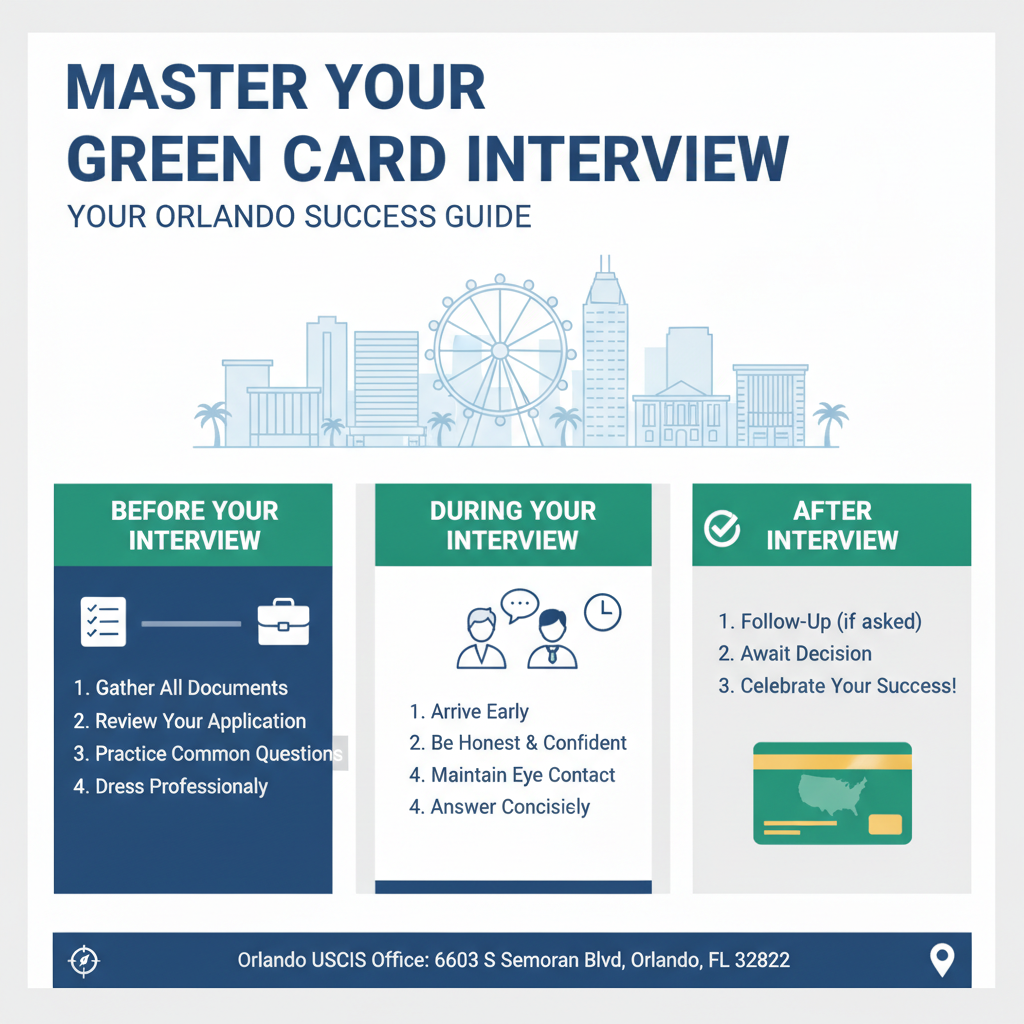
The importance of thorough preparation for your Green Card interview is a consistently highlighted topic in immigration law discussions. Recent trends emphasize the need for applicants to be meticulously prepared to ensure a smooth process. This focus is reflected in ongoing news from sources like Green Card Interview Preparation Tips (Immigration Law), which underscores the critical nature of this final step in securing permanent residency.
What This News Means for Immigrants in Orlando and Across Florida
The journey to obtaining a Green Card, or lawful permanent residency, is often long and complex, culminating in a critical interview with U.S. Citizenship and Immigration Services (USCIS). This interview is not just a formality; it's a pivotal moment where an immigration officer verifies all the information submitted in your application, assesses your eligibility, and determines your admissibility to the United States. For immigrants in Orlando, Central Florida, and throughout the nation, understanding how to prepare for this interview is paramount to success.
Why this news is showing up now
While the Green Card interview itself is a longstanding component of the immigration process, the emphasis on robust preparation is continually growing. USCIS, like many government agencies, is consistently refining its processes to enhance efficiency and integrity. This often translates into more detailed scrutiny during interviews. Furthermore, with evolving immigration policies and increased processing times, applicants are often under more pressure to get it right the first time. The current climate necessitates that applicants, especially those seeking Adjustment of Status within the U.S., approach their interview with meticulous attention to detail and a comprehensive understanding of their case. News reports frequently highlight the consequences of inadequate preparation, prompting attorneys and advocacy groups to reinforce the message of thoroughness.
How it can affect Florida residents
For individuals and families residing in Florida, particularly in the vibrant and diverse Orlando area, the implications of this focus on interview preparation are significant. Florida is home to a large immigrant population, and many residents are navigating the Green Card process through the Orlando USCIS Field Office. Whether you are applying through a family petition, an employment-based visa, or another category, your interview will likely take place at this local office or, for those undergoing Consular Processing, at a U.S. embassy or consulate abroad. The Orlando field office handles a high volume of cases, and officers are trained to identify inconsistencies or discrepancies. Therefore, residents of Orange County and the wider I-4 corridor must be exceptionally well-prepared. Understanding the specific requirements, gathering all necessary documents, and practicing your responses can make the difference between approval and a Request for Evidence (RFE) or, worse, a denial. Imigrar, located in Orlando, is acutely aware of the local nuances and processing patterns, offering tailored advice to our community.
Need Help? Our Orlando immigration team is ready to assist. Call +1 786-791-3106 for a free consultation, or message us online. Se Habla Español.
What Green Card Interview Preparation Is (and Why It Matters)
The Green Card interview is arguably the most crucial step in the application process for lawful permanent residency in the United States. It is a face-to-face meeting with a USCIS officer (for those adjusting status within the U.S.) or a Consular Officer (for those applying from abroad) whose primary goal is to verify the information provided in your application forms and supporting documents. They will also assess your admissibility to the U.S. and ensure you meet all statutory requirements for the Green Card category you are applying under.
A plain-English definition
In simple terms, a Green Card interview is like a final exam for your immigration application. You've submitted all your homework (forms and documents), and now you have to sit down with an official to prove that everything you've said is true, that you qualify for a Green Card, and that you don't pose any threat to the U.S. It’s your chance to present yourself, clarify any ambiguities, and demonstrate your eligibility directly to the decision-maker. This interview is designed to prevent fraud, ensure national security, and uphold the integrity of the immigration system.
Key terms you need to know
- Green Card: Official name for the Permanent Resident Card (Form I-551), which allows foreign nationals to live and work permanently in the United States.
- Adjustment of Status (AOS): The process of applying for a Green Card while physically present in the United States. This is typically done by filing Form I-485, Application to Register Permanent Residence or Adjust Status.
- Consular Processing: The process of applying for an immigrant visa (which leads to a Green Card) through a U.S. embassy or consulate in your home country. This is managed by the U.S. Department of State.
- USCIS: U.S. Citizenship and Immigration Services, the government agency that oversees lawful immigration to the United States.
- Sponsor/Petitioner: The U.S. citizen or lawful permanent resident who files an immigrant petition (e.g., Form I-130) on behalf of a foreign national relative. For employment-based cases, it's the employer.
- Beneficiary/Applicant: The foreign national seeking the Green Card.
- Affidavit of Support (Form I-864): A legally binding document filed by the sponsor to show they can financially support the immigrant and that the immigrant will not become a "public charge."
- Public Charge Rule: A long-standing provision in immigration law that allows the U.S. government to deny admission or a Green Card to individuals deemed likely to rely primarily on government assistance.
- Priority Date: The date your immigrant petition (e.g., Form I-130 or Form I-140) was filed. This date determines your place in line for a visa, especially for categories with annual quotas.
- Notice of Interview: The official letter from USCIS (Form I-797C, Notice of Action) or the National Visa Center (NVC) informing you of your interview date, time, and location, along with required documents.
- Request for Evidence (RFE): A letter from USCIS asking for additional documentation or information to support your application.
- Grounds of Inadmissibility: Specific reasons under U.S. immigration law why a foreign national may be denied entry or a Green Card (e.g., certain criminal offenses, health issues, immigration violations, public charge concerns).
Current Immigration Law: The Foundation
The legal framework governing Green Card eligibility and the interview process is primarily found in the Immigration and Nationality Act (INA), particularly in sections related to immigrant visas and Adjustment of Status. Understanding these foundational laws is key to preparing effectively.
Federal requirements
The INA outlines the general requirements for various Green Card categories. For example, Section 201 and 203 of the INA define the categories of immigrant visas available (e.g., family-sponsored, employment-based) and the annual numerical limitations. Section 245 of the INA specifically addresses Adjustment of Status for individuals already in the U.S., allowing them to obtain lawful permanent residency without leaving the country. Key federal requirements include:
- Eligibility for a Specific Green Card Category: You must qualify under one of the many categories, such as immediate relative of a U.S. citizen (spouse, unmarried child under 21, parent), family preference categories, employment-based categories, diversity visa lottery, or humanitarian programs.
- Admissibility: You must not be inadmissible to the U.S. on health, criminal, security, public charge, or previous immigration violation grounds (INA Section 212).
- Properly Filed Petitions and Applications: All necessary forms must be correctly filed and processed, including the underlying petition (e.g., Form I-130, Petition for Alien Relative; Form I-140, Immigrant Petition for Alien Worker) and the Green Card application itself (Form I-485 for AOS, or DS-260 for Consular Processing).
- Medical Examination: Most applicants must undergo a medical examination by a USCIS-approved civil surgeon (Form I-693, Report of Medical Examination and Vaccination Record) to ensure they do not have specific communicable diseases or other health-related inadmissibility issues.
- Financial Support: For family-based and some employment-based cases, the petitioner must submit an Affidavit of Support (Form I-864) to demonstrate they can financially support the applicant, preventing them from becoming a "public charge."
For detailed information on these forms and requirements, always refer to the USCIS official website.
Florida-specific considerations
While immigration law is federal, the practical application often involves local USCIS field offices. For Central Florida residents, the Orlando USCIS Field Office at 5449 Forbes Pl, Orlando, FL 32812, is where most Adjustment of Status interviews take place. Understanding the local office's procedures, typical processing times, and common interview styles can be beneficial. While the legal requirements remain the same nationwide, the specific officer you encounter, and their approach to questioning, can vary. Having local counsel like Imigrar, who are familiar with the Orlando office, can provide a significant advantage in preparing for your interview. We can help you anticipate the types of questions and concerns often raised in this specific jurisdiction.
You can find all necessary forms and instructions directly on the USCIS Forms page.
Navigating the complexities of immigration law requires expertise. Imigrar helps families and individuals in Orlando and across Florida prepare for Green Card interviews. Call us today at +1 786-791-3106 for a free, confidential consultation. Se Habla Español.
How to Prepare for Your Green Card Interview: A Complete Step-by-Step Guide
Thorough preparation is the bedrock of a successful Green Card interview. This comprehensive guide will walk you through the essential steps to ensure you are ready for this critical meeting.
1) Understand Your Case Type and Review Your Submitted Application
Before anything else, you must fully understand the specific Green Card category under which you applied. Whether it’s family-based (e.g., marriage to a U.S. citizen, parent-child), employment-based, or another category, each has unique eligibility criteria and focuses for the interview.
Action: Gather all copies of the forms you submitted, including:
- Form I-130, Petition for Alien Relative (if applicable)
- Form I-485, Application to Register Permanent Residence or Adjust Status (if applicable)
- Form I-140, Immigrant Petition for Alien Worker (if applicable)
- Form I-864, Affidavit of Support
- Form I-693, Report of Medical Examination and Vaccination Record
- Any other supporting forms (e.g., Form I-765, Form I-131)
Important: If you used an attorney or preparer, ask for copies of everything they submitted on your behalf.
2) Gather ALL Original Documents and Make Organized Copies
The Notice of Interview (Form I-797C) will list specific documents you need to bring. However, it is always best practice to bring originals and copies of *every* document you submitted with your application, plus any new documents that have become relevant since filing.
Action: Create an organized binder or folder with clearly labeled sections. Bring both originals and a complete set of copies for the officer.
Required Documents (General List – always check your specific Notice of Interview):
- Your Notice of Interview letter.
- Your passport (valid and expired, if any).
- Your birth certificate (original and certified translation if not in English).
- Your marriage certificate (if applicable, original and certified translation).
- Divorce decrees or death certificates for any previous marriages (for both applicant and petitioner, if applicable).
- Your EAD (Employment Authorization Document) and Advance Parole document (if you have them).
- Your Form I-94, Arrival/Departure Record.
- All previously submitted immigration forms (e.g., Form I-130, Form I-485, Form I-864, Form I-693).
- Additional copies of passport-style photos (check current USCIS requirements).
- Proof of U.S. citizen/LPR status for your petitioner (e.g., U.S. passport, birth certificate, Green Card).
- Medical examination report (Form I-693) in a sealed envelope, if you haven't submitted it yet or if it has expired.
- Police clearances from any country you lived in for more than 6 months since age 16 (for Consular Processing).
- Court and police records for any arrests or convictions (even if dismissed or expunged).
3) Prepare Specific Evidence for Your Case Type
Beyond the standard documents, you need to bring specific evidence to prove the bona fides (good faith) of your relationship or the validity of your employment petition.
For Marriage-Based Green Cards (most common in Orlando): The officer will heavily scrutinize the authenticity of your marriage.
- Joint Financial Documents: Joint bank accounts, joint credit card statements, joint tax returns (past 3 years), joint utility bills, joint mortgage/lease agreements, joint car titles/insurance.
- Co-mingling of Assets: Evidence you share financial responsibilities.
- Proof of Shared Life: Photos together over time (with dates and locations), affidavits from friends/family attesting to your relationship, travel itineraries together, life insurance policies naming each other as beneficiaries, wills, children's birth certificates (if applicable).
- Communication Records: Phone records, chat logs, emails (if recent and relevant, exercise discretion).
For Employment-Based Green Cards:
- Original job offer letter.
- Pay stubs, employment verification letters.
- Educational degrees, licenses, certifications relevant to the job.
- Evidence of your employer's continued ability to pay the offered wage.
Reminder: The more evidence you have that demonstrates a genuine, ongoing relationship or employment, the stronger your case.
4) Practice for the Interview and Anticipate Questions
The interview is a conversation, but it's also a formal legal proceeding. You need to be prepared to answer questions about your application, your life, and your relationship (if applicable) clearly and honestly.
Action:
- Review Your Application Thoroughly: Know every detail you submitted.
- Anticipate Questions:
- General: "Why do you want a Green Card?" "How did you meet your spouse?" "What is your spouse's job?" "Where do you live?" "Have you ever been arrested?" "Have you ever violated immigration law?"
- Marriage-based (deep dive): "What did you do on your first date?" "What side of the bed do you sleep on?" "What are your spouse's parents' names?" "Who pays the bills?" "What did you do for your last anniversary?" "Do you have pets?"
- Employment-based: "Describe your job duties." "What company do you work for?" "What are your qualifications?"
- Practice Answering: Practice with your spouse (if applicable) or a trusted friend. Speak clearly, concisely, and truthfully.
- Be Honest: Never lie or provide false information. If you don't know an answer, say so. If you need clarification, ask.
- Don't Volunteer Information: Answer the question asked, and stop. Do not elaborate unnecessarily unless prompted.
5) Understand Interview Day Logistics and Dress Code
The day of the interview can be stressful, but being prepared for the logistics can alleviate some anxiety.
Action:
- Location: Confirm the address of the Orlando USCIS Field Office well in advance. Plan your route, considering potential traffic on the I-4 corridor.
- Arrival Time: Arrive at least 30 minutes before your scheduled appointment. Security checks can take time.
- Dress Code: Dress professionally, as if for a job interview. This shows respect for the process and the officer.
- Interpreter: If you or your spouse (for marriage cases) are not fluent in English, you may need an interpreter. USCIS typically provides interpreters for certain languages, but often allows you to bring your own (who must be fluent in both English and your native language, and cannot be your petitioner or attorney). Confirm this with your attorney or USCIS. Se Habla Español. Imigrar can advise on interpreter needs.
- Children: If applying with children, they may need to attend, especially if they are over a certain age. Check your Notice of Interview.
6) What to Expect During the Interview
Knowing the general flow of the interview can help you feel more at ease.
Action:
- Oath: You will be sworn in to tell the truth.
- Identity Verification: The officer will verify your identity using your passport and other documents.
- Review of Application: The officer will go through your forms, confirming information and asking questions about your background, immigration history, and personal details.
- Relationship Questions (Marriage-Based): If applicable, you and your spouse may be interviewed together or separately. Questions will focus on the authenticity of your marriage.
- Admissibility Questions: You will be asked about criminal history, health issues, prior immigration violations, and public charge concerns.
- New Information: Be prepared to disclose any new information or changes since you filed your application (e.g., new address, new job, new baby, travel).
- Decision: Sometimes a decision is made on the spot, but often the officer will say they need to review the case further. You might receive a Request for Evidence (RFE) or a decision by mail within a few weeks or months.
Warning: The officer's tone may be neutral or even stern. Do not interpret this as hostility. They are simply doing their job to ensure due diligence. Remain calm, respectful, and truthful.
Feeling overwhelmed by the Green Card interview process? Let Imigrar guide you. Our experienced immigration attorneys in Orlando provide personalized preparation to ensure you’re ready. Call +1 786-791-3106 for a free consultation. Se Habla Español.
Practical Steps You Can Take Today
Don't wait until the last minute to prepare. Here are actionable steps you can start taking now to ensure a successful Green Card interview.
Actionable Checklist
Start checking these items off your list as soon as you receive your Notice of Interview:
- ✓ Locate your Notice of Interview and carefully read all instructions.
- ✓ Gather all original documents listed in your Notice of Interview.
- ✓ Make a complete set of copies of all documents, organized in a binder.
- ✓ Review every line of your submitted application forms (Form I-130, Form I-485, etc.).
- ✓ For marriage-based cases, compile compelling evidence of your bona fide marriage.
- ✓ Discuss potential interview questions with your spouse and practice your answers.
- ✓ Confirm the date, time, and location of your interview at the Orlando USCIS Field Office.
- ✓ Arrange for an interpreter if needed, and confirm USCIS policies on external interpreters.
- ✓ Schedule a consultation with an experienced immigration attorney at Imigrar for personalized preparation.
- ✓ Check the validity of your medical exam (Form I-693); if it's nearing expiration (typically 2 years from the civil surgeon's signature), be prepared to submit a new one.
- ✓ Ensure your passport is valid and not expired.
- ✓ Plan your travel to arrive at the USCIS office at least 30 minutes early.
Document Preparation Guidance
Organization is key. An organized presentation of documents can convey professionalism and make the officer's job easier, leaving a positive impression.
- Use a Binder or Folder: A three-ring binder with dividers for different sections (e.g., "Applicant's Documents," "Petitioner's Documents," "Relationship Evidence," "Financial Documents," "Medical Exam").
- Label Clearly: Label each divider with the type of documents it contains.
- Originals vs. Copies: Keep originals in a separate, secure pouch within the binder. Have a complete set of photocopies ready to hand to the officer. Do not give away your originals unless specifically requested and you are comfortable doing so.
- Certified Translations: Any document not in English must be accompanied by a complete and accurate English translation and a certification by the translator that they are competent to translate and that the translation is accurate.
- Photographs: For marriage-based cases, print photos showing various stages of your relationship (dating, engagement, wedding, holidays, with family/friends) and label them with dates and locations.
Timeline Expectations
Understanding the timeline can help manage expectations and reduce anxiety.
- Notice of Interview: Typically, you receive your Notice of Interview (Form I-797C) several weeks to a few months after your case is deemed "ready to be scheduled for an interview." You can check your case status and processing times on the USCIS Processing Times website.
- Interview Duration: Green Card interviews usually last between 20 minutes to an hour, but complex cases, especially marriage-based ones, can extend longer.
- Decision Time: While some decisions are made on the spot, it's more common to receive a decision by mail. USCIS aims to issue a decision within 30 days of the interview, but it can sometimes take several months, particularly if a Request for Evidence (RFE) is issued or if further background checks are required.
- Post-Interview Follow-Up: If you don't hear back within a reasonable timeframe (e.g., 90-day window), your attorney can help you follow up with USCIS.
How Imigrar Helps Immigrants in Orlando
At Imigrar, we understand that the Green Card interview is a high-stakes moment for you and your family. Our mission, "Keep Families Together," drives our commitment to providing expert, compassionate legal representation throughout this critical process. Based in Orlando, Florida, we serve clients not just locally, but nationwide, bringing extensive experience to every case.
Our team of dedicated immigration attorneys specializes in guiding clients through the complexities of the Green Card interview. We don't just fill out forms; we provide comprehensive support, including:
- Personalized Case Review: We meticulously review your entire application package, identifying any potential weaknesses or areas of concern that an officer might question.
- Thorough Document Preparation: We help you organize and compile all necessary original documents and supporting evidence, ensuring nothing is overlooked. For Central Florida residents, we are familiar with the specific expectations of the Orlando USCIS Field Office.
- Intensive Interview Preparation: We conduct mock interviews, asking questions similar to what USCIS officers might ask, especially for marriage-based cases. This practice builds confidence and helps you articulate your answers clearly and consistently.
- Legal Representation at the Interview: While not mandatory, having an attorney present at your interview can be invaluable. Your Imigrar attorney can clarify questions, address legal issues, and ensure your rights are protected, providing a calming presence.
- Post-Interview Support: If an RFE is issued or if there are delays, we will continue to advocate on your behalf, responding to USCIS inquiries and monitoring your case status.
We pride ourselves on our deep knowledge of immigration law and our commitment to our clients. We know the local landscape, from the I-4 corridor traffic to the specific procedures at the Orlando USCIS Field Office. Our bilingual team ensures that language is never a barrier, offering all our services in both English and Spanish. Se Habla Español.
Don't face this crucial interview alone. Let Imigrar be your trusted partner in securing your future in the United States. We offer a free consultation to discuss your case and how we can help you prepare for success.
Frequently Asked Questions
Q: Do all Green Card applicants need an interview?
A: Generally, most Green Card applicants applying through Adjustment of Status or Consular Processing are required to attend an interview. However, there


