


The journey to obtaining a Green Card, or lawful permanent residency, is a significant milestone for countless individuals and families seeking to build a new life in the United States. While the application process itself can be complex, the Green Card interview often stands as one of the most nerve-wracking yet crucial steps. This interview is your opportunity to present your case directly to a U.S. Citizenship and Immigration Services (USCIS) officer, providing evidence and answering questions to prove your eligibility for permanent residency.
At Imigrar, an immigration law firm based in Orlando, Florida, we understand the anxieties and hopes that accompany this vital interview. Our mission is to "Keep Families Together" by providing professional, compassionate, and effective legal guidance. We serve clients not only across Central Florida but nationwide, ensuring that every individual is thoroughly prepared for what lies ahead.
Feeling overwhelmed by your upcoming Green Card interview? Don't face it alone. Our experienced Orlando immigration team at Imigrar is here to guide you through every step. Call +1 786-791-3106 for a free consultation, or message us online. Se Habla Español.
The reporting that sparked this guide
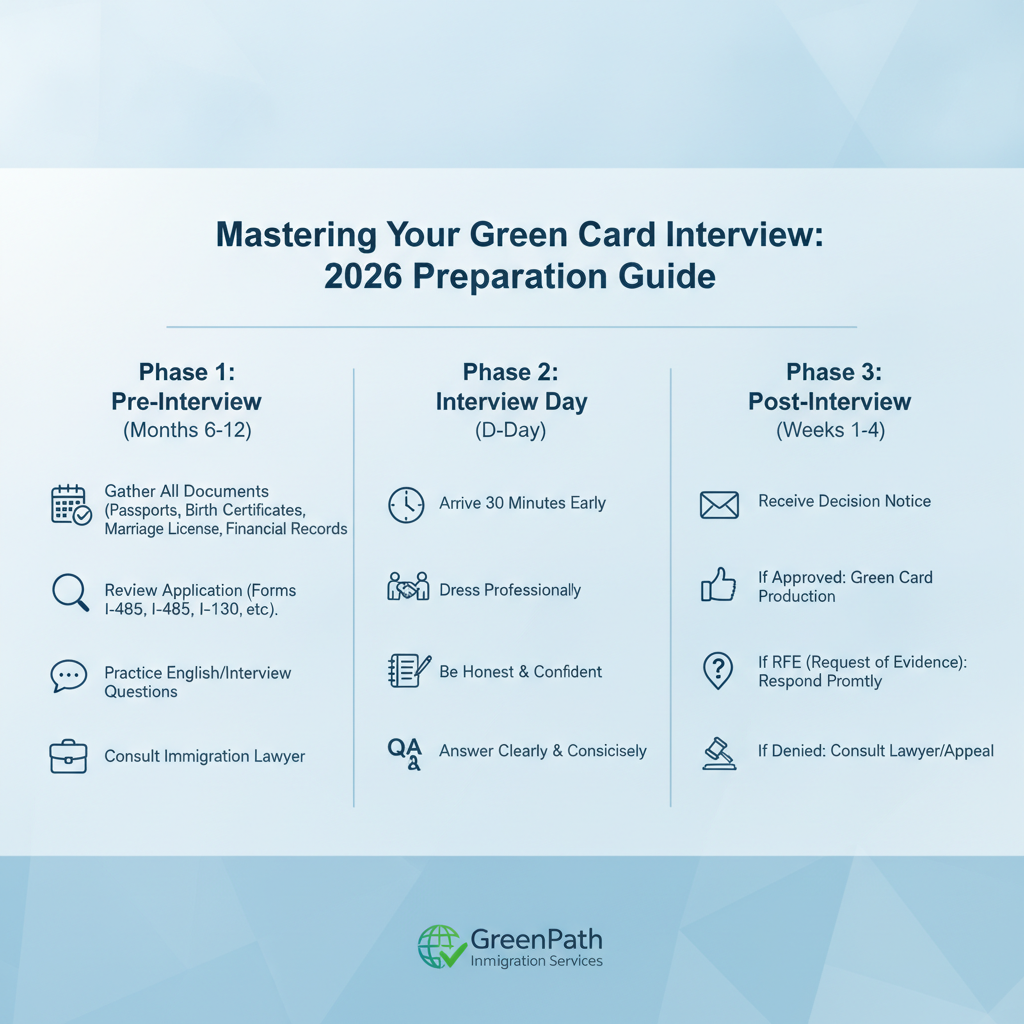
The ongoing conversation around immigration law, particularly concerning the intricacies of the Green Card application process, consistently highlights the importance of thorough preparation for interviews. News outlets and legal resources frequently emphasize the need for applicants to be well-versed in their own cases and to present compelling evidence. This continuous focus underscores that while the legal framework may evolve, the fundamental requirement for a well-prepared applicant remains constant. This guide draws upon the collective understanding and recurring advice found in expert discussions on Green Card Interview Preparation Tips (Immigration Law), aiming to provide you with the most current and actionable strategies for success.
What This News Means for Immigrants in Orlando and Across Florida
The consistent emphasis on Green Card interview preparation reflects the enduring nature of this critical step in the immigration process. For immigrants, especially those residing in a dynamic and diverse state like Florida, understanding and preparing for this interview is not just advisable; it's essential for a successful outcome.
Why this news is showing up now
In 2026, the discussion around Green Card interviews remains as relevant as ever due to several factors. Firstly, USCIS continues to process a significant backlog of applications, meaning interviews are a regular occurrence. While there have been ongoing efforts to streamline the process and even waive interviews for certain low-risk cases, the vast majority of applicants, particularly those applying for Adjustment of Status based on family petitions, will still be called for an interview. The consistency of this requirement keeps the topic in the spotlight for legal experts and immigration news outlets.
Secondly, evolving administrative policies and technological updates within USCIS often lead to subtle shifts in interview procedures or the types of questions officers are trained to ask. Staying informed means being aware of these potential changes, even if the core purpose of the interview remains the same. The legal landscape is always dynamic, and even minor adjustments can have significant implications for applicants.
Finally, the sheer volume of new applications, coupled with the natural human desire for guidance through complex legal procedures, ensures that "Green Card Interview Preparation Tips" is a perennially trending topic. People are always seeking clarity and strategies to navigate this high-stakes meeting successfully.
How it can affect Florida residents
For the vibrant immigrant communities in Florida, including those in Orlando, Miami, Tampa, and along the I-4 corridor, the need for diligent interview preparation is particularly pertinent. Florida is home to a vast and diverse immigrant population, with many applying for family-based Green Cards. This means that thousands of Floridians will receive an interview notice at some point in their immigration journey.
If your case is in Orlando, your interview will likely be scheduled at the Orlando USCIS Field Office. Understanding the local office's procedures and typical interview environment can be a distinct advantage. While federal law governs immigration, the local field office's operational nuances can sometimes influence the experience. For Central Florida residents, preparing means not only understanding federal requirements but also being familiar with the logistics of attending an interview at the specific Orlando location.
Moreover, Florida’s unique demographics mean that many applicants may come from diverse linguistic and cultural backgrounds. This underscores the importance of understanding the need for interpreters, if applicable, and ensuring cultural nuances are respectfully addressed during preparation. Imigrar, with its roots in Orlando and a team fluent in English and Spanish, is uniquely positioned to assist the diverse needs of Florida's immigrant population, ensuring that language or cultural barriers do not hinder a successful interview outcome.
The impact of a successful interview extends beyond just the individual; it means keeping families together, allowing individuals to contribute fully to their communities, and fostering economic growth in places like Orange County. Conversely, an unprepared interview can lead to delays, Requests for Evidence (RFEs), or even denial, causing significant stress and disruption. Therefore, comprehensive preparation is not just a recommendation; it's a necessity for Florida residents pursuing permanent residency.
What the Green Card Interview Is (and Why It Matters)
The Green Card interview is a pivotal moment in the immigration process, serving as the final in-person assessment of your eligibility for lawful permanent residency in the United States. It's a formal meeting with a USCIS officer designed to verify the information provided in your application, confirm your eligibility, and ensure that no grounds of inadmissibility apply to your case. Understanding this interview is crucial for anyone seeking a Green Card.
A plain-English definition
Simply put, the Green Card interview is your face-to-face meeting with an immigration officer. Think of it as a thorough verification step. The officer will review your application forms, examine your original documents, and ask you questions about your life, your background, and the basis of your Green Card application. For example, if you're applying based on marriage to a U.S. citizen, the officer will ask questions to confirm that your marriage is genuine and not solely for immigration purposes (a "bona fide" marriage). If you're applying based on a family petition, they'll verify the relationship. The goal is to ensure you meet all legal requirements and that there are no red flags or misrepresentations in your case. Both the applicant (beneficiary) and, in many family-based cases, the U.S. citizen or lawful permanent resident relative (petitioner) must attend.
Key terms you need to know
Navigating the Green Card process requires familiarity with specific legal terminology. Here are some essential terms related to your interview:
- Green Card: Formally known as a Permanent Resident Card, it is proof of your authorization to live and work permanently in the United States.
- Adjustment of Status (AOS): This is the process of applying for a Green Card while you are already inside the United States. The interview for AOS typically takes place at a USCIS Field Office, such as the one in Orlando.
- Consular Processing: This is the process of applying for a Green Card from outside the United States, typically at a U.S. Embassy or Consulate in your home country. While this guide focuses on Adjustment of Status interviews, many preparation tips are transferable.
- USCIS (U.S. Citizenship and Immigration Services): The government agency responsible for processing immigration benefits, including Green Card applications and interviews.
- Petitioner: The U.S. citizen or lawful permanent resident who files an immigration petition (e.g., Form I-130, Petition for Alien Relative) on behalf of an eligible foreign national.
- Beneficiary: The foreign national (you) who is seeking an immigration benefit, such as a Green Card, based on a petition filed by a petitioner.
- Form I-130, Petition for Alien Relative: The initial form filed by a U.S. citizen or LPR to establish a qualifying relationship with a foreign national.
- Form I-485, Application to Register Permanent Residence or Adjust Status: The main application form filed by the beneficiary to apply for a Green Card while in the U.S. This is the application that leads to the interview.
- Form I-864, Affidavit of Support: A legally binding document filed by the petitioner (and sometimes a joint sponsor) to show that the immigrant will have adequate financial support and will not become a "public charge." This is a crucial document for family-based Green Cards.
- Form I-693, Report of Medical Examination and Vaccination Record: A document completed by a USCIS-approved civil surgeon, certifying that the applicant has undergone a medical examination and is free of certain communicable diseases and has received required vaccinations.
- Inadmissibility: Specific grounds under U.S. immigration law that can make a person ineligible for a Green Card or other immigration benefits. These can include certain criminal convictions, health issues, immigration violations, or security concerns.
- Priority Date: The date USCIS receives your Form I-130 (or other qualifying petition). This date determines when an immigrant visa becomes available, especially for categories with annual numerical limits.
Understanding these terms will not only help you comprehend your application process but also enable you to communicate more effectively with your attorney and the interviewing officer.
Unsure about the terminology or your specific case? Our team at Imigrar can clarify everything. Reach out for expert legal assistance. Call +1 786-791-3106 for a free consultation, or message us online. Se Habla Español.
Current Immigration Law: The Foundation
The Green Card interview is conducted under the authority of the Immigration and Nationality Act (INA), the primary body of U.S. immigration law. This comprehensive statute outlines who is eligible for permanent residency, the various pathways to achieve it, and the grounds that may lead to denial. A solid understanding of the legal foundation of your application is paramount for a successful interview.
Federal requirements
The eligibility for a Green Card is primarily determined by federal law, specifically the INA. Most family-based Green Card applications, which often involve an interview, fall under several key sections:
- INA § 201 and § 203: These sections define the categories of immigrants eligible for Green Cards (e.g., immediate relatives of U.S. citizens, family-sponsored preferences) and establish annual numerical limitations for certain categories.
- INA § 204: This section outlines the petitioning process, such as the filing of Form I-130 by a U.S. citizen or lawful permanent resident to establish a qualifying family relationship.
- INA § 212: This critical section details the grounds of inadmissibility. During your interview, the officer will assess whether any of these grounds apply to you. These can include health-related grounds, criminal grounds, security-related grounds, public charge considerations (addressed by Form I-864), and prior immigration violations.
- INA § 245: This section governs the Adjustment of Status process, allowing eligible individuals already present in the U.S. to obtain permanent residency without leaving the country. The interview is a direct requirement of this process.
For family-based applications, the core legal requirement is to prove a "bona fide" relationship. For marriage-based Green Cards, this means demonstrating that the marriage is real and entered into in good faith, not solely to obtain an immigration benefit. For other family petitions, it means proving the biological or legal relationship (e.g., parent-child, sibling relationship).
All applicants must also demonstrate good moral character and pass security checks. The Form I-693 medical exam ensures you meet health requirements and have received necessary vaccinations, aligning with public health standards.
Florida-specific considerations
While U.S. immigration law is federal, the practical application often involves local USCIS Field Offices. For residents of Central Florida, the Orlando USCIS Field Office is where most Green Card interviews for Adjustment of Status are conducted. This office serves a wide geographical area, including Orange County and surrounding regions.
There are no state-specific immigration laws in Florida that affect your federal Green Card eligibility or interview requirements. However, understanding the local context is helpful:
- Orlando Field Office Procedures: While fundamental interview procedures are standard nationwide, each field office develops its own rhythm and minor procedural variations. An experienced local immigration attorney, like those at Imigrar, will have familiarity with the Orlando office's specific nuances, helping you prepare more effectively.
- Diverse Caseload: The Orlando office processes a broad spectrum of cases reflecting Florida's diverse immigrant population. This includes numerous family-based petitions, employment-based applications, and sometimes cases related to humanitarian relief.
- Language Access: Given Florida's significant Spanish-speaking population, the Orlando office is accustomed to providing interpreters or accommodating applicants who bring their own. However, relying on your own interpreter (pre-approved by USCIS) or an attorney who can facilitate communication, especially Se Habla Español, can be highly beneficial.
Reminder: All communication and documentation with USCIS must be in English or accompanied by certified English translations. This is a critical federal requirement that applies universally, including in Florida.
For official information, forms, and updates regarding federal immigration law, always refer to the USCIS official website. This site provides the most accurate and up-to-date details on all forms, requirements, and processing guidelines.

How to Prepare for Your Green Card Interview: A Complete Step-by-Step Guide
The Green Card interview is a critical juncture in your immigration journey. Proper preparation can significantly increase your chances of a smooth and successful outcome. This comprehensive guide outlines the essential steps to ensure you're fully ready for your interview.
1) Understand Your Interview Notice and Case Type
Your first step begins the moment you receive your interview notice, typically Form I-797C, Notice of Action. This document is paramount. It will specify:
- Date and Time: Mark this immediately and ensure no conflicts.
- Location: For Orlando residents, this will likely be the Orlando USCIS Field Office. Plan your route, travel time, and parking in advance. Aim to arrive at least 30-45 minutes early.
- Required Documents: The notice will list specific original documents and evidence you MUST bring. Do not overlook this list.
- Case Type: Understand the basis of your application (e.g., marriage-based, parent-child, employment-based). This will dictate the types of questions and evidence the officer will focus on. For marriage-based cases, both the petitioner and beneficiary are usually required to attend.
Important: Read every word of your interview notice carefully. It contains crucial instructions specific to your appointment.
2) Gather ALL Original Documents and Copies
This is arguably the most critical step. The officer needs to see original documents and will keep copies for your file. Organize these meticulously. It’s always better to bring more than you think you need, especially for marriage-based cases where proof of a bona fide marriage is paramount.
General Documents for BOTH Petitioner and Beneficiary:
- Your interview notice (Form I-797C).
- Valid government-issued photo identification (e.g., passport, driver's license).
- Birth certificates (original and copy).
- Marriage certificate (original and copy, if applicable).
- Divorce decrees or death certificates for any previous marriages (original and copy).
- Form I-693, Report of Medical Examination and Vaccination Record (if not already submitted, it must be in a sealed envelope from the civil surgeon).
- Passport-style photos (check the exact number required on your notice or USCIS website).
- Copy of your entire Form I-485 application package, including all supporting documents you originally submitted.
- Copy of the filed Form I-130 petition (if applicable).
- Original I-94 arrival/departure record (if applicable).
- Employment authorization document (EAD) and Advance Parole document (if you have them).
- Any criminal records, court dispositions, or police reports (even for minor offenses).
- Certified English translations for any document not in English, along with the original document.
Specific Documents for Marriage-Based Green Cards (to prove bona fide marriage):
- Joint bank account statements (showing both names).
- Joint utility bills (electricity, water, internet, cell phone).
- Joint lease agreements or mortgage statements (showing shared residence).
- Joint credit card statements.
- Vehicle titles or insurance policies in both names.
- Health, life, or auto insurance policies listing each other as beneficiaries.
- Children's birth certificates (if you have children together).
- Photos of you together from different periods (wedding, holidays, vacations, with family/friends).
- Affidavits from friends/family attesting to the legitimacy of your marriage (optional, but can be helpful).
- Airline tickets, hotel reservations, or other travel itineraries from trips taken together.
- Correspondence (letters, emails, text messages) exchanged between you, demonstrating ongoing relationship.
- Any other documents showing commingling of financial affairs or shared life.
For the Petitioner (Sponsor):
- Proof of U.S. citizenship or lawful permanent residency (e.g., U.S. passport, birth certificate, Green Card).
- Original Form I-864, Affidavit of Support, with all required attachments.
- Federal income tax returns (IRS transcripts or copies of Form 1040 with all schedules) for the past three years.
- Proof of current employment (e.g., recent pay stubs, employment verification letter).
Warning: Ensure all documents are current and valid. Expired documents will not be accepted.
3) Organize Your Evidence Meticulously
A well-organized presentation makes a strong impression and helps the interview proceed smoothly. Create separate folders or binders for different categories of documents:
- Application Forms: Your copy of Form I-485, I-130, I-864, etc.
- Personal Documents: Birth certificates, passports, marriage certificates.
- Financial Documents: Tax returns, pay stubs, joint bank statements.
- Proof of Relationship: Photos, joint bills, leases, affidavits.
- Medical Exam: The sealed Form I-693.
Use tabs and labels to clearly identify each section. Arrange documents chronologically within each section. This organization demonstrates your thoroughness and respect for the process, making it easier for the officer to review your case efficiently.
4) Review Your Application Forms Thoroughly
You must know every answer you provided on your Form I-485, Form I-130, and all other submitted forms. The interviewing officer will compare your verbal answers to the written information. Inconsistencies, even minor ones, can raise red flags and lead to further questioning or delays.
- Go through each form line by line.
- Familiarize yourself with dates, addresses, employment history, and travel history.
- If you discover any errors or omissions, discuss them immediately with your attorney. You may need to prepare an explanation or an updated form to present at the interview.
Reminder: Honesty is paramount. Do not attempt to conceal information. If there's an issue, it's best to address it transparently with legal guidance.
5) Practice Answering Potential Questions
While you cannot predict every question, many common themes arise in Green Card interviews. Practice answering these questions clearly, concisely, and honestly. For marriage-based cases, expect questions designed to gauge the authenticity of your relationship.
Common Questions for All Applicants:
- What is your full name, date of birth, and place of birth?
- Have you ever been arrested or convicted of a crime?
- Have you ever been deported or removed from the U.S.?
- Have you ever committed immigration fraud or misrepresented yourself?
- Do you understand the oath you just took (to tell the truth)?
Common Questions for Marriage-Based Applicants (both spouses):
- How did you meet? When and where was your first date?
- Who proposed? When and where?
- What are your spouse's full name, date of birth, and parents' names?
- What do you do for work? Where do you work?
- What are your daily routines? (e.g., who wakes up first, who cooks, who cleans?)
- Do you have any pets? What are their names?
- Where do you live? How many bedrooms are in your home? What color is your toothbrush?
- Who handles the finances? Do you have joint bank accounts?
- Have you traveled together? Where and when?
- What are your future plans together?
Warning: Answer only the question asked. Do not volunteer extra information unless it directly clarifies your answer. If you don't understand a question, politely ask the officer to repeat or rephrase it.
6) Dress Professionally and Arrive Early
First impressions matter. Dress in clean, neat, and conservative attire, as you would for a job interview. This shows respect for the officer and the process. Arriving early is also crucial. Aim to be at the USCIS Field Office at least 30-45 minutes before your scheduled appointment. This allows time for security checks, finding parking, and calming your nerves. Being late can lead to your interview being rescheduled or even denied. For those in Orlando, consider potential traffic delays on I-4 or other major routes, especially during peak hours.
7) Understand the Role of Your Attorney
While not legally required, having an experienced immigration attorney with you at the interview is highly recommended. Your attorney can:
- Provide a final review of your documents before the interview.
- Offer reassurance and support during the interview.
- Clarify questions or statements made by the officer


