


The journey to obtaining a Green Card, or lawful permanent residency in the United States, is often a complex and highly personal one. For many, the Green Card interview represents the culmination of months, or even years, of careful preparation and anticipation. This critical step determines whether an applicant will be granted the privilege of living permanently in the U.S., allowing families to stay together and build new lives.
At Imigrar, an immigration law firm based in Orlando, Florida, we understand the stakes involved. Our mission, "Keep Families Together," drives us to provide clear, actionable, and compassionate legal guidance to immigrants nationwide. This comprehensive guide is designed to demystify the Green Card interview process, offering you the knowledge and tools needed to approach it with confidence and clarity.
Need Expert Guidance? Don't face your Green Card interview alone. Our experienced Orlando immigration team is ready to assist you every step of the way. Call +1 786-791-3106 for a free consultation, or message us online. Se Habla Español.
The reporting that sparked this guide:
The ongoing discourse and frequent queries surrounding immigration procedures, particularly the Green Card interview, consistently highlight its significance and the need for clear guidance. The insights and questions emerging from general Green Card Interview Preparation Tips (Immigration Law) news and discussions underscore the critical role preparation plays in a successful outcome.
What This News Means for Immigrants in Orlando and Across Florida
The Green Card interview is a pivotal moment for any applicant, regardless of where they reside. For immigrants in Orlando, across Florida, and indeed nationwide, understanding how to effectively prepare for this interview is not just helpful—it's essential for success.
Why this news is showing up now
The topic of Green Card interview preparation is perennially relevant, but its prominence often fluctuates with changes in immigration policy, processing times, and public awareness campaigns. In 2026, several factors contribute to its heightened importance:
- Increased Efficiency and Processing: USCIS has made efforts to reduce backlogs and streamline processes, leading to more interview notices being issued. While this is positive, it also means applicants need to be ready to act quickly.
- Evolving Adjudication Standards: Immigration law is dynamic. While the core requirements for a Green Card remain largely consistent, the nuances of how adjudicators assess cases can evolve. This necessitates up-to-date preparation advice.
- Focus on Case Integrity: There's an ongoing emphasis on ensuring the integrity of applications, particularly for family-based petitions. This translates to more thorough interviews where applicants must clearly demonstrate eligibility and the bona fides of their relationships.
- Digital Information Accessibility: With more information available online, there's also a greater volume of both accurate and inaccurate advice circulating. This makes reliable, expert guidance, such as what Imigrar provides, more crucial than ever.
- Applicant Anxiety: For many, the interview is the most stressful part of the Green Card process. The demand for clear, practical advice on how to navigate this anxiety and perform well is consistently high.
How it can affect Florida residents
While federal immigration law applies uniformly across the U.S., local factors can certainly influence the experience of Florida residents:
- Orlando USCIS Field Office: Applicants residing in Central Florida, including Orlando, Orange County, and surrounding areas along the I-4 corridor, will typically have their interviews scheduled at the Orlando USCIS Field Office. Familiarity with this specific office's procedures, common interviewers, and local nuances can be a significant advantage.
- Diverse Population: Florida is home to a vast and diverse immigrant population. This means the Orlando office handles a wide array of cases, from marriage-based adjustments to employment-based petitions and asylum adjustments. Tailored preparation is key for each unique situation.
- Processing Times: While USCIS strives for consistency, processing times can vary by field office depending on caseloads and staffing. Keeping an eye on the USCIS Processing Times for the Orlando office is vital for managing expectations.
- Accessibility to Legal Counsel: Having access to experienced local immigration attorneys, like those at Imigrar, who are familiar with the Orlando Field Office and its practices, offers a distinct advantage. Our team can provide tailored advice based on specific local trends and insights.
- Stress and Logistics: The interview day itself can be stressful. For Florida residents, understanding traffic patterns in the Orlando area, parking at the field office, and ensuring all necessary documents are accessible can alleviate additional anxiety.
Understanding these aspects will not only help you prepare for your Green Card interview but also navigate the entire immigration process more effectively, especially if your case is handled in Orlando.
What Green Card Interview Preparation Is (and Why It Matters)
The Green Card interview is the final, in-person assessment by a USCIS officer to determine your eligibility for permanent residency in the United States. It is a mandatory step for most individuals applying for a Green Card through Adjustment of Status (AOS), where they are already present in the U.S., or through Consular Processing, where the interview takes place at a U.S. embassy or consulate abroad.
A plain-English definition
Think of the Green Card interview as a conversation with a government official where you confirm the information you've provided in your application, answer questions about your background, and provide additional evidence to support your case. For family-based petitions, especially marriage-based ones, the interview aims to verify the legitimacy of your relationship. It's an opportunity for USCIS to ensure that you meet all legal requirements for a Green Card and that no grounds of inadmissibility apply to you.
Key terms you need to know
Navigating the immigration process requires understanding specific terminology. Here are some key terms related to your Green Card interview:
- Adjustment of Status (AOS): The process by which eligible individuals already in the United States can apply for lawful permanent resident status (a Green Card) without having to return to their home country. The interview is a key part of this process.
- Consular Processing: The process by which individuals outside the United States apply for an immigrant visa at a U.S. embassy or consulate in their home country. Once approved, they enter the U.S. as lawful permanent residents.
- Petitioner: The U.S. citizen or lawful permanent resident who files an immigrant petition (e.g., Form I-130) on behalf of an eligible relative.
- Beneficiary: The immigrant who is being petitioned for, and who will receive the Green Card if approved.
- Priority Date: The date USCIS receives your immigrant petition (e.g., Form I-130). This date determines your place in the visa queue, especially for categories with annual visa limits.
- Affidavit of Support (Form I-864): A legally binding contract signed by the petitioner (and sometimes a joint sponsor) to accept financial responsibility for the immigrant. This ensures the immigrant will not become a "public charge."
- Public Charge Rule: A ground of inadmissibility under U.S. immigration law. Immigrants who are likely to become primarily dependent on the government for subsistence may be deemed a "public charge" and denied a Green Card.
- Bona Fide Marriage: A marriage entered into in good faith, not solely for the purpose of obtaining an immigration benefit. Proving a bona fide marriage is crucial for marriage-based Green Card applications.
- Notice of Intent to Deny (NOID): A letter from USCIS indicating that they intend to deny your application unless you provide additional information or evidence within a specified timeframe.
- Request for Evidence (RFE): A letter from USCIS asking for additional documents or information to support your application.
Understanding these terms will empower you to better comprehend the questions asked during your interview and the overall process, reducing stress and increasing your chances of success.
Feeling Overwhelmed? The terminology and process can be confusing. Let Imigrar simplify it for you. Schedule a free consultation with our Orlando immigration lawyers today at +1 786-791-3106. We speak English and Se Habla Español.
Current Immigration Law: The Foundation
The legal framework for obtaining a Green Card is primarily established by the Immigration and Nationality Act (INA), specifically sections related to eligibility for permanent residency. This comprehensive law outlines the various categories under which an individual can apply for a Green Card, the criteria they must meet, and the procedures involved.
Federal requirements
The Green Card interview process is governed by federal immigration laws and regulations. Key aspects include:
- Eligibility Categories: Applicants typically fall into family-based, employment-based, refugee/asylee, or special immigrant categories. Each category has specific requirements outlined in the INA. For instance, family-based immigration is primarily governed by INA Sections 201, 203, and 204.
- Required Forms:
- Form I-130, Petition for Alien Relative: Filed by a U.S. citizen or lawful permanent resident to establish a qualifying relationship with a foreign national.
- Form I-485, Application to Register Permanent Residence or Adjust Status: Filed by an eligible foreign national already in the U.S. to adjust their status to lawful permanent resident.
- Form I-864, Affidavit of Support: Submitted by the petitioner to demonstrate financial capability to support the beneficiary.
- Form I-693, Report of Medical Examination and Vaccination Record: Completed by a USCIS-approved civil surgeon to verify health requirements.
- Form I-765, Application for Employment Authorization (often filed concurrently with Form I-485).
- Form I-131, Application for Travel Document (often filed concurrently for Advance Parole).
You can find all official forms and instructions on the USCIS Forms page.
- Admissibility Standards: The INA also details grounds of inadmissibility, which can prevent an applicant from receiving a Green Card. These include health-related grounds, criminal grounds, security grounds, public charge grounds, and misrepresentation.
- Burden of Proof: The applicant bears the burden of proof to demonstrate eligibility for the Green Card and to overcome any grounds of inadmissibility. This is why thorough preparation and documentation are paramount for the interview.
For detailed information, always refer to the USCIS official website and the U.S. Department of State for consular processing guidelines.
Florida-specific considerations
While the underlying federal law is consistent, its application in Florida includes practical considerations for residents:
- Orlando USCIS Field Office: If you live in Orlando, Kissimmee, Sanford, or anywhere in Central Florida, your Adjustment of Status interview will likely be conducted at the USCIS Field Office located in Orlando. It's crucial to be aware of the specific address and arrive well in advance of your scheduled appointment.
- Local Attorney Expertise: An immigration attorney based in Orlando, like Imigrar, will have direct experience with the local field office, including common practices, adjudicators' expectations, and processing patterns. This local insight can be invaluable for preparing your case effectively.
- Medical Exam Providers: Florida residents must ensure their Form I-693 is completed by a USCIS-approved civil surgeon. A list of approved surgeons can be found on the USCIS website.
- Cultural Nuances: Florida's diverse population means that interviews may involve interpreters for various languages, particularly Spanish. At Imigrar, Se Habla Español, ensuring seamless communication for our Spanish-speaking clients.
Understanding these federal requirements and local considerations is fundamental to a successful Green Card application and interview process in Florida.
How to Prepare for Your Green Card Interview: A Complete Step-by-Step Guide
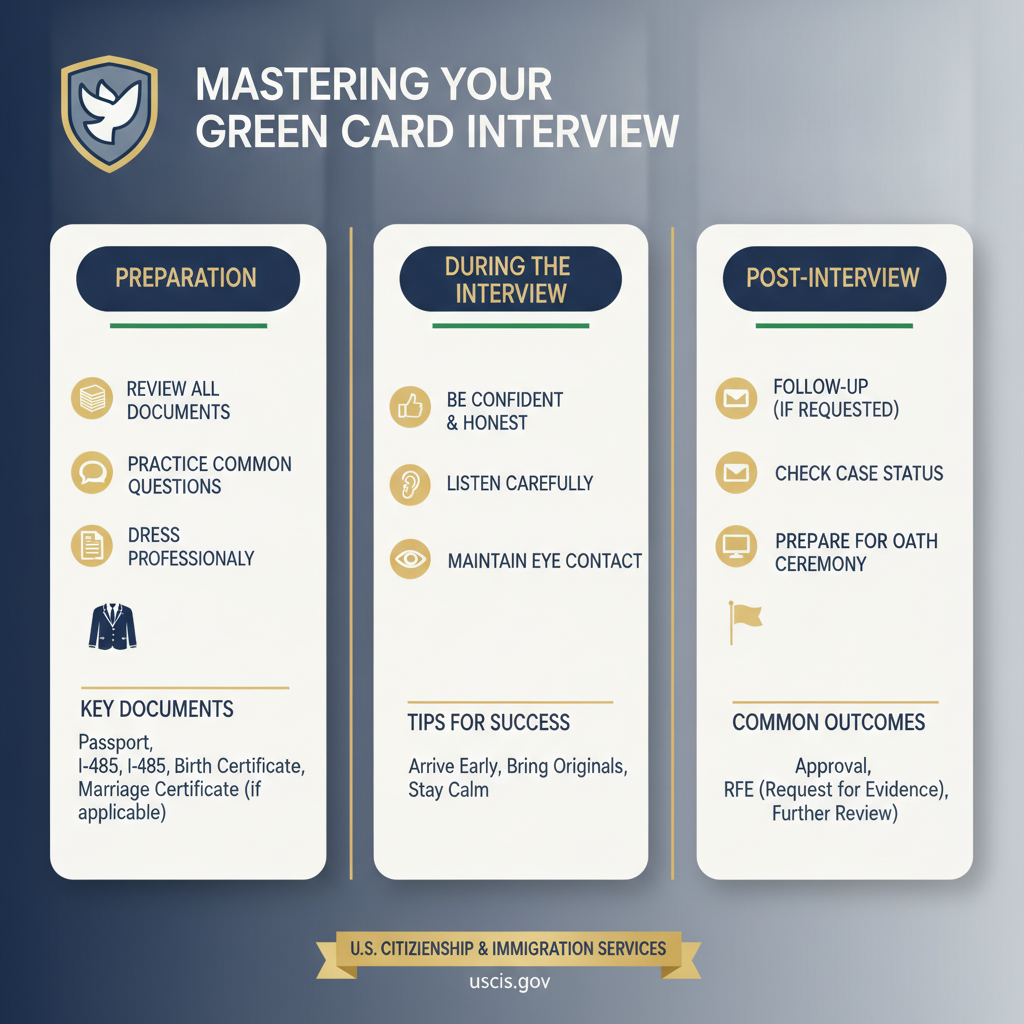
The Green Card interview is a critical step, and thorough preparation can significantly increase your chances of success. Follow this comprehensive guide to ensure you're ready for every aspect of your interview.
1) Understand Your Case & Review Your Application
Before anything else, you must have a complete understanding of your own application. The interviewing officer will ask questions directly from the forms you submitted. Any inconsistencies, even minor ones, can raise red flags.
- Review All Submitted Forms: Go through every single form you filed (Form I-130, Form I-485, Form I-864, etc.) line by line. Familiarize yourself with every answer you provided.
- Know Your Personal History: Be prepared to discuss your immigration history, employment history, residences, travel, and marital history in detail.
- Understand the Basis of Your Application: If it's marriage-based, know the specifics of how you met, your relationship timeline, and shared life experiences. If it's employment-based, understand your job duties and the sponsoring company.
Required Documents for this step (for your review, not to submit yet):
- Copies of all immigration forms previously filed (e.g., Form I-130, Form I-485, Form I-864, Form I-765, Form I-131).
- Copies of all supporting documents submitted with your application (birth certificates, marriage certificates, previous visas, etc.).
2) Gather & Organize All Original Documents
You must bring the originals of all documents that you previously submitted as copies. This is perhaps the most crucial logistical step. Create a well-organized binder with tabs for easy access to each category of documents.
- Personal Identification & Status Documents:
- Valid passport(s)
- Birth certificate (original and certified translation if applicable)
- Marriage certificate (original and certified translation if applicable)
- Divorce decrees (if applicable, original and certified translation)
- Any previous visas, entry stamps, and I-94 records
- State-issued photo ID (e.g., Florida Driver's License or ID card)
- Social Security card
- Application-Specific Forms & Evidence:
- Your interview notice (Important: You cannot enter the USCIS office without it!)
- Your most recent Form I-693 (Report of Medical Examination), sealed in the envelope from the civil surgeon. Do NOT open this envelope.
- Originals of all supporting documents for Form I-130 and Form I-485.
- Financial Documents (for Form I-864):
- Original Form I-864 (if not already submitted or if an updated one is requested)
- Petitioner's (and joint sponsor's, if applicable) federal income tax returns (IRS transcripts preferred) for the last three years.
- Proof of current employment (e.g., recent pay stubs, employment verification letter).
- Proof of assets (bank statements, property deeds, etc., if relying on assets).
- Police & Court Records:
- Original certified copies of any arrest records, court dispositions, or police reports, even for minor offenses, and regardless of whether charges were dropped or dismissed. Bring certified translations if not in English.
Reminder: For any document not in English, you must provide a certified English translation along with a copy of the original document.
3) Prepare Evidence of a Bona Fide Relationship (for Marriage-Based Green Cards)
If you are applying for a Green Card based on marriage to a U.S. citizen or permanent resident, proving your marriage is genuine is paramount. USCIS scrutinizes these cases to prevent marriage fraud.
- Co-mingling of Finances:
- Joint bank accounts (statements showing activity over time)
- Joint credit card statements
- Joint loans (car, house, personal)
- Joint tax returns (filed as "married filing jointly")
- Shared Residence:
- Joint lease agreements or mortgage statements
- Utility bills in both names at the same address
- Property deeds showing joint ownership
- Driver's licenses or state IDs showing the same address
- Insurance & Beneficiary Designations:
- Health, life, and car insurance policies listing each other as beneficiaries or joint policyholders.
- Wills or trusts naming each other.
- Retirement accounts or investment accounts listing each other as beneficiaries.
- Photographs & Correspondence:
- Photos together (family, friends, vacations) with dates and explanations.
- Correspondence (emails, text messages, cards, letters) showing communication over time.
- Travel itineraries for trips taken together.
- Affidavits from Friends & Family:
- Letters from people who know you as a couple, attesting to the legitimacy of your marriage. These should be notarized and include the affiant's contact information.
Warning: The more comprehensive and consistent your evidence, the stronger your case. USCIS is looking for a pattern of shared life, not just isolated documents.
4) Practice Your Interview
A mock interview can significantly reduce anxiety and help you articulate your answers clearly and concisely. Practice with your spouse (if applicable) and/or your attorney.
- Anticipate Questions: Prepare for common questions about your application, personal history, and (for marriage-based cases) your relationship.
- Be Truthful and Consistent: Always tell the truth. Your answers must be consistent with your submitted application. If you made an honest mistake on a form, be prepared to explain it clearly.
- Listen Carefully: Make sure you understand the question before answering. Don't be afraid to ask for clarification.
- Concise Answers: Answer directly and avoid volunteering unnecessary information.
- Attorney's Role: If you have an attorney, they can conduct a mock interview and prepare you for specific questions based on your case file and the Orlando USCIS Field Office's practices.
5) Understand Interview Day Logistics
The day of the interview itself requires careful planning to ensure a smooth experience.
- Arrive Early: Plan to arrive at the Orlando USCIS Field Office at least 30 minutes before your scheduled appointment. This allows time for parking, security checks, and finding the correct waiting area. Traffic around the I-4 corridor can be unpredictable.
- Dress Appropriately: Dress in professional, conservative attire. This shows respect for the process and the interviewing officer.
- Bring All Documents: Double-check your binder before leaving. Ensure you have your interview notice and a valid photo ID for entry.
- Remain Calm and Polite: The officer's demeanor might be neutral or stern; do not take it personally. Answer questions respectfully.
- Children at Interviews: If your children are also applying for Green Cards, they typically need to attend the interview. Check your interview notice for specific instructions.
6) Follow Up After the Interview
The interview is not always the final step. Be prepared for potential next steps.
- Decision at Interview: In some cases, the officer may approve your application on the spot, or tell you a decision will be mailed.
- Request for Evidence (RFE): If the officer needs more information or documents, they will issue an RFE. Respond promptly and thoroughly by the deadline. Your attorney can help you compile the response.
- Notice of Intent to Deny (NOID): This is a serious notice indicating USCIS plans to deny your case. You will have a chance to respond and provide compelling arguments or evidence to overcome the grounds for denial. Immediate legal counsel is crucial if you receive a NOID.
- Approval: If approved, you will typically receive a welcome notice and your Green Card will be mailed to you within a few weeks.
- Denial: If your application is denied, you may have options to appeal or refile, depending on the reasons for denial. Consult with an attorney immediately.
Don't Risk Delays or Denials. Imigrar's Orlando team provides comprehensive Green Card interview preparation, including mock interviews and accompanying clients. Call us at +1 786-791-3106 for a free consultation. Se Habla Español.

Practical Steps You Can Take Today
Proactive preparation is your best strategy. Here are actionable steps you can begin today to ensure you're interview-ready.
Actionable Checklist:
- Review Your Entire Application Package: Pull out all copies of forms and supporting documents you submitted. Read through them carefully to refresh your memory and identify any areas that might need clarification or additional evidence.
- Start Gathering Originals & Copies: Begin collecting the original versions of every document you submitted as a copy. This includes birth certificates, marriage certificates, passports, divorce decrees, police reports, etc. Make sure you have at least one copy of each original as well.
- Organize Documents into a Binder: Purchase a binder with dividers and tabs. Label each tab clearly (e.g., "Passports & IDs," "Birth Certificates," "Marriage Evidence," "Financial Documents"). This systematic approach will make it easy to present documents to the officer.
- Compile Robust Relationship Evidence (if applicable): If your Green Card is marriage-based, dedicate significant time to gathering a wide variety of joint documents (bank statements, leases, insurance, photos, affidavits). Aim for evidence that spans the entire duration of your marriage.
- Check USCIS Processing Times: Visit the USCIS Processing Times page and select your form type (e.g., I-485) and the Orlando Field Office to get an estimate of how long it might take for your interview to be scheduled and for a decision to be made after the interview.
- Consult with an Immigration Attorney: Even if you filed your application yourself, a consultation with an experienced immigration lawyer can provide invaluable insights, identify potential issues, and help you prepare for specific questions relevant to your case.
- Practice Answering Questions: Have a friend, family member, or your attorney conduct a mock interview. Focus on clear, concise, and truthful answers.
Document Preparation Guidance
- Originals vs. Copies: Always bring the original of every document, along with a high-quality photocopy. The officer will typically review the original and keep the copy for the file.
- Translations: Any document not in English must be accompanied by a complete and accurate English translation, along with a certification from the translator stating their competence and the accuracy of the translation.
- Order and Accessibility: Arrange documents in the order they were submitted or in a logical order that makes sense for the interview (e.g., personal IDs first, then application-specific documents, then supporting evidence).
- Digital Backups: While not for the interview itself, having digital backups of all your documents can be helpful for your records.
Timeline Expectations
The timeline for the Green Card interview process can vary significantly:
- Interview Scheduling: After filing Form I-485, it can take several months to over a year for an interview to be scheduled, depending on


