

The journey to obtaining a Green Card, or lawful permanent residency, in the United States is often complex and filled with anticipation. For many, the final hurdle is the Green Card interview, a crucial step where U.S. Citizenship and Immigration Services (USCIS) officers verify information, assess eligibility, and ensure all legal requirements are met. This interview can be a source of significant anxiety, but with proper preparation and expert guidance, it can be a smooth and successful experience.
At Imigrar, an immigration law firm based in Orlando, Florida, we understand the profound importance of this stage. Our mission is to "Keep Families Together," and we are dedicated to providing the most accurate, up-to-date, and actionable advice to help you achieve your immigration goals. Today, as of March 4, 2026, we’re addressing a topic that consistently surfaces in immigration news and discussions: how to thoroughly prepare for your Green Card interview.
Need Help? Our Orlando immigration team is ready to assist. Call +1 786-791-3106 for a free consultation, or message us online. Se Habla Español.
The reporting that sparked this guide:
Green Card Interview Preparation Tips (Immigration Law)
What This News Means for Immigrants in Orlando and Across Florida
Why this news is showing up now
While the Green Card interview has always been a fundamental component of the immigration process, its prominence in recent immigration discourse reflects several factors. Firstly, U.S. Citizenship and Immigration Services (USCIS) continues to emphasize the integrity of the immigration system, leading to more thorough reviews and, at times, more rigorous interviews. In an era of heightened national security and evolving immigration policies, USCIS officers are often tasked with delving deeper into applicants' backgrounds, relationships (especially in marriage-based cases), and intentions.
Secondly, with continuous updates to immigration policy and processing procedures, applicants often seek clarity and updated guidance. News outlets and legal resources frequently highlight the importance of interview preparation because it remains one of the most unpredictable and high-stakes parts of the process. For many, it's the culmination of years of waiting and significant investment, making any news or advice related to interview success highly relevant. The ongoing effort to clear backlogs from the pandemic also means that more interviews are being scheduled, bringing the topic to the forefront for a greater number of applicants.
How it can affect Florida residents
Florida, particularly Central Florida and the Orlando metropolitan area, is home to a vibrant and diverse immigrant population. Residents along the I-4 corridor and throughout Orange County often interact directly with the USCIS Field Office in Orlando. For these individuals, news and discussions about Green Card interview preparation are not abstract; they are directly applicable to their personal journeys.
The Orlando USCIS Field Office, like others nationwide, adheres to federal immigration laws and policies. However, local offices can have specific scheduling patterns, officer approaches, and processing nuances. Florida residents, therefore, need to be especially diligent in their preparation, understanding that while the federal guidelines are universal, the practical experience might have local characteristics. For instance, the volume of cases handled by the Orlando office for family-based petitions or **Adjustment of Status** applications means that officers are highly experienced in a wide array of scenarios. This underscores the need for applicants to be meticulously prepared, anticipating detailed questions and having all required documents in order. Furthermore, Florida's diverse communities mean that language assistance and culturally sensitive preparation are often critical components of a successful interview experience.
What a Green Card Interview Is (and Why It Matters)
A plain-English definition
A Green Card interview is a mandatory meeting with a USCIS officer, usually at a local field office, designed to verify the information provided in your Green Card application. Think of it as the final, personal check-point in your journey to becoming a lawful permanent resident of the United States. During this interview, the officer will review your application forms and supporting documents, ask questions about your background, your eligibility for a Green Card, and the nature of your relationship with the petitioner (if applicable, such as in marriage-based cases). The primary goal is to ensure that you meet all legal requirements for permanent residency and that there are no grounds for inadmissibility that would prevent you from receiving a Green Card. It's a critical step because the officer's recommendation directly influences the approval or denial of your application.
Key terms you need to know
Navigating the immigration process requires understanding specific terminology. Here are some key terms related to your Green Card interview:
- Green Card: Officially known as a Permanent Resident Card, it is proof of your authorization to live permanently in the United States.
- Adjustment of Status (AOS): The process of applying for a Green Card while you are physically present in the United States. This is often the path that leads to an interview at a USCIS Field Office like the one in Orlando.
- Consular Processing: The alternative process for obtaining a Green Card if you are applying from outside the United States, typically involving an interview at a U.S. embassy or consulate in your home country.
- USCIS: U.S. Citizenship and Immigration Services, the federal agency responsible for administering the country's lawful immigration system. They conduct Green Card interviews.
- Petitioner: The U.S. citizen or lawful permanent resident who files a petition on behalf of an immigrant relative (e.g., in family-based Green Card cases, the spouse, parent, or child).
- Beneficiary/Applicant: The immigrant seeking the Green Card.
- Inadmissibility: A legal term referring to certain conditions or actions that can make an individual ineligible to enter or remain in the United States and obtain a Green Card. These can include certain criminal offenses, health issues, immigration violations, or being deemed a "public charge."
- Affidavit of Support (Form I-864): A legally binding document signed by a petitioner (or joint sponsor) to accept financial responsibility for the immigrant, ensuring they will not become a public charge. This form is crucial for most family-based Green Cards.
- Priority Date: The date USCIS receives your immigrant petition (**Form I-130** or **Form I-140**). This date determines your place in the visa queue and when you can apply for **Adjustment of Status** or **Consular Processing** based on the Visa Bulletin.
- Request for Evidence (RFE): A letter from USCIS asking for additional documents or information to support your application.
- Notice of Intent to Deny (NOID): A letter from USCIS indicating their intention to deny your application, providing you an opportunity to respond before a final decision is made.
Current Immigration Law: The Foundation
The legal framework for obtaining a Green Card is primarily found in the Immigration and Nationality Act (INA), which is the body of law governing immigration to the United States. Understanding the core principles of the INA and related regulations is essential for anyone undergoing the Green Card interview process.
Federal requirements
The federal government, through the INA, sets forth the eligibility criteria and procedural requirements for all Green Card applications. Key sections of the INA that are particularly relevant to Green Card interviews include:
- INA § 204: This section outlines the requirements for immigrant petitions, such as **Form I-130**, Petition for Alien Relative, which is the foundational petition for most family-based Green Cards. The interview verifies the bona fides of the relationship established by this petition.
- INA § 245: This section details the conditions under which an individual may apply for **Adjustment of Status** to permanent resident while present in the U.S. The interview is a key part of this process, ensuring all eligibility requirements, like lawful entry and maintenance of status (if applicable), are met.
- INA § 212: This critical section lists the grounds of **inadmissibility**, which are reasons an individual might be denied entry or a Green Card. These grounds cover various issues, including health-related concerns, criminal history, security threats, public charge concerns, and previous immigration violations. The USCIS officer at your interview will be assessing whether any of these grounds apply to your case. This is why the medical exam (**Form I-693**) and thorough background checks are so important.
- INA § 213A: This section pertains to the **Affidavit of Support** (**Form I-864**), requiring petitioners (and sometimes joint sponsors) to demonstrate sufficient financial means to support the applicant and prevent them from becoming a "public charge." This is a significant focus, especially for family-based applications.
Applicants bear the burden of proof to demonstrate their eligibility for a Green Card. This means presenting compelling evidence and providing truthful, consistent testimony during the interview. USCIS officers are trained to identify inconsistencies or red flags that may suggest misrepresentation or fraud. Therefore, honesty and thorough documentation are paramount.
To learn more about these laws and official guidance, visit the USCIS official website.
Key forms you'll likely encounter and discuss during your interview include:
- Form I-130, Petition for Alien Relative
- Form I-485, Application to Register Permanent Residence or Adjust Status
- Form I-864, Affidavit of Support Under Section 213A of the INA
- Form I-693, Report of Medical Examination and Vaccination Record
- Form I-765, Application for Employment Authorization (often filed concurrently with **Form I-485**)
- Form I-131, Application for Travel Document (often filed concurrently with **Form I-485**)
You can find all official USCIS forms and their instructions at USCIS Forms.
Florida-specific considerations
While immigration law is federal, applying uniformly across all states, the practical experience of navigating the system can have local nuances. In Florida, particularly for those in the Orlando area, your Green Card interview will take place at the **Orlando USCIS Field Office** located at 6650 Forum Dr, Orlando, FL 32821. This office serves a vast and diverse population, meaning officers are accustomed to a wide range of cases, cultural backgrounds, and languages.
There are no state-specific immigration laws in Florida that alter the federal Green Card process. However, the volume and type of cases processed in Central Florida can influence processing times and the specific focus of interviews. For instance, given Orlando's status as a major tourist destination and its diverse immigrant communities, officers may be particularly attentive to issues like overstays on non-immigrant visas or complex family relationships. Having legal counsel familiar with the local practices and common issues at the Orlando Field Office can be a significant advantage, helping you anticipate potential questions and prepare targeted evidence.
Need Expert Guidance? Don't face your Green Card interview alone. Imigrar's experienced attorneys can help you prepare every step of the way. Call +1 786-791-3106 for your free consultation today. Se Habla Español.

How to Prepare for Your Green Card Interview: A Complete Step-by-Step Guide
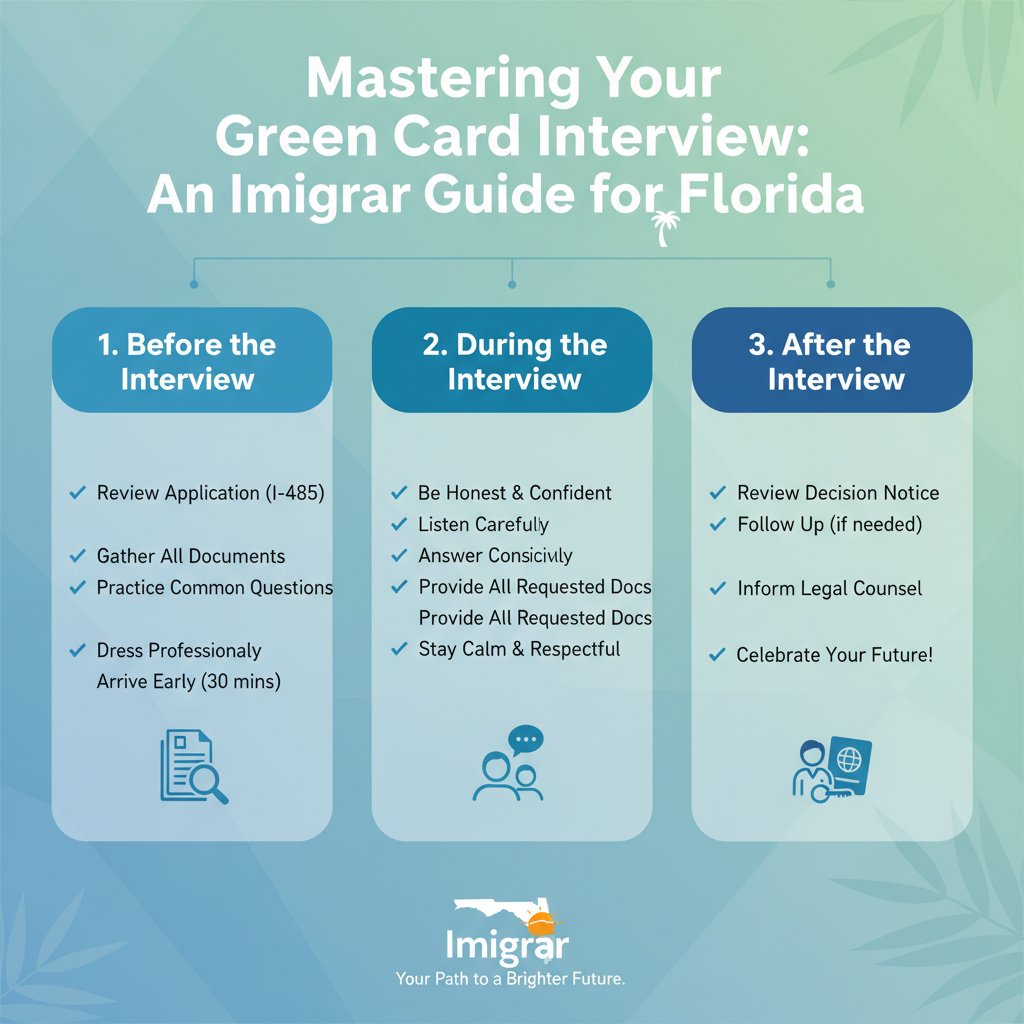
The Green Card interview is arguably the most critical stage of the **Adjustment of Status** process. Thorough preparation is not just recommended; it's essential. Here’s a comprehensive step-by-step guide to help you navigate it successfully.
1) Understand Your Case and Application Forms
Before anything else, you must have a complete and intimate understanding of every document you’ve submitted to USCIS. Your interview will be based directly on these forms. The USCIS officer will have your entire file in front of them, and your answers must be consistent with what you’ve already provided.
- Review Every Application Form: Go through your **Form I-130**, **Form I-485**, **Form I-864**, and all other supplementary forms. Pay close attention to dates, addresses, employment history, travel history, and all "yes" or "no" answers to the eligibility questions.
- Know Your Story: Be able to articulate your personal history, how you met your spouse (if applicable), details about your family, and your reasons for seeking permanent residency.
- Identify Potential Issues: If there were any complex parts of your application (e.g., previous immigration violations, criminal history, previous marriages, long periods of unemployment), be prepared to discuss them openly and honestly.
- Prepare Your Petitioner: If your petitioner (e.g., spouse) is also attending, ensure they are equally familiar with the application details and key dates.
Required Documents for this step (for review):
- Complete copies of all forms submitted to USCIS (**Form I-130**, **Form I-485**, **Form I-864**, etc.)
- Copies of all previously submitted supporting evidence.
- Personal notes or a timeline of significant life events (e.g., relationship milestones for marriage-based cases).
2) Gather and Organize All Original Documents
This is arguably the most crucial practical step. USCIS requires original documents for verification at the interview. Failure to bring them can lead to delays (e.g., a **Request for Evidence** or an unscheduled second interview).
- Create a Checklist: Use your application forms as a guide to list every document you submitted (or should have submitted) and need to bring in original form.
- Originals vs. Copies: Bring the original of *every* document, plus a clear photocopy of each. The officer may keep the copies and return the originals.
- Essential Documents:
- Your Green Card Interview Appointment Notice (Form I-797C).
- Valid passport and any previous passports.
- Birth certificates (for applicant and petitioner, if applicable).
- Marriage certificate (if applicable).
- Divorce decrees or death certificates for any previous marriages (for both applicant and petitioner).
- Original **Form I-693** (Report of Medical Examination and Vaccination Record) in a sealed envelope, if not already submitted.
- Police clearance certificates from all countries/regions where you've lived.
- All previous **Form I-20s**, **Form I-94s**, EAD cards, or other immigration documents.
- Two passport-style photos.
- Proof of petitioner's U.S. citizenship or lawful permanent residency (e.g., U.S. birth certificate, naturalization certificate, Green Card).
- Financial documents (for **Form I-864**): Original tax transcripts (IRS-issued), W-2s, pay stubs, employment verification letter, bank statements.
- Evidence of Bona Fide Marriage (for marriage-based cases): This is vital.
- Joint bank accounts, credit cards statements.
- Joint leases or mortgages.
- Utility bills in both names.
- Insurance policies showing each other as beneficiaries.
- Children's birth certificates (if applicable).
- Photos together from different times, with friends/family.
- Affidavits from friends, family, or employers attesting to the relationship.
- Travel itineraries and tickets from joint trips.
- Correspondence (emails, texts, cards).
- Organization is Key: Place documents in a binder with tabs, clearly labeled for easy access. This demonstrates preparedness and respect for the officer's time.
3) Prepare for Interview Questions
Anticipate the types of questions you'll be asked. While every interview is unique, common themes emerge based on the type of Green Card you're seeking.
- General Questions:
- Biographical information (name, date of birth, place of birth).
- Family history (parents, children).
- Employment history and education.
- Travel history to and from the U.S.
- Criminal history (even minor arrests or charges, disclose everything).
- Membership in any organizations or associations.
- Questions related to the "yes" or "no" questions on **Form I-485** (e.g., "Have you ever been arrested?", "Have you ever engaged in terrorist activities?").
- Marriage-Based Green Card Specific Questions: This can be very detailed and personal.
- How and when did you meet?
- What did you do on your first date?
- Who proposed?
- What are your spouse's habits?
- Details about your wedding, honeymoon, shared home.
- Daily routines, household chores, finances.
- Family members' names and relationships.
- Any previous marriages for either spouse.
- Practice and Role-Play: Practice answering questions out loud. If you have an attorney, conduct a mock interview. This helps build confidence and ensures your answers are clear and consistent.
4) Attend to Logistics Before the Interview Day
The day of the interview should be stress-free regarding logistics. Plan ahead to ensure you arrive prepared and on time.
- Location: Confirm the address of the **Orlando USCIS Field Office** (6650 Forum Dr, Orlando, FL 32821). Plan your route, considering potential traffic on the I-4 corridor.
- Time: Aim to arrive at least 30 minutes before your scheduled appointment. This allows time for parking, security, and finding the correct waiting area.
- Attire: Dress professionally. While not strictly required, it conveys respect for the process and the officer.
- Interpreter: If you or your petitioner require an interpreter and USCIS has approved one to attend, ensure they are present and understand their role (to interpret accurately, not to answer questions). If your attorney is bilingual, they may be able to assist, but their primary role is legal representation.
- Legal Counsel: Your Imigrar attorney will attend the interview with you. This is highly recommended as they can provide legal


