


The journey to obtaining a Green Card, also known as lawful permanent residency in the United States, is a significant milestone for countless individuals and families. While the process involves extensive paperwork and waiting periods, one of the most crucial steps is often the Green Card interview with U.S. Citizenship and Immigration Services (USCIS). This interview is your opportunity to demonstrate your eligibility and provide clarity on your application. Preparing adequately can make all the difference between approval and potential delays or denial.
At Imigrar, an immigration law firm based in Orlando, Florida, we understand the anxieties and hopes tied to this pivotal moment. Our mission is to keep families together, and that means equipping you with the knowledge and support needed to navigate complex immigration processes successfully.
The reporting that sparked this guide
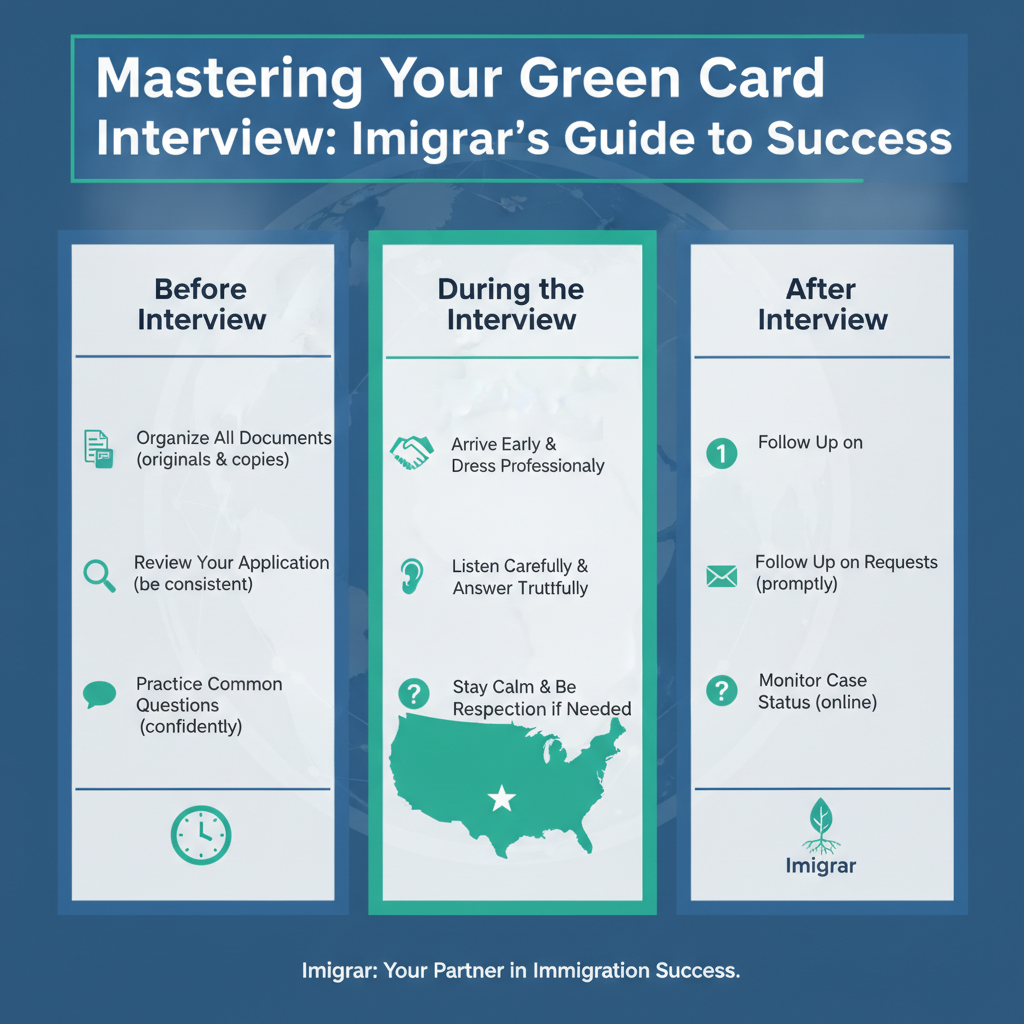
The ongoing importance of thorough preparation for immigration interviews is a constant theme in legal discourse and immigrant communities. News and legal updates frequently highlight the need for applicants to be well-informed and ready for their interviews. This guide is inspired by the continuous discussion and emphasis on Green Card Interview Preparation Tips (Immigration Law), reflecting the critical need for clear, actionable advice.
What This News Means for Immigrants in Orlando and Across Florida
The emphasis on Green Card interview preparation is not just a general recommendation; it directly impacts individuals seeking permanent residency in Florida and across the nation.
Why this news is showing up now
The focus on interview preparation is ever-present in immigration law for several reasons. USCIS regularly updates its policies and procedures, and interview requirements can evolve. Furthermore, with increasing application volumes and a heightened focus on national security and immigration integrity, interviews have become a more rigorous part of the Green Card process. For many, the interview is the final hurdle, and understanding how to clear it efficiently is paramount. It’s also a stage where the human element is strongest, and a well-prepared applicant can significantly ease the process for the interviewing officer.
How it can affect Florida residents
Florida is one of the nation’s most diverse states, with a large and vibrant immigrant population. For Central Florida residents, particularly those in Orange County and along the I-4 corridor, the Orlando USCIS Field Office is a primary point of contact for interviews. The stakes are high for families, professionals, and students who call Florida home and aspire to permanent residency. A well-prepared interview can expedite the process, helping families in Orlando and throughout Florida achieve stability and peace of mind sooner. Conversely, inadequate preparation can lead to delays, Requests for Evidence (RFEs), or even denials, causing immense stress and uncertainty for those building their lives here.
What the Green Card Interview Is (and Why It Matters)
The Green Card interview is a mandatory step for most individuals applying for lawful permanent residency in the United States, particularly those undergoing **Adjustment of Status** (applying from within the U.S.) or **Consular Processing** (applying from outside the U.S.). It is a formal meeting with a USCIS officer (or a Consular Officer if processing abroad) designed to verify the information provided in your application, confirm your eligibility for a Green Card, and ensure that no **inadmissibility** grounds apply to your case.
A plain-English definition
Think of the Green Card interview as a conversation where you and, if applicable, your sponsoring family member or employer, meet with an immigration officer. The officer's job is to review your application, ask questions about your eligibility, your relationship (if it's a family-based petition), your background, and your reasons for wanting to live permanently in the U.S. It's their chance to put a face to the paperwork and ensure everything is truthful and consistent. For family-based petitions, especially marriage-based ones, the interview aims to confirm the legitimacy of the relationship. For employment-based petitions, it verifies the job offer and your qualifications.
Key terms you need to know
Navigating the Green Card process involves understanding specific terminology. Here are some key terms:
- Green Card: The common name for a Permanent Resident Card, which proves your authorization to live and work permanently in the U.S.
- Adjustment of Status (AOS): The process of applying for a Green Card from within the United States without having to return to your home country. This is primarily handled by USCIS.
- Consular Processing: The process of applying for a Green Card through a U.S. embassy or consulate in your home country. This is managed by the U.S. Department of State.
- Petitioner: The U.S. citizen or lawful permanent resident who files an immigration petition (e.g., **Form I-130**, Petition for Alien Relative) on behalf of an eligible foreign national.
- Beneficiary: The foreign national who is seeking a Green Card based on the petition filed by the **Petitioner**.
- Affidavit of Support (Form I-864): A legally binding document signed by the **Petitioner** (and sometimes a joint sponsor) to accept financial responsibility for the **Beneficiary** to ensure they do not become a "public charge" in the U.S.
- Priority Date: The date USCIS receives your immigration petition. This date is crucial for tracking your place in the visa queue, especially for categories with annual numerical limits.
- Inadmissibility: Grounds under U.S. immigration law that can prevent an individual from entering the U.S. or obtaining a Green Card (e.g., certain criminal offenses, health issues, immigration violations).
- Request for Evidence (RFE): A letter from USCIS asking for additional documents or information to support your application.
- Notice of Intent to Deny (NOID): A letter from USCIS indicating their intention to deny your application and giving you a chance to respond.
Current Immigration Law: The Foundation
The framework for Green Cards and their associated interviews is rooted in the Immigration and Nationality Act (INA), primarily found in Title 8 of the U.S. Code. The INA governs virtually all aspects of immigration law in the United States, setting forth eligibility criteria, application procedures, and grounds for **inadmissibility**.
Federal requirements
To be eligible for a Green Card, an applicant must meet specific federal requirements outlined in the INA. These requirements vary depending on the category under which you are applying (e.g., family-based, employment-based, asylum/refugee status, diversity visa). Key federal statutes include:
- INA Section 201-204: Pertains to immigrant visas, quotas, and preference categories.
- INA Section 212: Outlines grounds for **inadmissibility** to the United States (e.g., health-related, criminal, security, public charge, illegal entry).
- INA Section 245: Specifically details the **Adjustment of Status** process for those applying from within the U.S.
For most Green Card applications, the process begins with a petition, such as **Form I-130**, Petition for Alien Relative, for family-based cases, or **Form I-140**, Immigrant Petition for Alien Worker, for employment-based cases. Once the petition is approved and a visa number is available (if applicable, determined by your **Priority Date**), the **Beneficiary** can file **Form I-485**, Application to Register Permanent Residence or Adjust Status, or begin **Consular Processing**.
Accurate and complete submission of required forms is critical. These include:
- Form I-130 (Petition for Alien Relative)
- Form I-485 (Application to Register Permanent Residence or Adjust Status)
- Form I-864 (Affidavit of Support)
- Form I-693 (Report of Medical Examination and Vaccination Record)
- Form I-765 (Application for Employment Authorization – often filed concurrently with I-485)
- Form I-131 (Application for Travel Document – often filed concurrently with I-485)
You can find all official forms and detailed instructions on the USCIS Forms page and general information on the USCIS official website.
Florida-specific considerations
While immigration law is federal, its implementation has local nuances. For Florida residents, the Orlando USCIS Field Office, located at 6680 Corporate Centre Blvd, Orlando, FL 32822, is a common site for **Adjustment of Status** interviews. The high volume of immigration cases in Florida means that officers are highly experienced in a wide range of scenarios, but it also means that clarity and thoroughness in your application are paramount to avoid unnecessary delays. There are no state-specific immigration laws that directly impact the federal Green Card interview process or eligibility, but Florida's diverse population means officers are accustomed to working with individuals from various cultural and linguistic backgrounds. However, applicants must still adhere strictly to federal guidelines.
Need Help? Navigating complex immigration laws can be challenging. Our Orlando immigration team is ready to assist with your Green Card application and interview preparation. Call +1 786-791-3106 for a free consultation, or message us online. Se Habla Español.
How to Prepare for Your Green Card Interview: A Complete Step-by-Step Guide
Preparing for your Green Card interview can feel overwhelming, but a structured approach can significantly boost your confidence and chances of success. Here’s a comprehensive guide:
1) Gather All Original Documents
This is arguably the most critical step. USCIS officers need to verify the authenticity of your claims. You must bring all original documents you submitted with your application, plus any new documents that have become available or were requested. Organize them neatly in a binder or folder, clearly labeled.
Required Documents Checklist:
- Appointment Notice: The official letter from USCIS scheduling your interview.
- Identification:
- Valid passport (for both **Petitioner** and **Beneficiary**)
- Driver’s license or state ID
- Employment Authorization Document (EAD)
- Advance Parole document (if applicable)
- Birth Certificates: Original birth certificates for both **Petitioner** and **Beneficiary**, and any dependent children.
- Marriage Certificate: Original marriage certificate if applying based on marriage.
- Divorce Decrees/Death Certificates: For any previous marriages of either spouse, proving their termination.
- Medical Examination Report: Original sealed Form I-693, if not already submitted or if it has expired (valid for two years from the civil surgeon's signature).
- Financial Documents:
- Form I-864, Affidavit of Support (original, signed by **Petitioner** and any joint sponsor)
- Most recent federal tax returns (for the last three years, if possible) with W-2s and 1099s
- Proof of income (pay stubs, employment verification letters)
- Bank statements, asset statements
- Proof of Relationship (for family-based petitions):
- Joint bank accounts, credit cards, leases/mortgages
- Utility bills in both names
- Insurance policies showing shared beneficiaries
- Photos together (dating to present, with family/friends, from trips)
- Correspondence (emails, texts, social media posts)
- Affidavits from friends/family attesting to the bona fide nature of the relationship
- Children’s birth certificates if you have children together
- Employment Documents (for employment-based petitions):
- Job offer letter
- Employer's letter of support
- Educational degrees, transcripts, professional licenses
- Resume/CV
- Travel History: Copies of all previous entry/exit stamps, visas, and **Form I-94** records.
- Police Records/Court Dispositions: For any arrests, citations, or convictions, even minor ones.
- Photos: Passport-style photos if specifically requested or if your previous ones are outdated.
- Copies of All Submitted Applications: Keep a complete copy of everything you submitted to USCIS.
Important: Bring both originals and copies of all documents. The officer will review the originals and keep the copies for your file.
2) Review Your Application Forms Thoroughly
Before your interview, meticulously review every form you submitted, especially **Form I-130** and **Form I-485**. You should be intimately familiar with every answer you provided. The officer will refer to these forms, and your verbal answers must be consistent with what's written. Any discrepancies, even minor ones, can raise red flags and lead to further questioning or **RFEs**.
- Check dates, addresses, employment history, and family details for accuracy.
- Ensure consistency between all forms (e.g., date of marriage on I-130 matches I-485).
- Be aware of any changes since you filed (e.g., new address, new job, new child). Bring documentation for these changes.
3) Prepare for Interview Questions
Anticipate the types of questions the officer might ask. While every interview is unique, common themes emerge. Practice answering these questions truthfully and concisely.
Common Questions for Family-Based Interviews (especially marriage-based):
- How did you meet? When was your first date?
- What are your spouse’s full name, date of birth, and place of birth?
- Where do you live? Can you describe your home?
- Who wakes up first? Who cooks? Who does chores?
- What did you do last weekend? What are your hobbies together?
- What are your immediate family members’ names? Have you met each other’s families?
- When was the last time you traveled together?
- Do you have joint bank accounts, insurance, or property?
- Have you ever been married before? Do you have children?
Common Questions for All Applicants:
- What is your full name, date of birth, and country of birth?
- Have you ever been arrested, cited, or convicted of any crime?
- Have you ever violated immigration laws (e.g., overstayed a visa, worked without authorization)?
- Do you understand the oath you just took?
- Are all the answers on your application true and correct?
- Why do you want a Green Card?
- What are your plans for the future in the U.S.?
- Have you ever been a member of any organization or political party?
- Do you have any medical conditions or communicable diseases?
Reminder: Always answer truthfully. If you don't understand a question, ask the officer to rephrase it. Do not guess or provide false information.
Facing your Green Card interview? Let Imigrar's experienced attorneys guide you through every step, ensuring you're fully prepared. We serve clients nationwide from our Orlando office. Call +1 786-791-3106 for a free consultation. Se Habla Español.
4) Organize Your Evidence
Presentation matters. A well-organized packet of documents shows respect for the officer's time and makes their job easier. Group documents by type (e.g., all financial documents together, all relationship proofs together). Use tabs or dividers. While the officer may not look at every single piece of evidence, having it readily available demonstrates your preparedness.
- Keep copies of your original application forms easily accessible.
- Create a table of contents for your binder if you have many documents.
- Do not offer documents unless asked, but be ready to present them promptly.
5) Practice Your Interview
Familiarity breeds confidence. Practice with a family member, friend, or ideally, your immigration attorney. This isn't about memorizing answers, but about becoming comfortable articulating your story and information clearly and concisely. Pay attention to your body language; appear calm, confident, and respectful.
- Practice answering questions out loud.
- Work on being concise but thorough in your answers.
- If English is not your first language, practice in English and consider whether you need an interpreter. (USCIS provides interpreters for free, but you can also bring your own if approved in advance).
6) Know Your Rights and What to Expect on Interview Day
On the day of your interview, arrive early (at least 30 minutes before your scheduled time) to allow for parking, security checks, and finding the correct waiting area. Dress professionally, as you would for a job interview. This demonstrates respect for the process and the officer.
- Your Attorney Can Be Present: You have the right to have an attorney present with you at the interview. For many, having legal counsel provides immense reassurance and ensures your rights are protected. Your attorney can clarify questions, object to inappropriate lines of questioning, and provide legal advice.
- The Oath: The interview will begin with you (and your attorney, if present) taking an oath to tell the truth.
- Questioning: The officer will ask questions based on your application and supporting documents. For marriage-based interviews, the **Petitioner** and **Beneficiary** may be interviewed together or separately.
- Be Honest and Concise: Answer all questions truthfully. If you don't know an answer, say "I don't know." If you don't understand, ask for clarification. Do not volunteer information that isn't requested.
- Review and Sign: At the end, you may be asked to review and sign an affidavit or a summary of your testimony. Read it carefully before signing.
- No Immediate Decision: It’s common not to receive an immediate decision. The officer may say they need to review the file further or request additional evidence via an **RFE**.
Warning: Never offer bribes or false information. Doing so can lead to immediate denial, criminal charges, and a lifetime ban from the U.S.
7) Follow-Up After the Interview
Your journey doesn't necessarily end when you leave the interview room. Be prepared for potential next steps.
- Request for Evidence (RFE): If the officer needs more information or documents, they will issue an **RFE**. Respond promptly and thoroughly by the deadline.
- Notice of Intent to Deny (NOID): In rare cases, USCIS might issue a **NOID** if they believe you are ineligible. This is a critical juncture where legal counsel is essential to formulate a strong response.
- Decision Notification: You will receive a decision by mail. If approved, your Green Card will be mailed to you. If denied, the letter will explain the reasons and your options for appeal or refiling.
You can check the status of your case online using the receipt number provided by USCIS on their Case Status Online tool, or monitor USCIS Processing Times for general estimates.

Practical Steps You Can Take Today
Don't wait until your interview notice arrives to start preparing. Proactive steps can significantly reduce stress and improve your chances of a smooth process.
Actionable Checklist:
- Consult an Immigration Attorney: This is our top recommendation. An experienced attorney can review your application, identify potential issues, help you gather documents, conduct mock interviews, and attend the actual interview with you.
- Start Gathering Documents Early: Begin collecting original birth certificates, marriage certificates, divorce decrees, and financial records well in advance. Some documents, especially from overseas, can take a long time to obtain.
- Organize Your Existing Records: Create a dedicated folder or binder for all immigration-related documents. Keep digital backups.
- Review Your Application Forms: Go through every line of **Form I-130**, **Form I-485**, and other submitted forms. Ensure you remember all the details and that everything is consistent.
- Track Your Mail and Email: USCIS primarily communicates via mail, but email notifications are also used. Ensure your address on file is current and check your mail regularly.
- Maintain Your Relationship Evidence (for marriage-based cases): Continue to collect photos, joint bills, shared correspondence, and other proofs of your ongoing, bona fide marriage.
- Be Mindful of Your Conduct: Avoid any activities that could lead to legal trouble, as this could impact your eligibility.
Document Preparation Guidance:
- Originals vs. Copies: Always bring both. USCIS will typically keep copies and return originals.
- Translations: Any document not in English must be accompanied by a certified English translation. The translator must certify that they are competent to translate and that the translation is accurate.
- Order: Organize documents in the order they were requested or in a logical sequence that mirrors your application.
- Tab and Label: Use clear tabs and labels to quickly locate specific documents during the interview.
Timeline Expectations:
The timeline for receiving an interview notice and a final decision can vary greatly depending on the USCIS field office, your specific Green Card category, and current processing times. For Central Florida residents, the Orlando USCIS Field Office typically schedules interviews within a few months to over a year after your **Form I-485** is filed and your biometrics are taken. After the interview, a decision can be made on the spot, within a few days, or sometimes several weeks if further review or an **RFE** is needed. Always check the USCIS Processing Times page for the most current estimates specific to your field office and form type.
Important: Do not make any major travel plans outside the U.S. without proper **Advance Parole** approval, as leaving


