


Today is May 10, 2026.
What This News Means for Immigrants in Orlando and Across Florida
The journey to obtaining a Green Card, or permanent residency in the United States, is a monumental step for countless individuals and families. For many, the final hurdle in this process is the Green Card interview, a crucial meeting with a United States Citizenship and Immigration Services (USCIS) officer. Recent discussions and trends in immigration law highlight the importance of thorough preparation for this interview, emphasizing accuracy, consistency, and a clear understanding of one's case.
Why this news is showing up now
The focus on Green Card interview preparation is perennially relevant, but it gains renewed emphasis due to several factors. USCIS continues to refine its interview protocols, often with an increased scrutiny on the authenticity of relationships for family-based petitions and the legitimacy of claims for other categories. Furthermore, as processing times fluctuate and backlogs are addressed, more interviews are being scheduled, bringing this critical stage into the forefront for a larger number of applicants. The immigration landscape is always evolving, and staying informed about best practices for interviews is essential to navigate these changes successfully. The demand for clear, actionable advice remains high as applicants seek to minimize risks and maximize their chances of approval.
How it can affect Florida residents
Florida, particularly Central Florida with its vibrant and diverse immigrant communities, sees a significant volume of Green Card applications. The Orlando USCIS Field Office, located at 5449 Forbes Pl, Orlando, FL 32812, is a busy hub for these interviews. For residents across Orlando, Kissimmee, Sanford, and the wider I-4 corridor, successful interview preparation directly impacts their ability to secure permanent residency and build their lives in the Sunshine State. Florida's large immigrant population means that many families are directly impacted by these processes, from reuniting loved ones to establishing stable lives. Understanding the nuances of interview preparation can alleviate stress and prevent common pitfalls that might delay or even jeopardize an application. This is particularly true for family-based petitions, which constitute a large portion of applications in Florida, where proving a bona fide relationship is paramount.
Need Help? Our Orlando immigration team is ready to assist. Call +1 786-791-3106 for a free consultation, or message us online. Se Habla Español.
What the Green Card Interview Is (and Why It Matters)
The Green Card interview is a critical step in the process of becoming a lawful permanent resident of the United States. It's a face-to-face meeting with a USCIS immigration officer who will review your application, verify the information you’ve provided, and determine your eligibility for a Green Card. This interview is essentially the government's way of ensuring that you meet all legal requirements and that your application is truthful and complete.
A plain-English definition
Think of the Green Card interview as your final exam for permanent residency. During this meeting, a USCIS officer will ask you questions about your background, your reasons for seeking a Green Card, and the details of your application. For family-based petitions, especially marriage-based ones, a significant portion of the interview will focus on the authenticity of your relationship. The officer’s goal is to confirm that you are genuinely eligible for a Green Card under U.S. immigration law and that there are no grounds for inadmissibility. It's a formal but necessary step to ensure the integrity of the immigration system.
Key terms you need to know
- Green Card: Officially known as a Permanent Resident Card, it is an identification document proving that you have been granted permanent residency in the U.S.
- Adjustment of Status (AOS): The process of applying for a Green Card while physically present in the United States. This is contrasted with Consular Processing, where the interview takes place at a U.S. embassy or consulate abroad.
- USCIS: United States Citizenship and Immigration Services, the federal agency responsible for administering the U.S. immigration system, including Green Card applications and interviews.
- Petitioner: The U.S. citizen or lawful permanent resident who files a petition on behalf of an immigrant relative or employee. For family-based cases, this is typically the U.S. citizen spouse, parent, or child.
- Beneficiary: The foreign national who is seeking a Green Card based on a petition filed by a petitioner.
- Form I-130: The Petition for Alien Relative, filed by a U.S. citizen or lawful permanent resident to establish a qualifying relationship with an eligible foreign relative who wishes to immigrate to the United States.
- Form I-485: The Application to Register Permanent Residence or Adjust Status, filed by an individual who is already in the U.S. and is seeking to become a lawful permanent resident. This is the primary form for Adjustment of Status.
- Form I-864: The Affidavit of Support, a legally binding contract an individual signs to accept financial responsibility for the intending immigrant. This ensures the immigrant will not become a "public charge."
- Form I-693: The Report of Medical Examination and Vaccination Record, completed by a USCIS-approved civil surgeon to ensure the applicant is not inadmissible on health-related grounds.
- Priority Date: The date USCIS receives your immigration petition (Form I-130). This date is crucial for tracking your place in the visa queue, especially for categories with annual visa limits.
- Bona Fide Marriage: A marriage entered into in good faith, not solely for the purpose of obtaining an immigration benefit. Proving a bona fide marriage is central to marriage-based Green Card applications.
The Green Card interview matters immensely because it is often the final and most personal step in your journey to permanent residency. A successful interview leads to approval, while missteps or inconsistencies can lead to delays, Requests for Evidence (RFEs), or even denial. It is your opportunity to present your case clearly and truthfully to an immigration officer.
Current Immigration Law: The Foundation
The legal framework governing Green Card applications and interviews is primarily found within the Immigration and Nationality Act (INA), along with regulations published by the Department of Homeland Security (DHS) and USCIS policy manuals. Understanding these foundational laws is crucial for any applicant.
Federal requirements
The core requirements for obtaining a Green Card are established by federal law. For most family-based Green Cards through Adjustment of Status, the relevant sections of the INA include:
- INA § 201-204: These sections define who is eligible to immigrate based on family relationships, establishing categories such as immediate relatives (spouses, minor children, and parents of U.S. citizens) and family preference categories (unmarried adult children of U.S. citizens, spouses and children of LPRs, etc.).
- INA § 245: This critical section outlines the conditions under which an individual physically present in the U.S. may adjust their status to that of a lawful permanent resident (i.e., obtain a Green Card without leaving the country). Key requirements often include lawful entry, maintenance of status (though some immediate relatives are exempt from certain violations), and being eligible for an immigrant visa.
- INA § 212: This section details various grounds of inadmissibility, which are reasons an individual might be denied entry or a Green Card. These can include health-related grounds, criminal grounds, security grounds, public charge grounds, and misrepresentation. During the interview, the USCIS officer will assess whether any of these apply to your case.
- INA § 213A: This section pertains to the Affidavit of Support (Form I-864), which requires the petitioner to demonstrate the financial ability to support the immigrant and ensure they do not become a "public charge."
During the interview, the USCIS officer's primary role is to verify that the applicant meets all statutory eligibility requirements and is not inadmissible under any of the grounds listed in INA § 212. The burden of proof rests with the applicant to demonstrate their eligibility by providing sufficient evidence and truthful testimony. All applicants must demonstrate good moral character and that their marriage (if applicable) is bona fide.
For more detailed information on immigration laws and policies, refer to the USCIS official website.
Florida-specific considerations
While immigration law is federal, the practical application often involves local field offices. For Central Florida residents, the Orlando USCIS Field Office is where most Adjustment of Status interviews take place. While the laws themselves don't change from state to state, the volume of cases, the specific interviewing officers, and local administrative procedures can influence the interview experience. Florida's highly diverse population means that USCIS officers in Orlando are experienced in handling a wide range of cultural backgrounds and complex family situations. It's not uncommon for officers to be particularly attuned to common issues or fraud patterns observed in the region, making thorough preparation even more critical for residents in Orange County and surrounding areas.
Applicants in Florida should be aware that processing times can vary, and while the Orlando office strives for efficiency, it's wise to monitor your case status and be prepared for potential delays. The high demand for immigration services in Florida means that officers often have tight schedules, reinforcing the need for applicants to be organized, concise, and ready to present their case clearly. All required forms, such as Form I-130, Form I-485, Form I-864, and Form I-693, must be accurately completed and submitted according to federal guidelines. You can find all official forms and instructions on the USCIS Forms page.
How to Prepare for Your Green Card Interview: A Complete Step-by-Step Guide
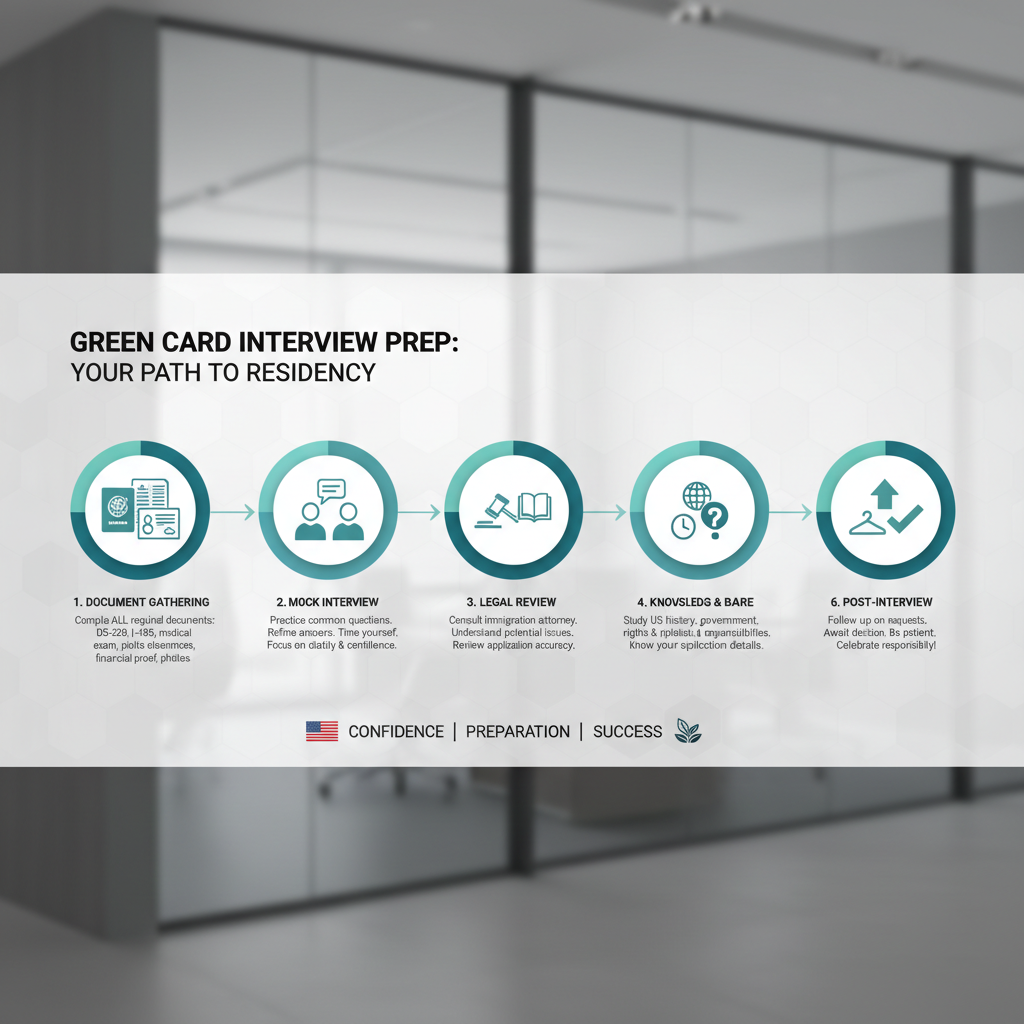
Preparing for your Green Card interview can feel overwhelming, but a structured approach can significantly boost your confidence and chances of success. Follow this comprehensive guide to ensure you're fully ready for this crucial step.
1) Understand Your Case Type and Review Your Application
Before anything else, fully grasp the specifics of your Green Card application. Are you applying through a family member (spouse, parent, child)? Is it employment-based? This will dictate the focus of your interview. Action:
- Thoroughly review every document you submitted to USCIS. This includes your initial petition (e.g., Form I-130), your Adjustment of Status application (Form I-485), the Affidavit of Support (Form I-864), and your medical exam results (Form I-693).
- Read through all your answers, dates, addresses, and employment history. The officer will likely ask questions directly from these forms.
- Familiarize yourself with any supplementary information or responses to Requests for Evidence (RFEs) you submitted.
Required Documents for this step (for review):
- Complete copy of Form I-130 petition packet (if applicable)
- Complete copy of Form I-485 application packet
- Complete copy of Form I-864 and supporting financial documents
- Complete copy of Form I-693 (medical exam)
- Any RFE responses and supporting documents
2) Gather All Original Documents and Copies
This is perhaps the most critical logistical step. You must bring all original documents that you submitted as copies with your application, plus copies of those originals for the officer to keep. Action:
- Create an organized binder or folder system. Separate documents by type (personal, financial, relationship evidence).
- Ensure you have both the original and a clear photocopy of every document. USCIS officers will often review originals and keep the copies.
- For Central Florida residents attending interviews at the Orlando USCIS Field Office, meticulous organization can speed up the process.
Required Documents (originals AND copies):
- Your interview notice (Important: You cannot enter the building without it!)
- Your passport (current and any expired ones with visas/stamps)
- Your birth certificate (and spouse's/children's if applicable)
- Marriage certificate (if applicable)
- Divorce decrees or death certificates for any prior marriages (for both petitioner and beneficiary, if applicable)
- Official government-issued photo identification (e.g., driver's license, state ID)
- Any previous immigration documents (e.g., I-94 arrival/departure record, EAD card, Advance Parole document)
- Updated Form I-693 (medical exam) in a sealed envelope, if you haven't submitted it or it's expired.
- Police clearance certificates from countries lived in (if applicable, and not already submitted).
- Originals of all documents submitted with Form I-864 (tax returns, W-2s, pay stubs, employment verification letters).
- Photos: Passport-style photos (check your interview notice for specific requirements, often two are needed).
3) Organize Your Evidence of Bona Fide Relationship (for marriage-based Green Cards)
If your Green Card application is based on marriage to a U.S. citizen or lawful permanent resident, proving your marriage is legitimate and not just for immigration purposes is paramount. Action:
- Collect a wide variety of joint documents that demonstrate commingling of finances, shared responsibilities, and a life together.
- Organize these documents chronologically or by category for easy access.
Required Documents (originals AND copies):
- Joint financial accounts: Statements from joint bank accounts (checking, savings), joint credit card statements.
- Joint property: Lease agreements, mortgage statements, property deeds showing both names.
- Joint utility bills: Electricity, water, internet, phone bills addressed to both spouses.
- Joint insurance policies: Health, auto, life insurance policies listing both spouses.
- Beneficiary designations: Retirement accounts, life insurance policies listing spouse as beneficiary.
- Correspondence: Letters, cards, emails, text messages exchanged between spouses.
- Photos: Dated photos of the couple together over time, with family, friends, on vacations. Include photos of your wedding and honeymoon.
- Affidavits from friends/family: Signed statements from people who know your relationship is genuine, often notarized.
- Children's birth certificates: If you have children together.
- Travel itineraries: Joint travel, hotel bookings.
4) Practice Answering Potential Questions
While you can't predict every question, you can anticipate common ones based on your application. The goal is to answer truthfully, consistently, and without hesitation. Action:
- Review your application forms and documents as if you were the immigration officer. What questions would you ask?
- Practice with your spouse, family member, or attorney. Have them ask you questions about your personal history, your relationship (if applicable), how you met, daily life, your petitioner's background, and your immigration history.
- Focus on consistency. Any discrepancies between your testimony and your submitted documents can raise red flags.
- For marriage-based interviews, be prepared for detailed questions about your daily routine, your spouse's habits, your home, and intimate details of your relationship.
- If you have any past immigration issues (overstays, previous denials, arrests), understand the details and be ready to explain them truthfully and clearly.
Important: Always tell the truth. Providing false information or misrepresenting facts can lead to a denial and severe future immigration consequences.
5) Prepare for the Day of the Interview
Logistics matter. A smooth interview day starts with good preparation. Action:
- Dress professionally: Treat it like a job interview. Neat, conservative attire shows respect for the process.
- Arrive early: Plan to arrive at the Orlando USCIS Field Office at least 30 minutes before your scheduled time. Parking can be an issue, and you'll need to go through security.
- Bring your attorney: While not legally required, having an experienced immigration attorney from Imigrar by your side can provide immense peace of mind, ensure your rights are protected, and help you navigate complex questions.
- Bring an interpreter (if needed): If you are not fluent in English and your spouse is not the petitioner (or if the officer doesn't allow the spouse to interpret), you must bring a certified interpreter. If Imigrar represents you, your attorney can often help facilitate this.
- Stay calm: It's normal to be nervous, but try to remain composed. Take deep breaths.
Need Help? Our Orlando immigration team is ready to assist. Call +1 786-791-3106 for a free consultation, or message us online. Se Habla Español.
6) What to Expect During the Interview
Knowing the general flow of the interview can reduce anxiety. Action:
- The Oath: You and your petitioner (if applicable) will be sworn in to tell the truth.
- Identity Verification: The officer will verify your identity using your passport and other IDs.
- Review of Application: The officer will go through your application forms, confirming information and asking clarifying questions.
- Questions: Be prepared for questions about your personal history, family, employment, travel, and any criminal history. For marriage-based cases, expect detailed questions about your relationship, how you met, living arrangements, and daily life.
- Separate Interviews (for marriage-based cases): In some marriage-based cases, especially if the officer has doubts about the bona fides of the marriage, they may conduct a "Stokes Interview" where spouses are interviewed separately and then compared for consistency.
- Providing Documents: The officer will ask for original documents and take copies. Have your organized binder ready.
Reminder: Answer all questions truthfully and directly. Do not volunteer unnecessary information. If you don't understand a question, ask for clarification. If you don't know an answer, say so.
7) Post-Interview Procedures
The interview is over, but the process might not be. Action:
- Immediate Decision: Sometimes, the officer will tell you on the spot that your application is approved.
- Request for Evidence (RFE): If the officer needs more information or documents, they will issue an RFE. You will typically have a specific deadline (e.g., 87 days or 120 days) to respond.
- Notice of Intent to Deny (NOID): If the officer believes your application should be denied, they may issue a NOID, giving you a chance to respond and provide additional evidence before a final decision is made.
- Decision by Mail: Most decisions are mailed to you within a few weeks or months. You can check your case status online at the USCIS official website or monitor USCIS Processing Times for general estimates.
- Green Card Mailing: If approved, your Green Card will be mailed to you.
Practical Steps You Can Take Today
Don't wait until the last minute to prepare for your Green Card interview. Here are actionable steps you can start taking right now to build a strong case and feel confident.
Actionable Checklist for Interview Preparation:
- ✓ **Review Your Entire Application:** Go through every form and document you submitted to USCIS. Ensure you remember all dates, addresses, and details.
- ✓ **Gather All Original Documents:** Start collecting all original birth certificates, marriage certificates, passports, and any other identifying documents.
- ✓ **Make Copies of Everything:** For every original document, make a clear photocopy. Organize them in a binder with tabs.
- ✓ **Compile Relationship Evidence (if applicable):** Begin collecting joint bank statements, utility bills, photos, and letters. The more variety and quantity, the better.
- ✓ **Practice Answering Questions:** Role-play with a family member or friend. Focus on clear, concise, and truthful answers.
- ✓ **Consult an Immigration Attorney:** Schedule a free consultation with Imigrar to review your case and get personalized advice.
- ✓ **Check for a Valid Medical Exam:** If you submitted your Form I-693 more than two years ago, or if it was not submitted, you may need an updated one.
- ✓ **Verify Your Finances:** Ensure the petitioner's Form I-864 documents (tax returns, W-2s) are consistent and meet income requirements.
- ✓ **Know Your Interview Location:** For those in Central Florida, familiarize yourself with the route to the Orlando USCIS Field Office.
Document Preparation Guidance
The key to successful document presentation is organization. Create a binder or accordion folder with clearly labeled tabs for each category of documents. For example: "Interview Notice," "Passports/IDs," "Birth/Marriage Certificates," "Financial Documents," "Relationship Evidence," "Medical Exam," "Attorney Correspondence." Within each tab, place the original document on top, followed by its copy. This makes it easy for the officer to review and take the copies they need. For relationship evidence, arrange photos chronologically with dates and descriptions, and highlight joint names on financial statements and bills.
Timeline Expectations
Once your Form I-485 is filed, the timeline for an interview can vary significantly based on your case type, the specific USCIS field office (e.g., Orlando USCIS Field Office), and current processing backlogs. You can monitor approximate processing times on the USCIS Processing Times page. Generally, after filing, you can expect:
- Receipt Notice: Within a few weeks.
- Biometrics Appointment: Typically 3-8 weeks after filing.
- Employment Authorization Document (EAD) / Advance Parole (AP): If applied for concurrently, these can take several months.
- Interview Notice: This can be several months to over a year after filing, depending on the office and case type.
- Interview: The actual interview.
- Decision: Can be immediate, within a few weeks


