


The journey to obtaining a Green Card, or lawful permanent residency in the United States, is a significant milestone for countless individuals and families. For many, this path culminates in a pivotal moment: the Green Card interview. This interview, conducted by a U.S. Citizenship and Immigration Services (USCIS) officer, is designed to verify the information in your application, ensure your eligibility, and confirm that you meet all legal requirements for permanent residency.
At Imigrar, we understand the stress and uncertainty that can accompany this crucial step. Our mission, "Keep Families Together," drives us to provide clear, actionable guidance to help you navigate the complexities of U.S. immigration law. This comprehensive guide is designed to equip you with the knowledge and confidence needed to approach your Green Card interview successfully.
The reporting that sparked this guide
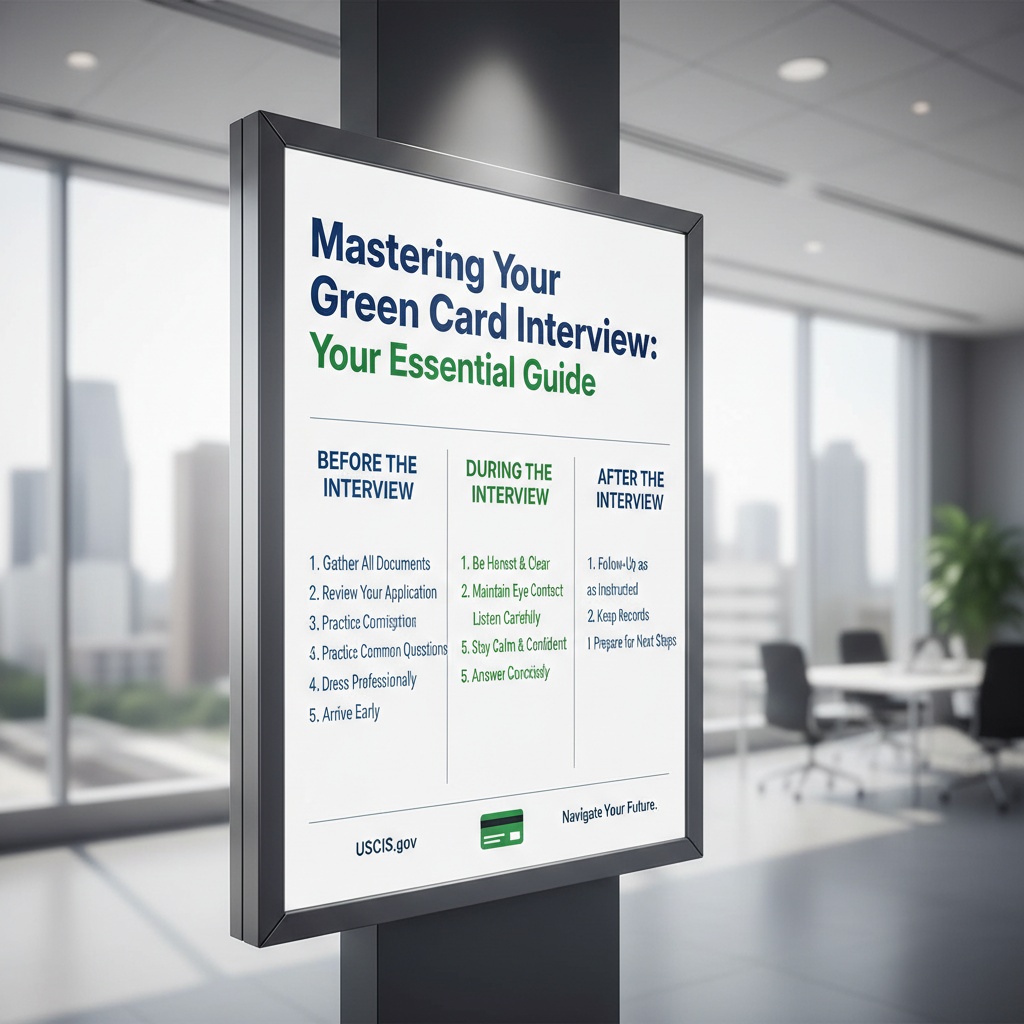
Recent trends and ongoing discussions in Green Card Interview Preparation Tips (Immigration Law) highlight the consistent importance of thorough preparation for these critical interviews. Immigration news sources frequently underscore the impact of well-prepared applicants versus those who underestimate the interview’s significance. As USCIS continues to process a high volume of applications, the interview remains a cornerstone of their adjudication process, making expert preparation more vital than ever.
What This News Means for Immigrants in Orlando and Across Florida
Why this news is showing up now
The emphasis on Green Card interview preparation is not new, but its prominence in immigration news cycles often reflects a few key factors. Firstly, the sheer volume of Green Card applications processed annually means that interviews are a constant and essential part of the immigration system. USCIS regularly updates its policies and procedures, and while the core purpose of the interview remains, specific nuances can change, prompting renewed discussions and advice. Additionally, as processing times fluctuate, applicants often find themselves waiting longer, which can lead to increased anxiety and a greater need for up-to-date guidance on how to best prepare when their interview notice finally arrives. The digital age also allows for quicker dissemination of practical tips and legal advice, making "how-to" guides a popular and necessary resource.
How it can affect Florida residents
For immigrants residing in Florida, particularly those in the Orlando area, the importance of robust Green Card interview preparation cannot be overstated. Florida is a melting pot, home to a vast and diverse immigrant population. This means the Orlando USCIS Field Office, like others across the state, handles a significant caseload, covering a wide range of Green Card categories, from family-based petitions to employment-based applications. The insights gained from general immigration news directly apply to your local experience:
- Local Field Office Procedures: While federal law governs immigration, local USCIS field offices, such as the one in Orlando, may have slight variations in their operational procedures or common lines of questioning. Being well-prepared ensures you can adapt to any specific local emphasis.
- High Volume of Cases: The high number of applicants in Central Florida means that USCIS officers are experienced but also busy. Presenting a clear, well-organized, and truthful case can significantly streamline your interview.
- Diverse Case Types: Orlando’s diverse population means officers interview individuals from various backgrounds and complex situations. Comprehensive preparation helps you clearly articulate your unique circumstances.
- Access to Resources: Being in a major metropolitan area like Orlando means you have access to experienced legal professionals who can provide tailored preparation, helping you navigate the interview with confidence.
Whether your Green Card application is based on a family relationship, employment, or another category, the interview is a critical step. Being proactive and thoroughly preparing can make all the difference in achieving a positive outcome for you and your family.
Need Help? Our Orlando immigration team is ready to assist. Call +1 786-791-3106 for a free consultation, or message us online. Se Habla Español.
What Green Card Interviews Are (and Why They Matter)
A plain-English definition
A Green Card interview is a formal meeting with a U.S. Citizenship and Immigration Services (USCIS) officer. Its primary purpose is for the officer to personally review your Green Card application, verify the information you've submitted, and ask questions to confirm your eligibility for lawful permanent residency in the United States. Think of it as the final check-point where USCIS ensures that all the details in your application are accurate, consistent, and meet the legal requirements for you to become a Permanent Resident.
This interview is typically required for most Green Card applicants, especially those applying through Adjustment of Status (meaning you are already in the U.S. and applying to change your immigration status) or those going through Consular Processing (meaning you are applying from outside the U.S. at a U.S. embassy or consulate).
Key terms you need to know
Navigating the Green Card process involves understanding several key terms:
- Green Card: Formally known as a Permanent Resident Card, it is an identification document that proves you have been granted lawful permanent residency in the United States.
- Permanent Resident: An individual who has been granted the privilege of permanently residing in the United States. Green Card holders are also known as lawful permanent residents.
- USCIS (U.S. Citizenship and Immigration Services): The government agency responsible for administering the country's lawful immigration system, including processing Green Card applications and conducting interviews.
- Adjustment of Status (AOS): The process of applying for lawful permanent resident status (a Green Card) while physically present in the United States. This is handled by USCIS.
- Consular Processing: The process of applying for a Green Card through a U.S. embassy or consulate in your home country (or another country if eligible). This is handled by the U.S. Department of State.
- Petitioner: The U.S. citizen or lawful permanent resident who files an immigration petition on behalf of a foreign national (e.g., a spouse filing for their husband or wife, or an employer filing for an employee).
- Beneficiary: The foreign national on whose behalf an immigration petition is filed and who seeks to obtain a Green Card.
- Form I-130, Petition for Alien Relative: The form a U.S. citizen or lawful permanent resident files to establish a qualifying relationship with an eligible foreign relative who wishes to immigrate to the United States.
- Form I-485, Application to Register Permanent Residence or Adjust Status: The primary form filed by a foreign national to apply for a Green Card if they are already in the United States (Adjustment of Status).
- Priority Date: The date USCIS receives your immigration petition (e.g., Form I-130 or Form I-140). This date determines your place in the visa queue, especially for categories with annual limits.
- Affidavit of Support (Form I-864): A legally binding document signed by a petitioner (sponsor) to accept financial responsibility for the intending immigrant.
- Notice of Interview: The official document from USCIS or the Department of State informing you of your interview date, time, and location, along with a list of documents to bring.
- Inadmissibility: Certain conditions or past actions (e.g., criminal history, certain health issues, prior immigration violations) that can make an individual ineligible to enter the U.S. or obtain a Green Card.
Current Immigration Law: The Foundation
The framework for Green Card interviews and eligibility is rooted in federal immigration law, primarily the Immigration and Nationality Act (INA). The INA, along with its regulations, establishes who is eligible for a Green Card, the categories under which they can apply, and the procedures for doing so. The interview serves as a critical step in ensuring compliance with these laws.
Federal requirements
The INA outlines various categories for obtaining a Green Card, each with specific requirements. The most common categories include:
- Family-Based Green Cards: For immediate relatives of U.S. citizens (spouses, unmarried children under 21, parents) and other family members (e.g., married children, siblings) of U.S. citizens and lawful permanent residents. The core requirement here is establishing a genuine familial relationship.
- Employment-Based Green Cards: For foreign nationals with specific job skills, investment capital, or extraordinary abilities that benefit the U.S. economy. Requirements vary by preference category (EB-1, EB-2, EB-3, EB-4, EB-5).
- Diversity Visa Lottery: For individuals from countries with historically low rates of immigration to the U.S.
- Special Immigrant Categories: Including religious workers, special immigrant juveniles, and others.
- Asylees and Refugees: Individuals granted asylum or refugee status in the U.S. may adjust their status to permanent resident after one year.
Regardless of the category, all applicants must generally demonstrate:
- Admissibility: They must not be inadmissible to the U.S. based on health, criminal, security, public charge, or prior immigration violations. Waivers may be available for some grounds of inadmissibility.
- Eligibility for the specific Green Card category: Meeting the criteria for the family relationship, employment skill, or other basis for their application.
- Good Moral Character: While not explicitly a requirement for all Green Card categories, it is often considered, especially in discretionary cases.
The interview is the USCIS officer's opportunity to assess these requirements firsthand. They will ask questions about your application, personal history, and the basis of your eligibility, ensuring that your testimony matches the documentation provided.
Key forms involved in the Green Card process include:
- Form I-130, Petition for Alien Relative: Filed by the U.S. citizen or LPR petitioner.
- Form I-485, Application to Register Permanent Residence or Adjust Status: Filed by the beneficiary seeking Adjustment of Status.
- Form I-765, Application for Employment Authorization: Often filed concurrently with Form I-485 to obtain work authorization while the Green Card application is pending.
- Form I-131, Application for Travel Document: Often filed concurrently with Form I-485 to obtain advance parole for travel outside the U.S. while the Green Card application is pending.
- Form I-693, Report of Medical Examination and Vaccination Record: Required for most Adjustment of Status applicants, submitted by a USCIS-approved civil surgeon.
For detailed information and to download forms, always refer to the USCIS official website.
Florida-specific considerations
While immigration law is federal, the practicalities of your Green Card interview often involve local USCIS field offices. For residents of Central Florida, your interview will likely be scheduled at the Orlando USCIS Field Office. While the legal requirements remain the same nationwide, understanding the local context can be helpful:
- Interview Location: If your case is in Orlando, your interview will be at the local USCIS Field Office. Familiarize yourself with its location, parking, and public transportation options well in advance.
- Appointment Backlogs: High population growth along the I-4 corridor and in Orange County often translates to significant demand for immigration services. This can sometimes lead to longer processing times or interview backlogs. You can check current processing times on the USCIS Processing Times page.
- Common Case Types: The Orlando office processes a high volume of family-based Green Card applications, particularly marriage-based cases, given the diverse communities in the region. Officers are highly experienced in these types of interviews.
- Language Services: If you are not fluent in English, you have the right to bring an interpreter. However, the Orlando Field Office serves a large Spanish-speaking population, and officers may sometimes be bilingual. Nevertheless, always be prepared with your own interpreter if you need one.
Regardless of where your interview takes place, the core principles of preparation, honesty, and thoroughness are paramount.
Need Help? Our Orlando immigration team is ready to assist. Call +1 786-791-3106 for a free consultation, or message us online. Se Habla Español.
How to Prepare for Your Green Card Interview: A Complete Step-by-Step Guide
The Green Card interview is the culmination of your application process. Being well-prepared is not just about having your documents in order; it's about understanding your case, anticipating questions, and presenting yourself confidently and truthfully. Here’s a detailed, step-by-step guide to help you prepare.
1) Understand Your Case and Application Thoroughly
Before anything else, you must be intimately familiar with every detail of your submitted application. The USCIS officer will have your entire file in front of them, and your answers must be consistent with what you've already provided. This step is critical for both the petitioner and the beneficiary.
- Review All Forms: Go through every application form you submitted, including Form I-130, Form I-485, and any supporting documents. Pay close attention to dates, addresses, employment history, and answers to eligibility questions.
- Understand the Basis of Your Green Card: Clearly articulate *why* you are eligible for a Green Card (e.g., "I am the spouse of a U.S. citizen," "I am sponsored by my employer for an EB-2 visa").
- Identify Potential Red Flags: Think about any aspect of your application that might raise questions. This could include prior immigration issues, criminal history, gaps in employment, or discrepancies in dates. Be prepared to explain these truthfully and clearly.
- For Marriage-Based Cases: Understand the timeline of your relationship, how you met, living arrangements, shared finances, and future plans.
Important: If you worked with an attorney to prepare your application, ask for a complete copy of your submitted file and review it diligently.
2) Gather and Organize All Required Documents
This is arguably the most critical practical step. The USCIS officer will need to see original documents and copies of everything you submitted, plus any documents requested in your interview notice, and often, additional proof of your eligibility. Organize everything neatly in a binder or folder, clearly labeled.
General Documents to Bring:
- Your interview appointment notice (Form I-797C).
- Valid passport(s) and any previous passports.
- Original birth certificate (for both applicant and petitioner, if applicable).
- Original marriage certificate (if applicable).
- Original divorce decrees or death certificates for any previous marriages (for both applicant and petitioner, if applicable).
- Original criminal record certificates (if any arrests or convictions).
- Medical examination report (Form I-693), if not already submitted and still valid. Ensure it's in a sealed envelope from the civil surgeon.
- All original supporting documents submitted with your application (e.g., employment letters, educational certificates, tax transcripts).
- Copies of all previously submitted forms (e.g., Form I-130, Form I-485, Form I-765, Form I-131).
- Two passport-style photos.
Additional Documents for Marriage-Based Green Cards (Proof of Bona Fide Marriage):
- Joint bank account statements.
- Joint utility bills, leases, or mortgage statements.
- Birth certificates of any children born to you and your spouse.
- Photos together (dating, wedding, family events, vacations).
- Affidavits from friends or family confirming your relationship.
- Life insurance policies, wills, or trusts naming each other as beneficiaries.
- Joint tax returns.
- Any other evidence showing commingling of finances or shared life.
For Employment-Based Green Cards:
- Original job offer letter.
- Employment verification letter.
- Educational diplomas and transcripts.
- Professional licenses or certifications.
- Employer's financial statements (if self-petitioning or for smaller companies).
Warning: Always bring originals, as well as clear photocopies, of every document. The officer will review the originals and keep the copies for the file. Failure to bring required documents can lead to delays or even a denial.
3) Prepare for Interview Questions
The questions asked will vary depending on your Green Card category, but they generally aim to verify the information in your application and your eligibility. Practice answering these questions truthfully and concisely.
Common Questions for All Applicants:
- Confirming personal information (name, date of birth, address).
- Questions about your immigration history (entries, exits, previous visas, any violations).
- Questions related to security and inadmissibility grounds (criminal history, affiliations, previous arrests, false claims to U.S. citizenship).
- "Have you ever been deported or removed from the U.S.?"
- "Do you understand the oath of allegiance?"
Common Questions for Marriage-Based Applicants:
- "How did you meet your spouse?"
- "When and where was your wedding?"
- "Where do you live together?" (Details about your home)
- "What are your daily routines?"
- "Who handles the finances?"
- "Describe a typical day together."
- "What are your future plans as a couple?"
- Questions about your spouse's family, friends, and habits.
Reminder: Answer truthfully and directly. If you don't know an answer, say so. Do not guess or provide false information.
4) Practice Your English (or Arrange for an Interpreter)
The interview will generally be conducted in English. If you are not fluent in English and cannot understand or answer questions adequately, you have the right to bring an interpreter. This interpreter must be at least 18 years old, fluent in both English and your native language, and cannot be your attorney or a witness (such as your spouse in a marriage-based case).
- Practice Speaking: If you plan to interview in English, practice speaking and understanding common immigration questions.
- Choose Your Interpreter Wisely: If you need an interpreter, ensure they are reliable, understand the nuances of legal terminology, and will accurately translate your answers without adding or omitting information.
Important: Inform USCIS in advance if you will be bringing an interpreter. Some field offices may require prior notification.
5) Know What to Expect on Interview Day
Understanding the logistics and decorum of the interview day can reduce anxiety.
- Dress Appropriately: Dress in clean, professional attire, as you would for a job interview. This shows respect for the process.
- Arrive Early: Plan to arrive at the Orlando USCIS Field Office at least 30-45 minutes before your scheduled appointment. This allows time for security checks, parking, and finding the correct waiting area.
- Bring Only Necessary Items: Leave unnecessary valuables and large bags at home.
- Be Respectful and Polite: Address the officer respectfully. Maintain eye contact, listen carefully to questions, and answer clearly.
- Take an Oath: You will be sworn in to tell the truth.
- The Interview Process: The officer will review your forms, ask questions, and examine your documents. They may take fingerprints or ask for additional documentation.
- Decision: Sometimes, a decision is made on the spot. More often, you will be told that a decision will be mailed to you. Do not press the officer for an immediate decision.
Tip: If your spouse is also attending (as is common for marriage-based cases), ensure you both understand that you might be questioned separately or together. Your answers should be consistent.
6) Address Potential Issues Proactively
If you have any past issues that could affect your admissibility (e.g., overstaying a visa, minor criminal offenses, previous denials), it is crucial to address them head-on. Do not try to hide information.
- Consult an Attorney: If you have any complex issues, such as grounds of inadmissibility, seeking legal counsel before your interview is paramount. An attorney can advise if a waiver is needed and help prepare your case accordingly.
- Gather Explanations and Evidence: For any adverse information, be prepared to provide a truthful explanation and any supporting documentation (e.g., court disposition, evidence of rehabilitation, hardship proof for a waiver).
7) Seek Legal Counsel from an Experienced Immigration Attorney
While this guide provides comprehensive information, the complexities of immigration law mean that every case is unique. An experienced immigration attorney can provide invaluable support:
- Case Review: An attorney can review your entire application package for accuracy and completeness.
- Interview Preparation: We can conduct mock interviews, helping you anticipate questions specific to your case and practice your answers.
- Document Organization: We can help you organize your documents efficiently and identify any missing pieces of evidence.
- Representation: An attorney can accompany you to the interview, providing legal guidance and support, and addressing any legal issues that may arise with the USCIS officer.
- Troubleshooting: If your case has complexities or potential issues, an attorney can help you prepare explanations and necessary waivers.
Having an attorney by your side can provide immense peace of mind and significantly increase your chances of a successful outcome, especially for residents of Orlando and Central Florida facing the local USCIS procedures.

Practical Steps You Can Take Today
Don't wait until the last minute to prepare for your Green Card interview. Here are actionable steps you can start taking today:
- Review Your Entire Application File: Get a copy of everything you submitted to USCIS. Read through it several times, highlighting dates, addresses, and key answers. Ensure you and your petitioner (if applicable) are on the same page.
- Create a Master Document Checklist: Based on your interview notice and the general list provided in this guide, create a comprehensive checklist of all documents you need to bring.
- Start Gathering Originals and Copies: Do not delay in collecting original birth certificates, marriage certificates, passports, and any other official documents. Make high-quality photocopies of everything.
- Organize Your Documents in a Binder: Use dividers and labels (e.g., "Originals," "Copies," "Proof of Bona Fide Marriage," "Financial Documents") to make it easy for both you and the officer to navigate.
- Discuss Your Case with Your Petitioner/Spouse: If your case involves a petitioner (e.g., spouse, parent, employer), sit down together and discuss every aspect of the application. Ensure your stories and details are consistent.
- Practice Answering Questions: Have a friend or family member conduct a mock interview with you. Practice answering common questions clearly, concisely, and truthfully. Focus on consistency with your written application.
- Check USCIS Processing Times: Regularly monitor the USCIS Processing Times page for your application type and field office (Orlando) to get an idea of when to expect an interview notice.
- Consult an Immigration Attorney: Schedule a consultation with an experienced immigration lawyer, especially if you have any concerns about your eligibility, past issues, or simply want professional guidance and representation.
Document Preparation Guidance
- Digital Backups: Scan all your important documents and save them to a secure cloud service or external hard drive. This provides a backup in case originals are lost.
- Labeling: Clearly label each section of your binder. For example, "Applicant's Birth Certificate," "Petitioner's Passport," "Joint Bank Statements," "Marriage Photos."
- Chronological Order: For documents like bank statements or utility bills, arrange them in chronological order, usually from newest to oldest, to show a clear timeline.
- Highlight Key Information: For lengthy documents, you can lightly highlight the relevant names, dates, or account numbers to make them easier for the officer to find.
- Translation: Any document not in English must be accompanied by a certified English translation. The translator must certify that they are competent to translate and that the translation is accurate.
Timeline Expectations
- Receiving the Interview Notice: After USCIS reviews your application, you will receive a Notice of Interview (Form I-797C) by mail. This notice typically arrives several weeks to a few months before your scheduled interview date. For Central Florida residents, this notice will specify the Orlando USCIS Field Office.
- Interview Duration: Green Card interviews can range from


