

The journey to U.S. citizenship is a monumental step for many immigrants, offering a profound sense of belonging and expanded rights. For years, the naturalization process has included a civics test and an English test, designed to ensure applicants have a basic understanding of American history, government, and language. However, as of 2026, significant updates have been implemented for the Naturalization Test, bringing new civics questions and revised requirements that every aspiring citizen needs to understand.
At Imigrar, an immigration law firm based in Orlando, Florida, we are committed to keeping families together and empowering our clients with the most current and accurate information. These 2026 changes are not just procedural; they represent a shift in how applicants will demonstrate their knowledge and commitment to American civic life. Understanding these updates is crucial for anyone planning to apply for naturalization in the coming months and years.
Navigating the new Naturalization Test changes can be complex. Our experienced Orlando immigration team is ready to assist you. Call +1 786-791-3106 for a free consultation, or message us online. Se Habla Español.
NEWS SOURCE REFERENCE SECTION
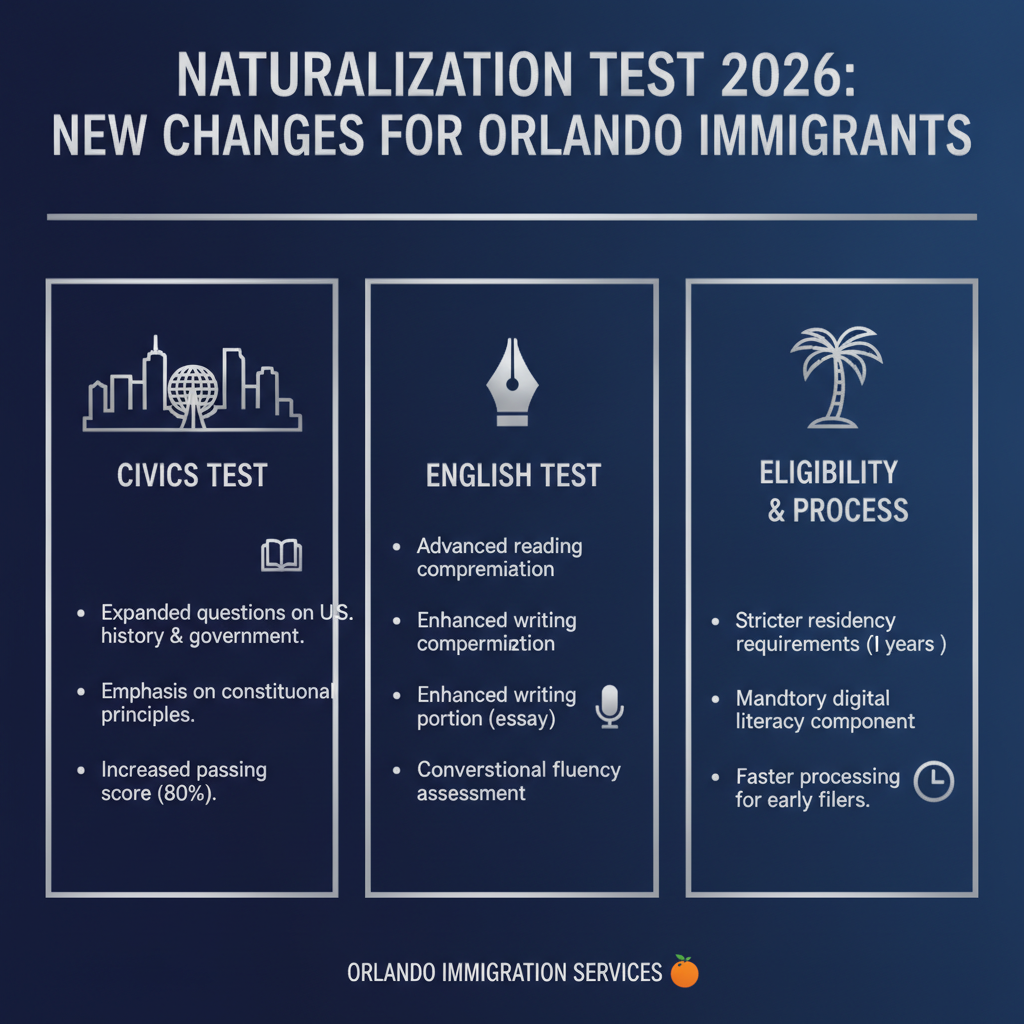
The reporting that sparked this guide: Naturalization Test Changes Coming in 2026 (Citizenship)
What This News Means for Immigrants in Orlando and Across Florida
The U.S. government periodically reviews and updates its citizenship requirements to ensure they remain relevant and effective. The changes to the Naturalization Test in 2026 are part of this ongoing process, reflecting a desire to assess a deeper understanding of American civics rather than just rote memorization.
Why this news is showing up now
Discussions and pilot programs for potential changes to the naturalization test have been underway for several years, with U.S. Citizenship and Immigration Services (USCIS) aiming to enhance the quality and effectiveness of the examination. The 2020 civics test revision, though later reverted, highlighted USCIS's interest in a more comprehensive and perhaps more challenging assessment. The current 2026 changes are the culmination of further research, public input, and a desire to align the test with contemporary educational standards and civic expectations. By September 2026, these new requirements are fully implemented, and applicants are now being tested under the updated format. This timing allows for a period of adjustment for applicants and educators, ensuring everyone has sufficient time to prepare for the new structure and content.
How it can affect Florida residents
For immigrants living in Florida, especially in bustling metropolitan areas like Orlando, Tampa, Miami, and Jacksonville, these changes have immediate implications. While the naturalization process is federal, local resources, study groups, and legal assistance will need to adapt to the new test format. Applicants in Central Florida, whether attending interviews at the Orlando USCIS Field Office or preparing through local community centers, must adjust their study methods. The Orlando USCIS Field Office, like all others nationwide, will administer the updated test. This means that if your case is in Orlando or anywhere along the I-4 corridor, your preparation strategies must now incorporate the new test requirements. It’s no longer enough to study the old 100 questions; a more nuanced approach is now essential.
What Naturalization Test Changes Are (and Why It Matters)
The Naturalization Test is a critical component of the U.S. citizenship application process. It assesses an applicant’s knowledge of American history and government (the civics test) and their ability to read, write, and speak English. The 2026 changes primarily focus on the civics portion, introducing a new format for questions and requiring a deeper, more contextual understanding of U.S. civics.
A plain-English definition
Put simply, the Naturalization Test is an examination that U.S. Citizenship and Immigration Services (USCIS) administers to individuals applying to become U.S. citizens. It consists of two main parts: an English test (to evaluate reading, writing, and speaking ability) and a civics test (to assess knowledge of U.S. history and government). The 2026 changes mean that the civics test is no longer solely based on a fixed list of 100 questions. Instead, it now incorporates more interactive, scenario-based questions that require applicants to demonstrate a practical understanding of civics, rather than just memorizing facts. These changes are significant because they require a different study approach and a more thorough grasp of American democratic principles.
Key terms you need to know
- Naturalization: The process by which a foreign citizen or national can become a U.S. citizen.
- USCIS (U.S. Citizenship and Immigration Services): The government agency responsible for overseeing lawful immigration to the United States. They administer the naturalization process and the test.
- Form N-400: The Application for Naturalization, the primary form you file to begin the citizenship process.
- Civics Test: The portion of the naturalization test that assesses an applicant's knowledge of U.S. history, government, and geography. This is the part that has seen the most significant changes in 2026.
- English Test: The portion of the naturalization test that assesses an applicant's ability to read, write, and speak basic English. While the format for this test remains largely consistent, proficiency is still paramount.
- Good Moral Character: A legal requirement for naturalization, meaning an applicant must demonstrate a history of honesty and adherence to the law.
- Continuous Residence: The requirement to have maintained residence in the U.S. for a specified period (typically 5 years, or 3 years if married to a U.S. citizen) before applying for naturalization.
The core reason these changes matter is that they aim to ensure new citizens have a more profound, functional understanding of the civic responsibilities and rights that come with citizenship. For applicants, this means preparation must go beyond simple flashcards and delve into the context and implications of U.S. governance.
Confused about the new test format or eligibility? Don't face it alone. Imigrar offers expert guidance. Call +1 786-791-3106 for a free consultation to discuss your specific situation, or message us online. Se Habla Español.
Current Immigration Law: The Foundation of U.S. Citizenship
While the Naturalization Test has changed, the underlying legal framework for U.S. citizenship remains rooted in federal law, primarily the Immigration and Nationality Act (INA). This act sets forth the fundamental requirements for who can become a U.S. citizen through naturalization.
Federal requirements
To be eligible for naturalization, applicants must meet several key federal requirements as outlined in Sections 310-336 of the Immigration and Nationality Act (INA). These include:
- Age: Be at least 18 years old at the time of filing Form N-400.
- Lawful Permanent Resident Status: Be a lawful permanent resident (Green Card holder) for a specific period. Generally, this is 5 years, or 3 years if you are married to a U.S. citizen and meet other criteria.
- Continuous Residence: Have maintained continuous residence in the U.S. for at least 5 years (or 3 years if married to a U.S. citizen) immediately preceding the filing of Form N-400. You cannot have left the U.S. for a single period of 6 months or more during this time, with limited exceptions.
- Physical Presence: Be physically present in the U.S. for at least half of the required continuous residence period (e.g., 30 months out of 5 years, or 18 months out of 3 years).
- Residence in State/USCIS District: Reside for at least 3 months in the state or USCIS district where you file your application. For those living in Orlando, this means having lived in Florida for at least 3 months.
- Good Moral Character: Demonstrate good moral character during the statutory period (typically the 5 or 3 years prior to filing). This means having a clean criminal record and adhering to U.S. laws. Certain criminal offenses can disqualify an applicant.
- Attachment to U.S. Constitution: Demonstrate an attachment to the principles and ideals of the U.S. Constitution.
- English Language Proficiency: Be able to read, write, and speak basic English. There are exceptions for age and length of permanent residence (e.g., the "50/20" and "55/15" rules).
- Knowledge of U.S. History and Government (Civics): Pass the civics test, which now includes the new 2026 questions and requirements.
- Oath of Allegiance: Be willing to take the Oath of Allegiance to the United States.
For more detailed information on eligibility and requirements, always refer to the official USCIS official website.
Florida-specific considerations
While naturalization is a federal process, living in Florida presents its own set of practical considerations. The Orlando USCIS Field Office handles applications for many Central Florida residents, including those in Orange County, Seminole County, and Osceola County. Understanding local processing times, typical interview procedures, and available community resources can be beneficial. For Central Florida residents, preparing for the updated civics test may involve utilizing local libraries, community colleges, or non-profit organizations that offer citizenship classes, many of which are now updating their curricula to reflect the 2026 changes. It's also important to note that while Florida doesn't have unique naturalization laws, the sheer diversity of its population means that resources and language assistance (like Se Habla Español services) are readily available.
Reminder: The specific requirements and test format are subject to change by USCIS. Always consult the most current information directly from USCIS or an experienced immigration attorney.
How to Prepare for the Naturalization Test (Current and Future): A Complete Step-by-Step Guide
Preparing for U.S. citizenship, especially with the 2026 test changes, requires a structured approach. This guide outlines the essential steps, focusing on how to navigate the process effectively.
1) Determine Your Eligibility
Before you even consider filing, ensure you meet the basic eligibility criteria. Review the federal requirements listed above regarding age, permanent residency duration, continuous residence, physical presence, and good moral character. Required Documents for Eligibility Assessment:
- Your Green Card (Form I-551) to confirm your lawful permanent resident status and residency start date.
- Travel records (entry/exit stamps, passport entries) to confirm continuous residence and physical presence.
- Any criminal records, even minor ones (arrest reports, court dispositions), to assess good moral character.
Important: If you have any concerns about your eligibility, particularly regarding continuous residence or good moral character, consult an immigration attorney immediately. Don't file Form N-400 without addressing these issues.
2) Prepare and File Form N-400, Application for Naturalization
Once you confirm eligibility, the next step is to accurately complete and file Form N-400. This form is extensive and requires detailed information about your personal history, family, residences, employment, travel, and moral character. Required Documents for Form N-400 Filing:
- Completed and signed Form N-400.
- Two passport-style photos (if filing by mail).
- Copy of your Green Card (front and back).
- Copy of your marriage certificate and spouse's citizenship proof (if applying based on 3-year marriage rule).
- Copies of tax returns for the past 5 (or 3) years.
- Payment of the filing fee and biometrics fee, or a fee waiver application (Form I-912).
Warning: Any inaccuracies or omissions on Form N-400 can lead to delays or even denial. Double-check all information before submitting.
3) Attend Your Biometrics Appointment
After USCIS accepts your Form N-400, you will receive an appointment notice for biometrics collection at an Application Support Center (ASC). This involves fingerprinting, photographs, and a signature, which USCIS uses to conduct background and security checks. Required Documents for Biometrics Appointment:
- Biometrics appointment notice.
- Valid photo identification (e.g., Green Card, passport, driver's license).
4) Study for the English and Civics Tests (New 2026 Format)
This is where the 2026 changes come into full effect. While the English test still assesses your ability to read, write, and speak basic English, the civics test now requires a more comprehensive understanding.
- English Test: You will be asked to read one of three sentences correctly, write one of three sentences accurately, and demonstrate your ability to speak English during the interview by answering questions about your Form N-400.
- Civics Test (2026 Format): Instead of simply memorizing 6 out of 10 answers from a list of 100 questions, the new civics test includes a combination of factual recall and scenario-based questions. For example, an officer might ask, "What are the three branches of government?" (factual) and then follow up with, "If the President vetoes a bill, what happens next and which branch is involved?" (scenario-based, requiring deeper understanding). USCIS has released updated study materials and sample questions reflecting this new approach. You will still be asked up to 20 questions, and you must answer 12 correctly to pass.
Practical Tip: Don't just memorize. Understand the *why* behind the answers. For example, instead of just knowing the names of the branches, understand their roles and how they interact (checks and balances). Utilize the new study guide available on the USCIS official website, which now includes the expanded question pool and scenario examples.
5) Attend Your Naturalization Interview
Your interview will be conducted by a USCIS officer, typically at a local field office (e.g., the Orlando USCIS Field Office). The officer will review your Form N-400, ask questions about your eligibility, test your English, and administer the civics test. Required Documents for Interview:
- Interview appointment notice.
- Your Green Card (Form I-551).
- Your passport and any other travel documents.
- State-issued identification (driver's license).
- All original documents that you submitted copies of with your Form N-400 (e.g., marriage certificates, birth certificates, divorce decrees, tax returns, criminal court documents).
- Any updated documents since filing your Form N-400 (e.g., new employment, new address, new travel, new arrests).
Important: Be honest and truthful in all your answers. If you don't understand a question, ask the officer to repeat or rephrase it. If your interview is in Orlando, ensure you arrive well in advance of your scheduled time, as parking and security checks can take time.
6) Receive a Decision and Take the Oath of Allegiance
After your interview, the USCIS officer will make a decision. You may receive a decision immediately, or it may take several weeks. If approved, you will typically receive a notice for an Oath of Allegiance ceremony. This is the final step, where you officially become a U.S. citizen. Required Documents for Oath Ceremony:
- Oath Ceremony notice (Form N-445).
- Your Green Card (which will be collected).
- Any other immigration documents requested on Form N-445.
After taking the oath, you will receive your Certificate of Naturalization, which is proof of your U.S. citizenship. You can then use this certificate to apply for a U.S. passport and register to vote.
Practical Steps You Can Take Today
The 2026 Naturalization Test changes mean that proactive and thorough preparation is more critical than ever. Here’s an actionable checklist to guide you:
- Start Studying Early (and Smart): Don't wait until your interview notice arrives. Begin studying for the civics test now, focusing on understanding concepts rather than just memorizing answers. Utilize the new USCIS study materials specifically designed for the 2026 test.
- Improve Your English Skills: Practice speaking, reading, and writing English daily. Watch English news, read books, and converse with English speakers. This will help with both the English test and understanding the civics questions.
- Gather All Required Documents: Compile all necessary original documents and copies well in advance. This includes your Green Card, passport, birth certificates, marriage certificates, divorce decrees, and tax records. Organizing these early will prevent last-minute stress.
- Review Your Form N-400 Thoroughly: Ensure every piece of information is accurate and up-to-date. Keep a copy for your records and be prepared to discuss every answer during your interview.
- Seek Legal Counsel: If you have any doubts about your eligibility, past criminal history, or understanding the new test format, consult with an experienced immigration attorney. An attorney can help identify potential issues and guide you through the complexities.
- Understand USCIS Processing Times: Check current USCIS Processing Times for Form N-400 for the Orlando Field Office. This will give you an idea of the timeline from filing to interview, allowing you to plan your study schedule effectively.
- Stay Informed: Regularly check the USCIS official website for any further updates or clarifications regarding the 2026 Naturalization Test.
Document preparation guidance
Create a master checklist of all documents. Organize them in a binder with dividers. Keep original documents separate from copies. When submitting documents to USCIS, always send copies unless they specifically request originals. Bring all originals to your interview. For Central Florida residents, having electronic copies backed up is also a good practice.
Timeline expectations
The naturalization process can take anywhere from 6 months to over 2 years, depending on the USCIS field office workload and the complexity of your case. For the Orlando USCIS Field Office, you can check specific processing times online. The 2026 test changes do not directly impact processing times but emphasize the need for thorough preparation, which can add to your personal study timeline. Filing Form N-400 at the earliest possible date after meeting your residency requirements is generally advisable.
Don't let the new Naturalization Test changes delay your citizenship journey. Get personalized advice and support from Imigrar. Call +1 786-791-3106 for your free consultation today, or message us online. Se Habla Español.
How Imigrar Helps Immigrants in Orlando Prepare for Naturalization
The path to U.S. citizenship, especially with the 2026 Naturalization Test changes, can be daunting. At Imigrar, our mission is to simplify this journey for you, ensuring accuracy, compliance, and peace of mind.
Our experience and expertise
With years of dedicated experience in immigration law, Imigrar has successfully guided countless individuals and families through the naturalization process. Our team of expert legal professionals is intimately familiar with the intricacies of USCIS requirements, including the latest 2026 test updates. We provide comprehensive support, from initial eligibility assessment to preparing you for your interview and the updated civics test.
We understand the unique challenges faced by immigrants in Orlando and across Florida. Our local knowledge of the Orlando USCIS Field Office, its procedures, and common interview practices allows us to offer tailored advice. We pride ourselves on clear communication, thorough preparation, and a compassionate approach, ensuring you feel confident and ready for every step.
Our services include:
- Eligibility Assessment: Thorough review of your history to confirm you meet all naturalization requirements.
- Form N-400 Preparation and Filing: Meticulous completion and submission of your application, ensuring all details are accurate and complete.
- Document Compilation: Guidance on gathering and organizing all necessary supporting documents.
- Interview Preparation: Comprehensive coaching for your USCIS interview, including mock interviews focusing on both the Form N-400 questions and the new 2026 civics test format.
- Legal Representation: Representation at your interview, if needed, to advocate on your behalf.
- Addressing Complex Issues: Assistance with cases involving criminal records, continuous residence issues, or other potential complications.
Free consultation offer
We believe that everyone deserves access to quality legal advice. That’s why Imigrar offers a free, no-obligation consultation. During this initial meeting, we will discuss your specific situation, assess your eligibility for naturalization, explain the impact of the 2026 test changes, and outline how we can assist you. This is your opportunity to ask questions, understand the process, and learn how our expertise can make a difference in your citizenship journey.
Don't navigate the complexities of immigration law alone. Let Imigrar be your trusted partner. Se Habla Español – our bilingual team is ready to serve you in both English and Spanish, ensuring clear communication and understanding every step of the way.

Frequently Asked Questions About the Naturalization Process and Upcoming Changes
Q: How will the 2026 Naturalization Test changes specifically affect the civics portion?
A: The 2026 changes mean the civics test is no longer just about memorizing the 100 questions. While those facts are still important, the new test incorporates scenario-based questions that require a deeper understanding of U.S. government and history. For example, instead of just naming a branch of government, you might be asked what that branch does in a specific hypothetical situation. USCIS has expanded the pool of potential questions and provided new study materials that emphasize contextual understanding over simple recall. You will still be asked up to 20 questions, and must answer 12 correctly to pass.
Q: What if I filed my N-400 before 2026 but my interview is scheduled for late 2026 or beyond? Will I take the old test or the new one?
A: Important: All naturalization interviews conducted on or after the implementation date in 2026 will use the updated test format. Even if you filed your Form N-400 before 2026, if your interview occurs in 2026 or later, you must be prepared for the new civics test questions and requirements. It is critical to update your study materials and preparation strategy accordingly.
Q: What are the primary eligibility concerns I should be aware of for naturalization?
A: The most common eligibility concerns include not meeting the continuous residence or physical presence requirements, having a criminal record (even minor offenses can impact good moral character), issues with tax compliance, or misrepresentation on previous immigration forms. Any of these can lead to delays


