


For many immigrants in Orlando, across Florida, and throughout the United States, achieving U.S. citizenship through naturalization is the ultimate goal. It represents stability, belonging, and the full rights and responsibilities of being an American. As of today, August 6, 2026, significant changes are on the horizon for the naturalization process, specifically regarding the civics test. These updates, set to be implemented later this year, underscore the importance of staying informed and preparing diligently.
At Imigrar, an immigration law firm based in Orlando, Florida, we are dedicated to helping individuals and families navigate the complexities of U.S. immigration law. Our mission is to "Keep Families Together," and that includes guiding you through every step of the naturalization process, even as the requirements evolve. We understand the anxieties that come with these changes and are here to provide clear, actionable advice.
Need Help? Our Orlando immigration team is ready to assist. Call +1 786-791-3106 for a free consultation, or message us online. Se Habla Español.
The reporting that sparked this guide
The immigration landscape is constantly shifting, and staying abreast of the latest developments is crucial. The news that has brought these upcoming changes into focus is:
Naturalization Test Changes Coming in 2026 (Citizenship)
This reporting highlights the proactive steps U.S. Citizenship and Immigration Services (USCIS) is taking to update the civics portion of the naturalization test, ensuring it remains relevant and reflective of contemporary American society.
What This News Means for Immigrants in Orlando and Across Florida
The announcement of changes to the Naturalization Civics Test in 2026 is a critical development for anyone planning to apply for U.S. citizenship. While the core requirements for naturalization remain, the way your knowledge of American history and government is assessed is evolving. For immigrants in Orlando and throughout Florida, understanding these changes is paramount to a successful application.
Why this news is showing up now
USCIS periodically reviews and updates its naturalization procedures and test content to ensure they are fair, accurate, and effective. The last significant revision to the civics test occurred in 2020, followed by a return to the 2008 version. These upcoming 2026 changes are part of USCIS's ongoing commitment to maintain the integrity and relevance of the citizenship process. The agency aims to ensure that new citizens have a foundational understanding of the U.S. system of government, history, and civic values. The current discussions and pilot programs are leading up to a formal implementation later this year, making it a timely and relevant topic for prospective citizens.
How it can affect Florida residents
For individuals residing in Florida, including those in Orlando, Tampa, Miami, and along the I-4 corridor, these changes will directly impact their naturalization journey. The Orlando USCIS Field Office, like all other field offices nationwide, will implement the new test questions and requirements. This means:
- Preparation Strategy Shift: If you are planning to apply for naturalization and your interview is scheduled for late 2026 or beyond, you will need to study the updated civics curriculum. This requires a shift in your study plan from the current 100 questions to the new format and expanded content.
- Potential for New Question Types: Reports suggest the new test may include different types of questions, moving beyond simple recall to assess a deeper understanding of civic principles. This could mean more open-ended questions or scenario-based inquiries.
- Increased Complexity: While the goal is clarity, any change can introduce an initial period of adjustment. It's crucial for applicants in Central Florida to access the most current study materials as soon as they are released by USCIS.
- Impact on Application Timelines: While the test change itself doesn't directly alter processing times for Form N-400, Application for Naturalization, the need for thorough preparation for the new test might influence when applicants feel ready to submit their application or attend their interview.
Important: If you have already applied and your interview is scheduled *before* the official implementation date of the new test (expected later in 2026), you will likely be administered the current 2008 civics test. However, it is always wise to confirm this with USCIS or your legal counsel as the implementation date approaches.
What Naturalization Is (and Why It Matters)
Naturalization is the process by which a foreign citizen or national can become a U.S. citizen. It's a transformative step, granting individuals the same rights and responsibilities as those born in the United States, with a few exceptions (such as being eligible to run for President). This process is governed primarily by the Immigration and Nationality Act (INA).
A plain-English definition
Think of naturalization as earning your full membership in the American club. You’ve lived here for a certain period, followed the rules, learned about the country, and now you’re ready to take an oath to become a full citizen. This involves demonstrating your commitment to the U.S. and proving your understanding of its government and history. The final step is typically taking the Oath of Allegiance, where you formally pledge your loyalty to the United States.
Key terms you need to know
- Naturalization: The process of becoming a U.S. citizen after birth.
- U.S. Citizenship and Immigration Services (USCIS): The government agency responsible for overseeing lawful immigration to the United States. They process naturalization applications and administer the tests.
- Form N-400: The official application form for naturalization. This is the primary document you file to begin the process.
- Civics Test: A component of the naturalization interview that assesses an applicant's knowledge of U.S. history and government. This is the test undergoing changes.
- English Test: Another component of the naturalization interview that assesses an applicant's ability to read, write, and speak basic English. This test is *not* expected to change significantly in 2026.
- Good Moral Character: A legal requirement for naturalization, meaning you must have adhered to U.S. laws and demonstrated good conduct during your residency.
- Oath of Allegiance: The final ceremony where an applicant formally pledges loyalty to the United States and becomes a U.S. citizen.
- Lawful Permanent Resident (LPR): Also known as a "green card holder," this is the status an individual must typically hold for a certain period before applying for naturalization.
Achieving citizenship matters profoundly because it strengthens your ties to the U.S., provides greater security against deportation, allows you to vote, run for office, obtain a U.S. passport, and petition for more family members. It also means you can never lose your right to live and work in the United States, unlike a green card holder who could, in certain circumstances, face removal proceedings.
Navigating the path to U.S. citizenship can be complex, especially with upcoming changes. Let Imigrar simplify it for you. Our experienced team in Orlando understands the nuances of naturalization law. Call us at +1 786-791-3106 for a free consultation. Se Habla Español.
Current Immigration Law: The Foundation
The process of naturalization is governed by federal law, primarily the Immigration and Nationality Act (INA). While the civics test content changes, the underlying legal requirements for eligibility for naturalization remain consistent. Understanding these foundational laws is crucial for any applicant.
Federal requirements
To be eligible for naturalization, applicants must generally meet several federal requirements outlined in the INA. These include:
- Age: Be at least 18 years old at the time of filing Form N-400.
- Lawful Permanent Residence: Be a Lawful Permanent Resident (LPR) (a green card holder) for at least 5 years. This requirement is reduced to 3 years if you are married to a U.S. citizen and meet other specific criteria, such as living in marital union with the citizen spouse for those 3 years.
- Continuous Residence: Have resided continuously in the U.S. as an LPR for at least 5 years (or 3 years if married to a U.S. citizen) immediately preceding the filing of Form N-400. This means you cannot have taken any trips outside the U.S. that break this continuity (generally, trips of 6 months or more can break continuity, and trips of 1 year or more automatically do).
- Physical Presence: Be physically present in the U.S. for at least half of the required continuous residence period (e.g., 30 months out of 5 years, or 18 months out of 3 years).
- Residency in State/USCIS District: Have resided for at least 3 months in the state or USCIS district where you file your application. For those in Orlando or Central Florida, this means residing in the jurisdiction of the Orlando USCIS Field Office.
- Good Moral Character: Demonstrate good moral character for the statutory period (5 or 3 years) preceding your application and up to the time of the Oath of Allegiance. This involves adhering to laws, paying taxes, and not having certain criminal convictions.
- Attachment to the U.S. Constitution: Demonstrate an attachment to the principles of the U.S. Constitution and be well-disposed to the good order and happiness of the United States.
- English Language Proficiency: Be able to read, write, and speak basic English. There are exceptions for age and length of residence (e.g., the "50/20" and "55/15" rules).
- Knowledge of U.S. History and Government (Civics): Pass the Civics Test, demonstrating knowledge and understanding of U.S. history and government. This is the component undergoing changes in 2026.
For official and detailed information on all requirements, always refer to the USCIS official website. Specifically, you will find comprehensive guides and instructions for Form N-400 on their USCIS Forms page.
Florida-specific considerations
While naturalization is a federal process, local factors can influence your journey. For applicants in Florida:
- Orlando USCIS Field Office: Most interviews for Central Florida residents are conducted at the Orlando USCIS Field Office. Understanding local procedures and wait times at this specific office can be beneficial. You can check average processing times on the USCIS Processing Times page.
- Community Resources: Florida has numerous community organizations and adult education centers that offer English as a Second Language (ESL) classes and civics preparation courses. Leveraging these local resources can be invaluable, especially as new test materials become available.
- State-Specific Laws: While state laws do not directly impact federal naturalization eligibility, certain state-level issues (like traffic infractions, minor criminal offenses, or even property disputes) could potentially impact your good moral character assessment. It's crucial to disclose all relevant information to USCIS and consult with an attorney if you have any concerns.
Reminder: Your journey to citizenship is a deeply personal one, but you don't have to navigate it alone. Imigrar serves clients nationwide, with a strong presence in Orlando, ready to assist Florida residents with their naturalization applications.
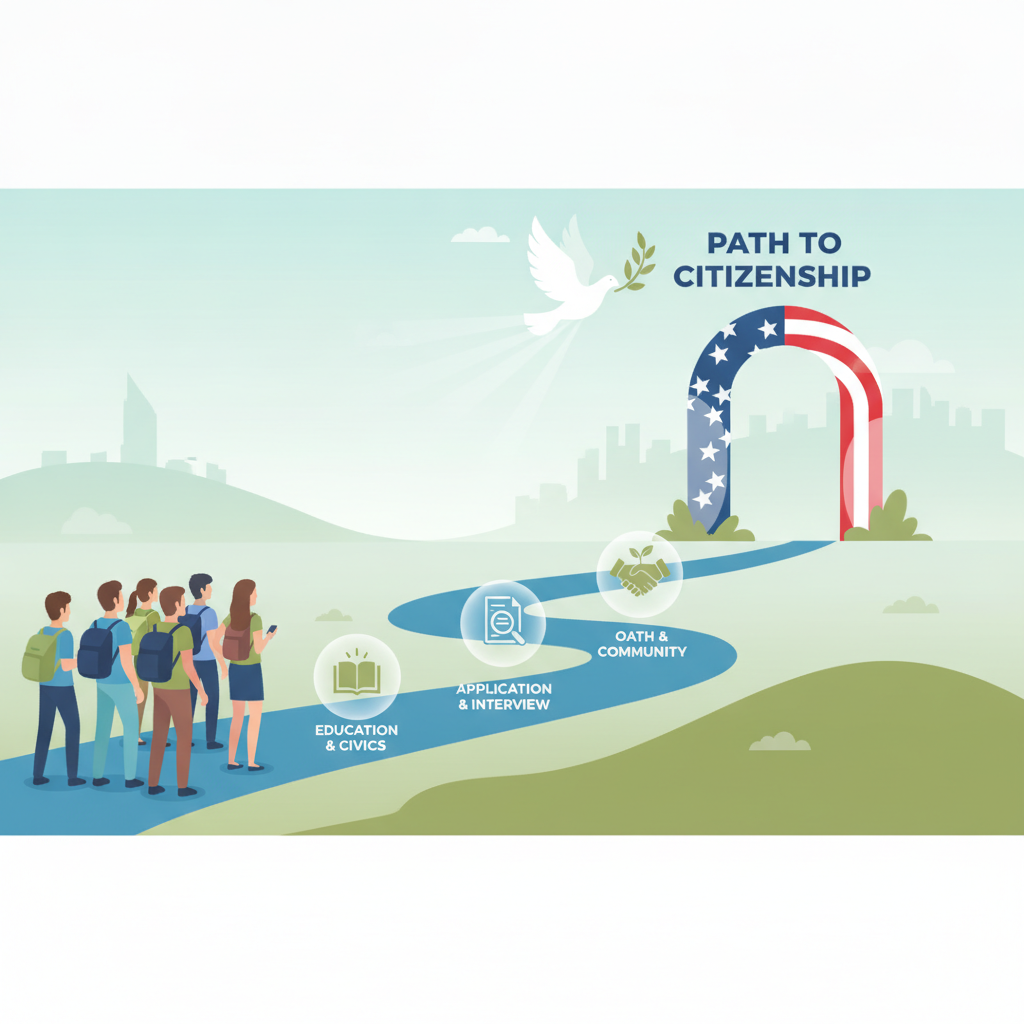
How to Prepare for Naturalization: A Complete Step-by-Step Guide
The naturalization process, while straightforward in its steps, requires meticulous preparation, especially with the upcoming civics test changes in 2026. Here’s a detailed guide to help you navigate it successfully.
1) Determine Your Eligibility (and Monitor Changes)
Before anything else, confirm you meet all the basic eligibility requirements mentioned above (age, LPR status, continuous residence, physical presence, good moral character, etc.).
- Documents Needed:
- Your Green Card (Form I-551)
- Proof of dates you became an LPR
- Travel records (entry/exit stamps, passport copies) to calculate physical presence
- Action: Use the USCIS official website to review current eligibility criteria for Form N-400. Pay close attention to any USCIS announcements regarding the specific implementation date for the new civics test. If your interview will likely fall after the implementation, start familiarizing yourself with any pilot test questions or announced changes as they become available.
2) Prepare and File Form N-400, Application for Naturalization
This is the cornerstone of your application. Fill out Form N-400 accurately and completely. Any errors or omissions can lead to delays or even denial.
- Documents Needed (common examples):
- Copy of your Green Card (front and back)
- Passport-style photos
- Marriage certificate (if applying under the 3-year rule)
- Divorce decrees (if applicable)
- Birth certificates of children
- Tax transcripts for the past 5 (or 3) years
- Court disposition documents for any arrests, citations, or convictions (even if minor)
- Selective Service registration proof (for males aged 18-26)
- Evidence of support for dependents (if applicable)
- Action: Gather all necessary documents. Ensure copies are clear and legible. Review the Form N-400 instructions thoroughly. Consider seeking legal advice to ensure all questions are answered correctly and all required supporting documents are included, especially if you have any criminal history or complex travel patterns.
3) Study for the English and Civics Test (with an Eye on 2026)
This is where the upcoming changes are most relevant. While you should prepare for the current test if your interview is soon, you must also be ready for the new civics questions if your interview is expected in late 2026 or beyond.
- Current Test Documents:
- The 100 civics questions and answers (current version)
- Reading and writing vocabulary lists
- Future Test Documents (as they become available):
- Updated civics study guide and questions
- Any new format or question type descriptions from USCIS
- Action:
- English Test: Practice reading, writing, and speaking English. USCIS provides lists of vocabulary words.
- Civics Test (Current): Study the existing 100 questions and answers. Many online resources and apps are available.
- Civics Test (2026 Changes): As soon as USCIS releases the new study materials and question sets (expected later in 2026), immediately shift your focus to these. Stay updated by checking the USCIS official website regularly for announcements.
4) Attend Your Biometrics Appointment
After filing Form N-400, you will receive an appointment notice for biometrics (fingerprints, photos, and signature). This is for background checks.
- Documents Needed:
- Appointment Notice (Form I-797C)
- Photo identification (e.g., Green Card, passport)
- Action: Attend your appointment on time at the specified Application Support Center (ASC). Dress appropriately and bring all required documents.
5) Attend the Naturalization Interview
This is the most critical step. You will meet with a USCIS officer who will review your application, test your English and civics knowledge, and ask questions about your eligibility and good moral character.
- Documents Needed:
- Appointment Notice
- Green Card (Form I-551)
- All original documents submitted with Form N-400 (e.g., marriage certificates, tax returns, court documents)
- Passport(s) and any other travel documents
- Proof of updated information since filing (e.g., new address, new job, new arrests if applicable)
- Action: Arrive early. Be honest and truthful in your answers. Listen carefully to the officer's questions. This is where you will be administered the English test and, crucially, the Civics Test. If your interview is in late 2026 or beyond, be prepared for the *new* civics test questions.
6) Receive a Decision and Attend the Oath Ceremony
After the interview, the officer will either make a decision immediately, request additional documents (N-14 request), or continue your case. If approved, you will receive a notice for your Oath of Allegiance ceremony.
- Documents Needed:
- Form N-445, Notice of Naturalization Oath Ceremony
- Your Green Card (which will be surrendered)
- Any foreign travel documents (passports) you hold
- Action: Attend the oath ceremony. This is the moment you officially become a U.S. citizen. You will surrender your Green Card and receive your Certificate of Naturalization.
Practical Steps You Can Take Today
Even with changes coming, there are many proactive steps you can take right now to prepare for your naturalization journey, particularly for those in Orlando and the surrounding Orange County area.
Don't let the upcoming Naturalization Test changes delay your dream of U.S. citizenship. Imigrar provides expert guidance and preparation assistance. Call our Orlando office today for a free consultation at +1 786-791-3106. Se Habla Español.
Actionable checklist with 5+ items:
- Review Your Eligibility: Double-check all criteria against your personal situation. If you're close to meeting the residency requirements, start planning.
- Gather Essential Documents: Begin collecting all documents required for Form N-400. This includes birth certificates, marriage certificates, tax records, and any court dispositions. Organize them in a clear, accessible manner.
- Start Studying (Current Test): If you plan to apply soon, begin studying the current 100 civics questions and English vocabulary. This will build a strong foundation, regardless of future changes.
- Monitor USCIS Announcements: Regularly visit the USCIS official website for updates on the 2026 civics test changes. Look for new study guides, pilot test results, and the official implementation date.
- Improve English Skills: Enroll in ESL classes or practice English daily through reading, writing, and conversation. This will benefit both the English and civics portions of the test.
- Consult an Immigration Attorney: A free consultation with an expert at Imigrar can clarify your eligibility, review your documents, and advise on how to prepare for the specific test version you're likely to face.
Document preparation guidance
- Create a Checklist: Use the official Form N-400 instructions to create a personalized checklist of every document you need.
- Originals vs. Copies: Generally, you submit copies of documents with your application, but you must bring the originals to your interview. Keep originals in a safe place.
- Translations: Any document not in English must be accompanied by a certified English translation.
- Organization: Use folders, binders, or digital files to keep everything organized. Label clearly.
- Criminal Records: If you have any arrests or convictions, even minor ones, obtain certified court dispositions. This is critical for the good moral character assessment.
Timeline expectations
The naturalization process can take time. Current processing times for Form N-400 vary by field office and can range from 6 months to over a year, sometimes longer. For the Orlando USCIS Field Office, you can check specific times on the USCIS Processing Times page.
- Application Filing to Biometrics: Typically 3-8 weeks.
- Biometrics to Interview: Can be several months, depending on the field office workload.
- Interview to Oath Ceremony: Often 2-6 weeks if approved on the spot, but can be longer if additional review is needed.
Warning: The upcoming test changes in 2026 add another layer of preparation. Factor in extra study time once the new materials are released. Don't rush your application just to beat the changes; thorough preparation is always the best strategy.
How Imigrar Helps Immigrants in Orlando
At Imigrar, we understand that the journey to U.S. citizenship is one of the most significant steps an immigrant can take. Located in Orlando, Florida, our firm is deeply committed to serving the diverse communities of Central Florida and clients nationwide. Our tagline, "Keep Families Together," truly reflects our dedication to helping you achieve your American dream.
Our experience and expertise
Our team of experienced immigration attorneys possesses in-depth knowledge of U.S. immigration law, including the intricate details of the naturalization process. We stay current with all USCIS policy updates, procedural changes, and, crucially, the upcoming 2026 Naturalization Test modifications. We have successfully guided countless individuals through their citizenship applications, from initial eligibility assessments to preparing for interviews and attending oath ceremonies.
We provide comprehensive support, including:
- Eligibility Assessment: Thorough review of your personal circumstances to ensure you meet all naturalization requirements, identifying any potential issues early on.
- Form N-400 Preparation: Meticulous assistance in completing Form N-400, ensuring accuracy and completeness to avoid delays.
- Document Compilation: Guidance on gathering and organizing all necessary supporting documents, including certified translations where required.
- Interview Preparation: Extensive coaching for your naturalization interview, including mock civics and English tests, and practice answering personal questions. We will help you prepare for *both* the current civics test and the anticipated 2026 changes, ensuring you are ready regardless of which version you face.
- Representation: Although not always required, an attorney can accompany you to your interview at the Orlando USCIS Field Office, providing peace of mind and immediate assistance if any unexpected issues arise.
- Troubleshooting: Addressing complex issues such as criminal history, extended absences from the U.S., or previous immigration violations that might impact your eligibility.
Free consultation offer
We believe everyone deserves access to expert legal advice. That's why Imigrar offers a free consultation to discuss your naturalization case. This initial meeting allows us to understand your situation, explain the process, address your concerns about the upcoming test changes, and outline how we can assist you. It's a no-obligation opportunity to get clear answers from trusted professionals.
Whether you're just starting to consider naturalization or are already in the process and worried about the 2026 changes, our team is here to help. We serve clients across Florida, from Orlando to the furthest reaches of the state, and nationwide.
Se Habla Español. We are proud to offer our services in both English and Spanish, ensuring that language is never a barrier to receiving the legal support you need. Our bilingual staff is ready to communicate effectively and clearly, making sure you understand every aspect of your case.
Don't leave your path to citizenship to chance. Partner with Imigrar for reliable, compassionate, and effective legal representation.
Frequently Asked Questions
Q: How will the 2026 Naturalization Test changes affect my eligibility for citizenship?
A: The upcoming changes primarily affect the *content* and *format* of the Civics Test portion of the naturalization interview, not the underlying eligibility requirements. You will still need to meet the age, residency, good moral character, and English language proficiency requirements as outlined in the INA. The change means you'll need to study a different set of civics questions and potentially prepare for new question types, but it won't alter whether you qualify to apply for citizenship based on your green card status.
Q: If I apply now (August 2026), will I take the old or new civics test?
A: This is a critical question. USCIS has indicated a formal implementation date for the new test later in 2026. If your naturalization interview is scheduled *before* that official implementation date, you will likely take the current 2008 version of the civics test (the 100 questions). If your interview falls *on or after* the implementation date, you will take the new version. Because processing times for Form N-400 can vary (see USCIS Processing Times), it's difficult to predict definitively. It is advisable to study *both* the current 100 questions and, as soon as they are released, the new materials. An attorney at Imigrar can help you assess your specific timeline.
Q: What if I have complex travel history or minor criminal offenses? How will this impact my naturalization?
A: Complex travel history (especially long absences from the U.S.) can impact your continuous residence and physical presence requirements. Minor criminal offenses, even if they seem insignificant, can affect your ability to establish good moral character. It is absolutely crucial to disclose all such information on Form N-400 and provide certified court dispositions for any arrests or convictions. Failure to disclose can be grounds for denial and even lead to more serious immigration consequences. Consulting with an experienced immigration attorney at Imigrar is highly recommended in these situations to assess potential issues and strategize the best approach.
Q: What documents should I prepare specifically for the new civics test?


