What This News Means for Immigrants in Orlando and Across Florida
The journey to becoming a U.S. citizen is a profound step for many immigrants, offering a sense of belonging, new rights, and enhanced opportunities. A critical component of this journey is the Naturalization Test, which assesses an applicant’s knowledge of U.S. history and government (civics) and their ability to read, write, and speak English. News of impending changes to this vital test in 2026 can understandably cause concern and raise many questions for aspiring citizens. For residents of Orlando and across Florida, understanding these updates is paramount to a successful application.Why this news is showing up now
The United States Citizenship and Immigration Services (USCIS) regularly reviews and updates its processes and requirements to ensure they remain relevant and effective. The Naturalization Test, in particular, has seen revisions over the years. The most recent significant review and update process for the civics test began in December 2022, with USCIS announcing plans to pilot a revised test. This pilot program, which involves volunteer community-based organizations, is a crucial step in developing the new test. The goal of these ongoing reviews is often to enhance the test’s accuracy and consistency, ensuring it effectively measures an applicant's civic knowledge and English proficiency. USCIS aims for a test that is fair, accessible, and reflective of the knowledge necessary for active participation in American civic life. The current discussion and pilot phase mean that while the changes aren't immediate, they are actively being developed and tested, with a target implementation date in late 2026. This advance notice provides a crucial window for applicants and legal professionals to prepare for the upcoming modifications. It also highlights USCIS’s commitment to transparency, allowing ample time for the public to understand and adapt to the new requirements before they become mandatory.How it can affect Florida residents
Florida is home to a vibrant and diverse immigrant population, with many individuals and families actively pursuing U.S. citizenship. Cities like Orlando, a major hub in Central Florida, see thousands of naturalization applications processed each year through the local USCIS Field Office. For these aspiring citizens, news of test changes directly impacts their preparation strategy and, potentially, their timeline for applying. **Key impacts for Florida residents include:** * **Preparation Strategy:** If you plan to apply for naturalization in 2026 or later, your study materials and methods for the civics test will need to adapt to the new format and questions. Current study guides may become outdated. * **Timeline Considerations:** Some applicants might consider accelerating their naturalization application process to take the current test if they are already eligible and prepared. Conversely, others might delay if they anticipate the new test format will be more favorable or if they need more time to study the revised curriculum. * **Access to Resources:** The availability of updated study materials, preparation classes, and legal guidance will be crucial. Immigration law firms like Imigrar in Orlando will be at the forefront of providing the latest information and support. * **Anxiety and Uncertainty:** Changes to such a significant part of the citizenship process can create stress. Understanding the specifics of the new test, as they become available, will be key to alleviating these concerns. * **Local Field Office Impact:** The Orlando USCIS Field Office, like others nationwide, will implement these new test procedures. Local attorneys and community organizations will be vital in disseminating information specific to the Central Florida region. Understanding these implications early allows you to make informed decisions about your naturalization journey. Imigrar is committed to keeping our Orlando community and clients nationwide fully informed and prepared for these upcoming changes.Need Help? Our Orlando immigration team is ready to assist. Call +1 786-791-3106 for a free consultation, or message us online. Se Habla Español.
What Naturalization Is (and Why It Matters)
Naturalization is the process by which a lawful permanent resident (LPR), also known as a green card holder, voluntarily becomes a U.S. citizen. It’s the final step for many immigrants in establishing full legal and civic ties to the United States. While holding a green card offers many benefits, naturalization provides an even greater level of security, rights, and opportunities.A plain-English definition
Simply put, naturalization is how a person who was born outside of the United States and was not a U.S. citizen at birth becomes one. This process is overseen by the U.S. Citizenship and Immigration Services (USCIS). It typically involves meeting specific eligibility requirements, submitting an application, attending an interview, passing English and civics tests, and finally, taking an Oath of Allegiance. Why does it matter? Becoming a U.S. citizen offers profound benefits: * **Voting Rights:** Citizens can vote in federal, state, and local elections, giving them a voice in their government. * **U.S. Passport:** Citizens can obtain a U.S. passport, allowing for easier international travel and consular protection abroad. * **Family Petitions:** Citizens can petition for a wider range of family members (e.g., married children, siblings) to come to the U.S., often with shorter waiting times. * **Protection from Deportation:** Citizenship provides security against deportation, even for certain criminal offenses that could lead to removal for green card holders. * **Government Jobs:** Many federal jobs require U.S. citizenship. * **Eligibility for Public Office:** Citizens can run for federal and most state and local elected offices. * **Sense of Belonging:** For many, it represents the culmination of their immigration journey, offering a deep sense of integration and belonging to the American community.Key terms you need to know
Navigating the naturalization process involves understanding specific terminology. Here are some key terms: * **Naturalization:** The process of becoming a U.S. citizen after birth. * **Lawful Permanent Resident (LPR):** A foreign national who has been granted the privilege of residing permanently in the United States as an immigrant. Also known as a "green card holder." * **Form N-400:** The official application form for naturalization, filed with USCIS. * **Civics Test:** A component of the naturalization interview that assesses an applicant's knowledge of U.S. history, government, and civics. This is the part of the test slated for changes in 2026. * **English Test:** Another component of the naturalization interview that assesses an applicant's ability to read, write, and speak basic English. * **Good Moral Character:** A legal requirement for naturalization, meaning an applicant must have adhered to certain standards of behavior during their time as an LPR. Certain criminal offenses or other actions can disqualify an applicant. * **Continuous Residence:** The requirement that an applicant maintain residence in the U.S. for a specified period (usually 3 or 5 years) before applying for naturalization. * **Physical Presence:** The requirement that an applicant must have actually been physically present in the U.S. for a certain cumulative period during their continuous residence. * **Oath of Allegiance:** The final step in the naturalization process, where an applicant formally pledges loyalty to the United States. * **USCIS (U.S. Citizenship and Immigration Services):** The federal agency responsible for administering immigration and naturalization benefits. * **Field Office:** Local USCIS offices where naturalization interviews and some other services are conducted (e.g., the Orlando USCIS Field Office). Understanding these terms will help you better comprehend the requirements and process for becoming a U.S. citizen, especially as you prepare for the upcoming changes to the Naturalization Test.Current Immigration Law: The Foundation
The framework for U.S. naturalization is primarily established by the **Immigration and Nationality Act (INA)**, specifically Section 312, which outlines the English language and civics knowledge requirements. This act sets the legal foundation upon which all naturalization applications are evaluated.Federal requirements
To be eligible for naturalization under current federal law, applicants must generally meet several strict criteria. While there are some exceptions and special circumstances, the most common requirements include: * **Age:** Be at least 18 years old at the time of filing Form N-400. * **Lawful Permanent Residency:** Have been a **Lawful Permanent Resident** (green card holder) for at least 5 years. This period is reduced to 3 years if you are married to a U.S. citizen, have been living in marital union with your spouse, and your spouse has been a U.S. citizen for at least 3 years. * **Continuous Residence:** Have resided continuously in the U.S. for at least 5 years (or 3 years if married to a U.S. citizen) immediately preceding the date of filing Form N-400. You must also maintain continuous residence from the date you file your application until you naturalize. Absences from the U.S. of more than six months but less than one year may break continuous residence unless proven otherwise. Absences of one year or more automatically break continuous residence. * **Physical Presence:** Have been physically present in the U.S. for at least half of the required continuous residence period (e.g., 30 months out of 5 years, or 18 months out of 3 years). * **Residence in USCIS District or State:** Have resided for at least 3 months in the state or USCIS district where you file your application. For those in Orlando, this means living in Florida for at least 3 months. * **Good Moral Character:** Demonstrate **Good Moral Character** for the statutory period (5 or 3 years) preceding your application and up to the Oath of Allegiance. This is a crucial and often complex requirement, encompassing your respect for U.S. laws, honesty, and overall conduct. Certain criminal offenses (even minor ones), false statements, or failures to pay taxes can disqualify an applicant. * **Attachment to the Principles of the U.S. Constitution:** Be willing to support and defend the U.S. Constitution and laws. This is affirmed through the Oath of Allegiance. * **English Language Proficiency:** Demonstrate the ability to read, write, and speak basic English. This is assessed during the interview. There are exceptions for applicants who are elderly and have been LPRs for a long time (e.g., 50 years old and 20 years an LPR, or 55 years old and 15 years an LPR). * **Knowledge of U.S. History and Government (Civics):** Pass the civics test. This is the component undergoing changes in 2026. Currently, applicants are asked up to 10 questions from a list of 100, and must answer at least 6 correctly. **Important:** Each of these requirements has detailed interpretations and potential exceptions. It’s vital to understand how they apply to your specific situation.Florida-specific considerations
While the federal requirements are universal, the application process can have practical nuances depending on your location. For immigrants in Florida, particularly those in the Orlando area, specific considerations include: * **Orlando USCIS Field Office:** If your case is in Orlando, your naturalization interview will typically be scheduled at the Orlando USCIS Field Office. Familiarity with this office's procedures, common interview questions, and specific officer tendencies can be beneficial. Our attorneys at Imigrar have extensive experience representing clients at this office. * **Volume of Applications:** Florida is one of the most populous states, meaning the Orlando and other Florida USCIS Field Offices handle a high volume of naturalization applications. This can sometimes impact processing times, though USCIS aims for consistency nationwide. You can check current processing times on the USCIS Processing Times website. * **Community Resources:** Central Florida, including Orange County and the wider I-4 corridor, has numerous community organizations that offer English classes and civics preparation. Imigrar often partners with or refers clients to these valuable resources. * **Legal Expertise:** Given the diverse immigrant communities in Florida, finding legal representation that understands the unique cultural and linguistic backgrounds of applicants, as well as the local USCIS environment, is crucial. Imigrar offers services in both English and Spanish (Se Habla Español) to serve our community effectively. For a complete list of forms and detailed instructions, always refer to the USCIS official website. Specifically, the primary form for naturalization is Form N-400, Application for Naturalization. Understanding the current legal landscape is the first step in preparing for the changes ahead.How to Become a U.S. Citizen: A Complete Step-by-Step Guide
The path to U.S. citizenship through naturalization is a multi-step process that requires careful attention to detail, thorough preparation, and patience. While the Naturalization Test is changing in 2026, the overall application process remains largely consistent. Here is a comprehensive step-by-step guide:1) Determine Your Eligibility
Before you even begin filling out forms, the most crucial first step is to confirm you meet all the eligibility requirements for naturalization. This involves a thorough self-assessment against the criteria outlined in the "Current Immigration Law" section. * **Check Age:** Are you at least 18 years old? * **Verify Green Card Status:** Have you been a **Lawful Permanent Resident** for the required duration (5 years generally, or 3 years if married to a U.S. citizen)? * **Assess Continuous Residence:** Have you maintained your residence in the U.S. for the required period? Be meticulous about any trips outside the U.S., especially if they were longer than 6 months. * **Calculate Physical Presence:** Have you been physically present in the U.S. for at least half of your continuous residence period? * **Review Good Moral Character:** This is a critical area. Have you had any arrests, convictions, or legal issues? Have you paid your taxes? Have you registered for Selective Service (if required)? Even minor infractions can impact your eligibility, so it's essential to be honest and upfront. * **Commitment to Constitution:** Are you willing to take the Oath of Allegiance and uphold the Constitution? **Required Documents for this Step (for self-assessment):** * Your Green Card (Form I-551) * Marriage certificate (if applying under the 3-year rule) * Travel records (entry/exit stamps in passport, flight itineraries) * Tax returns for the past 5 (or 3) years * Any court disposition documents for arrests or convictions (even if charges were dropped or expunged) * Selective Service registration number (if applicable) **Warning:** If you have any doubts about your eligibility, especially regarding good moral character or continuous residence, consult with an experienced immigration attorney before proceeding.2) Prepare and File Form N-400, Application for Naturalization
Once you've confirmed your eligibility, the next step is to meticulously complete and submit Form N-400. This form is extensive and requires detailed information about your personal history, residency, employment, family, and good moral character. * **Gather Supporting Documents:** Collect all necessary documents as listed in the N-400 instructions. This often includes copies of your Green Card, marriage certificate, birth certificates of children, tax transcripts, and evidence of any name changes. * **Complete the Form Accurately:** Fill out every section completely and honestly. Any omissions or inaccuracies can lead to delays or even denial. If a question doesn't apply, write "N/A." * **Passport-Style Photos:** Provide two identical, color passport-style photos taken within 30 days of filing. * **Pay the Filing Fee:** As of the date of this article, there is a filing fee for Form N-400, plus a biometrics fee, unless you qualify for a fee waiver. Check the USCIS fee schedule for the most current amounts. * **Assemble and Mail:** Organize your application packet carefully, making copies of everything for your records. Mail the application to the correct USCIS lockbox facility. **Required Documents (to submit with N-400):** * Completed and signed Form N-400 * Copy of your Green Card (front and back) * Two passport-style photos * Filing fee (check or money order) or approved fee waiver (Form I-912) * **If applying under the 3-year rule:** * Copy of marriage certificate * Proof of spouse's U.S. citizenship (e.g., birth certificate, naturalization certificate, U.S. passport) * Evidence of marital union (e.g., joint tax returns, bank statements, utility bills) * **If you have changed your name:** * Certified copy of the court order or marriage certificate reflecting the name change * **If you have children not born in the U.S.:** * Copies of their birth certificates3) Attend Your Biometrics Appointment
After USCIS accepts your Form N-400, you will receive an appointment notice (Form I-797C, Notice of Action) for a biometrics appointment at an Application Support Center (ASC). This appointment is typically scheduled a few weeks after you file your application. * **Purpose:** At the biometrics appointment, USCIS will collect your fingerprints, photograph, and signature. These are used to conduct background checks and verify your identity. * **What to Bring:** You must bring your appointment notice and a valid government-issued photo identification (e.g., Green Card, state ID, passport). **Required Documents:** * Biometrics appointment notice (Form I-797C) * Valid government-issued photo identification (e.g., Green Card, driver's license, passport)4) Attend the Naturalization Interview and Take the Tests
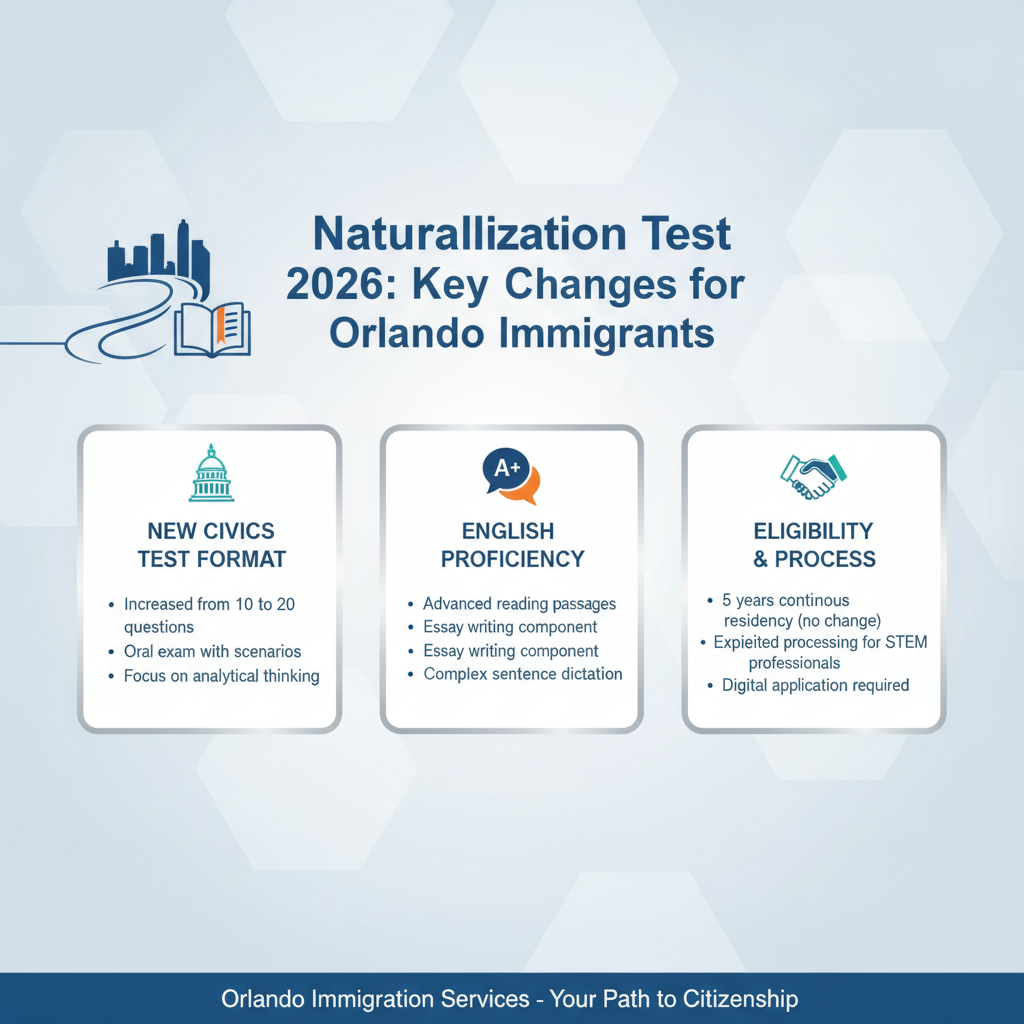
This is a critical stage where you meet with a USCIS officer, review your application, and take the English and Civics Tests. For those applying in 2026 or later, this is where the new civics test format will be implemented. * **Interview Review:** The officer will go through your Form N-400 line by line, asking you to confirm information and clarify any discrepancies. They will also ask questions about your good moral character, continuous residence, and attachment to the Constitution. * **English Test:** * **Speaking:** Assessed throughout the interview as you answer the officer's questions. * **Reading:** You will be asked to read one out of three sentences correctly from a tablet. * **Writing:** You will be asked to write one out of three sentences correctly from a tablet. * **Civics Test:** * **Current Test (pre-2026):** You will be asked up to 10 questions from the 100 civics questions list. You must answer 6 correctly to pass. * **New Test (2026 onwards):** The format and types of questions will change. USCIS has indicated a potential shift towards a multiple-choice format for the civics portion and may include more questions with visual aids, requiring a deeper understanding rather than rote memorization. The pilot program for the new test includes a civics portion with 20 questions presented in a multiple-choice format. The English portion would also include additional spoken English assessment items. **Important:** Stay updated on the specific changes as USCIS releases more details. * **What to Bring:** Your interview notice, your Green Card, all original documents you submitted copies of with your N-400, and any updated evidence (e.g., new tax returns, updated travel records, proof of residence if you moved). **Required Documents:** * Interview Appointment Notice * Your Green Card (original) * Your U.S. State-issued identification (e.g., Florida Driver's License) * Your current passport and any expired passports * All original documents you submitted copies of with your Form N-400 (e.g., marriage certificate, birth certificates, court dispositions) * Any updated documents or evidence (e.g., proof of continued residence, updated tax returns, new employment letters) **Reminder:** Practice for both the English and Civics tests extensively. For the new test, focus not just on memorization but on understanding the concepts.Navigating the naturalization interview can be daunting, especially with upcoming changes. Let Imigrar guide you. Call +1 786-791-3106 for expert interview preparation and legal support in Orlando. Se Habla Español.
5) Receive a Decision and Attend the Oath of Allegiance Ceremony
After your interview, the USCIS officer will either make a decision on your application, or they may request additional documents (Request for Evidence – RFE) or schedule a second interview. * **Approval:** If your application is approved, you will receive a **Form N-445, Notice of Naturalization Oath Ceremony**, detailing the date, time, and location of your oath ceremony. This ceremony is the final step where you officially become a U.S. citizen. * **Oath Ceremony:** At the ceremony, you will surrender your Green Card and take the Oath of Allegiance to the United States. You will then receive your Certificate of Naturalization. * **Denial:** If your application is denied, USCIS will send you a written explanation. You may have the option to appeal the decision by filing Form N-336, Request for a Hearing on a Decision in Naturalization Proceedings, or to reapply if the issues leading to the denial can be resolved. **Required Documents for Oath Ceremony:** * **Form N-445, Notice of Naturalization Oath Ceremony** * Your Green Card (original, to be surrendered) * Any re-entry permits issued by USCIS (original) * Any other immigration documents requested by USCIS6) Update Your Records (Optional, but Highly Recommended)
Once you receive your Certificate of Naturalization, you are officially a U.S. citizen! There are a few important steps you should take: * **Apply for a U.S. Passport:** This is your primary proof of U.S. citizenship for international travel. Apply through the U.S. Department of State (U.S. Department of State). * **Register to Vote:** As a citizen, you have the right to vote. Register at your local Supervisor of Elections office or when applying for your driver's license. * **Update Social Security Records:** Inform the Social Security Administration of your new citizenship status. * **Inform Other Agencies:** Update your status with any other relevant government agencies or institutions (e.g., DMV, banks, employers). This detailed process, while seemingly complex, is manageable with proper preparation and guidance. Imigrar is here to simplify it for you, especially as the Naturalization Test evolves.