What This News Means for Immigrants in Orlando and Across Florida
The journey to U.S. citizenship is a profound and life-changing step for millions of immigrants worldwide, including the vibrant communities across Florida. For many, the final hurdle is the naturalization interview, which includes the English and civics tests. Recent news reports and discussions from U.S. Citizenship and Immigration Services (USCIS) indicate that significant changes to the civics portion of the naturalization test are on the horizon, slated to take effect in **2026**. This development holds crucial implications for anyone planning to apply for U.S. citizenship in the coming years.Why this news is showing up now
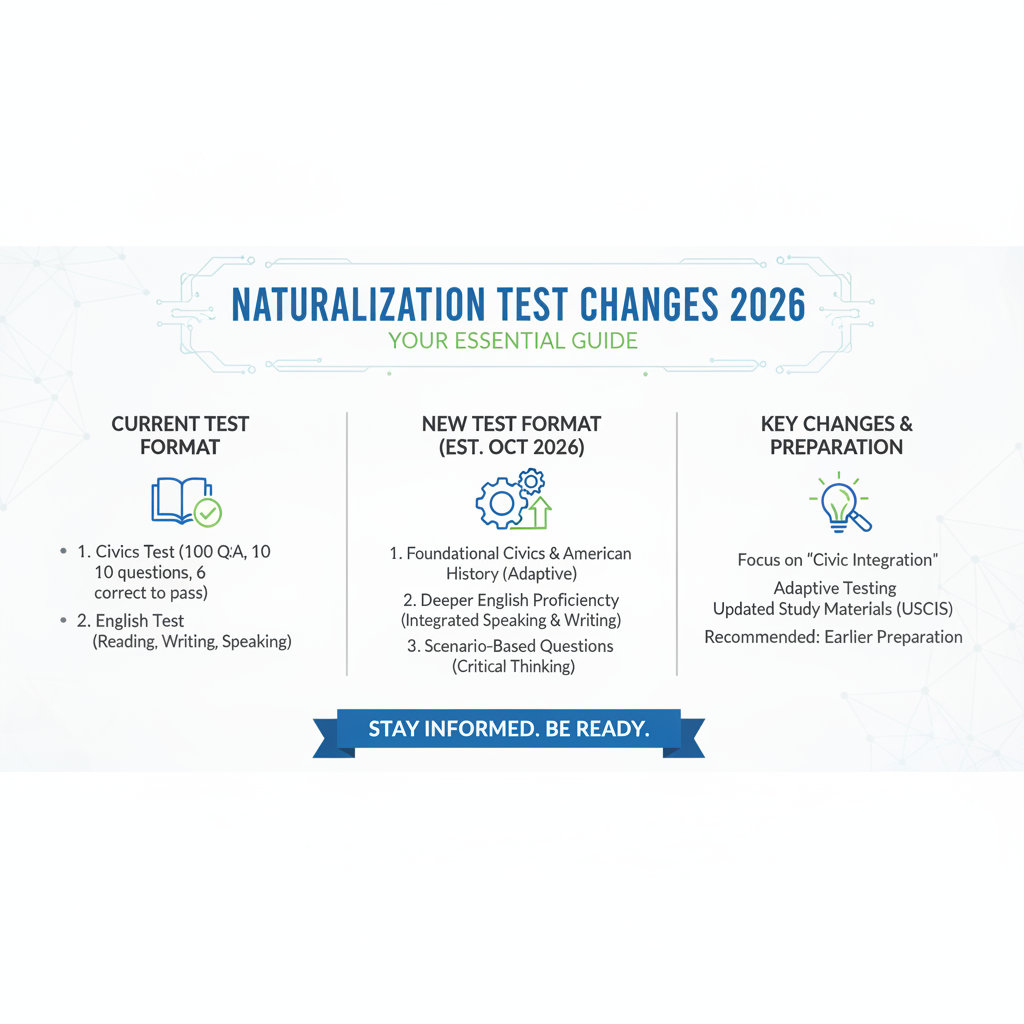
The discussion around changes to the naturalization test isn't entirely new. USCIS periodically reviews and updates its examination procedures to ensure they remain relevant, fair, and effective in assessing an applicant's knowledge of U.S. history, government, and civics. The last major revision to the civics test occurred in 2020 under the previous administration, which was then largely reverted to the 2008 version in 2021 after a period of public feedback and concerns regarding its increased difficulty and format. This current push for changes in **2026** stems from USCIS’s commitment to ongoing evaluation and improvement. The agency aims to develop a test that is not only robust but also clear and consistent, ensuring that aspiring citizens have a foundational understanding of American principles. The proposed changes are expected to incorporate more interactive and scenario-based questions, potentially requiring a deeper, more conceptual understanding rather than rote memorization. USCIS has indicated a desire to create a test that is more engaging and better reflects a practical understanding of civics. They are currently in the development and piloting phase, which is why this news is circulating now – to give the public and future applicants ample time to prepare and understand the upcoming shifts.How it can affect Florida residents
For the hundreds of thousands of immigrants living in Orlando, across Central Florida, and throughout the Sunshine State who aspire to become U.S. citizens, these impending changes are highly significant. Florida is home to one of the largest immigrant populations in the country, and the Orlando area, in particular, is a melting pot of cultures and nationalities. Here’s how these changes can affect you if you are a Florida resident: * **Preparation Strategy:** If you plan to apply for naturalization in **2026** or later, your study methods for the civics test will need to adapt. Simply memorizing 100 questions and answers might not be sufficient. You may need to focus on understanding concepts and applying them to real-world scenarios. * **Timing of Application:** Depending on when the new test officially rolls out in **2026**, applicants who file their **Form N-400**, Application for Naturalization, earlier in the year might still be subject to the current 2008 civics test format. Those filing later in the year, or whose interviews are scheduled after the effective date, will likely face the new version. This creates a critical window for strategic planning. * **Access to Resources:** It will be vital to access updated study materials. While USCIS provides official study guides, immigrants in Florida will benefit from local community resources, educational programs, and legal guidance from firms like Imigrar that are staying abreast of these developments. * **Orlando USCIS Field Office:** The Orlando USCIS Field Office, like others nationwide, will implement these changes. Understanding the local impact, processing times, and specific instructions from this office will be crucial for applicants in Orange County and surrounding areas along the I-4 corridor. * **Anxiety and Uncertainty:** Any change can bring anxiety. Understanding the scope of the revisions and having a clear plan will be essential to mitigate stress during the naturalization process.Need Help Navigating Naturalization Changes? Our Orlando immigration team at Imigrar is ready to assist. Don't face uncertainty alone. Call +1 786-791-3106 for a free consultation, or message us online. Se Habla Español.
What Naturalization Test Changes Are (and Why They Matter)
The news about upcoming modifications to the naturalization test in **2026** directly impacts the final stage of becoming a U.S. citizen. To understand these changes, it’s important to first grasp what naturalization entails and why the test is a critical component.A plain-English definition
**Naturalization** is the process by which a foreign citizen or national can voluntarily become a U.S. citizen. It is the culmination of years, and sometimes decades, of living and contributing to American society. The process involves meeting specific eligibility requirements, submitting an application, undergoing background checks, and attending an interview. A key part of that interview is demonstrating an understanding of English and U.S. civics. The **naturalization test** is designed to assess an applicant's ability to read, write, and speak English, and their knowledge of U.S. history and government (civics). Currently, the civics test consists of 10 questions chosen from a list of 100 possible questions. An applicant must answer 6 out of 10 questions correctly to pass. The English test involves reading one out of three sentences correctly and writing one out of three sentences accurately. The **changes coming in 2026** are expected to primarily affect the civics portion of this test. While the exact details are still under development by USCIS, the general direction suggests a shift from purely factual recall to a more conversational and analytical approach. This could mean: * **Scenario-Based Questions:** Instead of asking "Who is the Chief Justice of the United States now?", a question might be "If the President vetoes a bill, what happens next and who can override the veto?" or "Describe the responsibilities of a U.S. citizen." This requires not just knowing the answer but understanding the process and implications. * **Integrated English and Civics:** The test might blend English proficiency assessment more seamlessly with civics knowledge, asking applicants to explain concepts in their own words rather than just reciting memorized facts. * **Updated Content:** While core historical facts will remain, the way they are presented or the depth of understanding required might change. These changes matter because they aim to ensure that new citizens have a more profound and practical understanding of the country's governance and values, rather than just superficial knowledge. For applicants, it means a more comprehensive preparation strategy will be necessary.Key terms you need to know
To better navigate the naturalization process and understand the upcoming changes, familiarize yourself with these essential terms: * **Naturalization:** The legal process by which a non-citizen in a country may acquire citizenship of that country. * **USCIS (U.S. Citizenship and Immigration Services):** The federal agency responsible for administering the country’s lawful immigration system, including naturalization. Its official website is an invaluable resource: USCIS official website. * **Form N-400:** The official application form for naturalization. This is the primary document you file to begin the process. * **Civics Test:** The portion of the naturalization interview that assesses an applicant's knowledge of U.S. history and government. This is the part undergoing changes in **2026**. * **English Test:** The portion of the naturalization interview that assesses an applicant's ability to read, write, and speak basic English. * **Oath of Allegiance:** The final step in the naturalization process, where an applicant formally pledges loyalty to the United States. * **Lawful Permanent Resident (LPR) / Green Card Holder:** An individual who has been granted the privilege of residing permanently in the United States. This is generally a prerequisite for naturalization. * **Continuous Residence:** A naturalization requirement meaning that an applicant has maintained residence in the U.S. for a specified period (typically 3 or 5 years) without extended absences. * **Physical Presence:** A naturalization requirement meaning that an applicant has been physically present in the U.S. for a certain cumulative period within their continuous residence. * **Good Moral Character:** A naturalization requirement that applicants must demonstrate adherence to certain moral standards as defined by immigration law. * **N-648 Medical Certification for Disability Exceptions:** A form used by applicants seeking an exception to the English and/or civics requirements due to a physical or developmental disability or mental impairment.Current Naturalization Law: The Foundation
The process of naturalization is governed by federal law, primarily the Immigration and Nationality Act (INA) and its corresponding regulations in the Code of Federal Regulations (CFR). While state laws do not dictate naturalization requirements, understanding the federal framework is essential for all applicants, including those in Florida.Federal requirements
To be eligible for naturalization under most common provisions, applicants must meet several core federal requirements outlined in **Section 316 of the INA (8 U.S.C. § 1427)** and **8 CFR Part 316**: * **Age:** Be at least 18 years old at the time of filing **Form N-400**. * **Lawful Permanent Resident Status:** Be a **Lawful Permanent Resident** (Green Card holder) for at least 5 years. This period can be reduced to 3 years if you are married to a U.S. citizen and meet other specific criteria (INA Section 319(a)). * **Continuous Residence:** Have resided continuously in the U.S. as a **Lawful Permanent Resident** for at least 5 years (or 3 years if married to a U.S. citizen) immediately preceding the filing of **Form N-400**. Absences from the U.S. for 6 months or more can break continuous residence. * **Physical Presence:** Have been physically present in the U.S. for at least half of the required continuous residence period (e.g., 30 months for the 5-year requirement, 18 months for the 3-year requirement). * **Residence in District:** Reside for at least 3 months in the state or USCIS district where you file your **Form N-400**. For Central Florida residents, this typically means the Orlando USCIS Field Office district. * **Good Moral Character:** Demonstrate **good moral character** for the statutory period (typically 5 or 3 years) preceding your application and up to the time of the Oath of Allegiance. This is a broad category, and certain criminal offenses can make you ineligible. * **English and Civics Knowledge:** Demonstrate the ability to read, write, and speak basic English, and have a knowledge and understanding of U.S. history and government (civics). This is the area subject to **2026** changes. * **Attachment to the Principles of the U.S. Constitution:** Be willing to take the Oath of Allegiance to the United States. Certain exceptions exist for military personnel, spouses of U.S. citizens serving abroad, and others. It’s crucial to understand these requirements in detail, as even minor discrepancies can lead to delays or denial.Florida-specific considerations
While naturalization laws are federal, practical considerations vary by location. For those in Orlando and across Florida: * **USCIS Field Offices:** Florida has multiple USCIS Field Offices, with the Orlando office serving a large portion of Central Florida. Your interview will typically be scheduled at the office closest to your residence. The Orlando USCIS Field Office is located at 6718 Old Winter Garden Road, Orlando, FL 32835. * **Processing Times:** Processing times for **Form N-400** can vary significantly by field office. You can check current processing times for the Orlando USCIS Field Office and other locations on the official USCIS website: USCIS Processing Times. * **Community Resources:** Florida has numerous non-profit organizations and community centers that offer assistance with naturalization applications and civics test preparation. Imigrar frequently collaborates with and refers clients to such organizations. * **Language Services:** Imigrar proudly offers services in both English and Spanish (Se Habla Español), ensuring that language is not a barrier for our diverse clientele in Florida. Understanding the current legal framework is the first step towards a successful naturalization application, and these federal requirements will remain the foundation even with the upcoming test changes.How to Prepare for the Naturalization Test (Current & Future): A Complete Step-by-Step Guide
The naturalization process can seem daunting, but breaking it down into manageable steps makes it much clearer. This guide outlines the typical journey, with a special focus on preparing for the English and civics tests, especially in light of the **2026** changes.1) Determine Your Eligibility
Before you even think about filing, you must confirm you meet all the basic requirements. * **Check your Green Card status:** Ensure you have been a **Lawful Permanent Resident** for the required duration (5 years generally, 3 years if married to a U.S. citizen). * **Calculate continuous residence and physical presence:** Review your travel history. Any single trip outside the U.S. of 6 months or more can break your continuous residence. Total days spent outside the U.S. matter for physical presence. * **Review your moral character:** Consider any arrests, citations, or criminal history, even if minor. Certain issues can bar you from naturalization or require additional documentation and explanation. * **Age and residency:** Confirm you are 18 or older and have resided in your USCIS district (e.g., Orlando) for at least 3 months. **Required Documents for Eligibility Assessment (for your records, not filing):** * Your Green Card (Form I-551) * Passport(s) showing entry/exit stamps * Marriage certificate (if applying under the 3-year rule) * Divorce decrees or death certificates (if applicable) * Criminal records, arrest reports, court dispositions (if applicable)2) Prepare and File Form N-400, Application for Naturalization
Once eligibility is confirmed, the next step is to accurately complete and file your application. * **Gather all necessary documents:** This includes personal identification, residency proof, and any supporting documentation for eligibility. * **Complete Form N-400:** This is a comprehensive form requiring detailed personal, residential, employment, and travel history, as well as questions about your moral character. Be truthful and thorough. Any omissions or misrepresentations can lead to denial. * **Collect supporting evidence:** Attach copies of required documents. USCIS provides specific instructions on what to include. For example, if you've had arrests, you'll need certified court dispositions. * **Pay the filing fee:** The current **Form N-400** filing fee (as of late 2026) is typically $725, which includes the biometrics fee. Fee waivers may be available for eligible low-income applicants. * **Mail your application:** Send your completed **Form N-400** and supporting documents to the USCIS Lockbox facility designated for your geographic location. **Required Documents for Filing Form N-400:** * A copy of your Green Card (front and back) * Two passport-style photos (if required; check latest **Form N-400** instructions) * Fee payment (check, money order, or **Form G-1450** for credit card) * Marriage certificate (if applicable) * Evidence of termination of prior marriages (if applicable) * Certified court dispositions for any arrests or convictions (if applicable) * **Form N-648** (if seeking disability exception)3) Attend Your Biometrics Appointment
After USCIS accepts your **Form N-400**, you will receive an appointment notice for biometrics collection. * **Receive Appointment Notice (Form I-797C):** This notice will specify the date, time, and location of your appointment, typically at an Application Support Center (ASC) near you (e.g., the Orlando ASC). * **Attend the appointment:** At the ASC, your fingerprints, photograph, and signature will be collected. These are used for background and security checks. * **Important:** Bring your appointment notice and a valid government-issued photo identification (e.g., Green Card, passport).4) Prepare for the Naturalization Interview (English & Civics Test)
This is the most critical preparatory phase, especially with the **2026** changes in mind. * **English Test Preparation:** * **Reading:** Practice reading sentences aloud from USCIS study materials. Focus on understanding simple sentences about U.S. history and government. * **Writing:** Practice writing sentences dictated by another person. Pay attention to spelling and punctuation. * **Speaking:** Engage in conversations in English daily. Practice answering questions about your **Form N-400** application, as the USCIS officer will ask about it during the interview. Firms like Imigrar can conduct mock interviews. * **Civics Test Preparation (Current & Future):** * **Current Test (if applying before 2026 changes):** Study the 100 civics questions and answers provided by USCIS. You will be asked up to 10 questions and must answer 6 correctly. * **Future Test (for 2026 and beyond):** While exact questions are not yet released, start by: * **Understanding Concepts:** Don't just memorize. Understand *why* we have three branches of government, *what* the Bill of Rights protects, or *how* a law is made. * **Stay Updated:** Regularly check the USCIS official website for new study materials and announcements regarding the **2026** test. * **Engage with Civics:** Read news, watch documentaries about U.S. history and government. Discuss these topics in English. * **Practice Scenario-Based Thinking:** If USCIS introduces scenario questions, practice thinking critically about how government principles apply to situations. * **Seek Guidance:** An experienced immigration attorney can provide insight into the expected changes and direct you to the best study resources. **Required Documents for Interview Preparation:** * USCIS Civics Test study materials (current 100 questions, and future materials once released) * English language learning resourcesWorried About the New Civics Test? Imigrar can help you prepare effectively. Our legal team stays updated on all USCIS changes. Contact us for personalized guidance. Call +1 786-791-3106 for a free consultation, or message us online. Se Habla Español.
5) Attend the Naturalization Interview
This is your opportunity to demonstrate your eligibility and knowledge. * **Receive Interview Notice:** USCIS will mail you a notice (Form I-797C) with the date, time, and location of your interview, typically at the Orlando USCIS Field Office for Central Florida residents. * **Gather all original documents:** Bring your interview notice, Green Card, passport, and *originals* of all documents you submitted with your **Form N-400**, plus any updated documents (e.g., new marriage certificate, updated tax returns). * **Arrive prepared:** Dress professionally. Be polite and respectful. The officer will review your application, ask questions about it, and administer the English and civics tests. * **English and Civics Test:** * The English test involves reading, writing, and speaking. * The civics test will follow either the current 2008 format or the new **2026** format, depending on the implementation date and your interview schedule. * **Decision:** The officer may give you a decision on the spot, or send a decision by mail. If you pass, you will typically receive a **Form N-652**, Naturalization Interview Results, indicating a recommendation for approval. **Required Documents for the Interview:** * Interview Appointment Notice (Form I-797C) * Your Green Card (original) * Your passport(s) and any other travel documents (original) * State-issued identification (e.g., Florida Driver's License) * All original supporting documents submitted with **Form N-400** (e.g., marriage certificates, birth certificates, tax returns, court documents) * A list of all trips outside the U.S. since becoming an LPR, including dates * Selective Service registration card (for males aged 18-25)6) Receive a Decision and Attend the Oath Ceremony
The final steps to becoming a U.S. citizen. * **Decision:** If approved, you will receive **Form N-445**, Notice of Naturalization Oath Ceremony, with the date, time, and location of your ceremony. * **Oath Ceremony:** This is where you officially become a U.S. citizen. You will surrender your Green Card and take the Oath of Allegiance. * **Certificate of Naturalization:** You will receive your **Certificate of Naturalization** at the ceremony. This is your proof of U.S. citizenship. Keep it safe! * **Update Records:** After naturalization, you can apply for a U.S. passport and register to vote. **Required Documents for Oath Ceremony:** * **Form N-445**, Notice of Naturalization Oath Ceremony * Your Green Card (to be surrendered) * Any other immigration documents specified in **Form N-445**Practical Steps You Can Take Today
Even with the **2026** naturalization test changes on the horizon, there are many proactive steps you can take right now to prepare for your citizenship journey. **Actionable Checklist:** 1. **Confirm Your Eligibility:** Don't wait. Use the criteria outlined above to ensure you meet all requirements for continuous residence, physical presence, and good moral character. If you have any doubts, consult with an immigration attorney. 2. **Review Your Travel History:** Compile a detailed list of all your trips outside the U.S. since becoming a **Lawful Permanent Resident**. Note departure and return dates for each trip. This is crucial for **Form N-400** and the interview. 3. **Start Studying (Current Civics Test):** Even if the test changes in **2026**, the core principles of U.S. government and history will remain. Begin studying the current 100 civics questions and answers from the USCIS official website. This builds a strong foundation. 4. **Improve Your English Skills:** Practice reading, writing, and speaking English daily. Watch English-language news, read newspapers, and converse with native speakers. Focus on understanding and explaining concepts, not just memorizing. 5. **Gather Essential Documents:** Start collecting originals and copies of all necessary documents: Green Card, birth certificates, marriage certificates, divorce decrees, tax returns, police records, etc. Having these organized early will save time and stress. 6. **Maintain Good Moral Character:** Continue to abide by all U.S. laws. Avoid any actions that could negatively impact your **good moral character** assessment. 7. **Consult an Immigration Attorney:** This is perhaps the most important step. An expert like Imigrar can assess your eligibility, guide you through **Form N-400** preparation, provide mock interview practice, and keep you informed about the **2026** test changes as details emerge. **Document Preparation Guidance:** * **Originals vs. Copies:** For filing **Form N-400**, USCIS typically asks for copies of most documents. However, you MUST bring the *originals* to your interview. * **Translations:** If any supporting documents are not in English, you must provide a complete, certified English translation along with a copy of the original document. The translator must certify that they are competent to translate and that the translation is accurate. * **Organization:** Keep all your documents neatly organized in a binder or folder. Create a checklist and tick off items as you gather them. This will make the application process smoother and reduce the risk of missing crucial information. **Timeline Expectations:** * **Application Filing:** You can typically file **Form N-400** 90 days before you meet the continuous residence requirement (e.g., 4 years and 9 months if applying under the 5-year rule). * **Processing Times:** As of **2026**, **Form N-400** processing times can vary widely, from 6 months to over a year or more, depending on the USCIS Field Office (e.g., Orlando USCIS Field Office) and national backlogs. Check USCIS Processing Times regularly. * **Biometrics:** Usually scheduled 3-8 weeks after filing **Form N-400**. * **Interview:** Typically scheduled several months after biometrics. This is where the **2026** test changes become relevant. If your interview is scheduled after the official rollout of the new test, you will likely take the revised version. * **Oath Ceremony:** Usually 2-8 weeks after a successful interview, though sometimes it can be on the same day. **Important:** The **2026** test changes are still being finalized. Continue to monitor official USCIS announcements. The exact effective date within **2026** will be crucial for determining which test version you will take.