The reporting that sparked this guide: Naturalization Test Changes Coming in 2026 (Citizenship)
What This News Means for Immigrants in Orlando and Across Florida
Why this news is showing up now
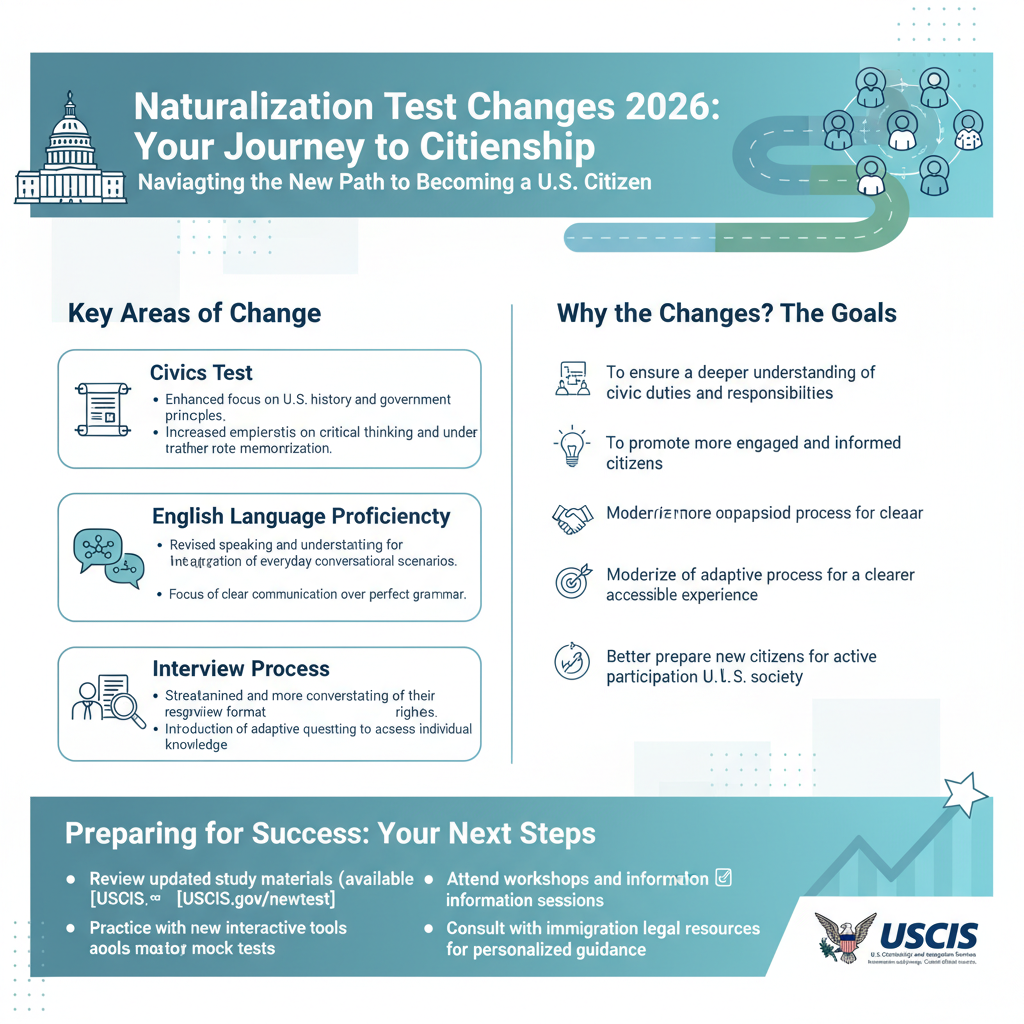
The U.S. Citizenship and Immigration Services (USCIS) periodically reviews and updates its naturalization policies and tests to ensure they remain relevant, fair, and effective in assessing an applicant's commitment to U.S. civic life. The current Naturalization Test primarily consists of an English language assessment (reading, writing, speaking) and a civics test based on 100 questions covering U.S. history and government. The discussion around changes for 2026 isn't entirely new. USCIS had previously implemented a revised civics test in December 2020 under the prior administration, which was widely criticized for its increased difficulty and was subsequently reverted to the 2008 version in February 2021. This history underscores USCIS's ongoing efforts to refine the naturalization process. The current push for 2026 changes stems from a desire to potentially modernize the test format and ensure it accurately reflects what a civic-minded U.S. citizen should know and understand. USCIS has conducted pilot programs and sought public feedback on potential revisions, particularly concerning the civics portion and how English proficiency is assessed within the interview context. These evaluations are now culminating in proposed changes slated for implementation in 2026, giving applicants and legal professionals time to prepare. The goal is often to create a test that is more consistent, secure, and reflective of modern civic engagement.How it can affect Florida residents
For immigrants living in Orlando, across Central Florida, or anywhere in the Sunshine State, these upcoming changes are highly relevant. Florida is home to a large and diverse immigrant population, many of whom are on the path to becoming U.S. citizens. Here’s how the 2026 Naturalization Test changes could affect you: * **Preparation Strategy Shift:** If the test format changes, particularly the civics portion from a purely oral, recall-based format to potentially more scenario-based or multiple-choice questions, your study methods will need to adapt. Rote memorization might become less effective than a deeper understanding of U.S. principles. * **Timing is Key:** The most immediate impact relates to the timing of your naturalization application. If you apply for naturalization now, and your interview is scheduled before the new test officially rolls out in 2026, you will take the current 2008 version of the test. If your interview falls on or after the implementation date, you will likely face the new test. This creates a strategic decision point for many eligible Green Card holders. * **Increased Uncertainty (Initially):** Any significant change to a government process can introduce a period of uncertainty as new guidelines are learned and applied. This is why staying informed and seeking expert legal guidance is crucial. * **Local Resources:** While the test is federal, local resources in Orlando and other Florida cities, such as community centers, adult education programs, and legal aid services, will need to update their citizenship preparation courses to reflect the new requirements. Imigrar, for its part, will be at the forefront of understanding and explaining these changes to our clients. * **Potential for New Exemptions/Accommodations:** With a new test design, there might also be revised guidance on who is exempt from certain portions or what accommodations are available for applicants with disabilities. **Important:** The exact implementation date within 2026 is still pending, and USCIS will provide official announcements. However, the expectation is that these changes are coming, and proactive preparation is your best defense against potential surprises.Concerned about the 2026 Naturalization Test changes? Don't navigate this alone. Our Orlando immigration team at Imigrar is ready to assist you with personalized guidance and expert preparation. Call +1 786-791-3106 for a free consultation, or message us online. Se Habla Español.
What the 2026 Naturalization Test Changes Are (and Why They Matter)
The upcoming changes to the Naturalization Test in 2026 are primarily focused on the civics portion and how English proficiency is assessed. While the specifics are still being finalized and officially published by USCIS, based on pilot programs and public discussions, we can anticipate certain key shifts.A plain-English definition
**Naturalization** is the process by which a lawful permanent resident (Green Card holder) becomes a U.S. citizen. The **Naturalization Test** is a critical part of this process, designed to ensure that applicants have a basic understanding of English and an adequate knowledge of U.S. history and government. It's not meant to be an academic exam, but rather to confirm an applicant's ability to integrate into American society and uphold civic duties. The **2026 Naturalization Test Changes** refer to the anticipated revisions to the format and content of the civics portion of this test, and potentially the English speaking assessment, which USCIS plans to implement. These changes aim to move beyond simple memorization and encourage a deeper understanding of U.S. civics.Key terms you need to know
Understanding these terms is fundamental to grasping the naturalization process and the upcoming changes: * **Naturalization:** The process of becoming a U.S. citizen for someone born outside the United States. * **Citizenship Test:** The common name for the Naturalization Test, comprising English and Civics components. * **Civics Test:** The portion of the Naturalization Test that assesses an applicant's knowledge of U.S. history, government, and civics. This is the primary focus of the 2026 changes. * **English Test:** The portion of the Naturalization Test that assesses an applicant's ability to read, write, and speak basic English. * **USCIS (U.S. Citizenship and Immigration Services):** The federal agency responsible for administering immigration and naturalization benefits. * **Form N-400 (Application for Naturalization):** The official application form required to initiate the naturalization process. * **Oath of Allegiance:** The final step in the naturalization process, where applicants formally renounce allegiance to any foreign state and pledge loyalty to the United States. * **Good Moral Character:** A legal requirement for naturalization, meaning an applicant must demonstrate adherence to community standards of morality and lawfulness for a specific period leading up to their application. **Why the Changes Matter:** The proposed changes are significant because they could alter how future citizens are evaluated. Instead of simply recalling facts, applicants might be asked to demonstrate a more conceptual understanding of civics. For example, rather than just listing the three branches of government, an applicant might need to explain their functions or how they interact. This shift could require a different approach to studying and preparation, emphasizing comprehension over rote memorization. Furthermore, integrating the English speaking assessment more naturally into the interview process, perhaps by asking applicants to describe photos or scenarios, could make the interview feel more organic but also potentially more challenging for some. The goal is often cited as making the test more "meaningful" and ensuring new citizens have a robust understanding of American principles.Current Immigration Law: The Foundation for Naturalization
While the Naturalization Test is evolving, the underlying federal laws and requirements for becoming a U.S. citizen remain steadfast. These laws are primarily found in the **Immigration and Nationality Act (INA)**, which governs all aspects of U.S. immigration.Federal requirements
To be eligible for naturalization, applicants must generally meet several key federal requirements as outlined in the INA: * **Age:** Be at least 18 years old at the time of filing **Form N-400**. * **Lawful Permanent Resident Status:** Be a **lawful permanent resident** (Green Card holder) for at least 5 years. This period is reduced to 3 years if you are married to and living with a U.S. citizen, and certain other conditions are met. Special rules apply to military personnel. * **Continuous Residence:** Have resided continuously in the U.S. for at least 5 years (or 3 years if married to a U.S. citizen) immediately preceding the filing of **Form N-400**. This means you haven't left the U.S. for extended periods that would break your "continuous residence." Generally, absences of more than 6 months but less than 1 year may break continuous residence unless proven otherwise. Absences of 1 year or more automatically break continuous residence. * **Physical Presence:** Have been physically present in the U.S. for at least half of the required continuous residence period (e.g., 30 months out of 5 years, or 18 months out of 3 years). * **Residency in Filing State/USCIS District:** Have resided for at least 3 months in the state or USCIS district where you file your application. For those in Orlando, this means living in the Orlando USCIS Field Office's jurisdiction. * **Good Moral Character:** Demonstrate **good moral character** during the statutory period (the 5 or 3 years leading up to your application) and up to the Oath of Allegiance. This is a crucial and often complex requirement, encompassing a review of your criminal record, tax compliance, and other legal obligations. Certain crimes or actions can disqualify an applicant. * **English Language Proficiency:** Be able to read, write, and speak basic English. There are exceptions for applicants who are: * 50 years old or older and have lived in the U.S. as a Green Card holder for at least 20 years (50/20 rule). * 55 years old or older and have lived in the U.S. as a Green Card holder for at least 15 years (55/15 rule). * 65 years old or older and have lived in the U.S. as a Green Card holder for at least 20 years (65/20 rule - can take a simpler civics test). * Applicants with a qualifying medical disability that prevents them from learning English or civics may be exempt with an approved **Form N-648**, Medical Certification for Disability Exceptions. * **Knowledge of U.S. History and Government (Civics):** Demonstrate knowledge and understanding of the fundamentals of U.S. history, principles, and government. This is assessed during the civics test. * **Attachment to the U.S. Constitution:** Be willing to take the **Oath of Allegiance** to the United States and demonstrate an attachment to the principles of the U.S. Constitution and the well-being of the United States.Florida-specific considerations
While naturalization requirements are federal, the process is administered through local USCIS field offices. For residents of Orlando and much of Central Florida, your application will be processed through the **Orlando USCIS Field Office**, located at 6650 TPC Drive, Orlando, FL 32822. This office is responsible for conducting interviews, administering tests, and holding oath ceremonies for applicants in its jurisdiction. * **Jurisdiction:** Ensure your 3-month residency requirement is met within the Orlando USCIS Field Office's jurisdiction before filing. * **Processing Times:** Processing times can vary significantly by field office. You can check estimated processing times for the Orlando office on the USCIS website. * **Local Resources:** Orlando offers various community organizations and adult education programs that provide citizenship classes and resources, though these will need to adapt to the 2026 changes. **Reminder:** The foundational eligibility requirements discussed above remain unchanged by the upcoming 2026 test revisions. The changes will specifically affect how the English and civics knowledge is assessed during the interview. For the most up-to-date information on all requirements and forms, always refer to the USCIS official website.