


The reporting that sparked this guide
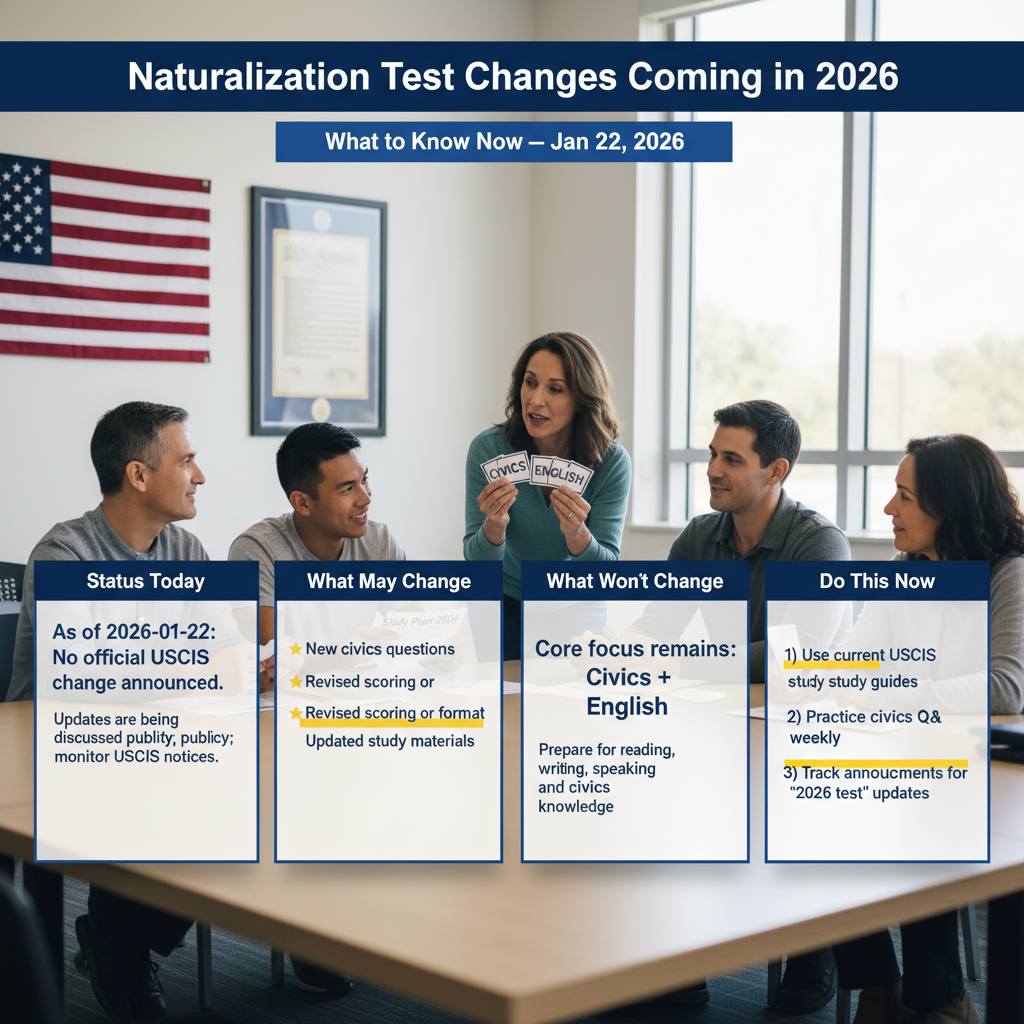
This article is based on trending coverage and public discussion about potential naturalization testing updates, including the possibility of new civics questions and revised requirements in 2026.
Naturalization Test Changes Coming in 2026 (Citizenship)
Important: As of today (2026-01-22), USCIS implements the naturalization test rules and questions through official policy guidance and public announcements. News coverage may describe proposals or anticipated changes before USCIS publishes final details. For the most current official information, visit the USCIS official website.
Need Help? Our Orlando immigration team is ready to assist. Call +1 786-791-3106 for a free consultation, or message us online. Se Habla Español.
What This News Means for Immigrants in Orlando and Across Florida
Why this news is showing up now
Naturalization testing changes tend to trend for three reasons:
- Policy cycles: USCIS periodically reviews the civics test question bank, officer training, and interview procedures to align with educational standards and operational needs.
- Election-year and civic education focus: Public interest grows when civics education becomes a national topic, prompting agencies to revisit how knowledge is evaluated.
- Operational modernization: USCIS continues expanding digital tools and standardized officer guidance, which can lead to updates in how tests are administered, scored, or documented.
Reminder: Even when changes are announced, USCIS typically provides an effective date and transition rules (for example, whether applicants who file before a certain date will take the “old” test). Those transition details matter as much as the new questions themselves.
How it can affect Florida residents
For immigrants living in Florida—especially in high-growth areas like Orlando, Kissimmee, and the I-4 corridor—naturalization test changes can affect:
- When you should file Form N-400 to avoid getting caught in a transition period without adequate preparation.
- How you study (new question categories, different phrasing, or updated expectations for answering verbally in an interview).
- Rescheduling risk if you are not ready for a revised test format and need a retest appointment.
- Processing strategy if you have travel plans, pending family cases (like Form I-130), or future plans for Adjustment of Status for relatives (often tied to a Priority Date in other contexts).
If your case is in Orlando, your interview will typically be scheduled through The Orlando USCIS Field Office (depending on jurisdiction and USCIS workload). That means your timeline may be influenced by local appointment availability and national policy rollouts.
What Naturalization Test Changes Coming in 2026 Is (and Why It Matters)
A plain-English definition
“Naturalization test changes” refers to updates USCIS may make to the requirements and content of the U.S. citizenship test given during the naturalization interview. The naturalization test has two primary parts:
- English test: speaking, reading, and writing basics.
- Civics test: questions about U.S. history and government.
When USCIS changes the test, it can mean:
- a new or revised civics question bank,
- different testing procedures (how many questions asked, how many must be answered correctly),
- new officer guidance on acceptable answers, or
- additional documentation or standardized steps at the interview.
Why it matters: A naturalization denial can delay citizenship for months or longer, and in some situations can expose underlying issues (like past trips, tax filing problems, or criminal history) that should be addressed before applying.
Key terms you need to know
- Form N-400: Application for Naturalization.
- Naturalization interview: The in-person (or sometimes modified) appointment where USCIS reviews your application, tests English/civics, and evaluates eligibility.
- Civics question bank: The official set of questions USCIS officers draw from for the civics test.
- Re-examination (retest): If you fail the English or civics portion, USCIS generally offers one more chance within a set period.
- Good moral character (GMC): A legal standard USCIS evaluates, often focused on the last 5 years (or 3 years for certain spouses of U.S. citizens), but can reach further back depending on the issue.
- Continuous residence and physical presence: Requirements that limit long trips abroad and require a minimum amount of time in the U.S.
- 90-day window: Many applicants can file up to 90-day window before meeting the 3-year or 5-year continuous residence requirement (if otherwise eligible).
Warning: Naturalization is not only a test—USCIS also reviews your entire eligibility record. Preparing for potential 2026 test updates should happen alongside a legal screening of your travel history, taxes, selective service registration (if applicable), and any arrests or citations.
Current Immigration Law: The Foundation
Naturalization is governed primarily by the Immigration and Nationality Act (INA) and related federal regulations. While news may focus on “test changes,” the legal eligibility rules typically remain stable unless Congress changes the INA.
Federal requirements
Key legal authorities include:
- INA § 316 (general naturalization requirements, including 5-year permanent residence, continuous residence, physical presence, GMC, English/civics).
- INA § 319 (naturalization for certain spouses of U.S. citizens—often the 3-year rule).
- 8 CFR Part 316 (regulatory requirements for naturalization under INA § 316).
- 8 CFR Part 319 (regulatory requirements under INA § 319).
USCIS implements these rules through forms, instructions, policy manual guidance, and officer training. The main form is Form N-400 (not an I-form), but many applicants also have immigration histories involving forms such as Form I-130 (family petition) and Form I-485 (Adjustment of Status application).
Official resources you should rely on include:
- USCIS official website
- USCIS Forms
- USCIS Processing Times
- U.S. Department of State (passport/visa context, and some citizenship-related guidance for families abroad)
- Executive Office for Immigration Review (immigration court system—relevant if you have removal history)
Florida-specific considerations
Naturalization is federal, so Florida does not create separate citizenship rules. However, Florida residents often face practical, local factors:
- Interview logistics: For Central Florida residents, the interview is commonly scheduled at The Orlando USCIS Field Office. Appointment availability can influence how quickly you reach the civics test stage.
- Name changes: If you request a legal name change through naturalization, your oath ceremony may require a judicial oath ceremony, which can affect scheduling.
- Travel patterns: Florida residents may take frequent international trips (Caribbean, Latin America). Those trips can create continuous residence issues if any trip is long or if total travel time is high.
- Document replacement: Hurricanes and moves along the I-4 corridor sometimes lead to lost records (tax transcripts, passports, green cards). Planning ahead matters.
Reminder: If you need to replace or renew a green card before applying, that process typically involves Form I-90. If you have conditional residence, you may need Form I-751 before naturalizing. (These are examples of Form I-XXX filings that can affect your citizenship timeline.)
Need Help? Our Orlando immigration team is ready to assist. Call +1 786-791-3106 for a free consultation, or message us online. Se Habla Español.
How to Prepare for Potential 2026 Naturalization Test Updates: A Complete Step-by-Step Guide
Below is a practical approach that protects you no matter what USCIS changes in 2026—because it focuses on eligibility, evidence, and interview readiness, not just memorizing answers.
1) Confirm you are eligible (before you study)
Start with eligibility screening. Studying for a new civics test won’t help if there is a hidden issue that could lead to a denial or a Notice of Intent to Deny (NOID).
Documents to gather:
- Front/back copy of your Permanent Resident Card
- All passports (current and expired) covering your permanent residence period
- Travel history list (dates out of the U.S.)
- Marriage certificate/divorce decrees (if applying under the 3-year rule)
- Tax transcripts (IRS) for relevant years
- Selective Service proof (if applicable)
- Certified court dispositions for any arrests/citations (even if dismissed)
Important: If you have any criminal history, prior immigration court proceedings, or long trips abroad, speak with an attorney before filing. In some cases, applying can trigger review of old issues.
2) Decide your filing strategy (timing matters)
Naturalization test changes often come with an effective date. If you are eligible now—or will be eligible soon—you may be able to file within the 90-day window before meeting the continuous residence requirement. Filing earlier (when allowed) can help you avoid uncertainty.
Documents to gather:
- Proof of current address in Florida (lease, mortgage, utility bill)
- Evidence supporting marital union (if applying under 3-year rule): joint bank statements, joint lease, children’s birth certificates
- Any pending immigration receipts (for example, Form I-751 receipt notice if applicable)
Timeline note: You can check estimated case timing at USCIS Processing Times. Orlando-area timelines can fluctuate, so planning around travel, work, and family events is key.
3) Prepare and file Form N-400 correctly
USCIS denials and delays frequently come from avoidable mistakes: missing addresses, incomplete travel lists, inconsistent employment history, or failure to disclose citations.
Documents to gather:
- Completed Form N-400 draft (with full address and employment history)
- Proof of lawful permanent resident status (green card copy)
- Two passport-style photos (only if required by your filing method/instructions)
- Fee payment method or fee waiver request (if eligible)
- Certified documents for legal name changes (if any)
Reminder: Always download the current form and instructions from USCIS Forms. USCIS can reject outdated editions.
4) Build a “test-proof” civics and English study plan
If USCIS introduces new civics questions in 2026, applicants who rely only on memorizing a narrow list may struggle. A “test-proof” plan focuses on understanding concepts so you can handle reworded questions.
Documents/materials to gather:
- USCIS civics study materials (official PDFs and practice tests)
- A notebook of weak topics (Constitution, branches of government, rights/responsibilities)
- English reading/writing practice sheets
- Any medical documentation if you may qualify for an English/civics exception (see Step 5)
Practical approach: Study in 20–30 minute sessions, 4–5 days per week. Add short speaking practice: officers evaluate spoken English during the interview, not just reading/writing.
5) Identify whether you qualify for age/time or medical exceptions
Some applicants do not have to meet the standard English requirement (and may take the civics test in their preferred language with an interpreter) based on age and years as a permanent resident. Others may qualify for a medical disability exception.
Documents to gather:
- Green card issue date evidence (to calculate years as LPR)
- Government-issued ID
- If claiming medical exception: medical records and a properly completed Form N-648 (Medical Certification for Disability Exceptions), signed by an authorized medical professional
Warning: Form N-648 must be prepared carefully. Weak or inconsistent medical certifications can lead to delays, Requests for Evidence (RFEs), or denial of the exception.
6) Prepare for the interview at The Orlando USCIS Field Office
If your case is in Orlando, plan for traffic and parking, especially during peak times along the I-4 corridor. Bring originals and organized copies. Expect the officer to review your N-400 line-by-line.
Documents to bring:
- Interview notice (Form I-797C)
- Permanent Resident Card (original)
- State ID/driver’s license
- All passports and travel documents
- Tax transcripts and proof of child support/alimony compliance (if applicable)
- Marriage/divorce documents and proof of ongoing marital union (if applying under 3-year rule)
- Court dispositions for any incidents
Important: If you have pending immigration matters—like an old Form I-130 petition history, a prior Form I-485 Adjustment of Status filing, or any issue involving a Priority Date—bring receipts and approvals. Officers may ask about your full immigration history.
7) Plan for outcomes: approval, continuance, retest, or denial
At the end of the interview, USCIS may:
- Approve you (recommended for approval) and later schedule the oath ceremony,
- Continue your case for additional documents (RFE) or further review,
- Schedule a retest if you fail English or civics, or
- Deny the application.
Documents to gather (just in case):
- Any missing evidence identified during the interview
- Updated tax transcripts
- Proof of address changes (if you moved)
- Attorney representation documents if you decide to hire counsel after interview
Reminder: If you fail the civics or English test, USCIS generally provides one additional opportunity (often within about 60–90 days, though scheduling varies). This is exactly why preparing for possible 2026 updates early is smart.
Need Help? Our Orlando immigration team is ready to assist. Call +1 786-791-3106 for a free consultation, or message us online. Se Habla Español.
Practical Steps You Can Take Today
If you’re worried about new civics test questions or requirements in 2026, the best move is to get “application-ready” now. Here is an actionable checklist you can start this week.
- 1) Calculate your eligibility date (5-year or 3-year rule) and identify your filing 90-day window.
- 2) Create a complete travel log with all trips outside the U.S. since becoming a permanent resident. Include departure/return dates and destinations.
- 3) Order IRS tax transcripts and confirm you filed properly. If you owe taxes, set up a payment plan and keep proof.
- 4) Request certified court dispositions for any arrest, charge, citation, or case—no matter how old or “minor.”
- 5) Start civics study using official USCIS materials and focus on concepts (branches of government, constitutional amendments, voting rights) so you can handle reworded questions.
- 6) Practice spoken English by answering civics questions out loud. The interview is conversational.
- 7) Review your N-400 disclosure questions carefully (membership, taxes, selective service, immigration violations). If any answer is complicated, consult counsel.
Timeline expectations (general):
- 2–6 weeks: Gather records (tax transcripts, court documents, passport copies).
- 1–3 months: Consistent civics/English prep for most applicants.
- Several months to over a year: N-400 processing from filing to oath can vary significantly by workload. Always verify at USCIS Processing Times.
Important: If USCIS announces that a new test applies to filings after a certain date, filing sooner (if eligible) may lock you into the current test. But do not rush a filing if you have unresolved issues—accuracy is more important than speed.
How Imigrar Helps Immigrants in Orlando
At Imigrar, we help permanent residents and their families prepare strong, organized naturalization applications that are ready for real-world interviews—especially when policies are changing or unclear.
Our Orlando-based team (serving clients nationwide) can help you:
- Confirm eligibility and calculate your filing date (including the 90-day window),
- Identify risks that could lead to delays or denial (travel, taxes, prior immigration issues, criminal history),
- Prepare Form N-400 and supporting evidence in a clean, officer-friendly format,
- Prepare for the civics/English interview with practical coaching,
- Respond to RFEs or prepare for a retest, and
- Address related family immigration goals (for example, future petitions using Form I-130, or planning around Adjustment of Status with Form I-485 and a Priority Date when applicable).
Free consultation available. Se Habla Español. Call us at +1 786-791-3106.
Frequently Asked Questions
Q: Will the naturalization civics test definitely change in 2026?
A: USCIS test changes become “real” when USCIS publishes official guidance, an effective date, and transition rules. News coverage may discuss anticipated updates (like new question banks or revised scoring). To avoid surprises, prepare using official USCIS study resources and watch for updates on the USCIS official website.
Q: If the test changes after I file Form N-400, which test will I take?
A: It depends on USCIS transition rules. In past updates, USCIS sometimes applied a new test to applications filed after a specific date, while earlier filings used the prior version. The key is your receipt date and USCIS’s announced policy. If you’re eligible now, filing sooner can sometimes reduce uncertainty—but only file when your application is accurate and complete.
Q: Can test changes affect my immigration status or green card?
A: A test change by itself does not change your permanent resident status. However, the naturalization process involves a full eligibility review. If USCIS finds an issue (for example, abandonment of residence, misrepresentation, or certain criminal problems), it could impact your case. If you have concerns, consult an attorney before applying—especially if you have removal history (see Executive Office for Immigration Review resources for context on immigration court matters).
Q: How long does the naturalization process take in Orlando?
A: Timelines vary based on USCIS workload and scheduling at The Orlando USCIS Field Office. You can track estimates using USCIS Processing Times. Plan for several months to over a year in some cases. If you have urgent travel, discuss options with counsel (and avoid long trips that could affect continuous residence).
Q: What documents do I need for the naturalization interview?
A: Bring your interview notice, green card, state ID, all passports, and supporting documents for any “yes” answers on the N-400 (court dispositions, tax proof, selective service proof, marriage/divorce records). If you are applying under the 3-year rule, bring evidence of ongoing marital union. If you have any prior filings like Form I-130 or Form I-485 (Adjustment of Status), bring approval notices and receipts so your immigration history is clear.
Q: How much does it cost to apply for citizenship?
A: USCIS filing fees can change, so confirm the current N-400 fee on USCIS Forms before filing. You may also have costs for passport photos, translations, certified court records, and legal help. Some applicants may qualify for a fee waiver or reduced fee depending on income and circumstances—an attorney can help you evaluate that option.
Q: What happens if my N-400 is denied or I fail the test?
A: If you fail the civics or English test, USCIS generally provides one retest opportunity. If your case is denied, you may have the option to request a hearing on the decision (commonly by filing Form N-336, Request for a Hearing on a Decision in Naturalization Proceedings). Denials can also be addressed by reapplying later, depending on the reason. Because denials can have serious consequences, get legal advice immediately if you receive a denial, NOID, or RFE.
Common Mistakes (and How to Avoid Them)
Mistake #1: Waiting to study until the interview is scheduled
When policies may change, waiting increases stress and raises the risk of failing if the question bank is updated. Start now with official materials and focus on understanding, not just memorizing.
Mistake #2: Filing Form N-400 without screening for red flags
Applicants sometimes rush to “beat” a new test and overlook issues like long trips abroad, tax filing errors, or unresolved citations. Those issues can cause delays, denials, or worse. A careful legal review is often the best investment.
Mistake #3: Bringing incomplete documents to the interview
Missing certified dispositions, incomplete travel records, or lack of marital evidence (for 3-year cases) can lead to continuances and months of delay. Build an interview binder and bring originals plus copies.
Need Help? Our Orlando immigration team is ready to assist. Call +1 786-791-3106 for a free consultation, or message us online. Se Habla Español.
Closing: Don’t Let 2026 Test Changes Derail Your Citizenship Plan
Headlines about “Naturalization Test Changes Coming in 2026” can feel stressful—especially for families working hard to reach citizenship. The best protection is a strong filing strategy, clean documentation, and interview preparation that works even if USCIS updates the civics questions or procedures.
For Central Florida residents, planning ahead also means preparing for scheduling realities at The Orlando USCIS Field Office and avoiding last-minute document scrambles. If you live in Orange County or commute along the I-4 corridor, build extra time into your interview day and keep your records organized.
Need personalized guidance? Call Imigrar at +1 786-791-3106 for a free consultation or message us online. Se Habla Español. Our mission is to Keep Families Together.


