


The reporting that sparked this guide
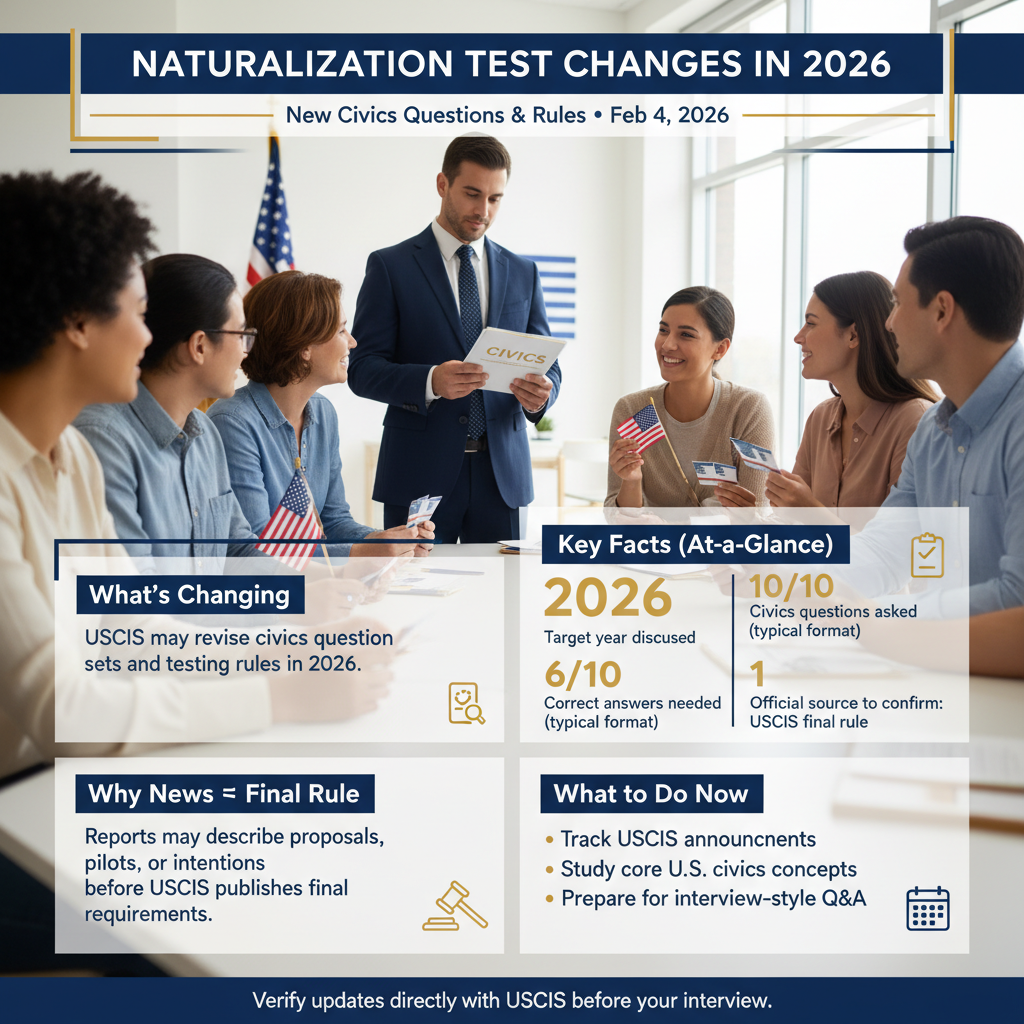
The reporting that sparked this guide: Naturalization Test Changes Coming in 2026 (Citizenship)
Reminder: News reports often describe proposals, pilot programs, or policy intentions before USCIS publishes final rules. This article explains what the “naturalization test changes in 2026” conversation could mean, how the naturalization test works today, and how to prepare in a way that protects you regardless of the final version.
Need Help? Our Orlando immigration team is ready to assist. Call +1 786-791-3106 for a free consultation, or message us online. Se Habla Español.
What This News Means for Immigrants in Orlando and Across Florida
Why this news is showing up now
Naturalization testing—especially the civics portion—tends to become a “trending” topic whenever the federal government signals that it may revise the exam. The civics test is not set in the U.S. Constitution; it is administered by USCIS as part of the naturalization interview. That means it can change through agency policy, updated training guidance, and (in some scenarios) rulemaking. When a new administration, new USCIS leadership, or new policy priorities emerge, proposed revisions often follow.
In the past, USCIS has updated the civics test content and format, and it has also changed its approach to the English portion (reading/writing/speaking) and interview procedures. So when you see headlines about “new civics test questions and requirements,” the practical takeaway is this: plan early, and prepare in a way that covers both the current test and plausible updates.
Important: USCIS typically announces effective dates and transition rules (for example, which applicants take the old vs. new test based on filing date or interview date). Until USCIS publishes official guidance, treat “2026 changes” as a reason to prepare—not a reason to delay.
How it can affect Florida residents
Florida has one of the largest immigrant populations in the country, and Central Florida—especially along the I-4 corridor—has seen continued growth in lawful permanent residents (LPRs) eligible for citizenship. If your case is in Orlando, your naturalization process is typically handled through the Orlando USCIS Field Office for the interview and oath scheduling (depending on your ZIP code and USCIS routing).
Here’s what potential civics-test updates could mean for Florida residents:
- Study materials may change (new or revised questions, different emphasis on civics topics, or new scoring rules).
- More uncertainty about timelines if USCIS rolls out training or transition periods, which can temporarily affect interview scheduling or consistency.
- Higher stakes for “borderline” cases where applicants already face challenges (prior arrests, long trips abroad, tax issues, selective service, or complicated immigration histories).
- Language and disability accommodations remain crucial—especially for older applicants, applicants with medical conditions, and those who qualify for exceptions.
Need Help? Our Orlando immigration team is ready to assist. Call +1 786-791-3106 for a free consultation, or message us online. Se Habla Español.
What Naturalization Test Changes Coming in 2026 Is (and Why It Matters)
A plain-English definition
“Naturalization test changes coming in 2026” generally refers to potential updates to the tests you take during your U.S. citizenship interview—especially the civics test (U.S. history and government), and sometimes the English test (speaking, reading, and writing).
During the naturalization interview, a USCIS officer evaluates:
- Your eligibility for citizenship (residence, physical presence, good moral character, attachments to the Constitution, etc.).
- Your English ability (unless you qualify for an exemption).
- Your civics knowledge through oral questions (unless you qualify for an exemption or accommodation).
If USCIS changes the civics test questions, the number of questions asked, the passing score, or the way questions are evaluated, it directly affects how you should study and how you should plan your filing date and interview prep.
Key terms you need to know
- Naturalization: The legal process of becoming a U.S. citizen (usually after being a lawful permanent resident).
- USCIS: U.S. Citizenship and Immigration Services, the agency that adjudicates Form N-400 and conducts interviews.
- Civics test: The portion of the naturalization interview where USCIS asks questions about U.S. history and government.
- English test: A speaking evaluation during the interview plus reading and writing tests (unless exempt).
- Re-examination: If you fail the English or civics test, USCIS usually schedules a second attempt within a set period.
- Oath ceremony: The final step where you take the Oath of Allegiance and become a U.S. citizen.
- Good Moral Character (GMC): A legal standard evaluated over a statutory period (often 5 years, or 3 years for certain spouses of U.S. citizens) and sometimes beyond.
- 90-day window: Many applicants may file up to 90 days before completing the required continuous residence period (if otherwise eligible).
Warning: While this article focuses on civics/English testing, the biggest citizenship risks often come from eligibility issues—such as long international trips, prior immigration fraud, criminal history, or inconsistent information across applications.
Current Immigration Law: The Foundation
The rules for naturalization come primarily from the Immigration and Nationality Act (INA) and its implementing regulations in the Code of Federal Regulations (CFR). USCIS also publishes policy guidance and the civics question sets.
Federal requirements
Most applicants apply using Form N-400 under INA § 316 (general naturalization requirements) or INA § 319 (certain spouses of U.S. citizens). Key federal requirements commonly include:
- Be at least 18 years old (with limited exceptions through derived citizenship scenarios).
- Be a lawful permanent resident (green card holder).
- Meet continuous residence and physical presence requirements (usually 5 years/30 months, or 3 years/18 months for certain spouses).
- Show Good Moral Character for the statutory period (and potentially beyond depending on facts).
- Demonstrate attachment to the principles of the U.S. Constitution.
- Be able to read, write, and speak basic English (unless exempt).
- Pass the civics test (unless exempt).
Official starting points for federal guidance include: USCIS official website, USCIS Forms, and USCIS Processing Times.
Important: Naturalization is not the same as Adjustment of Status (getting a green card in the U.S.). If you are still pursuing permanent residence through a family case, you may be filing Form I-130 and Form I-485 first—and only later filing Form N-400.
Reminder: Family-based immigration often involves a Priority Date and visa availability. Naturalization does not use the same “priority date” system, but your history may include it.
Florida-specific considerations
Naturalization is a federal process, so Florida does not create separate citizenship rules. However, Florida-specific realities can still matter:
- Local processing patterns: The Orlando area may have its own interview/oath scheduling rhythms based on staffing and volume at the Orlando USCIS Field Office.
- Travel patterns: Florida residents often travel internationally more frequently (Caribbean, Latin America, Europe). Long trips can disrupt continuous residence and physical presence.
- Name changes: Some applicants prefer a legal name change at oath. Local court coordination and ceremony type can affect timing.
- Records: If you have Florida arrests or citations (even if resolved), certified dispositions are critical for Form N-400 review.
If your case is in Orlando or Orange County, plan ahead to gather certified records from local agencies and courts. That preparation often prevents delays and “Request for Evidence” (RFE) situations.
How to Prepare for Naturalization Test Changes: A Complete Step-by-Step Guide
The safest approach is to prepare for the naturalization interview under current USCIS rules while building flexibility for updated civics questions. Below is a step-by-step plan that works whether changes arrive in early 2026, later in 2026, or are phased in.
1) Confirm you’re eligible (and choose the best filing strategy)
Before you worry about civics questions, confirm your eligibility and timing. Many denials are not about the test—they’re about eligibility mistakes.
Key eligibility checks include:
- Continuous residence and physical presence calculations.
- Any trip of 6+ months (or 1+ year) and whether you rebutted disruption of residence.
- Tax filings and whether you filed as “resident” when required.
- Selective Service registration (for many males who lived in the U.S. between ages 18–26).
- Criminal history, citations, and arrests—anywhere in the U.S. or abroad.
Reminder: Many applicants can file within the 90-day window before meeting the continuous residence requirement. Filing at the right time may help you avoid being caught in a transition between old and new test versions—depending on how USCIS implements changes.
Documents to gather for Step 1:
- Front/back copy of your green card.
- All passports (current and expired) covering the eligibility period.
- Travel history (dates out of the U.S.).
- Marriage certificate/divorce decrees (if applicable).
- Tax transcripts (often helpful), W-2s/1099s.
- Selective Service proof (if applicable).
- Certified court dispositions for any arrests/citations (if applicable).
2) File the correct application and track your case
Naturalization is filed on Form N-400. Make sure every answer matches your prior immigration filings. Inconsistencies can trigger deeper review.
After filing, monitor receipts, biometrics reuse notices, interview scheduling, and any RFEs. Check official references and tools: USCIS official website and USCIS Processing Times.
Warning: If USCIS introduces a new test version, it may apply based on filing date, interview date, or a specific cutoff. Tracking your case helps you pivot your study plan as soon as USCIS publishes official transition rules.
Documents to gather for Step 2:
- Completed Form N-400 draft (for attorney review if possible).
- Two passport-style photos (only if required for your filing method/situation).
- Fee payment method or fee waiver request (if eligible).
- Address history and employment history details.
- Evidence of marital union (if applying under INA § 319 and applicable).
3) Build a “two-track” civics study plan (current + possible 2026 update)
USCIS civics test prep should always start with the official question set and study resources published by USCIS. If changes are announced, add the updated list immediately—but do not abandon the fundamentals.
A two-track approach means:
- Track A: Master the current USCIS civics questions and answers.
- Track B: Add any newly announced questions/format changes as soon as USCIS publishes them.
For many applicants, the highest return comes from daily repetition and speaking answers out loud, not just reading flashcards.
Documents/materials to gather for Step 3:
- USCIS civics question list (download from USCIS official website).
- Notebook or digital notes for “my state officials” (Florida governor, U.S. senators, U.S. representative).
- Practice tests and audio practice resources (preferably USCIS-provided or reputable).
- Calendar for a 4–8 week study schedule.
4) Prepare for the English and interview speaking portion (and request accommodations if needed)
Even if the civics questions change, USCIS officers still evaluate your ability to communicate during the interview unless you qualify for an exception. Some applicants qualify for age/time-as-LPR English exceptions (with civics in their language). Others may qualify for disability-based accommodations.
If you have a medical condition that affects your ability to learn or demonstrate knowledge, talk to a qualified attorney about the medical disability exception process (often involving Form N-648).
Important: Do not “self-diagnose” your way into an exception. Improper or poorly supported disability exception filings can lead to delays and credibility concerns.
Documents/materials to gather for Step 4:
- English reading/writing practice sentences (USCIS examples).
- Medical records and provider information (only if exploring Form N-648).
- Interpreter planning (if eligible for a language-based exception).
- List of any prior names, addresses, and trips to practice answering consistently.
5) Organize your interview packet like an officer would
A clean, well-organized interview packet reduces stress and prevents missing-document delays—especially if policy changes create more scrutiny or inconsistent practices during a transition year.
If your case is in Orlando, plan as if the officer may ask for clarifying documents even when not strictly required—particularly for:
- Extended travel outside the U.S.
- Prior marriages or complex family histories.
- Any criminal/citation history.
- Tax filing questions.
Documents to gather for Step 5 (bring to interview):
- Original green card + copy.
- State ID/driver’s license.
- All passports (current/expired) and travel documents.
- Marriage certificate, divorce decrees, death certificates (as applicable).
- Proof of spouse’s U.S. citizenship (if applicable).
- Tax transcripts for the statutory period (often recommended).
- Selective Service proof (if applicable).
- Certified court dispositions and arrest reports (if any).
6) Attend the interview, handle retests, and plan for the oath
At the interview, the officer reviews your Form N-400, tests English (if applicable), and conducts the civics test. If you pass and are approved, USCIS schedules the oath ceremony.
If you fail the civics or English portion, USCIS typically offers a second chance (a re-examination) within a set period. Keep studying and address what went wrong—especially if a new test format is being implemented and officers are adjusting.
Reminder: Bring any updated information (new trips, address changes, marital changes) to the interview and be ready to amend your N-400 answers.
Documents/materials to gather for Step 6:
- Interview notice.
- Updated travel log since filing.
- Any new supporting documents since filing (new marriage documents, court updates, etc.).
- Oath ceremony notice (once issued).
Need Help? Our Orlando immigration team is ready to assist. Call +1 786-791-3106 for a free consultation, or message us online. Se Habla Español.
Practical Steps You Can Take Today
Whether USCIS introduces a new civics test in 2026 or simply updates the question bank, you can take steps right now that reduce risk and improve your odds.
Actionable checklist (do these now)
- 1) Check your eligibility dates and mark your 90-day window on a calendar.
- 2) Pull travel history from passports and create a single list of all trips (dates out and back).
- 3) Get tax transcripts for the statutory period and confirm you filed correctly.
- 4) Request certified court dispositions for any arrests/citations—even if dismissed or sealed.
- 5) Start daily civics practice (10–20 minutes/day, speaking answers out loud).
- 6) Verify your Florida elected officials shortly before interview (officials can change).
- 7) If you have a medical issue, consult counsel early about accommodations and timelines.
Document preparation guidance
The best “test prep” is often case prep. Officers can spend more time on your civics/English when the file is clean. In contrast, missing documents can derail an interview and lead to delays.
For Central Florida residents, consider building a binder (or PDF folder) with:
- Identity and immigration documents (green card, IDs, passports).
- Family documents (marriage/divorce, children’s birth certificates if relevant).
- Travel and residence proof (if you have long trips or complicated residence).
- Tax and employment proof.
- Any criminal/court records.
Timeline expectations
Processing times change. Check the official tool: USCIS Processing Times. In many cases, naturalization can take months from filing to oath, but local workload (including at the Orlando USCIS Field Office) can make timelines longer or shorter.
Important: If USCIS rolls out a new test version, there may be a transition period that affects scheduling and officer training. Build flexibility into your timeline—especially if you have upcoming international travel.
How Imigrar Helps Immigrants in Orlando
Imigrar is an immigration law firm based in Orlando, Florida, serving clients nationwide. Our mission is simple: Keep Families Together. Naturalization is often the final step that brings long-term security—voting rights, a U.S. passport, and protection from many immigration uncertainties.
We help clients prepare for citizenship with a strategy that goes beyond memorizing civics answers:
- Eligibility analysis (continuous residence, physical presence, Good Moral Character).
- Risk review for prior arrests, immigration history, and prior filings.
- Preparation for the naturalization interview and test.
- Support with accommodations and exceptions when appropriate.
- Representation and guidance if USCIS issues an RFE or a denial.
Se Habla Español. Call us at +1 786-791-3106 to schedule a free consultation.
Need Help? Our Orlando immigration team is ready to assist. Call +1 786-791-3106 for a free consultation, or message us online. Se Habla Español.
Frequently Asked Questions
Q: Will the naturalization civics test definitely change in 2026?
A: Not necessarily. Headlines often reflect proposals or anticipated policy shifts. The definitive source is USCIS. Monitor updates through the USCIS official website. The safest approach is to prepare under the current test while staying ready to add any new USCIS-published questions.
Q: If I file Form N-400 now, could I still be required to take a new 2026 test?
A: It depends on USCIS transition rules. USCIS may apply a new test based on the filing date, interview date, or another cutoff. If your interview occurs after a new test becomes effective, USCIS could require the new version. If you want a filing strategy that reduces uncertainty, speak with counsel and consider your eligibility date and the 90-day window.
Q: Do civics test changes affect my immigration status or green card?
A: Civics test changes do not change your underlying lawful permanent resident status. However, the naturalization process involves a full eligibility review. Warning: If USCIS finds a serious issue (for example, fraud in prior filings or certain criminal problems), that review can create immigration risk. If you have concerns, consult an attorney before filing.
Q: How long does the citizenship process take in Orlando?
A: Timelines vary based on USCIS workload, staffing, and your case complexity. The best way to estimate is to check USCIS Processing Times and compare to your local field office patterns. For Central Florida residents, interview and oath scheduling through the Orlando USCIS Field Office can vary throughout the year.
Q: What documents should I bring to the naturalization interview?
A: Bring your green card, government-issued ID, all passports, the interview notice, and originals of civil documents (marriage/divorce). If you had any arrests or citations, bring certified dispositions. If applying based on marriage to a U.S. citizen, bring proof of spouse’s citizenship and evidence of ongoing marital union. Being over-prepared is better than missing a critical record.
Q: How much does it cost to apply for citizenship?
A: USCIS fees can change, and the total cost depends on whether you file online or by mail and whether you request a fee waiver or reduction (if eligible). Always confirm current fees and instructions on USCIS Forms. Also budget for document costs (certified court records, translations) and legal help if your case is complex.
Q: What happens if I fail the civics or English test?
A: In many cases, USCIS offers a second attempt (re-examination) for the portion you failed, usually scheduled within a set timeframe. Use that time to focus on weak areas and consider professional coaching or legal guidance. If you fail again, USCIS can deny the N-400—though you may have options, including refiling or requesting a hearing in certain circumstances.
Q: What happens if my Form N-400 is denied?
A: A denial can happen for test failure, eligibility issues, or documentation problems. Depending on the reason, you may be able to file an administrative review request (hearing) or reapply. Important: If the denial is tied to criminal or fraud findings, get legal advice immediately because it can create broader immigration consequences.
For immigration court-related resources (not typical for most N-400 applicants, but relevant for some), see: Executive Office for Immigration Review. For consular and travel-related information, see: U.S. Department of State.
Common Mistakes (and How to Avoid Them)
Mistake #1: Waiting to study until the interview notice arrives
If test questions change close to your interview date, last-minute study becomes much harder. Avoid this by starting early and using a two-track plan (current test + any announced updates). Aim for steady practice over 4–8 weeks.
Mistake #2: Ignoring eligibility “red flags” because you’re focused on civics
Many applicants assume the test is the main hurdle, but eligibility issues are often the real problem—especially travel, taxes, and criminal history. Important: Get certified dispositions and tax transcripts before filing, not after.
Mistake #3: Submitting inconsistent information across immigration forms
USCIS compares your Form N-400 to prior filings. If your past includes family processes like Form I-130 or green card filings such as Form I-485 (Adjustment of Status), inconsistencies can trigger delays or denials. Review prior copies and align dates, addresses, and marital history.
Reminder: Some applicants worry about unrelated terms like Priority Date from earlier family-based cases. While it is not part of the N-400 test, it may appear in your immigration history and should be consistent across records.
Warning: Don’t miss USCIS deadlines. If you receive an RFE, respond fully and on time. While the exact RFE deadline varies, treat any response window like a hard cutoff similar to 180 days in other immigration contexts—late responses can lead to denial.

Closing: Prepare Now—So 2026 Test Changes Don’t Catch You Off Guard
Naturalization test updates can feel stressful, especially when headlines suggest new requirements are coming. But most successful applicants do two things: (1) confirm eligibility and file strategically, and (2) prepare consistently using official USCIS materials while staying flexible for updates.
If your case is in Orlando, Orange County, or anywhere along the I-4 corridor, early preparation can make the difference between a smooth interview and months of avoidable delay.
Need Help? Our Orlando immigration team is ready to assist. Call +1 786-791-3106 for a free consultation, or message us online. Se Habla Español.
Se Habla Español. Call Imigrar at +1 786-791-3106 or contact us online to prepare your Form N-400, reduce risk, and walk into your interview ready—no matter what changes 2026 brings.


