


The reporting that sparked this guide
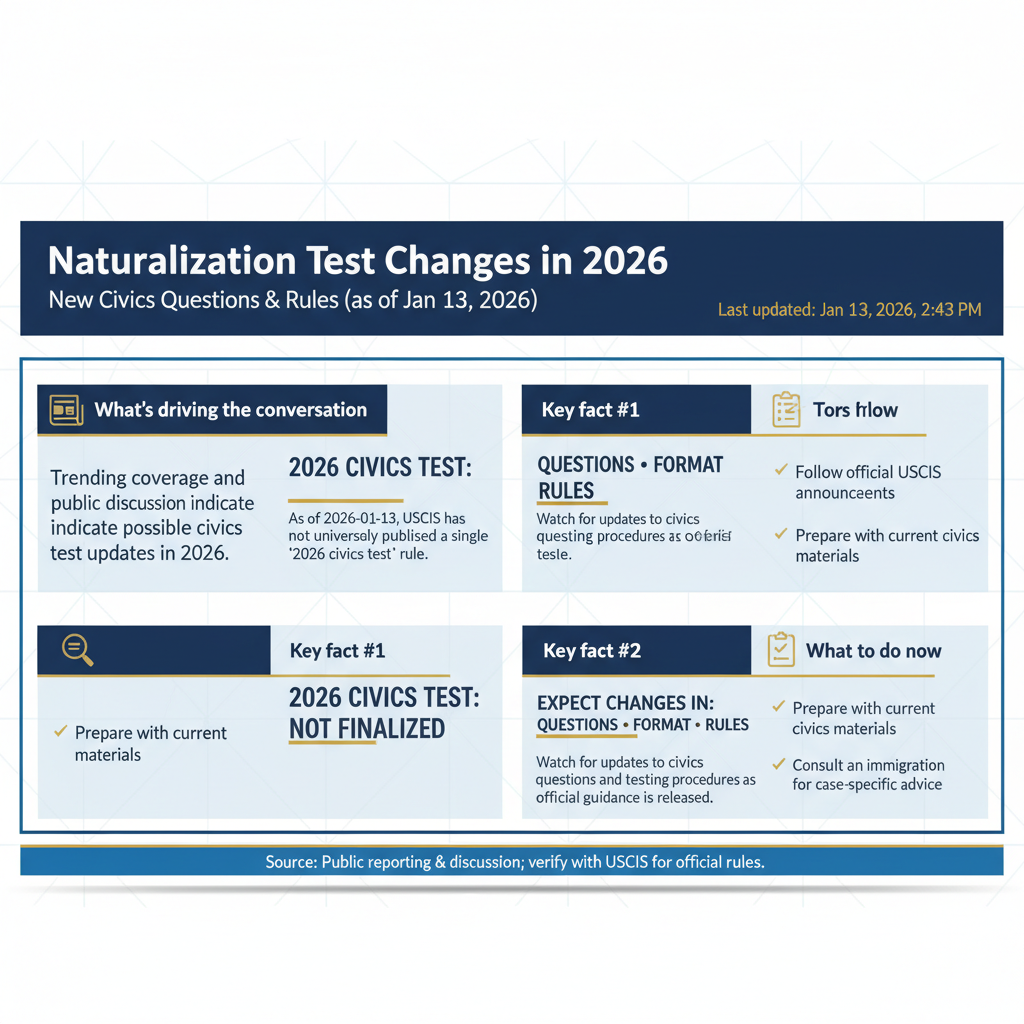
This article is based on trending coverage and public discussion about upcoming naturalization testing updates, including: Naturalization Test Changes Coming in 2026 (Citizenship).
Important: As of today (2026-01-13), USCIS has not universally published a single, final “2026 civics test” rule that applies to every applicant in every filing situation. What we do know is that USCIS has authority to update the civics test and study materials, and that changes can be implemented with transition rules (for example, depending on your filing date). This guide focuses on what has historically changed, what USCIS typically changes, and how to protect your case while updates roll out.
Need Help? Our Orlando immigration team is ready to assist. Call +1 786-791-3106 for a free consultation, or message us online. Se Habla Español.
What This News Means for Immigrants in Orlando and Across Florida
Why this news is showing up now
The U.S. naturalization process is built around standardized testing—especially the civics and English portions of the naturalization interview. When USCIS updates the civics test, it can affect:
- Which questions you study (and how many)
- How the officer administers the test at the interview
- Which applicants are “grandfathered” into the prior version based on a filing date
- How study materials and community programs (libraries, ESL programs, nonprofits) teach citizenship preparation
The reason you may be hearing about “Naturalization Test Changes Coming in 2026” is that USCIS periodically revises question banks and guidance to reflect updated civic information, improve test design, and standardize officer practices. Public attention increases when leaked drafts, announcements, or stakeholder discussions suggest an imminent update.
Reminder: Even when the civics questions change, the legal eligibility requirements for naturalization usually do not change at the same time. Many applicants confuse “test changes” with “eligibility changes.” They’re different.
How it can affect Florida residents
For Central Florida residents—especially those along the I-4 corridor (Orlando, Kissimmee, Sanford, and surrounding Orange County communities)—the practical impact is preparation strategy and timing:
- Study plan timing: If you file Form N-400 before a change takes effect, you may be tested under the current version (depending on USCIS transition rules).
- Interview readiness: If your case is in Orlando, your naturalization interview is typically scheduled through the Orlando USCIS Field Office. Officers there apply national USCIS policy, but scheduling backlogs can affect which test version applies.
- English/civics exemptions: Florida has large communities of long-term residents who may qualify for age/time-in-status accommodations (for example, the “50/20” or “55/15” civics-only rules). A test update can change the exact list of civics questions you should study, even if you qualify for accommodations.
Warning: If you wait until the last minute to study because you heard “the test is changing,” you may accidentally create risk. The safest approach is to prepare for naturalization based on your expected filing and interview timeline, and confirm which test version applies to you.
What Naturalization Test Changes Coming in 2026 Is (and Why It Matters)
A plain-English definition
“Naturalization test changes” refers to USCIS updating the content and/or administration of the U.S. citizenship test given during a naturalization interview. The test includes:
- English test (speaking, reading, writing)
- Civics test (U.S. history and government)
The civics test is the part most likely to be revised because USCIS uses a question bank and can update it periodically. Changes may include new questions, reworded answers, different emphasis areas, or updated study materials.
Key terms you need to know
- Naturalization: The legal process to become a U.S. citizen after being a lawful permanent resident (green card holder) and meeting eligibility requirements.
- Form N-400: The USCIS application for naturalization.
- Civics test question bank: The official list of possible questions USCIS may ask during the interview.
- Transition rule: USCIS guidance that determines which test version applies based on your filing date, interview date, or other factors.
- Continuous residence / physical presence: Core eligibility rules that often matter more than the test itself.
- Good moral character: A legal standard that can be affected by criminal issues, certain immigration violations, and misrepresentation.
- Orlando USCIS Field Office: The local office that typically conducts interviews for applicants living in the Orlando area and parts of Central Florida.
Important: The civics test is only one part of the interview. Many denials and delays happen because of eligibility issues (travel, taxes, selective service, prior arrests, or prior immigration history)—not because of civics questions.
Current Immigration Law: The Foundation
Naturalization is governed primarily by the Immigration and Nationality Act (INA) and related federal regulations. Even if the civics test changes in 2026, the underlying statutory eligibility criteria remain rooted in federal law.
Federal requirements
Key legal authorities include:
- INA § 316 (8 U.S.C. § 1427): General naturalization requirements (including continuous residence, physical presence, and good moral character).
- INA § 319 (8 U.S.C. § 1430): Naturalization for spouses of U.S. citizens (the common “3-year rule”).
- 8 C.F.R. Part 316 and Part 312: Regulations covering naturalization procedures and the English/civics requirements, including exemptions and accommodations.
USCIS administers the process through Form N-400 and conducts interviews, testing, and oath ceremonies. Official resources include the USCIS official website, the USCIS Forms page, and USCIS policy guidance.
While this article focuses on naturalization, many families pursue citizenship after completing earlier steps such as family petitions and green card processes. For context, common family-based forms include Form I-130 and Form I-485, and concepts like Adjustment of Status and a Priority Date can shape the timeline to reach permanent residence (and eventually eligibility for naturalization).
Florida-specific considerations
Naturalization is federal, so Florida does not create separate citizenship rules. However, Florida residents often face practical and regional considerations:
- Local scheduling realities: If your case is in Orlando, interview scheduling and oath ceremony availability can affect how quickly you reach the test stage.
- Name changes: In some jurisdictions, a judicial oath ceremony may be required for a legal name change; timing can vary and may affect how quickly you receive your Certificate of Naturalization.
- Travel patterns: Central Florida residents often travel internationally for extended family reasons; long trips can affect continuous residence/physical presence and complicate naturalization.
You can monitor timeframes using USCIS Processing Times.
Need Help? Our Orlando immigration team is ready to assist. Call +1 786-791-3106 for a free consultation, or message us online. Se Habla Español.
How to Prepare for Possible 2026 Naturalization Test Updates: A Complete Step-by-Step Guide
The best way to handle potential civics test changes is to build a plan that protects your eligibility, your timeline, and your study strategy—without guessing. Below is a practical roadmap we use with clients at Imigrar.
1) Confirm your eligibility and safest filing date
Before you worry about new civics questions, confirm the basics: are you eligible to file now, and is filing now strategically safer than waiting?
- General 5-year rule: Most applicants can apply after 5 years as a lawful permanent resident.
- 3-year rule: Some spouses of U.S. citizens can apply after 3 years, if all requirements are met.
- 90-day window: You may be able to file up to 90-day window before you reach the required residency anniversary (USCIS allows early filing in many cases).
Required documents to gather at this stage:
- Front/back copy of your green card
- Passport(s) and travel history (dates of trips)
- Marriage certificate and spouse’s proof of citizenship (if applying under 3-year rule)
- Tax transcripts (recommended)
- Selective Service registration proof (if applicable)
- Court dispositions for any arrest/citation (even if dismissed)
Important: If you have any criminal history, prior immigration violations, or long trips abroad (especially 6+ months), speak with counsel before filing.
2) Track which civics test version is likely to apply to you
USCIS typically applies test versions based on policy effective dates and “grandfathering” rules. When a new test is introduced, USCIS may specify that:
- Applicants who file before a certain date take the prior test, even if interviewed later; or
- Applicants interviewed after a certain date take the new test; or
- A phased approach applies by filing date and interview date.
Required items to organize:
- A copy of your filed Form N-400 and receipt notice
- A folder (digital or paper) containing the civics materials you studied (version/date)
- Bookmarks to official USCIS study pages (avoid random “question dumps”)
Use official sources first: USCIS official website and USCIS Forms.
3) Build a study plan that works even if questions change
Even when the question bank changes, the subject areas usually remain similar: Constitution, branches of government, rights/responsibilities, and key historical concepts.
Documents/materials to gather:
- USCIS civics study materials (official PDF/audio, if available)
- Notebook of weak topics and corrected answers
- Reading/writing practice lists (official USCIS vocabulary lists when available)
- Practice tests from reputable community organizations (but verify against USCIS)
Reminder: The English speaking portion is evaluated throughout the interview. Don’t focus only on civics.
4) Prepare your N-400 “interview package” like a legal file
The naturalization interview is not only a test—it’s also a sworn review of your entire application. Inconsistencies can cause delays, Requests for Evidence (RFEs), or even denial.
Documents to bring/organize (typical list—your case may require more):
- Interview notice
- Permanent resident card (green card)
- State ID/driver’s license
- All current and expired passports and travel documents
- Certified court dispositions for any incident (arrest, charges, restraining orders)
- Marriage/divorce documents, if relevant
- Proof of marital union (3-year rule cases): joint lease/mortgage, bank statements, insurance, children’s birth certificates
- Tax transcripts and proof of filing/payment plans if any issues
Warning: Do not guess about travel dates, addresses, or employment history. If your timeline is messy, we recommend building a written chronology before the interview.
5) Attend biometrics and monitor your case status
After filing, USCIS usually schedules biometrics (fingerprints/photo) unless reused. Case timing varies; check: USCIS Processing Times.
Documents to keep ready:
- Biometrics appointment notice (if scheduled)
- Receipt notices and online account access
- Any USCIS correspondence
If your case is in Orlando, appointments may be influenced by local capacity in Central Florida. Keep your address current with USCIS to avoid missed notices.
6) Pass the interview (English + civics) and understand retest rules
At the interview, you’ll answer questions about your Form N-400, complete the English test (unless exempt), and take the civics test. If you fail the English or civics portion, USCIS generally provides one retest opportunity within a set period.
Items to bring:
- Your complete interview package (see Step 4)
- Any updated documents since filing (new trips, job changes, marital changes)
- Proof of lawful name change (if applicable)
Important: If new civics requirements apply to your case, you must be prepared for that version at the interview—even if you studied an older version. That’s why confirming the applicable test version is critical.
7) Take the Oath of Allegiance and protect your new status
After approval, you’ll be scheduled for an oath ceremony. Once you take the oath, you become a U.S. citizen and can apply for a U.S. passport through the U.S. Department of State.
Documents to bring:
- Oath ceremony notice
- Green card (you will surrender it)
- Any USCIS-issued travel documents (if any)
- Certificate of Naturalization review checklist (to confirm accuracy)
Reminder: Review your Certificate of Naturalization carefully before leaving the ceremony site. Fixing errors later can take time and may require additional filings.
Need Help? Our Orlando immigration team is ready to assist. Call +1 786-791-3106 for a free consultation, or message us online. Se Habla Español.
Practical Steps You Can Take Today
If you’re worried about “new civics test questions and requirements” in 2026, here is a practical, low-risk plan you can start now—whether you live in Orlando, elsewhere in Orange County, or anywhere in Florida.
Actionable checklist
- 1) Calculate your earliest filing date using the 90-day window rule (and confirm you meet continuous residence and physical presence).
- 2) Request tax transcripts and verify you filed correctly for the last 5 years (or 3 years if applying under the spouse rule).
- 3) Build a travel log with exact departure/return dates; reconcile with passport stamps and flight receipts.
- 4) Collect certified court dispositions for any incident—even if dismissed.
- 5) Start civics study using official USCIS materials and avoid unofficial lists that may be outdated after a 2026 update.
- 6) Practice interview English (speaking clearly about your application history is often more important than “perfect grammar”).
- 7) If you have complications, schedule a legal review before filing, not after a denial.
Document preparation guidance
Create a “citizenship binder” (paper or digital) with tabs:
- Identity: passports, birth certificate + certified translation if needed
- Status: green card, prior USCIS approvals
- Residence: leases, mortgages, utility bills (helpful in some cases)
- Marriage/family: certificates, divorce decrees, children’s birth certificates
- Taxes: transcripts and payment plans
- Legal: certified court records
- Study: USCIS civics/English materials (with dates/versions)
Important: If you previously filed Form I-130 or Form I-485 through Adjustment of Status, keep copies. Past filings can matter if USCIS asks about prior addresses, entries, or marital history. Your earlier Priority Date is usually not central to naturalization, but your immigration history is.
Timeline expectations
Processing times vary. Many applicants ask, “Will the 2026 test changes delay my case?” Not necessarily. Typically:
- USCIS may update study resources before the change becomes mandatory.
- USCIS may apply transition rules rather than pausing cases.
- Local scheduling (including the Orlando area) can be the bigger driver of timing than the test itself.
Check your estimated timeframe at USCIS Processing Times.
How Imigrar Helps Immigrants in Orlando
At Imigrar, our mission is to Keep Families Together. We help lawful permanent residents across Orlando, Orange County, and nationwide prepare strong naturalization cases—especially when policy updates create uncertainty.
- We evaluate eligibility under INA rules, including continuous residence, physical presence, and good moral character.
- We identify risk issues (prior arrests, long travel, tax problems, prior immigration filings) before they become denials.
- We prepare clients for the interview and testing process, including how to respond clearly and honestly.
- We assist with evidence organization and corrections to avoid inconsistencies.
If your case is in Orlando, we can help you prepare for what to expect at the Orlando USCIS Field Office and how to navigate local scheduling realities for Central Florida residents along the I-4 corridor.
Se Habla Español. Call us at +1 786-791-3106 for a free consultation.
Frequently Asked Questions
Q: Will the 2026 civics test changes affect my eligibility to become a U.S. citizen?
A: Usually, no. Test updates typically change the questions and study materials, not the core legal eligibility rules in INA § 316 or § 319. Your eligibility still depends on lawful permanent resident status, continuous residence, physical presence, good moral character, and other statutory requirements. The main impact is that you must study the correct question bank for the version that applies to your filing/interview date.
Q: If I file now, can USCIS still test me on the new 2026 questions later?
A: It depends on USCIS transition rules. When USCIS changes the civics test, it may “grandfather” applicants based on the filing date of Form N-400 or the interview date. If you want to reduce uncertainty, file as soon as you are eligible (including the 90-day window when allowed) and track USCIS announcements on the USCIS official website.
Q: Does failing the civics test affect my green card or immigration status?
A: A failed civics test typically does not cancel your green card. Most applicants get a retest opportunity. However, the interview also reviews your entire record. If USCIS finds a serious issue (for example, misrepresentation, certain criminal issues, or abandonment of residence), that can create broader consequences. If you have concerns, get legal advice before the interview.
Q: How long does the naturalization process take in Florida, including Orlando?
A: Timelines vary by workload and staffing. For Central Florida residents, the Orlando-area scheduling cycle can affect how quickly you receive biometrics, an interview date, and an oath ceremony. The best way to estimate current timing is to check USCIS Processing Times and then build a buffer in your planning (travel, work deadlines, and family obligations).
Q: What documents should I bring to my naturalization interview if questions or requirements change?
A: Bring your green card, passports, state ID, interview notice, and a well-organized set of supporting documents (marriage/divorce records, tax transcripts, selective service proof, and certified court dispositions if applicable). The civics test change itself doesn’t usually change which documents USCIS requests, but it may change what you study. Keep your civics materials tied to an official USCIS source and version date.
Q: How much does it cost to apply for naturalization, and will a test change increase fees?
A: USCIS filing fees can change over time, but a civics test update does not automatically mean a fee increase. Always verify the current Form N-400 filing fee on the USCIS Forms page. Consider additional costs for translations, certified court records, and legal help when needed. If cost is an issue, ask about fee waiver eligibility.
Q: What happens if my naturalization application is denied after the interview?
A: USCIS will issue a written decision explaining the reason. Some denials can be challenged through an administrative hearing request (commonly associated with Form N-336) or by refiling later after fixing the issue. If the denial is tied to a legal problem (criminal history, residence issues, or alleged misrepresentation), talk to an immigration attorney immediately before taking next steps. If you are in removal proceedings, the Executive Office for Immigration Review may be involved in your broader immigration case.
Common Mistakes (and How to Avoid Them)
Mistake #1: Studying from outdated or unofficial question lists
When a change is rumored, unofficial websites often circulate “new questions” that are incomplete or wrong. Avoid this by using USCIS materials first and verifying dates/versions.
Mistake #2: Filing Form N-400 without addressing travel, taxes, or arrests
Many applicants focus on civics and ignore eligibility risk. Long trips, inconsistent tax filing, or missing certified dispositions can trigger delays or denials. Resolve these issues before filing whenever possible.
Mistake #3: Treating the interview like only a test (not a sworn legal review)
The officer will review your entire Form N-400 under oath. Inconsistent answers about addresses, employment, or marital history can create credibility issues. Prepare a timeline, review your application carefully, and bring documentation.
Need Help? Our Orlando immigration team is ready to assist. Call +1 786-791-3106 for a free consultation, or message us online. Se Habla Español.
Official Resources to Follow (So You Don’t Rely on Rumors)
To stay current on any 2026 naturalization test updates, rely on official channels and credible government references:
- USCIS official website (policy updates, study materials, announcements)
- USCIS Forms (current N-400 instructions and fees)
- USCIS Processing Times (time estimates by form and office)
- U.S. Department of State (passport after naturalization)
- Executive Office for Immigration Review (if removal proceedings intersect with your case)
Reminder: If you see a headline about “new requirements,” confirm whether it is (1) a change in the civics question bank, (2) a change in interview administration, or (3) an actual legal change to eligibility standards. Those are not the same.
Closing: Get a Personalized Naturalization Plan for 2026
Naturalization test updates can feel stressful—especially if you’re preparing while working, raising children, and supporting family here and abroad. The good news is that most applicants can succeed by filing at the right time, using official study materials, and preparing the interview like a legal review.
If your case is in Orlando, if you live in Orange County, or if you’re anywhere along the I-4 corridor, Imigrar can help you understand which civics test version is likely to apply and how to prepare confidently.
Call Imigrar at +1 786-791-3106 for a free consultation, or message us online. Se Habla Español.


