


The reporting that sparked this guide
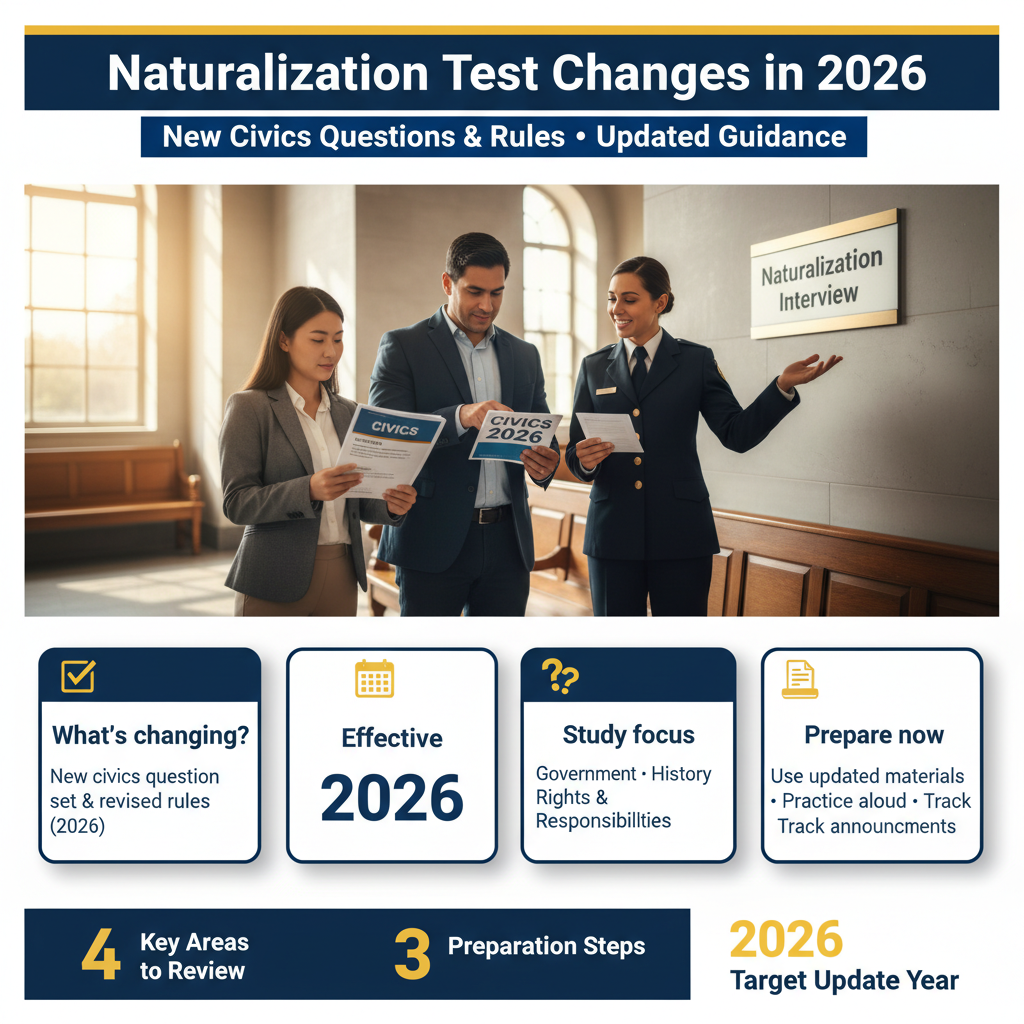
Recent coverage and discussion around potential updates to the U.S. naturalization civics test in 2026 has raised important questions for applicants preparing for citizenship. Here is the news reference that prompted this article:
Naturalization Test Changes Coming in 2026 (Citizenship)
Important: As of today (2026-01-16), USCIS has not published a single, definitive “final rule” that applies to every applicant in 2026. What we do have is growing reporting and public discussion about new civics test questions and requirements. This guide explains how the naturalization test works now, what “test changes” usually mean in practice, and how to protect your timeline if you plan to file soon.
Need Help? Our Orlando immigration team is ready to assist. Call +1 786-791-3106 for a free consultation, or message us online. Se Habla Español.
What This News Means for Immigrants in Orlando and Across Florida
Why this news is showing up now
Naturalization testing changes tend to become “trending” when one or more of the following happens:
- USCIS updates study materials (for example, the official civics question bank or policy guidance) on the USCIS official website.
- Stakeholders (community groups, educators, and attorneys) notice shifts in how interviews are being conducted and start sharing patterns.
- Election cycles and civic education initiatives increase public interest in citizenship—and with it, interest in the civics test.
- Operational changes inside USCIS (staffing, training, interview formats, or updated guidance) create real-world effects even before formal rulemaking is widely understood by the public.
Reminder: USCIS has changed the civics test in the past, including changes to the question set and scoring approach. When changes occur, USCIS typically provides a transition period and clarifies which version applies based on the filing date of Form N-400 (Application for Naturalization).
How it can affect Florida residents
For Florida residents—especially in high-volume areas like Orlando, Tampa, Miami, and along the I-4 corridor—test changes can affect:
- How you study (new question bank, different emphasis areas, or updated “expected answers”).
- When you file (some applicants prefer to file before a new test version takes effect).
- What happens at the interview (how civics and English are administered, and how officers document results).
- Retest strategy if you do not pass the English or civics portion at the first interview.
If your case is in Orlando, you may also feel the effects of local scheduling and backlogs. The Orlando USCIS Field Office serves a broad region of Central Florida, and small policy shifts can translate into meaningful differences in interview preparation and timing.
To check current estimates, you can review USCIS Processing Times, but keep in mind that posted times are averages and can change quickly.
What Naturalization Test Changes Coming in 2026 Is (and Why It Matters)
A plain-English definition
When people say “Naturalization test changes,” they usually mean changes to one or more parts of the citizenship testing process during the Form N-400 interview, including:
- Civics test content (the list of possible questions and the “correct” answers USCIS accepts).
- Civics test format (how many questions are asked, how many must be answered correctly, and how questions are selected).
- English test administration (speaking, reading, and writing components and how they are evaluated).
- Interview procedures (how officers document responses, handle accommodations, and schedule retests).
These changes matter because they can affect your preparation plan, your confidence at the interview, and your timeline to become a U.S. citizen—especially if you are near eligibility and deciding when to file.
Key terms you need to know
- Naturalization: The legal process of becoming a U.S. citizen after meeting eligibility requirements (usually as a lawful permanent resident).
- Form N-400: The application used to apply for U.S. citizenship through naturalization.
- Civics test: The portion of the naturalization interview that tests knowledge of U.S. history and government.
- English test: The portion that evaluates your ability to speak, read, and write basic English (unless an exemption applies).
- Medical disability exception: A potential exception from English and/or civics requirements based on a qualifying medical condition, typically documented with Form N-648 (Medical Certification for Disability Exceptions).
- 90-day window: Many lawful permanent residents can file Form N-400 up to 90 days before they meet the continuous residence requirement (commonly 5 years, or 3 years for certain spouses of U.S. citizens).
- Warning: Naturalization testing is only one part of eligibility. Issues like trips abroad, taxes, selective service, criminal history, and prior immigration filings can impact approval.
Although this article is about the civics test, your interview is also a legal eligibility review. A “test change” does not override statutory requirements—USCIS must still apply the law in the Immigration and Nationality Act.
Need Help? Our Orlando immigration team is ready to assist. Call +1 786-791-3106 for a free consultation, or message us online. Se Habla Español.
Current Immigration Law: The Foundation
Even if USCIS updates the civics question set in 2026, the underlying legal authority for naturalization remains grounded in federal law—primarily the Immigration and Nationality Act (INA)—and federal regulations and policy guidance.
Federal requirements
Most naturalization applicants must show they meet requirements under the INA, including (commonly):
- Lawful permanent resident status (green card holder) for the required period.
- Continuous residence and physical presence in the U.S.
- Good moral character (a legal standard assessed over a statutory period and sometimes beyond).
- Attachment to the Constitution and willingness to take the Oath of Allegiance.
- English and civics knowledge, unless exempt.
USCIS implements these requirements through regulations (including 8 C.F.R. parts governing naturalization) and USCIS policy guidance. You can find official instructions, updates, and study materials through the USCIS official website and the USCIS Forms page.
Important: Naturalization is separate from family-based green card processes like Form I-130 (family petition) and Form I-485 (Adjustment of Status). However, your immigration history—including past filings and your Priority Date in some contexts—can still matter when USCIS reviews your record.
Florida-specific considerations
Naturalization is federal, meaning Florida does not set citizenship rules. But Florida-specific realities can affect your case:
- Interview location and scheduling: For Central Florida residents, the Orlando USCIS Field Office typically handles N-400 interviews. Appointment availability can shift based on staffing and volume.
- Name changes: If you request a legal name change through naturalization, timing may depend on how local courts coordinate with USCIS ceremonies (this can vary by field office practice).
- Travel patterns: Florida residents often have frequent international travel (Caribbean, Latin America, Europe). Long trips can raise continuous residence questions.
- Documentation realities: After hurricanes or moves along the I-4 corridor, applicants sometimes lack consistent records. Rebuilding a clean paper trail is crucial.
Reminder: For any immigration court-related concerns (for example, if you have an old removal order or proceedings history), consult the Executive Office for Immigration Review resources and speak with counsel before filing.
For travel and passport-related context after naturalization, see the U.S. Department of State website.
How to Prepare for the 2026 Naturalization Test Changes: A Complete Step-by-Step Guide
This step-by-step guide is designed for applicants who are eligible (or close to eligible) and want to prepare strategically amid possible civics test updates in 2026.
1) Confirm you are eligible to file (and pick your best filing date)
Before you worry about new civics questions, confirm you can file Form N-400 and choose a date that protects your case. Many applicants can file within the 90-day window before meeting the continuous residence requirement.
Documents to gather:
- Front and back of your green card
- State ID/driver’s license (Florida ID if applicable)
- Marriage certificate (if applying under the 3-year rule)
- Spouse’s proof of U.S. citizenship (passport, birth certificate, or naturalization certificate)
- Travel history (dates of trips outside the U.S.)
- Tax transcripts or returns (commonly last 3–5 years)
- Selective Service registration proof (if required)
- Certified court dispositions for any arrests/citations
Warning: If you have any criminal history, prior immigration violations, or extended travel abroad, talk to an attorney before filing. Filing at the wrong time can trigger delays or denials.
2) Identify which civics test version is likely to apply to you
Historically, when USCIS changes the civics test, the applicable version often depends on when you file Form N-400 (and sometimes when you are interviewed). If changes are implemented with a transition period, applicants may be “grandfathered” into the previous test version.
Documents/info to gather:
- A copy of your submitted Form N-400 and receipt notice (Form I-797C)
- Any USCIS announcements or guidance saved as PDFs/printouts
- Your USCIS online account screenshots showing filing date and status
Practical tip: Study using the most current materials on the USCIS official website. If USCIS publishes a new question set, prioritize that set—but keep a backup plan if your filing date locks you into the prior version.
3) Build a study plan that covers civics + English + interview review
The naturalization interview is not only a test—it is also a review of your entire application. A strong plan includes:
- Civics: Memorize questions and understand concepts (branches of government, constitutional principles, rights/responsibilities).
- English speaking: Practice answering N-400-style questions out loud.
- Reading/writing: Practice USCIS sample sentences and vocabulary.
- N-400 review: Be ready to explain addresses, jobs, trips, and any “yes/no” answers.
Documents/materials to gather:
- USCIS civics study materials (print or digital)
- Your completed Form N-400 copy
- A timeline of addresses/employment for the last 5 years (or 3 years)
- List of trips abroad with exact dates
Important: If the 2026 update adds new questions or changes “expected answers,” avoid relying solely on third-party flashcards. Always verify against USCIS materials.
4) Prepare your evidence packet for the interview (even if not required)
USCIS does not require you to bring a massive binder, but being organized can prevent delays—especially if the officer requests clarification on residence, marriage, taxes, or travel.
Documents to bring (common examples):
- Original green card and state ID
- All passports (current and expired) covering your LPR period
- Certified tax transcripts (recommended) or copies of returns
- Proof of marital union (if applying under 3-year rule): joint lease/mortgage, bank statements, insurance, children’s birth certificates
- Proof of Selective Service registration (if applicable)
- Certified court dispositions for any incidents
- Proof of legal name change (if any)
If your case is in Orlando, plan for logistics: parking, arrival time, and security screening at the Orlando USCIS Field Office. Bring only what you need, and keep documents neatly labeled.
5) Attend the biometrics appointment (if scheduled) and the naturalization interview
Some applicants are scheduled for biometrics; others may have biometrics reused. Then comes the interview where the officer reviews your Form N-400, administers the English test (unless exempt), and administers the civics test.
Documents to bring:
- Biometrics appointment notice (if applicable)
- Interview appointment notice
- Government-issued photo ID
- All evidence listed in Step 4
Reminder: If you need language or disability accommodations, request them properly and early. For a medical exception, Form N-648 must be prepared carefully and supported by a qualified medical professional.
6) If you do not pass, use the retest window strategically
If you fail the English or civics test at the interview, USCIS typically schedules a second opportunity (a retest) within a set period. This is where “test changes” can become confusing—because applicants worry they’ll be switched to a new test version.
Documents to gather:
- Interview results notice showing which section(s) were not passed
- Officer’s notes (if provided) or your own notes immediately after interview
- Updated study plan focusing on weak topics
Warning: Do not ignore a retest notice. Missing an appointment can lead to denial for abandonment or failure to prosecute.
7) Take the Oath of Allegiance and update your records
Once approved, you will be scheduled for an oath ceremony. After you naturalize, you can apply for a U.S. passport and update your Social Security record.
Documents to bring:
- Oath ceremony notice
- Permanent resident card (you will surrender it)
- Any USCIS-requested documents
- Proof of name change approval (if applicable)
After the oath, consult the U.S. Department of State for passport instructions and timelines.
Need Help? Our Orlando immigration team is ready to assist. Call +1 786-791-3106 for a free consultation, or message us online. Se Habla Español.
Practical Steps You Can Take Today
Even without a finalized “2026 test overhaul” announcement, you can take concrete steps now that improve your odds of passing and reduce delays.
Actionable checklist:
- 1) File strategically: If you are eligible now (or within the 90-day window), consider filing sooner rather than later—especially if you are concerned about adapting to a new question set.
- 2) Use official study materials: Study directly from USCIS resources on the USCIS official website and confirm you are using the correct civics question set.
- 3) Create a “residence & travel” master timeline: List every address, job, and trip abroad. This reduces mistakes and helps you answer confidently at the interview.
- 4) Order tax transcripts: Tax transcripts are often cleaner than self-prepared copies. If you have filing issues, consult a qualified tax professional.
- 5) Resolve court records early: If you have any arrest/citation history, request certified dispositions now—some counties take weeks.
- 6) Practice speaking English in N-400 format: It’s not just vocabulary—it’s comfort answering personal history questions.
- 7) Plan for timing: Monitor USCIS Processing Times and build buffer time for travel, work, and childcare.
Timeline expectations (typical, varies by case):
- Filing to biometrics: often a few weeks (or biometrics reuse)
- Filing to interview: often several months depending on workload
- Interview to oath: sometimes same day, sometimes weeks/months
Important: If you have international travel planned, be cautious with long trips. Extended absences can raise continuous residence issues and can also cause you to miss appointments.
How Imigrar Helps Immigrants in Orlando
At Imigrar, our mission is to Keep Families Together. Naturalization is often the final step after years of building a life in the United States—and it should feel empowering, not intimidating.
We help clients in Orlando, Orange County, and across the I-4 corridor, and we also serve clients nationwide. Our support commonly includes:
- Eligibility strategy and filing-date planning (including the 90-day window)
- Full preparation and filing of Form N-400
- Risk assessment for travel history, prior immigration issues, or criminal records
- Interview preparation focused on English, civics, and N-400 review
- Guidance on disability accommodations and Form N-648 when appropriate
Se Habla Español. If you feel stressed about possible 2026 civics test changes, we can help you create a plan that is realistic and tailored to your history.
Need Help? Our Orlando immigration team is ready to assist. Call +1 786-791-3106 for a free consultation, or message us online. Se Habla Español.
Frequently Asked Questions
Q: Will the naturalization civics test definitely change in 2026?
A: USCIS periodically updates civics materials and can change question banks or testing formats. Trending reports suggest changes may be coming in 2026, but applicants should rely on official USCIS announcements and study materials. The safest approach is to (1) confirm your eligibility, (2) file when ready, and (3) study from the most current resources on the USCIS official website.
Q: If I file now, can USCIS make me take the “new” test later?
A: Historically, when USCIS changes the civics test, the version you take is often tied to your Form N-400 filing date and USCIS transition rules. If a new test is implemented, USCIS typically clarifies who takes which version. Keep copies of your receipt notice and filing date proof. If your case is in Orlando and your interview is scheduled after an implementation date, an attorney can help confirm which test version should apply to you.
Q: Do civics test changes affect my immigration status or green card?
A: Civics test changes do not change your underlying lawful permanent resident status by themselves. However, the naturalization process involves a full eligibility review. If USCIS finds an issue (for example, abandonment of residence, misrepresentation, or certain criminal grounds), it can affect the N-400 decision and, in rare cases, trigger additional review. If you have concerns, consult counsel before filing.
Q: What documents should I bring to the naturalization interview?
A: Bring your interview notice, green card, state ID, all passports, and supporting records for any issues in your case (taxes, marriage, travel, court dispositions). If you are applying based on marriage to a U.S. citizen, bring proof of ongoing marital union (joint bills, lease/mortgage, insurance). Organization matters—especially if officers ask follow-up questions. For official filing references, see USCIS Forms.
Q: How much does it cost to apply for naturalization?
A: USCIS fees can change, so confirm the current filing fee for Form N-400 directly on the USCIS official website. Some applicants may qualify for a fee reduction or fee waiver depending on income and circumstances. Also budget for supporting costs like certified court records, translations, and passport applications after naturalization (see U.S. Department of State for passport fees).
Q: What happens if I fail the civics or English test?
A: USCIS generally gives you a second chance to pass the failed portion at a later appointment (a retest). Use that time to study targeted weak areas and practice interview-style answers. Warning: If you miss the retest appointment or fail again, USCIS may deny the N-400. If that happens, you may have options, including filing an administrative review request (depending on the reason for denial). Get legal advice quickly to protect deadlines.
Q: What happens if my naturalization application is denied?
A: The denial notice will explain the reason. Some denials are fixable (for example, insufficient evidence, failure to meet continuous residence, or failure to pass tests). Others may require deeper legal analysis (criminal issues, misrepresentation, or prior immigration problems). You may be able to request a hearing on the decision or reapply later. If you have any history involving immigration court, consult the Executive Office for Immigration Review information and speak with an attorney immediately.
Common Mistakes (and How to Avoid Them)
Mistake #1: Studying from outdated or unofficial civics question lists
When test changes are rumored, unofficial lists spread fast. Avoid wasting time on incorrect materials. Always verify your study source with USCIS. Start with the USCIS official website and confirm you are using the correct question bank for your filing date.
Mistake #2: Treating the interview like “just a test” and ignoring eligibility issues
The officer will review your entire Form N-400. Issues like long trips abroad, inconsistent addresses, unpaid taxes, or undisclosed citations can derail an otherwise strong applicant. Build a clean timeline and bring supporting evidence.
Mistake #3: Filing without understanding how past immigration filings can surface
USCIS can review prior filings, including family-based cases like Form I-130, green card filings like Form I-485 (Adjustment of Status), and related records. If there were inconsistencies in prior applications, address them proactively with legal guidance.
Deeper Context: What “New Civics Test Questions and Requirements” Could Look Like
Because the news cycle often compresses complex policy into headlines, it helps to understand the kinds of changes USCIS has made historically—and the types of updates that are plausible when people say “new civics test questions and requirements.”
1) Changes to the question bank (content updates)
USCIS may revise the pool of possible questions to reflect:
- Updated civic terminology or clearer wording
- Greater emphasis on constitutional structure and democratic principles
- Current civics education standards (without turning the test into a political quiz)
- Clarified “acceptable answers” to reduce inconsistent grading
Important: Even subtle wording changes can affect how applicants study—especially for those learning English or relying on translations.
2) Changes to format (how many questions, how many correct)
A “requirements” change can mean the rules of the civics test itself—for example, how many questions an officer asks and how many correct answers are needed to pass. Applicants should watch for USCIS guidance that states the exact format and any transition rules.
3) Changes to interview administration (consistency and documentation)
Sometimes USCIS changes are more operational than substantive, such as:
- Different officer training on how to ask questions
- More standardized documentation in the case file
- Updated accommodations procedures
These “behind the scenes” changes can still impact applicants—especially those with anxiety, language barriers, or complex histories.
4) Changes affecting exemptions and accommodations
USCIS rules already include exemptions for certain applicants based on age and length of permanent residence, and disability exceptions through Form N-648. If USCIS adjusts requirements, it may also clarify:
- How officers evaluate disability exception documentation
- What types of accommodations are available during testing
- How interpreters may be used when an exemption applies
Warning: Improperly prepared disability documentation can cause delays, second interviews, or denials. This is an area where legal guidance is especially valuable.
Orlando & Central Florida Focus: Planning Your Case Around Local Realities
For Central Florida residents, practical planning matters as much as legal eligibility.
If your case is in Orlando...
- Plan ahead for appointment timing: Morning appointments can reduce stress and help you arrive early.
- Bring a document “quick grab” folder: Officers may ask for passports, tax records, or marriage evidence quickly.
- Expect security screening: Leave extra time and avoid bringing prohibited items.
The Orlando USCIS Field Office and the I-4 corridor
Applicants living along the I-4 corridor (Orlando, Kissimmee, Sanford, Lake Mary, and surrounding areas) should build buffer time for traffic and parking. Missing an interview can create major delays and may require rescheduling, which can add months.
Reminder: If you move within Florida (for example, from Orange County to another county), update your address promptly with USCIS to avoid lost notices.
Official Resources to Monitor for 2026 Updates
If you are tracking possible 2026 civics test changes, use official sources first. Here are key links we recommend bookmarking:
- USCIS official website (news, policy updates, and study materials)
- USCIS Forms (latest Form N-400 and instructions)
- USCIS Processing Times (field office and service center estimates)
- U.S. Department of State (passport steps after naturalization)
- Executive Office for Immigration Review (immigration court information if relevant)
Important: If you see a headline about “new requirements,” verify whether it is (1) a change to study materials, (2) a policy update, or (3) a formal rule change with an effective date and transition guidance.
Putting It All Together: A Smart Strategy for 2026
The best way to reduce stress about possible naturalization test changes is to focus on what you can control:
- Eligibility first: Confirm continuous residence, physical presence, and good moral character.
- Filing date strategy: Use the 90-day window when appropriate and avoid unnecessary delays.
- Study from USCIS: Build confidence with official materials and consistent practice.
- Interview readiness: Know your N-400, your travel history, and your documents.
- Get help for complexity: If you have prior issues, do not guess—get legal advice.
And remember: naturalization is not only a test day—it’s a process. A calm, well-documented case is often a successful case.
Closing: Talk to an Orlando Naturalization Attorney Before the Rules Shift
If you are worried about Naturalization Test Changes Coming in 2026, the most effective step is to get a personalized plan. At Imigrar, we help you file correctly, prepare thoroughly, and avoid surprises—so you can move forward with confidence and keep your family’s future secure.
Need help now? Call Imigrar at +1 786-791-3106 for a free consultation. You can also message us online. Se Habla Español.


