


The reporting that sparked this guide
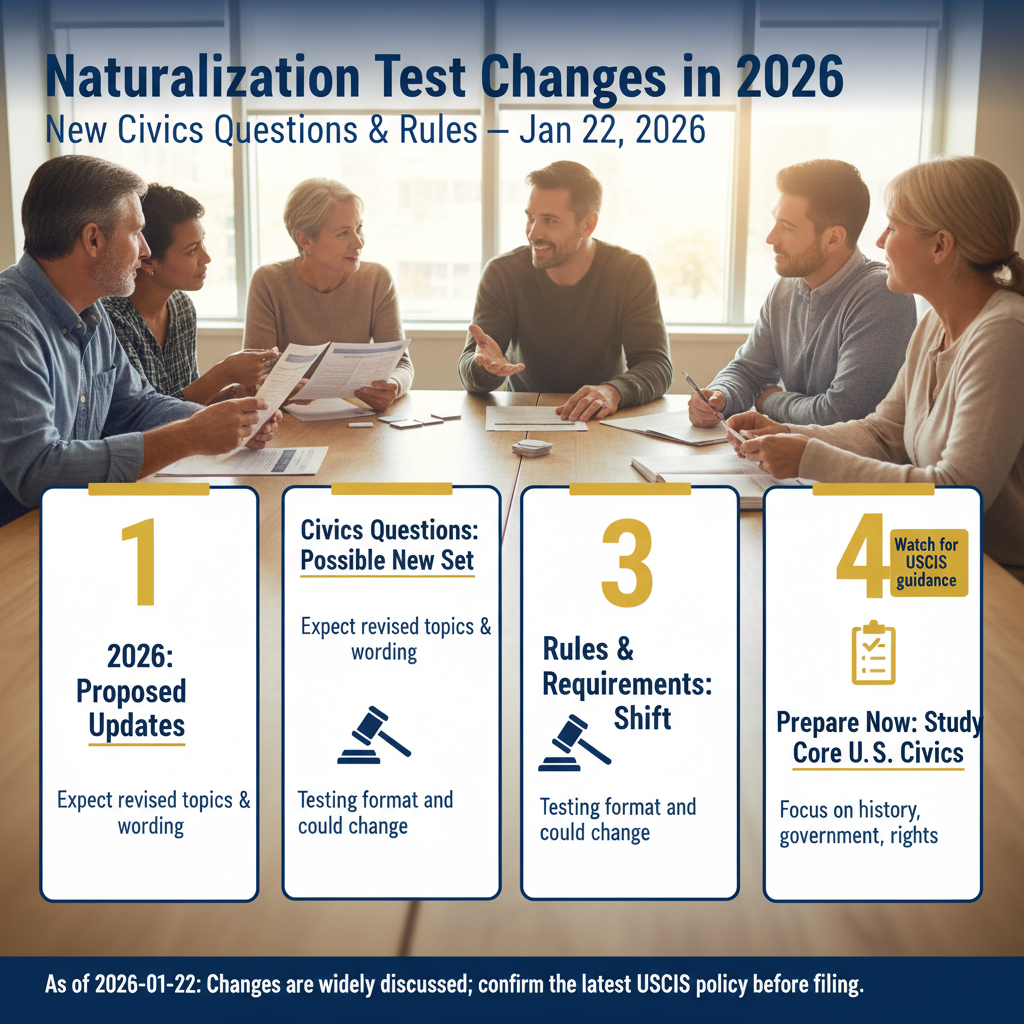
This article is based on trending reporting and public discussion about potential updates to the U.S. naturalization civics test and related requirements expected in 2026.
Naturalization Test Changes Coming in 2026 (Citizenship)
Important: As of today (2026-01-22), USCIS implements naturalization testing through published policy and official materials. News coverage may describe proposals, drafts, or anticipated changes before USCIS issues final guidance. Always verify the latest rules on the USCIS official website.
Need Help? Our Orlando immigration team is ready to assist. Call +1 786-791-3106 for a free consultation, or message us online. Se Habla Español.
What This News Means for Immigrants in Orlando and Across Florida
Why this news is showing up now
Naturalization test updates tend to trend for three reasons:
- Periodic modernization: USCIS reviews civics and English testing to ensure questions reflect current government structure, civic principles, and plain-language standards.
- Policy shifts between administrations: In recent years, the civics test has changed and then reverted, which makes any new proposal in 2026 especially newsworthy.
- High demand for citizenship: More lawful permanent residents are applying for citizenship, and even small changes to the test can affect preparation strategies, timelines, and retest expectations.
Reminder: Until USCIS publishes final rules and effective dates, your preparation should focus on the currently valid naturalization requirements and test materials available through USCIS.
How it can affect Florida residents
For Florida residents—especially in Central Florida along the I-4 corridor (Orlando, Kissimmee, Sanford, and surrounding Orange County communities)—a civics test update could affect:
- Study plans and class curricula: Community programs, libraries, and adult education providers may update materials quickly once USCIS announces final questions.
- Interview readiness: Naturalization interviews already include English reading/writing and civics. New question pools or formats can change how applicants practice.
- Timing decisions: Some applicants may prefer to file earlier to test under the current version (if USCIS sets a future effective date), while others may wait for clearer guidance.
If your case is in Orlando, your interview is typically scheduled through the local USCIS field office that serves the area. The Orlando USCIS Field Office interview experience can vary by officer and day, but the legal standards remain federal and uniform nationwide.
What Naturalization Test Changes Coming in 2026 Is (and Why It Matters)
A plain-English definition
“Naturalization test changes” refers to updates USCIS may make to the citizenship testing process—most commonly the civics test question bank (the list of questions officers can ask) and sometimes the testing format (how many questions are asked, how many must be answered correctly, and how the exam is administered).
Naturalization itself is the process where a lawful permanent resident (green card holder) becomes a U.S. citizen by filing an application, attending biometrics, completing an interview, passing English and civics tests (unless exempt), and taking the Oath of Allegiance.
Key terms you need to know
- Naturalization: The legal process to become a U.S. citizen (generally by filing Form N-400).
- Civics test: The U.S. history and government portion of the naturalization exam.
- English test: Speaking (evaluated throughout the interview), plus reading and writing components unless exempt.
- Eligibility: Meeting the legal requirements to naturalize (residence, physical presence, good moral character, etc.).
- Good Moral Character (GMC): A legal standard USCIS reviews based on the statutory period and sometimes beyond.
- Continuous residence / physical presence: Rules that limit long trips outside the U.S. and require a certain amount of time physically in the U.S.
- 90-day window: Many applicants may file up to 90-day window before completing the required 3 or 5 years of continuous residence (if otherwise eligible).
- Warning: Not all applicants must take the English test; some qualify for age/time-in-status exemptions, but civics may still apply in a modified form.
Why it matters: For most applicants, the civics test is the most stressful part of the process. If USCIS changes question pools, difficulty level, or passing criteria, it may affect how long you should study, whether you should enroll in a class, and how you plan your filing timeline.
Current Immigration Law: The Foundation
Naturalization is governed primarily by the Immigration and Nationality Act (INA) and implementing regulations. Key legal authorities include:
- INA § 316 (general naturalization requirements, including continuous residence, physical presence, and GMC)
- INA § 319 (naturalization for spouses of U.S. citizens under the 3-year rule)
- 8 CFR Part 316 (regulations on naturalization and examinations)
- 8 CFR Part 312 (English and civics requirements and exemptions)
Federal requirements
Most applicants for U.S. citizenship must:
- Be a lawful permanent resident (LPR) for the required period (typically 5 years, or 3 years if married to and living with a U.S. citizen spouse under INA § 319)
- Meet continuous residence and physical presence rules
- Show Good Moral Character during the statutory period
- Demonstrate attachment to the U.S. Constitution and willingness to take the Oath
- Pass the English and civics tests unless exempt
USCIS publishes official test content, study tools, and policy updates on the USCIS official website. You can also access current forms and instructions through USCIS Forms.
Reminder: Naturalization is separate from family-based processes like Form I-130 and Form I-485. However, your history with Adjustment of Status (often via Form I-485) can matter if USCIS reviews prior immigration filings for accuracy and possible misrepresentation.
Florida-specific considerations
Naturalization is federal, so Florida does not create separate citizenship requirements. However, Florida residents often face practical, location-based factors:
- Interview logistics: If your case is in Orlando, you may be scheduled at the Orlando USCIS Field Office depending on jurisdiction and workload.
- Name changes: Some applicants prefer a judicial oath ceremony to include a legal name change; scheduling can vary by local court/USCIS coordination.
- Travel patterns: Florida residents often travel internationally; extended trips can disrupt continuous residence and physical presence.
- Record access: Getting certified dispositions for arrests or citations from Florida courts (including Orange County) can take time—plan ahead.
To track timelines, check USCIS Processing Times. For passport and citizenship evidence after naturalization, see the U.S. Department of State.
Need Help? Our Orlando immigration team is ready to assist. Call +1 786-791-3106 for a free consultation, or message us online. Se Habla Español.
How to Prepare for the 2026 Naturalization Test Update: A Complete Step-by-Step Guide
This step-by-step guide is designed for applicants who want to (1) file a strong Form N-400 case and (2) be ready if USCIS updates the civics test questions or format in 2026.
1) Confirm your eligibility and your best filing date
Before you focus on the civics test, confirm you qualify to apply. Many “test problems” are actually eligibility problems (travel, taxes, prior citations, selective service, or marital history).
Documents to gather:
- Front and back of your green card
- Marriage certificate and spouse’s proof of U.S. citizenship (if applying under the 3-year rule)
- Divorce decrees/annulments/death certificates for all prior marriages (you and spouse)
- Travel history (passport stamps, itineraries, I-94 history if relevant)
- Selective Service proof (if applicable)
- Tax transcripts (recommended) or tax returns for the statutory period
Timeline note: Many eligible applicants can file in the 90-day window before reaching the 3- or 5-year residence anniversary. Choosing the right date can help avoid delays or a denial.
2) Build a “USCIS-ready” civics and English study plan (current + flexible)
Because the news suggests possible 2026 civics updates, a smart approach is to study the current official USCIS civics questions while also strengthening broader civic understanding (not just memorization).
Documents/materials to gather:
- Current USCIS civics question set and study tools (from USCIS official website)
- English reading/writing practice sheets (USCIS materials)
- Your own glossary of key terms (Constitution, amendments, branches of government, etc.)
- Notebook of ���weak areas” and practice answers
Practical strategy: If USCIS introduces new questions, applicants who understand the concepts (not only the exact wording) adapt faster.
3) Prepare your Form N-400 package carefully (and consistently)
USCIS will compare your Form N-400 answers to prior filings (including your green card process, such as Form I-485 or consular processing records). Inconsistencies can trigger delays, requests for evidence, or deeper questioning at interview.
Documents to gather:
- Copies of prior immigration filings if available (I-130, I-485, asylum filings, etc.)
- Certified court dispositions for any arrest/citation (even if dismissed)
- Proof of current address and employment history
- Evidence of marital union (if applying under the 3-year rule)
Warning: If you ever had an immigration court case, removal order, or pending proceedings, do not file without legal screening. For information about immigration court, see Executive Office for Immigration Review.
4) Track your case and prepare for biometrics and the interview
After filing, you’ll typically receive a receipt notice, then a biometrics appointment (or reuse notice), and later the interview notice. Processing times vary by field office and workload.
Documents to gather:
- USCIS receipt notices and online account access
- Government-issued photo ID (driver’s license/state ID)
- All passports (current and expired) covering the statutory period
- Green card (original)
- Any updated documents since filing (new trips, new job, new address)
Check estimated timelines using USCIS Processing Times, but remember that individual cases vary.
5) Train for the civics test like the real interview (including “curveballs”)
Even if the 2026 changes are not yet effective for your case, practicing in a realistic interview format reduces anxiety and improves performance.
Documents/materials to gather:
- Printed civics questions for rapid review
- Audio recordings of yourself answering (to improve clarity)
- List of common follow-up questions (e.g., about your application answers)
- English reading/writing practice words/sentences
Important: USCIS officers can ask civics questions from the official list applicable to your test version. If USCIS creates a new 2026 version, they typically publish which applicants are tested under which version (often based on filing date). Confirm on USCIS once updates are announced.
6) Plan for the retest possibility and know your options
If an applicant fails the English or civics test, USCIS generally provides a second chance (a re-examination) within a set period. A calm retest plan is part of good preparation.
Documents to gather:
- Any notice indicating which portion was failed
- Your study plan updated to focus on missed areas
- Medical documentation if you may qualify for an exemption (see Step 7)
Reminder: If USCIS denies the N-400, there may be options to request a hearing on the decision (through Form N-336)—but the best strategy is to prevent denial through strong eligibility screening and accurate filings.
7) If you may qualify for an exemption or accommodation, prepare early
Some applicants qualify for age/time-as-LPR exemptions from English, and others may request disability-based exceptions or accommodations. These cases require careful documentation.
Documents to gather:
- Proof of age and date you became an LPR (green card issue date)
- Medical records supporting a disability exception, if applicable
- Completed medical certification (commonly Form N-648, if appropriate)
- Interpreter arrangements if you qualify for an exemption and will test civics in your language
Warning: Disability exceptions are closely reviewed. Incomplete or inconsistent medical documentation can delay the case or lead to denial.
Practical Steps You Can Take Today
If you’re hearing about “Naturalization Test Changes Coming in 2026” and feeling unsure, here are concrete actions you can take now—before any new test version becomes effective.
Actionable checklist (do this now)
- Check your eligibility dates and mark your 90-day window on a calendar.
- Download only official study materials from USCIS official website (avoid outdated PDFs and random apps).
- Request tax transcripts and verify you filed consistently (especially if you traveled or changed jobs).
- Order certified court dispositions for any arrest or citation—do not assume “dismissed” means “no record.”
- Create a travel log with all trips, dates, and countries to prevent mistakes on Form N-400.
- Practice civics out loud 10–15 minutes per day; build confidence for the interview setting.
- Update your address with USCIS if you moved (address issues can cause missed interview notices).
Document preparation guidance
Build a single “citizenship folder” (digital + paper) containing:
- Identity documents (passport(s), driver’s license, green card)
- Marriage/divorce records
- Tax transcripts/returns
- Employment history and addresses for the last 5 years
- Any immigration notices and prior filings you have
Important: If you previously filed family-based paperwork like Form I-130 or Form I-485, keep copies. Those records can help resolve inconsistencies quickly and avoid delays.
Timeline expectations
Naturalization timelines vary. Many cases take months from filing to interview, and scheduling can depend on local capacity. For Central Florida residents, the Orlando-area scheduling patterns can shift with staffing and volume.
Use USCIS Processing Times as a starting point, and plan buffer time for:
- Getting court records (often weeks)
- Medical certification preparation (if needed)
- Rescheduling conflicts due to travel or emergencies
Need Help? Our Orlando immigration team is ready to assist. Call +1 786-791-3106 for a free consultation, or message us online. Se Habla Español.
How Imigrar Helps Immigrants in Orlando
At Imigrar, we help clients in Orlando, across Central Florida, and nationwide prepare strong, organized naturalization applications and interview plans—especially when policy changes or test updates create uncertainty.
Our support typically includes:
- Eligibility screening (travel, taxes, prior immigration history, arrests/citations)
- Strategic filing timing (including the 90-day window)
- Application preparation and consistency review across prior filings
- Interview preparation focused on civics, English, and application-based questioning
- Guidance on exemptions/accommodations where appropriate
Se Habla Español and we work with families under our guiding principle: Keep Families Together.
Reminder: If your case involves prior removal proceedings, consult counsel before filing. Immigration court information is available through the Executive Office for Immigration Review.
Frequently Asked Questions
Q: Will the naturalization civics test definitely change in 2026?
A: News coverage suggests changes may be coming, but the controlling authority is USCIS’s official announcement and published materials. Until USCIS issues final guidance with an effective date, applicants should study the currently valid test. Monitor updates on the USCIS official website and consider filing timing if you are already eligible.
Q: If I file now, could I still be tested under the new 2026 questions?
A: Typically, USCIS applies a test version based on the filing date (and sometimes the interview date), but the exact rule depends on the official rollout. Once USCIS announces the change, it usually clarifies which applicants fall under which test. If your case is in Orlando, your interview scheduling could place your interview after an effective date—so filing earlier may or may not control the test version. Confirm once USCIS publishes details.
Q: Do naturalization test changes affect my immigration status or green card?
A: The civics test changes do not change your underlying lawful permanent resident status by themselves. However, the naturalization process involves a full review of eligibility and background. Issues like long trips abroad, certain criminal matters, or inconsistencies in prior filings (including Form I-485 through Adjustment of Status) can affect the N-400 outcome and, in rare cases, create broader immigration risk. Get legal advice if you have red flags.
Q: What documents should I bring to the naturalization interview?
A: Bring your green card, state ID, all current and expired passports, and any documents related to answers on your Form N-400 (marriage/divorce records, court dispositions, tax transcripts, selective service proof, and evidence of marital union if applying under the 3-year rule). If you moved, bring proof of your current address. If USCIS requests specific items in your interview notice, bring exactly those items.
Q: How long does the naturalization process take in Florida?
A: Timelines vary by workload and field office. For Central Florida residents, the Orlando USCIS Field Office scheduling can fluctuate. The best public estimate is the tool at USCIS Processing Times. Also plan extra time for gathering certified court records and correcting any application issues.
Q: How much does it cost to apply for U.S. citizenship?
A: USCIS fees can change, so verify the current filing fee for Form N-400 directly on USCIS Forms and the N-400 page. Additional costs may include biometrics (if applicable), obtaining certified court records, medical documentation for Form N-648 (if needed), and attorney fees if you hire counsel.
Q: What happens if I fail the civics test or English test?
A: In many cases, USCIS gives you a second opportunity to pass the portion you failed at a re-examination appointment. Use the time to focus on weak topics and practice in interview format. If you believe you qualify for an exemption (age/time as LPR or disability), consult an attorney before the retest so you don’t miss the chance to document it properly.
Q: What happens if my naturalization application is denied?
A: USCIS will issue a written decision explaining the reason. Depending on the basis, you may be able to request a hearing with USCIS (commonly via Form N-336) or reapply later. Because some denials are linked to broader issues (like Good Moral Character, travel, or prior misrepresentation), speak with counsel before taking the next step.
Common Mistakes (and How to Avoid Them)
Mistake #1: Filing to “beat the change” without checking eligibility
Some applicants rush to file because they fear new civics questions. But the bigger risk is filing when you’re not eligible (continuous residence problems, extended trips, unpaid taxes, or unresolved court issues). Avoid this by doing a full eligibility review first and using the 90-day window correctly.
Mistake #2: Studying from outdated or unofficial materials
Apps and social media posts often recycle old question sets. If USCIS updates the test in 2026, unofficial sources can lag behind or publish incorrect “new questions.” Avoid this by using only USCIS materials from the USCIS official website and confirming the test version that applies to your filing date.
Mistake #3: Ignoring prior records and inconsistencies
USCIS may compare your N-400 to past filings, including family petitions like Form I-130, green card filings like Form I-485, and any past statements to immigration officers. Inconsistencies can trigger delays or tougher questioning. Avoid this by gathering prior filings when possible and preparing consistent, truthful explanations.
Additional Official Resources (Use These, Not Rumors)
Because naturalization test changes can evolve quickly, rely on primary sources:
- USCIS official website (policy updates, study tools, and announcements)
- USCIS Forms (official forms and instructions, including N-400)
- USCIS Processing Times (case time estimates)
- U.S. Department of State (passport applications after naturalization)
- Executive Office for Immigration Review (immigration court information)
Reminder: If you are tracking family-based timelines, you may also see terms like Priority Date in visa bulletin contexts. While Priority Date is crucial for many immigration categories, naturalization eligibility for LPRs is generally based on time in status and statutory requirements rather than visa availability.
Need Help? Our Orlando immigration team is ready to assist. Call +1 786-791-3106 for a free consultation, or message us online. Se Habla Español.
Closing: Get Ready for 2026—Without Guessing
Naturalization test updates can feel intimidating, especially when headlines mention “new questions” or “new requirements.” The best approach is to (1) confirm eligibility, (2) file a clean and consistent Form N-400, and (3) study using official materials so you’re ready whether the test stays the same or changes in 2026.
If your case is in Orlando or you live anywhere in Central Florida along the I-4 corridor, Imigrar can help you plan your filing timeline, organize documents, and prepare for the interview with confidence.
Need legal guidance now? Call +1 786-791-3106 for a free consultation or message us online. Se Habla Español. Imigrar — Keep Families Together.


