


The reporting that sparked this guide
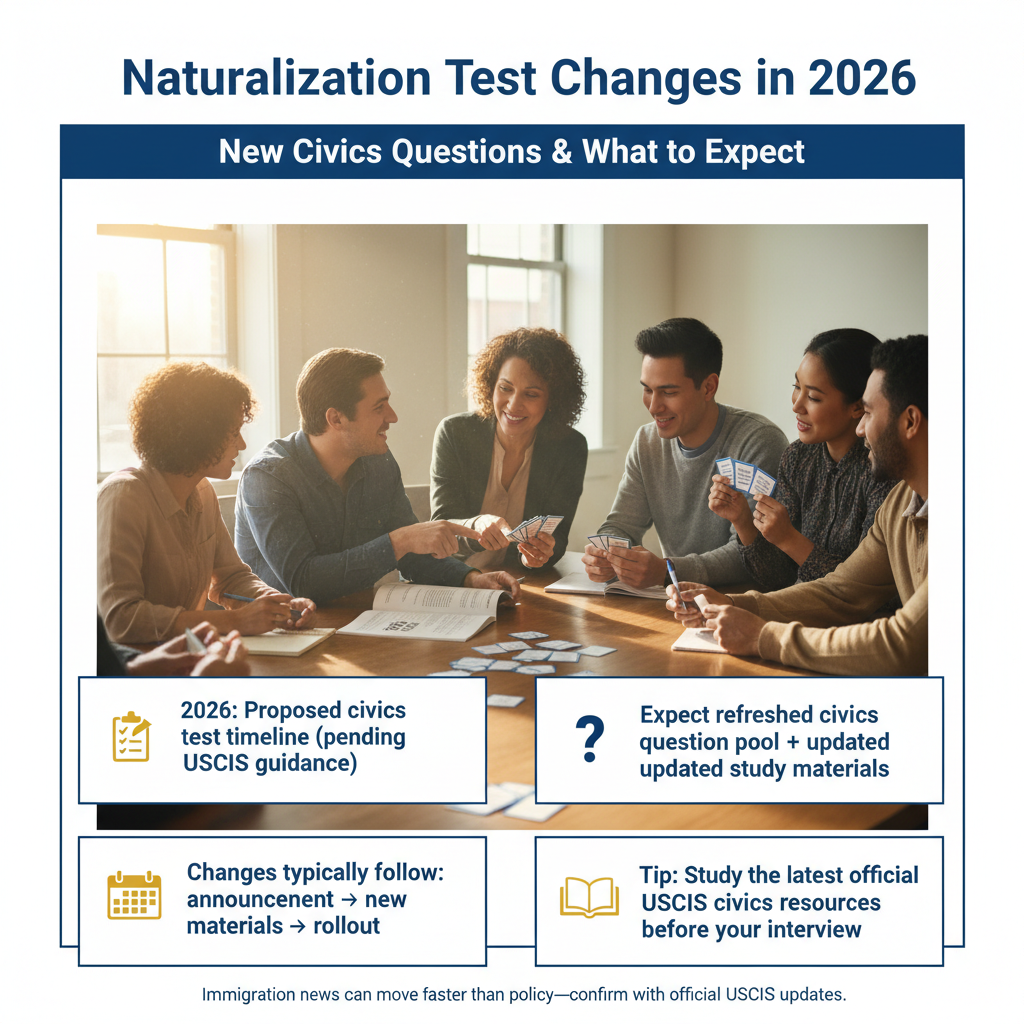
The reporting that sparked this guide comes from: Naturalization Test Changes Coming in 2026 (Citizenship).
Reminder: Immigration news can move faster than official policy. USCIS changes typically take effect only after formal announcements, publication of updated study materials, and implementation guidance. In this article, we explain what “naturalization test changes” usually mean, what to watch for in 2026, and how to prepare responsibly—especially if you’re filing Form N-400 soon.
Need Help? Our Orlando immigration team is ready to assist. Call +1 786-791-3106 for a free consultation, or message us online. Se Habla Español.
What This News Means for Immigrants in Orlando and Across Florida
Why this news is showing up now
The U.S. naturalization process includes an English test and a civics test. Over the past several years, USCIS has periodically revised the civics test format and content, and public attention spikes whenever there are signs of another update—especially when a target year (like 2026) is mentioned in reporting, advocacy discussions, or agency planning.
In practice, “naturalization test changes” can include:
- New or revised civics questions (for example, updated historical references or wording)
- Changes to the number of questions asked during the interview
- Changes to how many correct answers are required to pass
- Updated study materials, vocabulary lists, and officer guidance
- Clarifications on exemptions or accommodations (age/time as a permanent resident, disability accommodations)
Important: USCIS normally applies a specific test version based on when you file or when you are interviewed—depending on the official rule for that rollout. That means timing matters. If you’re planning to apply in 2026, you should prepare for the possibility that you’ll be tested under updated materials.
How it can affect Florida residents
For Florida residents—especially in high-growth areas like Orlando, Orange County, and along the I-4 corridor—naturalization demand is strong. When test requirements shift, we often see:
- Increased anxiety for applicants close to filing
- Confusion about which test version applies
- More Requests for Evidence (RFEs) or interview reschedules when applicants are not fully prepared
- Higher demand for English/civics classes and mock interviews
If your case is in Orlando, your interview will typically be handled through the local USCIS infrastructure (often referred to as the Orlando-area field office operations). The specific scheduling and local processing pace can vary—so it’s smart to track your case and plan study time well before the interview.
You can monitor general timelines using USCIS Processing Times, and confirm official updates on the USCIS official website.
What Naturalization Test Changes Coming in 2026 Is (and Why It Matters)
A plain-English definition
“Naturalization test changes” means USCIS may update the content or format of the U.S. citizenship tests you take during your naturalization interview—primarily the civics portion (U.S. history and government), and sometimes related English reading/writing prompts.
Most applicants for U.S. citizenship file Form N-400 and attend an in-person interview. At that interview, a USCIS officer typically:
- Reviews your Form N-400 answers
- Checks eligibility (residence, good moral character, etc.)
- Administers the English test (unless exempt)
- Administers the civics test (unless exempt)
If USCIS updates the civics test in 2026, it can affect what you study, how you practice, and how you plan your filing timeline.
Key terms you need to know
- Naturalization: The legal process of becoming a U.S. citizen after being a lawful permanent resident.
- Lawful Permanent Resident (LPR): A “green card” holder.
- Form N-400: Application for Naturalization.
- Civics test: Questions about U.S. history and government asked at the interview.
- English test: Speaking (evaluated throughout), plus reading and writing (unless exempt).
- Oath ceremony: The final step where you take the Oath of Allegiance and become a citizen.
- Accommodations: Adjustments for applicants with qualifying disabilities (often documented with Form N-648).
- 90-day window: Many applicants can file up to 90-day window before completing the required continuous residence period (commonly 5 years, or 3 years if married to a U.S. citizen and otherwise eligible).
Warning: This article discusses a “2026” change based on trending news. Always confirm the controlling test version and study materials directly through USCIS at USCIS official website and the official civics resources USCIS publishes.
Need Help? Our Orlando immigration team is ready to assist. Call +1 786-791-3106 for a free consultation, or message us online. Se Habla Español.
Current Immigration Law: The Foundation
Naturalization is governed primarily by the Immigration and Nationality Act (INA). Key legal anchors include:
- INA § 316 (general naturalization requirements, including continuous residence and physical presence)
- INA § 319 (naturalization through marriage to a U.S. citizen in certain cases)
- INA § 312 (English and civics requirements, including exemptions and accommodations)
- Implementing regulations found in 8 C.F.R. Part 316 and related sections
Even if the civics test questions change, the underlying legal requirements usually remain the same: eligibility, truthfulness, and proving you meet statutory criteria.
Federal requirements
While each case is unique, many applicants must show:
- Lawful permanent resident status for the required period (commonly 5 years, or 3 years in some marriage-based cases)
- Continuous residence and required physical presence in the U.S.
- Ability to read, write, and speak basic English (unless exempt)
- Knowledge of U.S. history and government (civics) (unless exempt)
- Good moral character during the statutory period
- Attachment to the principles of the U.S. Constitution
USCIS is the agency that adjudicates Form N-400. Official guidance, forms, and updates are available at: USCIS official website and USCIS Forms.
Reminder: Many families pursuing citizenship also have related immigration matters, such as family petitions (Form I-130), green card applications (Form I-485) through Adjustment of Status, or travel planning that should be coordinated with citizenship timelines. If you are still waiting on a family-based case, your Priority Date may control when a green card is available.
Florida-specific considerations
Naturalization is federal, so the legal standard is the same in Florida as anywhere else. However, Florida-specific realities can affect your experience:
- Local scheduling: The Orlando USCIS Field Office interview calendar can be affected by regional demand and staffing.
- Travel patterns: For Central Florida residents, frequent travel (especially extended trips abroad) can create continuous residence or physical presence issues.
- Name changes: Some applicants request a legal name change at naturalization; local court coordination can affect oath scheduling depending on how USCIS handles ceremonies.
If your case is in Orlando, plan for logistics (transportation, arrival time, parking, and document organization) and build extra time into your preparation schedule.
For travel-related questions, consult the U.S. Department of State. For immigration court information (if applicable), see the Executive Office for Immigration Review.
How to Prepare for the 2026 Naturalization Test Update: A Complete Step-by-Step Guide
Below is a practical, attorney-informed roadmap to prepare for potential civics test updates while still meeting today’s naturalization requirements. This is designed for applicants filing Form N-400 in 2025–2026, and for those already scheduled for interviews.
1) Confirm your eligibility and your filing window
Before you worry about civics questions, make sure you are eligible to apply. Many applicants can file within the 90-day window before completing the continuous residence requirement.
Documents to gather:
- Front and back of your Permanent Resident Card (green card)
- State ID/driver’s license (Florida ID if applicable)
- Marriage certificate/divorce decrees (if applying under INA § 319 or if marital history is relevant)
- Selective Service registration proof (if required based on age and registration rules)
- Travel history (passport stamps, itineraries, dates of trips)
- Tax transcripts or returns (often helpful to show compliance)
Important: Extended trips can create eligibility issues. As a general concept, long absences may trigger deeper scrutiny. If you had trips approaching or exceeding 180 days, consult an attorney before filing.
2) Track USCIS announcements and lock in the correct study materials
If USCIS changes the civics test in 2026, the agency will typically publish updated resources. You should rely on official materials—not social media summaries.
Documents and resources to collect:
- A saved link/bookmark to the USCIS official website
- USCIS civics study materials (downloaded PDFs, if available)
- Any USCIS press releases or policy updates relevant to the test version
- Your USCIS online account screenshots/receipts (if you file online)
Reminder: USCIS sometimes differentiates between test versions based on filing date or interview date. Keep proof of your filing date (receipt notice) and be ready to show you prepared using the correct version.
3) Build a civics study plan that can adapt to new questions
The safest approach for a possible 2026 update is to study in a way that prepares you for both content changes and test-day stress:
- Study core concepts (Constitution, branches of government, rights/responsibilities) rather than memorizing only short answers
- Practice speaking answers out loud (the interview is oral)
- Use spaced repetition (daily short sessions beat cramming)
- Do weekly mock tests under time pressure
Documents and tools to gather:
- Notebook with your missed questions and corrected answers
- Audio recordings of you practicing answers (optional)
- Flashcards (paper or app-based)
- Calendar plan counting back from your estimated interview month
For Central Florida residents balancing work and family, a realistic plan might be 20–30 minutes per day for 6–10 weeks, plus a longer mock interview once per week.
4) Prepare your English component (and evaluate exemptions or accommodations)
USCIS evaluates English speaking during the entire interview. Reading and writing are tested unless you qualify for an exemption based on age and time as a permanent resident, or you qualify for a medical disability exception (often supported by Form N-648).
Documents to gather:
- Evidence of age and green card issue date (to evaluate exemptions)
- If seeking disability accommodation: completed medical evaluation paperwork (commonly Form N-648)
- Practice sheets for reading/writing (based on USCIS vocabulary lists)
Warning: Disability exceptions must be legitimate and properly documented. Incomplete or inconsistent medical forms can delay your case or lead to denial.
5) File Form N-400 carefully and prepare for your biometrics/interview
Filing accurately reduces delays and protects credibility. USCIS will review your eligibility, travel, family history, and any criminal/traffic issues. Even if the civics test changes, a denial often happens for eligibility or credibility reasons—not for missing a civics question.
Documents to gather for filing and interview prep:
- Your completed Form N-400 draft (and a copy of the final submitted form)
- All passports (current and expired), travel documents, and reentry permits (if any)
- Certified court dispositions for any arrests/citations (if applicable)
- Proof of marital union (if applying under marriage provisions)
- Tax transcripts, W-2s/1099s (as applicable)
If your case is in Orlando, plan to arrive early and bring an organized binder. The Orlando USCIS Field Office interview experience is usually professional and structured, but preparation makes a major difference.
6) Attend the interview, handle retests if needed, and plan for the oath
At the interview, the officer will confirm your identity, review your application, test English/civics (unless exempt), and decide whether to approve, continue, or deny.
Documents to bring to the interview:
- Interview notice
- Green card
- State ID/driver’s license
- All passports and travel documents
- Marriage/divorce documents (if relevant)
- Any updated evidence since filing (new trips, new address, new job, etc.)
If you do not pass English or civics at the first interview, USCIS generally provides a second opportunity within a set period (often within 60–90 days). Use that time strategically with targeted practice and legal guidance if there are broader issues.
Practical Steps You Can Take Today
Whether the civics test changes in 2026 or not, the best preparation is proactive and organized. Here is a checklist you can start this week.
Actionable checklist
- Important: Create a “citizenship folder” (digital + paper) with your green card, passports, tax records, and travel history.
- Check your eligibility date and mark your 90-day window on your calendar.
- Begin civics study now using official USCIS materials and a consistent schedule.
- Write out your full 5-year (or 3-year) address and employment history so you can complete Form N-400 accurately.
- If you had any arrests/citations, request certified dispositions early (some courts take weeks).
- If you might need accommodations, speak with an attorney before submitting medical documentation (often Form N-648).
- Monitor official updates at USCIS official website and keep a record of what version you studied.
Document preparation guidance
The most common interview-day problems are missing documents and inconsistent dates. To reduce risk:
- Make a single list of all trips outside the U.S. (dates out/dates back). Cross-check with passport stamps.
- Keep proof of any legal name changes.
- Keep proof of marital status changes (marriage, divorce, annulment, death certificates).
- Keep tax documentation consistent with what you report on Form N-400.
Timeline expectations
Processing times vary by workload and location. Many cases take several months from filing to interview, and then additional time to oath scheduling. Track estimates here: USCIS Processing Times.
For Central Florida residents, build in flexibility for rescheduling and document requests. If a civics test update rolls out in 2026, USCIS may also update training and procedures, which can temporarily affect scheduling.
Need Help? Our Orlando immigration team is ready to assist. Call +1 786-791-3106 for a free consultation, or message us online. Se Habla Español.
How Imigrar Helps Immigrants in Orlando
Imigrar is an immigration law firm based in Orlando, Florida, serving clients nationwide. Our mission is to Keep Families Together. We help lawful permanent residents pursue citizenship with a strategy that addresses both the civics test and the bigger legal picture—eligibility, travel history, prior immigration filings, and any issues that could trigger delays or denials.
Our naturalization support commonly includes:
- Eligibility screening (continuous residence, physical presence, good moral character)
- Preparation and filing of Form N-400
- Document organization and interview readiness coaching
- Guidance on exemptions/accommodations, including disability-based requests when appropriate
- Support for complex histories (prior removal proceedings, long trips, arrests, prior misstatements)
If your case is in Orlando, we can help you prepare for what the Orlando USCIS Field Office typically focuses on—clear timelines, consistent travel disclosures, and confident interview performance.
Call us for a free consultation at +1 786-791-3106. Se Habla Español.
Frequently Asked Questions
Q: Will the naturalization civics test definitely change in 2026?
A: Not every news cycle results in an immediate USCIS change. USCIS test updates typically require official publication of new materials and implementation guidance. Treat 2026 as a “watch closely” year, and rely on the USCIS official website for confirmed updates.
Q: If I file Form N-400 now, could I still be tested under the 2026 version?
A: Possibly. USCIS has, in past transitions, applied different test versions depending on filing date or interview date. Keep your receipt notice and study the version USCIS says applies to your cohort. If you’re close to filing, speak with counsel about timing and risk.
Q: Does a civics test change affect my immigration status or green card?
A: A test change does not change your underlying lawful permanent resident status. However, your Form N-400 interview is still a legal adjudication. If USCIS finds an eligibility issue (for example, a continuous residence problem or a serious good moral character concern), it can affect the naturalization decision and, in rare cases, trigger deeper review. Get legal advice if you have red flags.
Q: How long does naturalization take in Florida, especially around Orlando?
A: Timelines vary. Many applicants wait several months from filing to interview, then additional time to the oath ceremony. For the most current estimates, check USCIS Processing Times and select the form and location. If your case is in Orlando, local demand along the I-4 corridor can influence scheduling.
Q: What documents should I bring to the naturalization interview?
A: Bring your interview notice, green card, state ID, all passports (current and expired), travel records, and any documents related to marital status changes, taxes, and court dispositions if applicable. If you updated anything after filing (new trips, address changes), bring proof and be ready to explain clearly.
Q: How much does it cost to apply for U.S. citizenship?
A: USCIS fees can change, and the total cost depends on whether you request fee waivers or have related filings. Always confirm current filing fees and instructions directly through USCIS at USCIS Forms. If cost is a concern, ask about eligibility for fee reductions/waivers and how to submit a strong request.
Q: What happens if I fail the civics or English test?
A: Many applicants who fail a portion of the test at the first interview get one more opportunity (a retest) within a set period. Use that time to focus on missed areas and practice under realistic conditions. If you fail again, USCIS may deny the application, but you may have options to reapply or challenge the decision depending on the reason.
Q: What happens if my N-400 is denied for reasons other than the test?
A: Denials can be based on eligibility issues (continuous residence, good moral character, misrepresentation, etc.). Next steps may include filing a motion/appeal where available, reapplying when eligible, or addressing underlying problems first. If you have any risk factors, speak with an attorney before filing or before the interview.
Common Mistakes (and How to Avoid Them)
Mistake #1: Studying the wrong test version or relying on unofficial question lists
When a change is rumored or announced, unofficial lists spread quickly. Avoid confusion by downloading study materials directly from the USCIS official website and saving proof of what you used.
Mistake #2: Underestimating travel history and continuous residence rules
Applicants often focus on civics and forget that eligibility is the foundation. Long trips, frequent travel, or unclear dates can cause problems. Important: If you had trips near or over 180 days, consult counsel before filing.
Mistake #3: Bringing incomplete records for arrests, citations, or court matters
Even minor incidents can require documentation. Don’t bring only a receipt or online printout—get certified dispositions when possible. Missing court records can lead to delays, continuances, or denials.
Need Help? Our Orlando immigration team is ready to assist. Call +1 786-791-3106 for a free consultation, or message us online. Se Habla Español.
Additional official resources you should rely on
Because test updates can be confusing, here are trustworthy government sources to keep bookmarked:
- USCIS official website
- USCIS Forms
- USCIS Processing Times
- U.S. Department of State
- Executive Office for Immigration Review
Reminder: If you are also pursuing a family-based process—like Form I-130 or Form I-485 through Adjustment of Status—coordinate strategy carefully. A pending case, a changing Priority Date timeline, or travel plans can affect when citizenship is realistic and how you should prepare.
Closing: Get a personalized naturalization plan for 2026
Naturalization is one of the most meaningful steps an immigrant can take—and changes to the civics test can make the process feel uncertain. The good news is that you can prepare in a way that works even if USCIS updates questions in 2026: confirm eligibility, track official announcements, study consistently, and organize your documents like a professional.
If your case is in Orlando, or you live anywhere in Central Florida (Orange County and along the I-4 corridor), Imigrar can help you file confidently and prepare for the interview with a clear strategy.
Need Help? Call Imigrar at +1 786-791-3106 for a free consultation, or message us online. Se Habla Español. Our mission is to Keep Families Together.


