


The reporting that sparked this guide
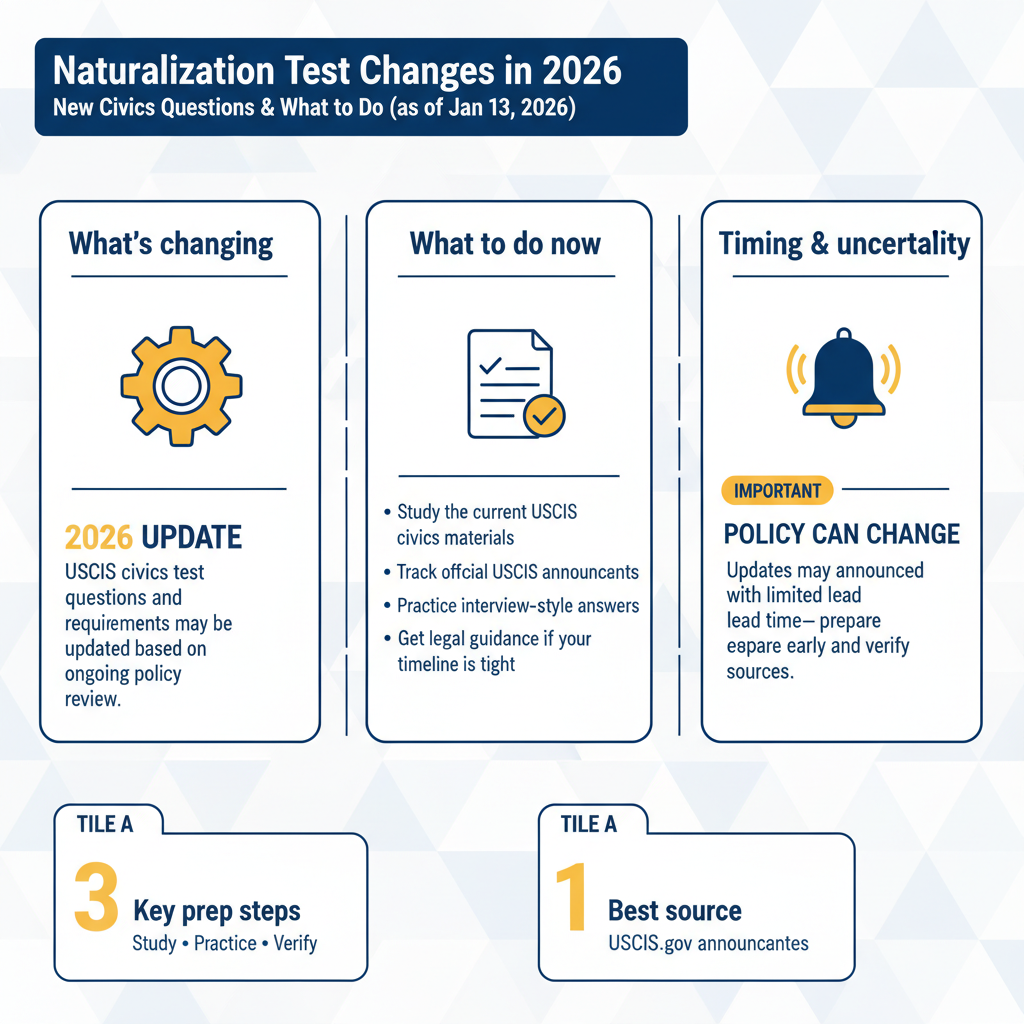
This article is based on trending coverage and discussion about upcoming naturalization civics testing updates, including new questions and requirements expected for 2026:
Naturalization Test Changes Coming in 2026 (Citizenship)
Important: As of today (2026-01-13), USCIS policy can change through formal announcements, Federal Register notices, and updates to the USCIS Policy Manual. If you are preparing to file now, you should rely on official USCIS instructions and your specific filing date rules.
Need Help? Our Orlando immigration team is ready to assist. Call +1 786-791-3106 for a free consultation, or message us online. Se Habla Español.
What This News Means for Immigrants in Orlando and Across Florida
Why this news is showing up now
Naturalization testing rules (especially the civics portion) tend to become “trending” when USCIS signals that it may revise question banks, scoring methods, or interview expectations. Historically, changes to the civics test have occurred when:
- USCIS updates training and standardized interview procedures for officers.
- There is a policy shift emphasizing civic education, English proficiency, or interview consistency.
- USCIS modernizes study materials, including digital learning tools and revised question sets.
- Processing backlogs and staffing changes lead USCIS to adjust workflow and interview formats.
Reminder: When changes happen, USCIS usually applies “transition rules,” meaning the version of the test you take can depend on when you file and sometimes when you are interviewed. That is why the “2026 changes” matter even if your naturalization interview is months away.
How it can affect Florida residents
For Florida residents—especially in high-volume areas like Central Florida—the biggest practical impacts are:
- Study strategy changes: new civics questions can require new study materials and different preparation timelines.
- Interview readiness: even if your eligibility is strong, test performance can delay approval if you need a re-test.
- Scheduling pressure: if many applicants try to file before a change, local field offices can see increased demand.
If your case is in Orlando, you may be scheduled at the Orlando USCIS Field Office depending on your residence and USCIS jurisdiction. For Central Florida residents along the I-4 corridor (including Orange County and surrounding areas), planning ahead is especially important because appointment availability and interview scheduling can fluctuate.
What Naturalization Test Changes Coming in 2026 Is (and Why It Matters)
A plain-English definition
“Naturalization test changes” generally refer to updates USCIS makes to the testing portion of the U.S. citizenship process. When you apply for citizenship using Form N-400, you typically must pass:
- An English test (speaking, reading, and writing), unless an exemption applies; and
- A civics test (U.S. history and government).
In plain English: the “2026 changes” could mean the civics questions are updated, the way questions are asked changes, or the pass/fail requirements are adjusted.
Key terms you need to know
- Naturalization: the legal process to become a U.S. citizen after being a lawful permanent resident (green card holder) or qualifying through military service.
- Form N-400: the application for naturalization filed with USCIS.
- Civics test: the oral test where a USCIS officer asks questions about U.S. history and government.
- English test: reading/writing and speaking evaluation during the interview.
- Re-examination (re-test): if you fail the English or civics test, USCIS generally gives you a second chance within a set period.
- USCIS Policy Manual: USCIS’s official guidance on how officers apply immigration laws and policies.
- 90-day window: a common timing concept in naturalization—many applicants can file up to 90-day window before meeting the continuous residence requirement (for certain categories).
- Warning: Don’t confuse naturalization testing changes with green card processes like Adjustment of Status using Form I-485 or family petitions like Form I-130. They are different processes, but your immigration history can affect naturalization eligibility.
Why it matters: Even small changes can affect approval timelines. If you are not prepared for the version of the civics test you will be given, you might fail, leading to a re-test appointment and months of additional waiting. For many families, naturalization is also a gateway to petition relatives faster, protect against certain immigration consequences, and gain voting rights—so delays can be costly.
Need Help? Our Orlando immigration team is ready to assist. Call +1 786-791-3106 for a free consultation, or message us online. Se Habla Español.
Current Immigration Law: The Foundation
Naturalization rules are grounded in federal law—primarily the Immigration and Nationality Act (INA)—and implemented through federal regulations and USCIS policy guidance. The civics and English testing requirements come from federal statute and regulation, and USCIS controls the specific question sets and procedures.
Federal requirements
Key legal authorities include:
- INA § 312 (8 U.S.C. § 1423): establishes English and civics requirements (with certain exceptions and accommodations).
- INA § 316 (8 U.S.C. § 1427): general naturalization requirements (continuous residence, physical presence, good moral character, attachment to the Constitution).
- INA § 319 (8 U.S.C. § 1430): special rules for spouses of U.S. citizens (including the 3-year rule).
- 8 C.F.R. Part 316 and 8 C.F.R. Part 312: regulations governing naturalization and the testing requirements.
USCIS publishes official test and study resources and updates them when policies change. For official guidance, start here:
- USCIS official website
- USCIS Forms (including Form N-400)
- USCIS Processing Times
Important: If you have ever filed for a green card through Adjustment of Status using Form I-485, or a family petition with Form I-130, your prior filings, travel history, and any requests for evidence can become relevant during the naturalization review. Officers often review the “whole file,” not just the N-400.
Florida-specific considerations
Florida does not create separate naturalization laws—citizenship is federal. However, Florida-specific realities can affect your case:
- Field office workload: The Orlando USCIS Field Office may experience periods of higher demand, which can influence interview scheduling.
- Name changes: Some applicants seek a legal name change as part of naturalization. Court-related scheduling and oath ceremony availability can vary by location.
- Travel patterns: Florida residents often travel internationally (Caribbean, Latin America, Europe). Long trips can raise continuous residence or physical presence issues.
For Central Florida residents living along the I-4 corridor (Orlando, Kissimmee, Sanford, and nearby communities in Orange County and beyond), planning around travel, work schedules, and test preparation is critical—especially if a new civics test version is introduced with a transition period.
How to Prepare for the 2026 Naturalization Test Changes: A Complete Step-by-Step Guide
This guide focuses on the practical “action” most readers need right now: preparing for naturalization while anticipating potential 2026 civics test updates. Because USCIS applies test versions based on filing and interview timing, your plan should cover both.
1) Confirm you are eligible to file (and choose the right filing date)
Before you worry about civics questions, confirm eligibility under the correct rule—most commonly the 5-year rule (INA § 316) or 3-year rule for spouses of U.S. citizens (INA § 319).
Documents to gather:
- Front/back of your Permanent Resident Card (green card)
- Marriage certificate (if applying under the 3-year rule)
- Divorce decrees or death certificates for prior marriages (if any)
- Evidence of spouse’s U.S. citizenship (passport, birth certificate, naturalization certificate)
- Travel records (passport stamps, itineraries, CBP history if available)
- Selective Service registration proof (if applicable)
Reminder: Many applicants can file within a 90-day window before meeting the continuous residence requirement. Filing too early can lead to denial; filing strategically may help you fall under a specific civics test version if USCIS sets transition rules.
2) Identify which civics test version is likely to apply to you
USCIS typically specifies which test applies based on your filing date and sometimes your interview date. If changes are expected in 2026, you should:
- Monitor USCIS announcements and study materials updates on the USCIS official website.
- Check whether USCIS publishes a “transition rule” (for example: “Applicants who file on or after X date will take the new test”).
- Prepare for both the current and potential updated question sets if your case timeline overlaps the change.
Documents / materials to gather:
- USCIS civics study guide (current version)
- Any USCIS press release or policy update printout (for your records)
- Your N-400 filing receipt (once filed) to prove your filing date
3) File Form N-400 correctly and keep proof of everything
When you file Form N-400, accuracy matters. Naturalization interviews often focus on consistency: addresses, employment, travel, marital history, and any law enforcement contact.
Documents to prepare and keep organized:
- Completed Form N-400 copy (exact version submitted)
- Filing fee proof or fee waiver request (if applicable)
- Two passport-style photos if required for your filing category/method (follow USCIS instructions)
- Tax transcripts (often helpful, especially if there are questions about support obligations)
- Court dispositions for any arrests/citations (even if dismissed)
- Proof of legal name change (if any)
Warning: If you have past immigration filings—like Form I-130 or Form I-485 through Adjustment of Status—inconsistencies between those forms and your N-400 can trigger delays or deeper review. Issues tied to your original Priority Date or prior admissibility questions can also resurface during naturalization.
4) Prepare for the English and civics tests (with a “change-ready” study plan)
Even if only the civics questions change, your best preparation is structured and measurable. A strong plan includes:
- Daily practice (15–30 minutes) rather than cramming.
- Oral practice (because the civics test is typically spoken).
- Reading/writing drills using USCIS-style vocabulary.
- Mock interviews that include N-400 review questions.
Study materials to build your binder:
- USCIS civics question list (current and any newly released list)
- Flashcards (paper or app-based)
- Practice reading sentences and writing sentences (USCIS samples)
- A one-page “life timeline” (addresses, jobs, trips) to avoid confusion at interview
Important: If you qualify for age/time exceptions (often called “50/20,” “55/15,” or “65/20”), you may be eligible to take the civics test in your preferred language and/or receive simplified requirements. USCIS sets these rules under INA § 312 and related guidance.
5) Attend biometrics (if scheduled) and track your case status
USCIS may schedule biometrics (fingerprints/photo) or reuse prior biometrics. Either way, you should track your case and prepare for the interview notice.
Documents to bring/keep for this stage:
- Biometrics appointment notice (if issued)
- Government-issued ID (green card, passport, state ID/driver’s license)
- All USCIS receipt notices
- Updated travel log (continue tracking trips after filing)
Use official tools to monitor timing:
- USCIS Processing Times
- USCIS official website (case status and account updates)
6) Prepare for the naturalization interview (Orlando-specific planning)
The naturalization interview is where the civics and English tests happen and where an officer reviews your N-400 line-by-line. If your case is in Orlando, plan for:
- Traffic and parking around the Orlando area (I-4 congestion can be real).
- Arriving early with organized documents.
- Bringing updated evidence for anything that changed after filing (new job, new address, new trips).
Documents to bring to the interview (common examples):
- Interview appointment notice
- Green card + passport(s) (current and expired)
- State ID/driver’s license
- Marriage certificate and spouse proof (if applying under 3-year rule)
- Proof of termination of prior marriages
- Tax transcripts, child support documentation (if applicable)
- Court dispositions for any arrests/citations
- Selective Service proof (if applicable)
- Evidence of continuous residence (leases, mortgage, utility bills) if there were long trips
7) Oath ceremony, certificate review, and next steps after approval
If approved, you will attend an oath ceremony and receive a Certificate of Naturalization. Review it immediately for errors.
Documents/items for this stage:
- Oath ceremony notice
- Your green card (you typically surrender it at oath)
- Any USCIS-issued travel document (if applicable)
- A checklist to review the certificate for name/date-of-birth errors
After you naturalize, you may want to:
- Apply for a U.S. passport through the U.S. Department of State.
- Update SSA records and your driver’s license.
- Consider family immigration options (for example, petitions that may become faster once you are a citizen).
Need Help? Our Orlando immigration team is ready to assist. Call +1 786-791-3106 for a free consultation, or message us online. Se Habla Español.
Practical Steps You Can Take Today
If you are worried about 2026 civics test changes, the best approach is to reduce uncertainty: lock in eligibility, file correctly, and study in a way that adapts to updates.
Actionable checklist (do these now):
- Confirm your earliest filing date (especially if you plan to use the 90-day window).
- Request your tax transcripts and keep them ready for the interview.
- Build a travel log with every trip outside the U.S. since becoming a resident (dates matter).
- Collect certified court dispositions for any incident—arrest, citation, or charge—no matter how old.
- Study civics daily and practice speaking answers out loud (most failures are from nerves + lack of oral practice).
- Create an “N-400 consistency file” comparing your N-400 to prior filings like Form I-130 and Form I-485 (addresses, marriage dates, children, employment).
- Track USCIS announcements weekly so you can pivot if the question bank changes.
Document preparation guidance:
- Use one binder (or PDF folder) with tabs: Identity, Residence, Marriage/Family, Taxes, Travel, Court/Police, Immigration History.
- Keep originals and bring copies. USCIS may scan or review originals and keep copies.
- If any document is not in English, obtain a proper translation with a translator certification.
Timeline expectations (typical, but varies):
- Filing to biometrics (or reuse notice): often a few weeks to a few months.
- Filing to interview: varies widely by field office workload—check USCIS Processing Times.
- If you fail the civics or English portion: USCIS generally schedules a re-test within about 180 days of the initial interview (timing can vary).
Warning: If you have any risk factors—extended travel, prior removal proceedings, misrepresentation concerns, unpaid taxes, or criminal history—do not “rush file” just to beat a test change. A strategic filing is often better than a fast filing.
How Imigrar Helps Immigrants in Orlando
At Imigrar, we help clients in Orlando, throughout Central Florida, and nationwide prepare strong naturalization applications—especially when policy changes create uncertainty. Our approach focuses on two goals: (1) eligibility and risk management, and (2) interview/test readiness.
- We review your full immigration history (including prior filings like Form I-130 and Form I-485 through Adjustment of Status) to identify inconsistencies before USCIS does.
- We help you prepare a clean, organized evidence package and a practical interview plan.
- We advise on timing strategy when there are potential test updates and transition rules.
- We support families with a “Keep Families Together” mindset—citizenship is often the step that unlocks safer, faster family options.
Se Habla Español. If you prefer to prepare for your N-400 interview and civics test in Spanish, we can guide you through the process, explain the requirements, and help you understand what to expect at the Orlando USCIS Field Office.
Need a plan for 2026 changes? Call us at +1 786-791-3106 for a free consultation or message us online.
Frequently Asked Questions
Q: Will the 2026 naturalization test changes affect my eligibility for citizenship?
A: Usually, test changes affect how you demonstrate eligibility (passing civics/English), not the underlying eligibility rules. Eligibility is mainly based on federal law (INA §§ 312, 316, 319), such as continuous residence, physical presence, and good moral character. However, if you fail the test and need a re-test, your case can be delayed. If you are close to eligibility, talk to a lawyer before filing to ensure you file within the 90-day window correctly and avoid preventable delays.
Q: If I’m a green card holder in Orange County, will Orlando handle my naturalization case?
A: Often, yes—many applicants in Orange County are scheduled through the Orlando USCIS Field Office, but jurisdiction can change based on your exact ZIP code and USCIS workload. If your case is in Orlando, plan ahead for interview day logistics and bring a well-organized document set to reduce the chance of a continuance (a rescheduled decision due to missing documents).
Q: Do naturalization test changes impact my immigration status if I fail?
A: Failing the civics or English test does not automatically harm your lawful permanent resident status. USCIS generally gives you another opportunity to pass. The bigger concern is if the interview reveals separate issues (for example, abandonment of residence due to long trips, or a good moral character problem). If you have any risk factors, consult an attorney before the interview.
Q: How long does the N-400 process take in Florida right now?
A: Timelines vary by field office and staffing. The best way to estimate is to check USCIS Processing Times and select the field office and form type. In Central Florida, timelines can shift with demand. Also remember: if you need a re-test, that can add additional months—sometimes up to around 180 days depending on scheduling.
Q: What documents should I prioritize if USCIS changes the civics test in 2026?
A: Civics test changes mostly affect study materials, not documents. Still, strong documentation helps your interview go smoothly. Prioritize: (1) green card and passports, (2) travel history, (3) marriage and divorce records, (4) taxes, and (5) certified court dispositions if there was any arrest/citation. If you previously filed Form I-130 or Form I-485, ensure your N-400 answers are consistent with those filings (dates, addresses, family information, and immigration history).
Q: How much does it cost to apply for naturalization?
A: USCIS fees can change, so confirm the current filing fee on USCIS Forms and the N-400 page on the USCIS official website. Some applicants may qualify for a fee waiver or reduced fee depending on income and circumstances. We can help you evaluate whether a fee waiver is appropriate and how to document it.
Q: What happens if my naturalization application is denied?
A: USCIS will issue a written decision explaining the reason. Depending on the basis, you may be able to request a hearing (commonly through a Form N-336 request for a hearing on a decision). Denials can be based on test failure after re-test, eligibility issues, or discretion concerns. If you are in removal proceedings, the immigration court system may be involved—official information is available through the Executive Office for Immigration Review. If you receive a denial, speak with an attorney immediately to preserve deadlines and plan next steps.
Q: I have a pending family case (Form I-130/I-485). Do the 2026 civics changes matter to me?
A: The civics test is for naturalization, not for getting a green card. If you are still in Adjustment of Status with Form I-485, you cannot naturalize yet. However, planning matters: once you become a permanent resident, your Priority Date and category can affect when family members can immigrate, and later your naturalization can speed up certain family petitions. If your long-term goal is citizenship, it’s smart to build good records now (taxes, travel tracking, and document consistency).
Common Mistakes (and How to Avoid Them)
Mistake #1: Studying the wrong civics test version
When USCIS updates the civics test, applicants sometimes rely on outdated YouTube videos or old flashcards. Avoid this by downloading materials directly from the USCIS official website and confirming the version that applies to your filing date. Keep a PDF copy of the study guide you used.
Mistake #2: Filing quickly to “beat the change” without checking eligibility
Filing too early (even by days) can lead to denial. Also, rushing can cause errors and omissions—especially in travel dates and addresses. Use the 90-day window carefully, and talk to counsel if you have long trips, complicated marital history, or any arrests.
Mistake #3: Underestimating the interview’s N-400 review
Many people focus only on civics questions and forget the officer will test credibility through the N-400. Inconsistencies with older filings like Form I-130 or Form I-485 can cause delays. Prepare a clear timeline and bring supporting records.
Need Help? Our Orlando immigration team is ready to assist. Call +1 786-791-3106 for a free consultation, or message us online. Se Habla Español.
Additional Official Resources (Recommended)
Because naturalization testing changes are implemented through official USCIS updates, use primary sources whenever possible:
- USCIS official website
- USCIS Forms
- USCIS Processing Times
- U.S. Department of State (passport after naturalization)
- Executive Office for Immigration Review (if your case intersects with immigration court)
Closing: Plan Now for 2026 Naturalization Testing Updates
Naturalization is one of the most important immigration milestones—and potential 2026 civics test changes are a reminder that timing and preparation matter. If your case is in Orlando or anywhere in Central Florida along the I-4 corridor, a smart plan can help you avoid re-tests, delays, and unnecessary stress.
Important: The best “insurance policy” against test changes is a well-prepared N-400, consistent documentation, and a study routine that can adapt if USCIS updates the question bank.
Need Help? Our Orlando immigration team is ready to assist. Call +1 786-791-3106 for a free consultation, or message us online. Se Habla Español.


