

The reporting that sparked this guide
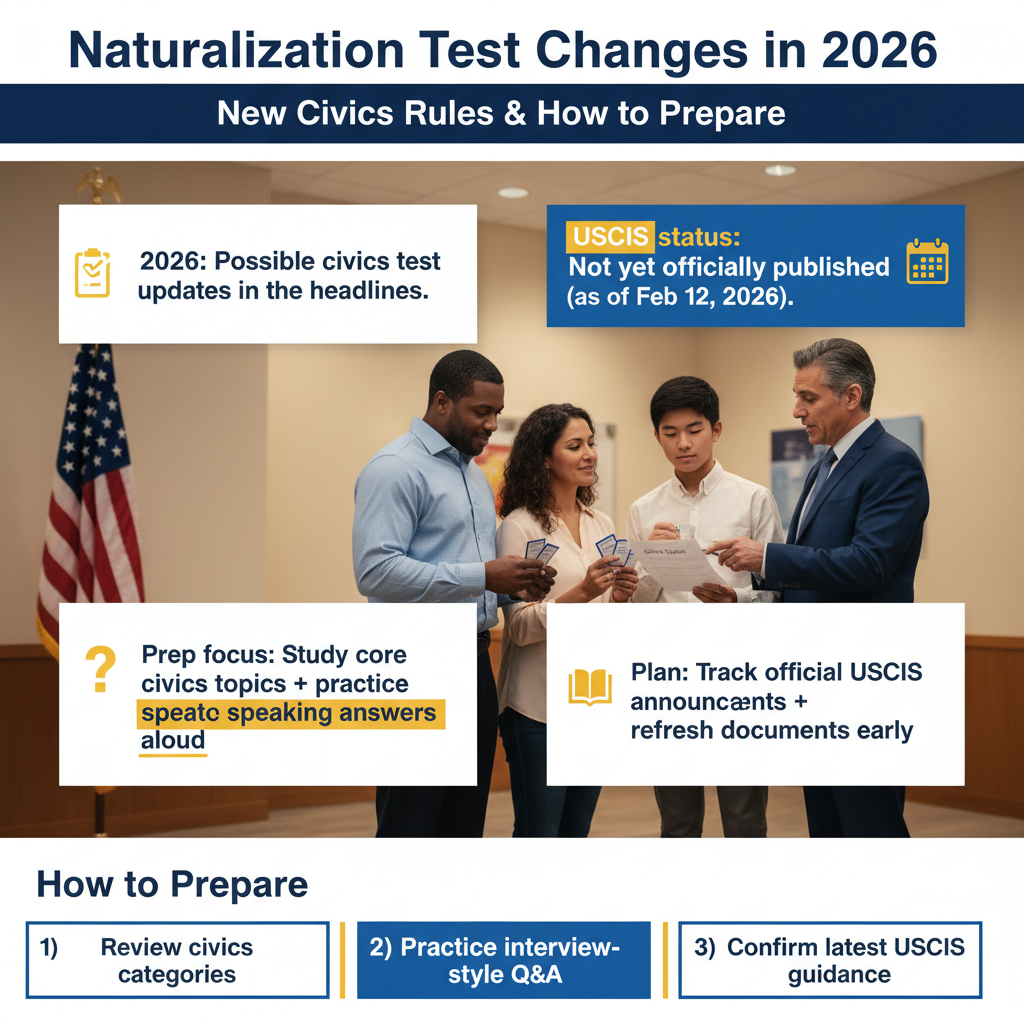
Immigration news moves fast, and many families are seeing headlines about possible updates to the U.S. citizenship exam. Here is the news reference that prompted this article: Naturalization Test Changes Coming in 2026 (Citizenship)
Important: As of today (2026-02-12), USCIS has not published a single, definitive “final rule” page in this news link itself. This guide explains how the naturalization test works under current law, what kinds of changes USCIS has made in the past, what “new civics questions and requirements” typically means in practice, and how to prepare so you are not caught off guard if USCIS rolls out a revised test version in 2026.
Need Help? Our Orlando immigration team is ready to assist. Call +1 786-791-3106 for a free consultation, or message us online. Se Habla Español.
What This News Means for Immigrants in Orlando and Across Florida
Why this news is showing up now
Naturalization policy often becomes “trending” when USCIS signals that it may revise the civics portion of the naturalization test, update study materials, or change how officers administer the interview. Historically, civics test updates happen when USCIS:
- Revises the official question bank (for example, adding, removing, or rewording questions).
- Changes the format (how many questions asked, how many must be correct).
- Updates guidance for interview procedures, accommodations, or English exemptions.
- Responds to litigation, policy shifts, or a new administration’s priorities.
If “new civics test questions and requirements” are being discussed for 2026, the practical takeaway is this: your test version may depend on when you file and when USCIS schedules your interview. That timing issue is one of the biggest stress points we see for applicants in Orange County and along the I-4 corridor who are already studying.
Reminder: USCIS typically announces test changes with updated study resources and a transition period. When transition rules apply, the “edition” of the test can be tied to the Form N-400 filing date or the interview date—so planning matters.
How it can affect Florida residents
For Central Florida residents, test changes can affect:
- Study strategy: You may need to study a different question set than friends or family who applied earlier.
- Interview readiness: Officers at the Orlando USCIS Field Office will follow the guidance in effect at the time of interview.
- Timing decisions: Some people consider filing sooner to try to test under the current version, while others wait to feel more prepared.
- English and civics accommodations: Applicants who qualify for age/time exemptions or medical disability exceptions may still be eligible regardless of question updates.
If your case is in Orlando (or you live anywhere in the I-4 corridor), your interview scheduling depends on USCIS workload and local capacity. Always check official updates at the USCIS official website and monitor estimates at USCIS Processing Times.
What Naturalization Test Changes Coming in 2026 Is (and Why It Matters)
A plain-English definition
“Naturalization test changes” usually refers to USCIS updating the civics test (U.S. history and government questions) and/or the related interview procedures. The naturalization test has two main parts:
- English test: speaking (evaluated during the interview), reading, and writing.
- Civics test: oral questions about U.S. government and history, asked by a USCIS officer.
The civics test is not a school exam—there is no essay, and you do not need to memorize long explanations. But you do need to understand the official answers and respond clearly. If USCIS updates the question bank in 2026, applicants may need to learn new or reworded answers, and some may face a different passing threshold depending on the final policy.
Key terms you need to know
- Naturalization: The legal process for a lawful permanent resident (green card holder) to become a U.S. citizen (generally via Form N-400).
- Civics test: The portion of the naturalization interview where the officer asks U.S. history/government questions from an official list.
- English exemptions (50/20, 55/15, 65/20): Rules that may allow certain applicants to take the civics test in their preferred language (with an interpreter) if they meet age and permanent residence duration requirements.
- Medical disability exception: A possible exception to English/civics requirements using Form N-648 when properly supported by a medical professional.
- Good Moral Character (GMC): A legal requirement that looks at conduct during the statutory period (typically 5 years, or 3 years for certain spouses of U.S. citizens) and sometimes beyond.
- Continuous residence / physical presence: Requirements about maintaining residence in the U.S. and not taking disqualifying trips abroad.
- 90-day window: Many applicants can file up to 90-day window before completing the required 3- or 5-year permanent residence period (if otherwise eligible).
Warning: The civics test is only one part of naturalization. Many denials come from eligibility issues (travel, taxes, selective service, criminal history, prior immigration filings), not from failing civics questions.
Current Immigration Law: The Foundation
Even if USCIS changes the civics test question set in 2026, the legal basis for naturalization largely comes from federal statutes and regulations—not from the question bank itself.
Federal requirements
The core naturalization framework is primarily found in:
- Immigration and Nationality Act (INA) § 316 (general naturalization requirements) and related provisions.
- INA § 319 (naturalization for certain spouses of U.S. citizens).
- 8 C.F.R. Part 316 (regulations on naturalization, including testing and eligibility).
- INA § 312 (English and civics requirements, including exemptions and accommodations).
In most cases, to naturalize you must:
- Be at least 18 years old.
- Be a lawful permanent resident (LPR) for the required period (usually 5 years, or 3 years if eligible through marriage to a U.S. citizen under certain conditions).
- Show continuous residence and physical presence.
- Demonstrate Good Moral Character.
- Pass the English and civics tests (unless exempt or granted an exception).
- Take the Oath of Allegiance.
The application is filed on Form N-400. Official instructions and updates are on the USCIS official website and the USCIS Forms page.
Important: People often confuse naturalization with family-based green card processes such as Form I-130 (family petition) and Form I-485 (Adjustment of Status). Those are different processes, but past filings can affect your naturalization case (for example, if there were prior misrepresentations, abandonment issues, or unresolved tax/support obligations).
If you are waiting on a family-based case, concepts like a Priority Date matter for immigrant visa availability—but they are usually not part of the naturalization test itself. Still, your overall immigration history can be reviewed in the N-400 interview.
Florida-specific considerations
Naturalization is federal, so Florida does not set separate citizenship rules. However, Florida residents often face practical, local issues that matter:
- Local interview scheduling: The Orlando USCIS Field Office workload can affect how quickly you receive your biometrics and interview.
- Name changes: If you want a legal name change through naturalization, local oath ceremony scheduling and court coordination can affect timing.
- Travel patterns: Florida residents frequently travel internationally (Caribbean, Latin America, Europe). Long trips can impact continuous residence and physical presence.
- Hurricane/emergency disruptions: Disasters can cause rescheduling; keep copies of all notices and update your address promptly.
If your case is in Orlando, plan for travel and work commitments around interview windows. Use USCIS Processing Times as a baseline, but remember that local realities can differ.
Need Help? Our Orlando immigration team is ready to assist. Call +1 786-791-3106 for a free consultation, or message us online. Se Habla Español.
How to Prepare for Naturalization Test Changes: A Complete Step-by-Step Guide
The safest approach when a new test version may be introduced is to prepare in a way that works under either version: build strong civics knowledge, confirm eligibility, and document your case so the interview is smooth.
1) Confirm you are eligible to file (and choose the right filing date)
Before you worry about civics questions, confirm eligibility and timing. Many applicants qualify to file within the 90-day window before they complete the 3- or 5-year permanent residence requirement.
- Check continuous residence: Long trips can break it.
- Check physical presence: Total days in the U.S. during the statutory period.
- Check marital eligibility (if applying under 3-year rule): You generally must be living in marital union with the U.S. citizen spouse and the spouse must have been a citizen for the required period.
- Check criminal and traffic history: Even arrests without conviction matter.
Documents to gather (Step 1):
- Front/back copy of your green card.
- All passports (current and expired) covering the statutory period.
- Travel records (dates of every trip).
- Marriage certificate/divorce decrees (if applicable).
- Court dispositions for any arrest/citation (certified copies when available).
- Selective Service registration proof (if applicable).
- Tax transcripts (recommended).
Reminder: If you have any risk factors (prior removal proceedings, misrepresentation concerns, long absences, unpaid taxes, or criminal history), speak with counsel before filing. If removal proceedings are involved, EOIR may be relevant: Executive Office for Immigration Review.
2) File the correct application and track your case
Most applicants file Form N-400 online or by mail. USCIS will issue a receipt notice and later a biometrics appointment (sometimes reused).
Documents to gather (Step 2):
- Completed Form N-400 (and any necessary supplements).
- Payment (or fee waiver request, if eligible).
- Two passport-style photos (only if required for your filing method/situation).
- Legal name change documents (if any).
- If requesting disability exception: Form N-648 with supporting medical documentation.
Use official resources for forms and instructions: USCIS Forms.
Important: Keep a complete PDF copy of everything you submit. If USCIS later asks questions at the interview, your own copy is your best protection against mistakes and memory gaps.
3) Build a study plan that works even if the civics test changes
If USCIS changes the question bank in 2026, the best preparation is a flexible study plan:
- Start with the current official civics questions and answers from USCIS.
- Focus on understanding concepts (Constitution, branches of government, rights/responsibilities), not just memorization.
- Practice speaking answers out loud, clearly and confidently.
- Study in short sessions (15–30 minutes) daily instead of cramming.
Documents/materials to gather (Step 3):
- USCIS official civics study materials (printouts or saved PDFs from USCIS official website).
- Notebook with your weak topics.
- Flashcards (paper or app).
- Audio practice recordings (your phone is fine).
Warning: Avoid relying only on unofficial YouTube lists or outdated apps. If the 2026 update is real, unofficial sources are often the last to update and the first to contain errors.
4) Prepare for the English test and the interview “conversation”
The officer evaluates English speaking during the entire interview, not only during reading/writing. Even applicants with strong civics knowledge can struggle if they don’t practice real interview-style questions.
Documents/materials to gather (Step 4):
- Practice reading sentences (from USCIS examples).
- Practice writing sentences (dictation practice).
- List of “yes/no” eligibility questions and your answers (especially travel, marital history, taxes, and any arrests).
- Interpreter arrangements if you qualify for an age/time exemption (and USCIS rules allow it for your situation).
For Central Florida residents, local community ESL programs can help, but make sure your practice matches USCIS-style phrasing and pacing.
5) Organize your evidence packet for interview day (even if you filed online)
USCIS may not ask for every document, but you should bring a well-organized folder. This is especially important if there are any complexities (name changes, divorce, child support, prior citations, long trips).
Documents to gather (Step 5):
- Interview notice (original) and a copy.
- Green card (original).
- State ID/driver’s license.
- All passports and travel documents.
- Certified court dispositions (if any).
- Tax transcripts for the last 3–5 years (recommended).
- Marriage certificate and proof of ongoing marital union (if filing under 3-year rule).
- Selective Service proof (if applicable).
- Any USCIS correspondence (RFEs, prior approvals).
If your case is in Orlando, plan your route and parking early. The Orlando USCIS Field Office can have security screening lines; arrive early and bring only what you need.
6) Attend the interview, take the civics/English tests, and follow up correctly
At the interview, the officer will review your Form N-400, confirm your identity, test English (unless exempt), and administer the civics test. If you pass and are otherwise eligible, you may receive:
- A same-day oath ceremony notice (sometimes), or
- A later oath ceremony scheduling notice, or
- A request for more evidence, or
- A retest appointment if you fail English or civics the first time.
Documents to bring/keep (Step 6):
- Any updated documents since filing (new trips, new address, marital changes).
- Proof of legal name change request (if applicable).
- A written list of corrections to your N-400 (if you notice errors).
Important: If you fail the civics or English test, USCIS typically gives one retest opportunity within a set period. Do not panic—use the time strategically and get legal guidance if there are also eligibility concerns.
Practical Steps You Can Take Today
Whether the 2026 update changes 10 questions or completely reworks the format, the most effective preparation starts now. Use this checklist to stay ready.
- Checklist item #1: Download and save the current USCIS civics study materials from the USCIS official website so you can compare later if USCIS updates them.
- Checklist item #2: Make a travel log for the last 5 years (or 3 years). Include every trip date. This prevents mistakes that can trigger delays.
- Checklist item #3: Request IRS tax transcripts early (especially if you changed jobs or had multiple employers). Tax compliance is a frequent interview topic.
- Checklist item #4: If you have any arrests or citations, request certified court dispositions now. Some Florida counties take time to produce records.
- Checklist item #5: Practice civics answers out loud 10 minutes/day—focus on clarity, not speed.
- Checklist item #6: Review your prior immigration filings (green card process, entries/exits). If you previously filed Form I-130 or Form I-485 (Adjustment of Status), keep copies; inconsistencies can create credibility issues.
- Checklist item #7: Track processing and plan for timelines using USCIS Processing Times.
Timeline expectations (general): Naturalization commonly takes several months to over a year depending on workload, background checks, and local scheduling. For Central Florida residents, interview timing at the Orlando USCIS Field Office can shift seasonally.
Reminder: If you move, update your address with USCIS promptly. Missing a notice can cause serious delays.
Document preparation guidance: Use a simple folder system: (1) identity, (2) residence and travel, (3) family/marriage, (4) taxes and employment, (5) court/police records, (6) prior USCIS notices. This reduces interview stress and helps you answer confidently.
Need Help? Our Orlando immigration team is ready to assist. Call +1 786-791-3106 for a free consultation, or message us online. Se Habla Español.
How Imigrar Helps Immigrants in Orlando
At Imigrar, our mission is “Keep Families Together”. Naturalization is often the final step after years of building a life in the U.S.—and it should feel empowering, not confusing.
We help clients in Orlando, Orange County, and across the I-4 corridor (and we serve clients nationwide) by:
- Confirming eligibility and building a safe filing strategy—especially when there are travel issues, prior immigration complications, or criminal history concerns.
- Preparing and filing Form N-400 with a strong, organized evidentiary record.
- Advising on English/civics exemptions and disability exceptions using Form N-648 when appropriate.
- Preparing you for the interview with mock interview practice and civics coaching.
- Responding to RFEs and helping with retest preparation if needed.
Se Habla Español. If you feel nervous about test changes in 2026, we can help you create a plan tailored to your timeline and your case history.
Call +1 786-791-3106 for a free consultation, or message us online at https://www.imigrar.com/contact.
Frequently Asked Questions
Q: If the civics test changes in 2026, which test version will I take?
A: It depends on the USCIS transition policy (when announced). In past changes, USCIS has sometimes tied the test version to the Form N-400 filing date, while in other situations the interview date mattered. The safest approach is to study the current official materials now and watch for USCIS announcements on the USCIS official website. If your case is in Orlando, your interview date may be months after filing, so planning for both possibilities can reduce risk.
Q: Will a new civics test change my eligibility for citizenship?
A: Usually no. Test questions affect how you demonstrate knowledge, but eligibility is based on federal law (INA and 8 C.F.R.). The bigger eligibility issues are continuous residence, physical presence, Good Moral Character, and whether you have disqualifying criminal or immigration history. If you have concerns, speak with counsel before filing.
Q: Can test changes affect my green card or immigration status?
A: Filing Form N-400 does not automatically put your green card at risk. However, USCIS can review your full immigration history during naturalization. If there were problems in earlier filings—like inconsistencies in a prior Form I-130 or Form I-485 (Adjustment of Status)—USCIS may ask questions. In rare cases, serious fraud or removability issues can trigger enforcement concerns. Get legal advice if you suspect any past issues.
Q: How long does the naturalization process take in Florida?
A: Timelines vary by workload and case complexity. Many cases take several months to over a year. For Central Florida residents, scheduling at the Orlando USCIS Field Office can affect interview dates. Check estimates at USCIS Processing Times, and remember that requests for evidence, name change requests, or prior records checks can extend the timeline.
Q: What documents should I bring to the naturalization interview?
A: Bring your green card, government ID, all passports, your interview notice, and documents supporting anything “yes” in your N-400 history (marriage/divorce records, court dispositions, tax transcripts, selective service proof). If you are applying under the 3-year marriage rule, bring proof of marital union. If you moved, bring proof of your current address. If your case is in Orlando, arrive early and keep your documents organized to reduce stress.
Q: How much does it cost to apply for citizenship?
A: USCIS filing fees can change, so confirm the current amount directly on the USCIS Forms and USCIS official website pages for Form N-400. Some applicants may qualify for a fee waiver or reduced fee depending on USCIS rules. Also budget for document costs (certified dispositions, translations) and optional legal representation.
Q: What happens if I fail the civics test or my application is denied?
A: If you fail the English or civics test at the first interview, USCIS generally provides one retest opportunity. If denied for eligibility reasons, you may have options such as filing an administrative appeal (Form N-336) or reapplying later, depending on the reason. Warning: If denial is based on serious issues (criminal grounds, fraud, abandonment of residence), you should speak with an attorney immediately before taking next steps—especially if there is any risk of referral to immigration court. For immigration court information, see Executive Office for Immigration Review.
Q: I’m over 50/55/65—do I still need to take the English test if questions change?
A: If you qualify under the age/time rules (commonly called 50/20, 55/15, or 65/20), you may be exempt from the English requirement and may take the civics test in your preferred language with an interpreter, following USCIS rules. A revised question set in 2026 would not typically remove statutory exemptions, but it could change which civics questions apply. Confirm using USCIS guidance and get individualized advice.
Common Mistakes (and How to Avoid Them)
Mistake #1: Studying only unofficial or outdated civics lists
When a change is rumored, outdated lists spread quickly. Avoid this by downloading study materials directly from the USCIS official website. If USCIS publishes a new 2026 question bank, switch immediately and verify you are using the correct test version.
Mistake #2: Filing without checking travel, taxes, or court records
Many denials are not about civics at all. Applicants sometimes file within the 90-day window but forget that long trips may have broken continuous residence. Others have unresolved tax filing issues or cannot obtain court dispositions. Fix these issues before filing whenever possible.
Mistake #3: Assuming naturalization is “just a test” and ignoring prior immigration history
USCIS can review your entire immigration record. If there were inconsistencies in prior filings like Form I-130, Form I-485 (Adjustment of Status), or other applications, the officer may ask detailed questions. If you are unsure, consult an attorney to avoid surprises.
Reminder: While this article focuses on civics test changes, your safest path is a complete strategy: eligibility + documentation + interview preparation.
Need Help? Our Orlando immigration team is ready to assist. Call +1 786-791-3106 for a free consultation, or message us online. Se Habla Español.
Additional official resources (recommended)
For readers who want to follow official updates and understand how immigration agencies interact, these government sources are reliable starting points:
- USCIS official website
- USCIS Processing Times
- USCIS Forms
- U.S. Department of State (useful if you are dealing with passports, consular processing, or derivative citizenship questions)
- Executive Office for Immigration Review (immigration court information)
Closing: Prepare now so test changes don’t derail your citizenship goals
News about “Naturalization Test Changes Coming in 2026” can feel unsettling—especially if you are already studying. The most reliable strategy is to (1) confirm eligibility, (2) file correctly, (3) study using USCIS materials, and (4) prepare for the interview as a whole, not just the civics questions.
If your case is in Orlando, if you live in Orange County, or if you commute along the I-4 corridor and need a plan that fits your schedule, Imigrar can help you move forward with confidence.
Need help with your naturalization case? Call +1 786-791-3106 for a free consultation or message us online: https://www.imigrar.com/contact. Se Habla Español.


