

The reporting that sparked this guide
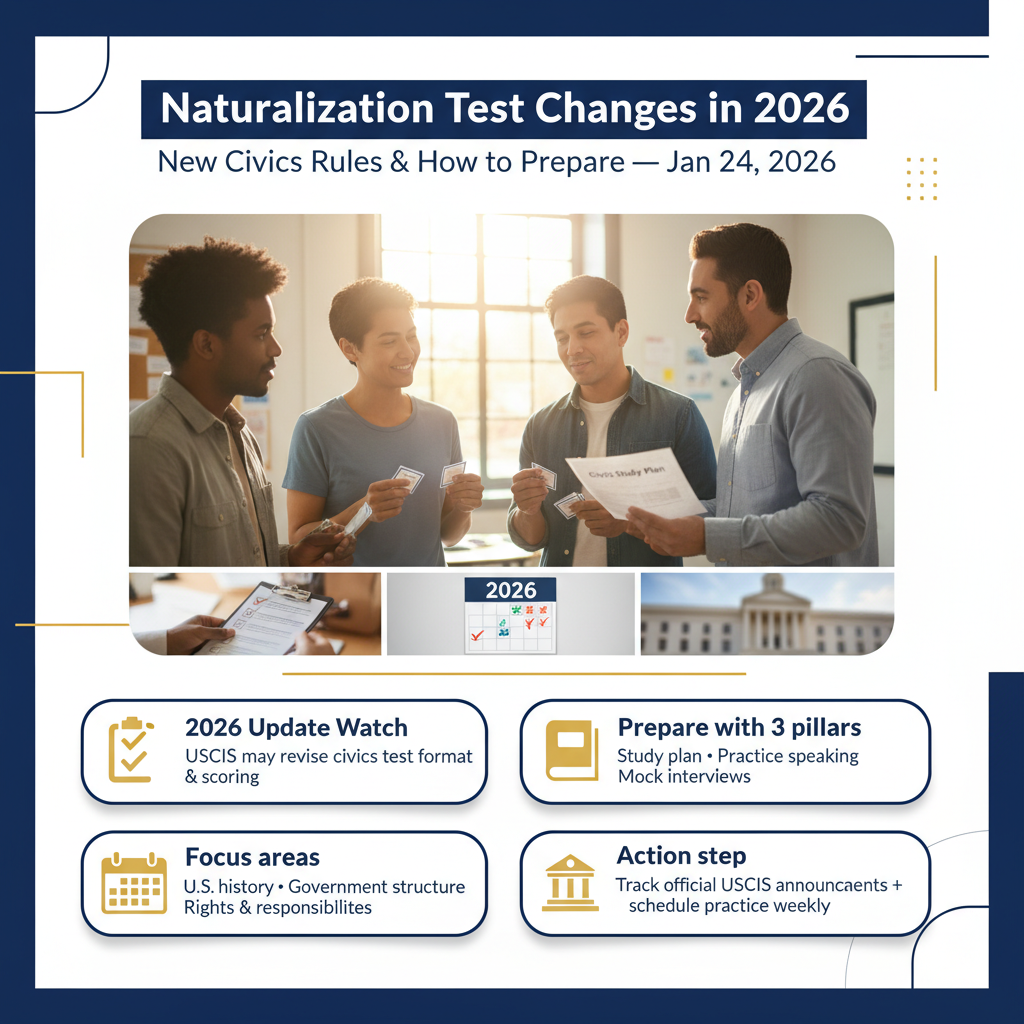
Immigration news moves fast, and naturalization policy updates can have real, immediate consequences for families preparing for U.S. citizenship. The reporting that prompted this guide is: Naturalization Test Changes Coming in 2026 (Citizenship).
Reminder: As of today (2026-01-24), USCIS has not universally implemented a single “2026 test” across all applicants in a way that is publicly standardized in one announcement. What we are seeing in the news cycle is increased attention to potential updates—such as new civics questions, revised study materials, and modified testing requirements—based on prior USCIS practice of periodically updating the civics test and the agency’s authority to change test content and administration.
This article explains how the civics test works under current law, what “changes” typically look like when USCIS updates the test, how to prepare if new questions are introduced, and what to do if your interview is scheduled near a transition period.
Need Help? Our Orlando immigration team is ready to assist. Call +1 786-791-3106 for a free consultation, or message us online. Se Habla Español.
What This News Means for Immigrants in Orlando and Across Florida
Why this news is showing up now
Naturalization testing “change” stories tend to trend for three reasons:
- USCIS periodically updates civics content (question banks, study guides, and administration rules) to reflect civic knowledge priorities and current government structure.
- Transition windows create confusion: when a new test is introduced, USCIS often sets a “use this test if you filed on/after X date” rule. People with interviews scheduled around that line worry about which version applies.
- Election-cycle and civic education attention: public interest rises when civic knowledge is in the spotlight, and media outlets amplify policy discussions about civics requirements.
Important: Historically, when USCIS changes the civics test, the biggest practical issue is not “harder vs. easier”—it’s which test version applies to your filing date, what materials you should study, and whether you qualify for an exception (age/time as an LPR, medical disability, etc.).
How it can affect Florida residents
For Central Florida residents—especially along the I-4 corridor (Orlando, Kissimmee, Sanford, Lakeland, and Tampa-area commuters)—naturalization demand can surge when applicants believe a new test is coming. That can affect:
- Interview scheduling at the Orlando USCIS Field Office (appointment availability and rescheduling delays).
- Study strategy (old question bank vs. new question bank).
- Retest planning if you do not pass English/civics the first time.
If your case is in Orlando, the key is to prepare for your interview based on your N-400 filing date, any USCIS transition guidance, and your eligibility for accommodations or exemptions.
What Naturalization Test Changes Coming in 2026 Is (and Why It Matters)
A plain-English definition
“Naturalization test changes” usually refers to USCIS updating one or more of the following for people applying for U.S. citizenship through naturalization:
- The civics test question bank (the list of possible questions the officer may ask).
- The test format (how many questions asked, how many must be correct).
- The study materials and official guidance (flashcards, PDFs, videos).
- How the English test (reading/writing/speaking) is administered.
- Rules around retests and documentation for accommodations.
These changes matter because your naturalization interview is a single event with high stakes: it determines whether you become a U.S. citizen, whether you must return for a second interview (retest), or whether USCIS may deny the application if eligibility issues exist.
Key terms you need to know
- N-400: The Application for Naturalization (the main USCIS form for citizenship).
- Civics test: Oral questions about U.S. history and government asked during the naturalization interview.
- English test: Speaking (evaluated throughout), plus reading and writing components unless exempt.
- Age/time exceptions: Certain applicants may take the civics test in their preferred language if they meet age + years as a lawful permanent resident thresholds.
- Medical disability exception: If approved, may waive English and/or civics using Form N-648 (Medical Certification for Disability Exceptions).
- RFE: Request for Evidence—USCIS asks for more documents before deciding.
- Notice to Appear (NTA): In some cases, USCIS can refer a person to removal proceedings if serious issues arise.
Warning: Naturalization is not only a test. USCIS also reviews good moral character, continuous residence, physical presence, selective service registration (when applicable), taxes, and criminal/immigration history.
Current Immigration Law: The Foundation
Naturalization is governed primarily by the Immigration and Nationality Act (INA) and implementing regulations. Key legal authorities include:
- INA § 312 (8 U.S.C. § 1423): English language and civics requirements (and exceptions).
- INA § 316 (8 U.S.C. § 1427): General naturalization requirements (residence, physical presence, good moral character).
- INA § 319 (8 U.S.C. § 1430): Naturalization through marriage to a U.S. citizen (3-year rule).
- 8 C.F.R. Part 312: Regulations on the English and civics requirements.
- 8 C.F.R. Part 316: General naturalization regulations.
Federal requirements
Under current federal rules, most applicants must:
- File Form N-400 and attend biometrics (if required) and an in-person interview.
- Demonstrate continuous residence and physical presence (typically 5 years as an LPR, or 3 years if married to and living with a U.S. citizen, with additional conditions).
- Show good moral character during the statutory period (and sometimes beyond).
- Pass an English test and a civics test unless an exception/waiver applies.
- Take the Oath of Allegiance to become a U.S. citizen.
Official guidance and updates should always be verified on the USCIS official website, including the civics test resources and policy manual.
You can also check: USCIS Processing Times and download forms from USCIS Forms.
Florida-specific considerations
Immigration law is federal, so Florida does not set the naturalization test. However, Florida residents may face practical, local issues:
- Appointment logistics at the Orlando USCIS Field Office (parking, arrival time, security screening, rescheduling consequences).
- Name change requests: If you request a legal name change, your oath may be scheduled in a judicial ceremony, which can affect timing.
- Travel patterns: For Central Florida residents who frequently travel internationally (or cruise from Port Canaveral), tracking trips for physical presence/residence is crucial.
If your case is in Orlando or Orange County, plan ahead for interview day traffic on the I-4 corridor and build buffer time. Missing an interview can significantly delay your case.
Reminder: While this article focuses on naturalization testing, many readers are also navigating family immigration. Terms like Adjustment of Status, Priority Date, Form I-130, and Form I-485 matter for getting a green card before you can apply for citizenship. Those are separate processes, but they often appear in a person’s immigration timeline.
Need Help? Our Orlando immigration team is ready to assist. Call +1 786-791-3106 for a free consultation, or message us online. Se Habla Español.
How to Prepare for the 2026 Naturalization Test Update: A Complete Step-by-Step Guide
Below is a practical, interview-focused roadmap that works whether USCIS keeps the current civics format or introduces new questions in 2026. The goal is to make sure you are ready for whichever version applies to your filing date and interview date.
1) Confirm which civics test version applies to you
USCIS typically ties test version eligibility to the date you file Form N-400 (and sometimes to when your interview is scheduled). If USCIS announces a 2026 update, they usually publish transition rules and study materials.
- Check the civics test page and policy updates on the USCIS official website.
- Save a PDF/screenshot of the USCIS page that states the applicable test version for your filing date.
- If you refile after a denial, your new filing date may change which test applies.
Documents to gather for this step:
- Your Form N-400 receipt notice (Form I-797C) showing the received date
- Any USCIS interview notice(s)
- Any USCIS correspondence about testing or interview procedures
2) Build your eligibility “foundation” before you study
Applicants sometimes focus so heavily on civics questions that they overlook eligibility issues that can derail the case. Before you invest weeks studying, confirm you meet the core requirements under INA § 316 or INA § 319.
Documents to gather for this step:
- Front/back copy of your green card
- All passports (current and expired) covering the statutory period
- Travel history list (dates out of the U.S.)
- Tax transcripts (recommended) and/or filed returns
- Marriage certificate/divorce decrees (if applying under the 3-year rule)
- Selective Service proof (if applicable)
- Certified court dispositions for any arrests/citations
Important: Even minor criminal issues, unpaid taxes, or long trips abroad can change strategy. If there are concerns, talk to counsel before the interview—especially if your case is in Orlando and the interview is coming up quickly.
3) Study using USCIS materials—and prepare for “new question bank” scenarios
If new civics questions are introduced in 2026, USCIS usually publishes an updated question bank and study resources. Your safest approach is:
- Start with the official question bank on the USCIS official website.
- Practice orally (the civics test is typically spoken Q&A).
- Use spaced repetition (short daily sessions outperform long weekly cram sessions).
Documents/materials to gather for this step:
- USCIS civics questions PDF/flashcards (official)
- Notebook with your “missed questions” list
- Any interpreter plan (only if you qualify for an age/time exception)
- Medical documentation draft (only if pursuing Form N-648)
Reminder: If you qualify for an age/time exception, you may be allowed to take the civics test in your language with an interpreter. The civics questions may still come from the same bank, but your testing method changes.
4) Prepare your interview packet like a “mini-audit”
The interview is where USCIS verifies your application answers, identity, and eligibility. The best practice is to bring a well-organized packet that matches your N-400.
Documents to gather for this step:
- Interview notice (original)
- Green card (original)
- State ID/driver’s license
- All passports and travel documents
- Evidence of marital union (if applying under 3-year rule): joint lease/mortgage, bank statements, insurance, children’s birth certificates
- Tax transcripts (IRS) for the statutory period
- Proof of address history (leases, utility bills) if needed
- Certified court dispositions for any incidents
Warning: Do not guess at dates or facts in the interview. If you don’t remember, say so and offer documentation. Inconsistencies can create delays or credibility concerns.
5) Understand the English/civics testing flow and retest rules
Typically, USCIS evaluates speaking throughout the interview, then administers reading/writing and civics. If you fail English or civics, USCIS often schedules a second interview (a retest) within a set window.
Important: Retests are time-sensitive. Many applicants hear “you get a second chance” and relax. But missing the retest or showing up unprepared can lead to denial.
Documents/materials to gather for this step:
- Your study plan calendar
- Any proof supporting an exemption/accommodation request
- Updated N-400 corrections list (changes since filing: trips, address, marital status)
6) Plan for oath scheduling—and timing around travel and deadlines
After approval, you must take the oath to become a citizen. Timing varies by field office and whether you requested a name change.
- If you have urgent travel, consider timing your N-400 filing and interview carefully.
- Do not apply for a U.S. passport until after the oath ceremony.
- After naturalization, update SSA records and consider voter registration where appropriate.
Documents to gather for this step:
- All travel plans for the next 3–6 months
- Any court name change paperwork (if applicable)
- Your permanent resident card (you will surrender it at oath)
7) If you have complications, get legal screening before the interview
Naturalization can expose issues that were never addressed in earlier filings—especially if there were prior immigration petitions such as Form I-130 or Form I-485 through Adjustment of Status, or if there were extended trips abroad affecting residence.
Documents to gather for this step:
- Prior USCIS filings and approval notices (I-130/I-485/I-751, etc.)
- Any prior immigration court documents (if applicable)
- FOIA records if there is uncertainty about past entries or proceedings
You can reference immigration court information through the Executive Office for Immigration Review if you suspect prior proceedings.
Need Help? Our Orlando immigration team is ready to assist. Call +1 786-791-3106 for a free consultation, or message us online. Se Habla Español.
Practical Steps You Can Take Today
Whether the 2026 update ends up being a new question bank, a revised format, or a clarification of existing rules, you can reduce stress now with a simple plan.
Actionable checklist (do these this week)
- Download the latest civics study materials directly from the USCIS official website and confirm the version/date.
- Create a travel log for the last 5 years (or 3 years if applying under the marriage rule). Include every trip, even short weekend travel.
- Order IRS tax transcripts for the statutory period (recommended over self-prepared copies).
- Collect certified dispositions for any arrest/citation—even if charges were dropped.
- Set a study schedule: 20–30 minutes/day, 5 days/week, with one weekly mock interview.
- If you may qualify for an exception, schedule a consultation to evaluate age/time rules or Form N-648.
Document preparation guidance
- Use one binder or folder with tabs: Identity, Residence, Taxes, Marriage/Family, Travel, Legal Issues, Updated Changes.
- Bring originals and copies. Originals are for review; copies are for USCIS if requested.
- Write a one-page “changes since filing” sheet: new trips, new address, job changes, marital status changes.
Timeline expectations (general)
Processing times vary, and they can change quickly. Always check: USCIS Processing Times.
- Many applicants complete the process in several months to over a year, depending on field office workload.
- Transition periods (when a new civics test is introduced) can create appointment surges.
Reminder: If you are still waiting for a green card through a family petition (for example, Form I-130 with a Priority Date), naturalization comes later. If you are pursuing Adjustment of Status with Form I-485, focus first on maintaining eligibility and lawful status where required.
Important: Some immigration benefits have strict deadlines like 180 days or a 90-day window (for example, certain renewal or filing windows in other contexts). Naturalization itself is not typically framed as a 180-day/90-day window benefit, but your broader immigration history may include deadlines—track them carefully and ask counsel if any apply to your situation.
How Imigrar Helps Immigrants in Orlando
At Imigrar, our mission is simple: Keep Families Together. We help clients in Orlando, across Central Florida, and nationwide prepare strong naturalization cases—especially when news about test changes creates uncertainty.
Our team can help you:
- Confirm eligibility under the 5-year or 3-year rules and identify red flags early.
- Prepare and file Form N-400 with a clean, consistent record.
- Create a personalized study plan for the civics/English test—tailored to your background and any exceptions.
- Prepare for the interview with mock questions and document organization.
- Respond to RFEs and represent you through complications when appropriate.
We offer a free consultation to help you understand your options and next steps. Se Habla Español.
Need Help? Our Orlando immigration team is ready to assist. Call +1 786-791-3106 for a free consultation, or message us online. Se Habla Español.
Frequently Asked Questions
Q: Will everyone take a new naturalization civics test in 2026?
A: Not necessarily. When USCIS updates the civics test, it often applies the new version based on a specific rule (commonly the Form N-400 filing date). If your application was filed before the effective date, you may be tested under the prior version. Always confirm on the USCIS official website and keep a copy of the guidance for your records.
Q: I live in Orlando—does the Orlando USCIS Field Office use different questions?
A: No. The civics test is a federal USCIS standard. The Orlando office follows USCIS rules like any other field office. What can differ locally is scheduling speed, ceremony availability, and how quickly interviews are rescheduled. If your case is in Orlando, plan carefully around traffic and arrive early to avoid a missed appointment.
Q: Can naturalization test changes affect my immigration status or green card?
A: A test update by itself does not change your status. But the naturalization process involves a full eligibility review. If USCIS discovers an issue (criminal history, fraud/misrepresentation, abandonment of residence, unpaid taxes), it can delay or deny the N-400 and—rarely—trigger enforcement actions. If you have concerns, speak with counsel before the interview.
Q: What documents should I bring to the naturalization interview if new requirements are introduced?
A: Bring the standard originals (green card, passports, state ID, interview notice) plus any documents that support your N-400 answers: tax transcripts, marriage/divorce documents, selective service proof, and certified dispositions for any arrests/citations. If USCIS updates test procedures, it typically updates guidance rather than requiring brand-new categories of documents, but you should always review your interview notice and USCIS instructions.
Q: How long does the naturalization process take in Florida, and will a new test slow it down?
A: Timelines vary by year and workload. A new test can cause a surge of filings and rescheduling, which may indirectly affect processing. Check current estimates using USCIS Processing Times. For Central Florida residents, local appointment availability at the Orlando field office is often the biggest practical variable.
Q: How much does it cost to apply for U.S. citizenship, and will the fee change with the new test?
A: USCIS fees can change, but a civics test update does not automatically change the filing fee. The cost to file Form N-400 depends on the current USCIS fee schedule at the time you file and whether you qualify for a fee waiver or reduction. Always verify fees directly on the USCIS official website or through USCIS Forms instructions.
Q: What happens if I fail the civics or English test because the questions changed?
A: In many cases, USCIS will schedule a second interview (retest) for the portion you failed. Use the time between interviews strategically: focus on the official question bank, practice speaking answers out loud, and consider a mock interview. If you fail again, USCIS can deny the N-400, but you may be able to reapply later—depending on why you failed and whether there are other eligibility issues.
Q: If my N-400 is denied, will I be deported?
A: A denial does not automatically mean removal. Many denials are for failure to meet eligibility requirements or failure to pass tests. However, if USCIS finds serious issues (fraud, certain crimes, abandonment of residence), it can have broader consequences and may lead to referral to enforcement or immigration court. If you have any risk factors, consult an attorney before filing or before the interview. Immigration court information is administered under the Executive Office for Immigration Review.
Common Mistakes (and How to Avoid Them)
Mistake #1: Studying the wrong test version
When test changes trend in the news, applicants often use outdated YouTube videos or old PDFs. Avoid this by downloading materials only from the USCIS official website and confirming which version applies to your filing date.
Mistake #2: Treating the interview like “just a civics quiz”
The officer reviews your entire N-400 for consistency and eligibility. Prepare your residence/travel history, taxes, and any legal issues. If something is complicated—especially arrests or long trips—get legal advice before the interview.
Mistake #3: Missing the interview or retest appointment
Orlando-area traffic and scheduling conflicts happen. But missing an appointment can delay your case or lead to denial. Build extra time for I-4 corridor congestion and follow rescheduling instructions exactly if you truly cannot attend.
Additional official resources (bookmark these)
- USCIS official website
- USCIS Forms
- USCIS Processing Times
- U.S. Department of State (passport and travel information after naturalization)
- Executive Office for Immigration Review (immigration court information)
Reminder: After you naturalize, you can apply for a U.S. passport through the U.S. Department of State. Do not make international travel plans that depend on a U.S. passport until after your oath ceremony and certificate are in hand.
Putting it all together for 2026: a realistic preparation strategy
Here is the most practical way to prepare amid “2026 test change” headlines:
- File correctly (or review your filed N-400) so your eligibility is strong and consistent.
- Verify the applicable test version using USCIS guidance tied to your filing date.
- Study only official materials and practice orally with mock interviews.
- Organize documents like you expect questions—because you should.
- Get legal help early if there are any complications (travel, taxes, prior arrests, prior immigration issues).
For Central Florida residents, the practical edge is planning: keep your calendar flexible around interview/oath scheduling and avoid last-minute document scrambles.

Closing: Get a personalized naturalization plan
Naturalization test updates can feel stressful, but most applicants succeed with the right version of the study materials, a consistent N-400, and strong interview preparation. If your case is in Orlando—or anywhere in Florida—and you want clarity on eligibility, timelines, and how to prepare for potential 2026 civics changes, we can help.
Need Help? Our Orlando immigration team is ready to assist. Call +1 786-791-3106 for a free consultation, or message us online. Se Habla Español.
Imigrar — Orlando, Florida (serving clients nationwide). Keep Families Together. Se Habla Español.


