


The reporting that sparked this guide
The reporting that prompted many of our clients to ask questions about the U.S. citizenship process is here: Naturalization Test Changes Coming in 2026 (Citizenship).
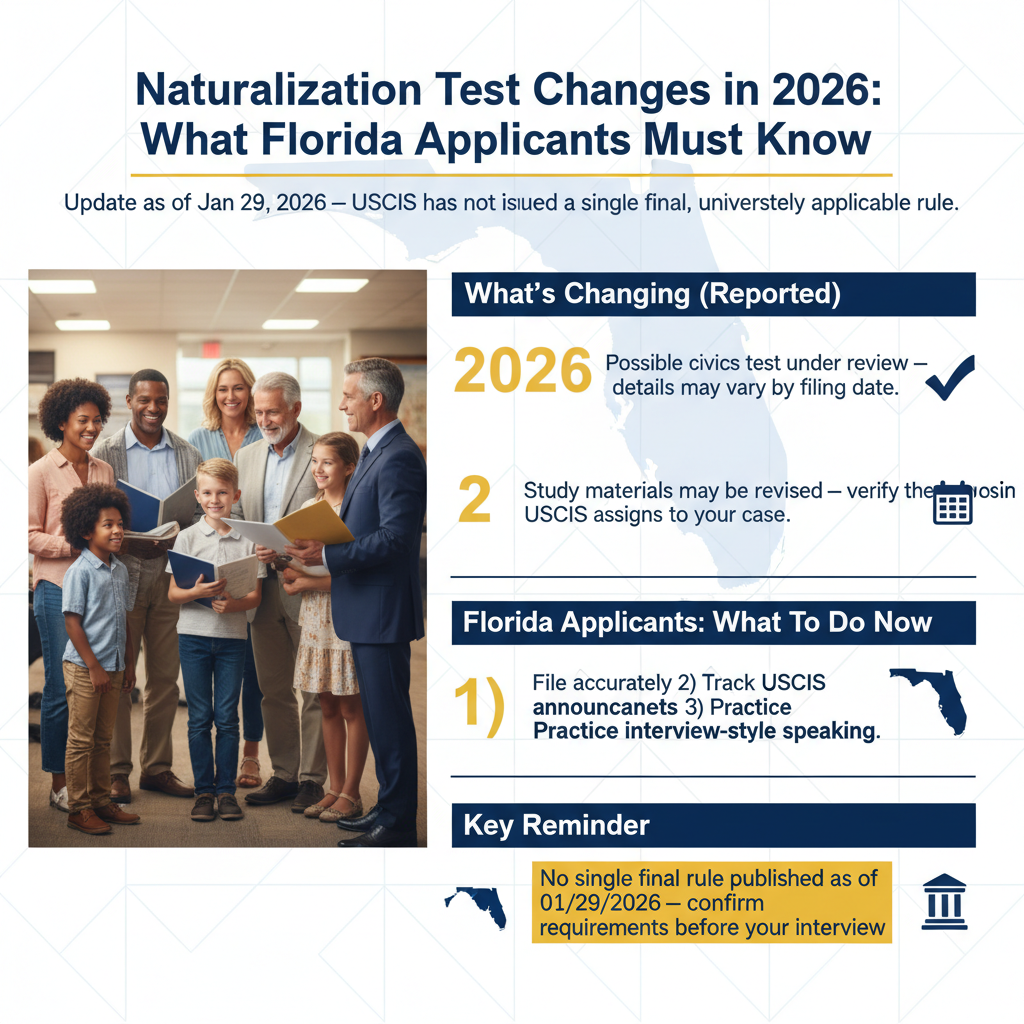
Important: As of today (2026-01-29), USCIS has not published a single, universally applicable “final rule” that definitively replaces the current naturalization civics test for every applicant nationwide. However, USCIS can update the civics test and study materials through policy and operational changes. This guide explains what changes commonly look like, what to watch for, and how to prepare safely so you are not caught off guard.
Need Help? Our Orlando immigration team is ready to assist. Call +1 786-791-3106 for a free consultation, or message us online. Se Habla Español.
What This News Means for Immigrants in Orlando and Across Florida
Why this news is showing up now
“Naturalization test changes” tends to trend when USCIS signals updates to the civics question bank, modifies how questions are asked in interviews, or changes how applicants can demonstrate English and civics knowledge. The U.S. citizenship process is highly standardized, but USCIS periodically revises:
- Which civics topics are emphasized (government structure, constitutional principles, history, civic participation)
- How questions are worded (plain language vs. more technical phrasing)
- What counts as an acceptable answer (synonyms, broader phrasing, or stricter phrasing)
- Study resources (official flashcards, videos, and lesson plans)
A major reason this becomes newsworthy is the potential for a “transition period,” where some applicants are tested under the current version and others under the new version based on filing date, interview date, or a USCIS-announced “effective date.”
Reminder: If you plan to apply soon, the smartest approach is to prepare using the most current USCIS materials while also building flexibility to handle updated phrasing or new question sets.
How it can affect Florida residents
For Central Florida residents, including Orange County and communities along the I-4 corridor (Orlando, Kissimmee, Sanford, Lakeland, and Tampa-area commuters), test changes can affect:
- Preparation strategy (what you study and how you practice speaking)
- Timing decisions (whether to file earlier to stay under the current test, if USCIS announces a cutoff)
- Retest planning if you do not pass the English or civics portion on the first attempt
- Family planning for those pursuing citizenship to petition relatives later (often involving Form I-130 and sometimes Form I-485 for Adjustment of Status)
If your case is in Orlando, the interview is typically scheduled through the local USCIS field office system. The Orlando USCIS Field Office follows national USCIS policy, but appointment availability and processing pace can vary by workload.
You can track general timelines at USCIS Processing Times, but remember that posted times are ranges, not guarantees.
What Naturalization Test Changes Coming in 2026 Is (and Why It Matters)
A plain-English definition
The “naturalization test” is the set of checks USCIS uses during your citizenship interview to confirm you qualify for U.S. citizenship. It typically includes:
- An English test (speaking, reading, and writing)
- A civics test (U.S. history and government questions asked orally)
- A review of your Form N-400 application and your background
“Test changes” generally mean USCIS updates the civics questions, alters the passing rules, or adjusts the way the officer administers the interview. Even small changes can matter because applicants often prepare for months using specific question banks and practice scripts.
Key terms you need to know
- Naturalization: The process of becoming a U.S. citizen after meeting eligibility requirements.
- Form N-400: The USCIS application for naturalization.
- Civics test: Oral questions about U.S. government and history asked at the interview.
- English exceptions: Some applicants may qualify for exemptions or accommodations based on age/time as a permanent resident or medical disability.
- RFE (Request for Evidence): USCIS asking for more documents—this can delay the case.
- Good Moral Character: A legal requirement that looks at criminal history, taxes, child support, honesty, and other conduct during the statutory period.
- Continuous Residence and Physical Presence: Rules about time living in the U.S. and time spent inside the U.S.
- Priority Date: Usually relevant in family/employment immigration; not a naturalization concept, but it matters if citizenship is part of a bigger plan involving Form I-130, Form I-485, and Adjustment of Status.
Warning: Social media often oversimplifies test changes as “harder” or “easier.” In reality, what matters is what USCIS officially publishes and applies on your interview date.
Current Immigration Law: The Foundation
Naturalization is governed primarily by the Immigration and Nationality Act (INA) and implementing regulations. The civics test and English requirements are part of the statutory and regulatory framework, and USCIS administers them through policy guidance and standardized materials.
Federal requirements
Key legal authorities include:
- INA provisions on naturalization eligibility (generally INA §§ 316 and 319, among others)
- Regulations at 8 C.F.R. Part 316 (naturalization examination and requirements)
- USCIS policy guidance published in the USCIS Policy Manual
Core federal requirements typically include:
- Be a lawful permanent resident (green card holder) for the required period (often 5 years; often 3 years if married to and living with a U.S. citizen spouse)
- Meet continuous residence and physical presence rules
- Demonstrate Good Moral Character
- Pass the English and civics tests (unless an exception applies)
- Take the Oath of Allegiance
USCIS is the main agency for naturalization. Official information and updates should be verified at the USCIS official website and the USCIS Policy Manual.
Reminder: Naturalization is separate from family-based green card processes, but many families plan both. For example, a U.S. citizen may file Form I-130 for certain relatives, and eligible relatives in the U.S. may file Form I-485 for Adjustment of Status. Timing can depend on a Priority Date.
Florida-specific considerations
Florida does not set the naturalization test—USCIS does. However, Florida residents should consider:
- Local interview scheduling: Orlando-area applicants may experience different appointment availability than Miami, Tampa, or Jacksonville.
- Name changes: Some applicants request a legal name change through the naturalization process; oath ceremony logistics can differ by location.
- Travel patterns: Frequent trips through Orlando International Airport (MCO) can affect continuous residence/physical presence if travel is lengthy.
For forms and official filing details, use USCIS Forms.
How to Prepare for Naturalization Test Changes: A Complete Step-by-Step Guide
The safest strategy is to prepare to pass under the current requirements while staying ready for updated civics questions and interview practices. Below is a step-by-step plan we use with many clients.
1) Confirm your eligibility and your best filing window
Before you focus on civics questions, confirm you are eligible to file and that filing now won’t create avoidable risk (for example, unresolved taxes, selective service issues, or problematic travel history).
- 90-day window: Many applicants can file up to 90 days before meeting the continuous residence requirement (USCIS allows early filing in certain cases).
- Warning: Filing early does not fix eligibility problems—USCIS can still deny if requirements are not met.
Documents to gather:
- Front/back of green card
- State ID/driver’s license
- Marriage certificate/divorce decrees (if applicable)
- Tax transcripts (often helpful)
- Travel history (dates of departures/returns)
- Any criminal court dispositions (certified, if applicable)
2) Track USCIS announcements and lock in the correct study materials
If USCIS rolls out new civics questions in 2026, it will typically publish updated study resources, and sometimes an effective date. Your job is to study from the correct source and avoid unofficial lists that may be incomplete.
Documents/resources to gather:
- Official civics study materials from USCIS official website
- Your printed Form N-400 draft (so you can practice answering questions clearly)
- A notebook of vocabulary for reading/writing practice
Important: If USCIS announces a transition, your test version may depend on when you file, when you are scheduled, or the date USCIS applies the change. We recommend saving PDFs/screenshots of the USCIS study page you used, in case there is confusion later.
3) Build a civics study plan that can survive a question update
Instead of memorizing only “flashcard answers,” learn the underlying concepts. That way, if USCIS rephrases questions, you can still respond correctly.
Documents/resources to gather:
- Current USCIS civics question set (official)
- List of your local elected officials (may change after elections)
- Practice audio recordings (your own phone recordings are fine)
Study method that works well:
- Week 1–2: Learn government structure (Congress, President, courts)
- Week 3–4: Learn rights/responsibilities, civic participation
- Week 5–6: Learn history themes (founding, wars, movements)
- Weekly: Practice answering aloud under time pressure
4) Prepare for the English test and the N-400 interview questions
Many applicants focus on civics and forget that the officer will also test English (unless exempt) and review your entire Form N-400 line by line. The interview is often where cases get delayed due to missing documents or unclear answers.
Documents to gather:
- Interview folder with originals: green card, passport(s), state ID
- Marriage/divorce documents (if applicable)
- Evidence of selective service registration (if applicable)
- Proof of tax filing/payment plans (if applicable)
- Certified dispositions for any arrests/citations (if applicable)
Reminder: Even if a civics test changes, the N-400 eligibility questions remain critical. A perfect civics score cannot overcome an eligibility problem (for example, a serious criminal issue or failure to meet continuous residence).
5) File Form N-400 correctly and prepare for biometrics and interview timing
Filing accurately reduces delays and increases your chances of a smooth interview. After filing, USCIS typically schedules biometrics (if needed) and later the interview.
Documents to gather before filing:
- Completed Form N-400
- Supporting documents based on your eligibility category
- Payment method for the filing fee or fee waiver request (if eligible)
- Address history and employment history (5 years or 3 years depending on category)
To monitor timeframes, check USCIS Processing Times.
Important: If USCIS announces that the new civics test applies to interviews after a certain date, your filing and scheduling strategy may matter. Do not guess—verify the official USCIS announcement.
6) Attend the interview ready for either the current or updated civics format
On interview day, the officer will confirm your identity, review your application, and administer the English and civics tests as required. If changes roll out, the officer will use the version USCIS instructs them to use.
Documents to bring:
- Interview notice
- Green card and government-issued ID
- All passports and travel documents (current and expired)
- Any updated documents since filing (new marriage, divorce, address change, travel, citations)
If your case is in Orlando, plan extra time for traffic on the I-4 corridor and parking. Late arrival can cause rescheduling and delays.
7) If you don’t pass, use the retest opportunity strategically
If you fail the English or civics portion, USCIS generally provides another chance within a set period. Use that time to focus on weak areas and clarify any eligibility questions raised by the officer.
Documents to gather after an unsuccessful attempt:
- USCIS results sheet noting which parts were not passed
- A study plan targeting missed topics
- Any additional evidence the officer requested (if any)
Warning: If the officer also identified eligibility concerns (not just test performance), you should speak with counsel immediately because the issue may require legal argument or additional records, not just more studying.
Need Help? Our Orlando immigration team is ready to assist. Call +1 786-791-3106 for a free consultation, or message us online. Se Habla Español.
Practical Steps You Can Take Today
Whether USCIS changes the civics questions in 2026 or simply updates phrasing and study tools, you can take steps now that help under any version of the test.
Actionable checklist (do these this week)
- Download and print the latest civics study materials directly from USCIS official website.
- Create a one-page “officials sheet” with your U.S. Senators, U.S. Representative, Florida Governor, and your local mayor—update it if elections change names.
- Practice speaking answers out loud (not silently reading). Record yourself to fix pronunciation.
- Review your travel history and count long trips—continuous residence issues can derail an otherwise strong case.
- Request IRS tax transcripts early if you’ve had filing issues or name mismatches.
- Collect certified court dispositions for any arrests/citations—even if charges were dropped.
Document preparation guidance
Organize your file so you can respond quickly if USCIS asks for clarification. A practical system:
- Identity: green card, passports, state ID
- Family: marriage/divorce records, children’s birth certificates
- Residence & travel: leases/mortgage summaries, trip list
- Taxes: transcripts, payment plans, proof of filing
- Legal: certified dispositions, proof of probation completion
Timeline expectations
Timelines vary, but many naturalization cases follow this general sequence:
- File Form N-400
- Biometrics (if scheduled)
- Interview and tests
- Oath ceremony
Check your local estimates using USCIS Processing Times.
Reminder: If USCIS announces a new test effective date, your “best” timeline could change. Filing earlier may help some applicants, but not if you are not fully eligible.
How Imigrar Helps Immigrants in Orlando
Imigrar is an immigration law firm based in Orlando, Florida, serving clients nationwide. Our mission is to Keep Families Together. Naturalization is more than a test—it is a legal process where small mistakes can create delays or denials.
We help clients by:
- Confirming eligibility and identifying risks before filing
- Preparing and filing Form N-400 with a complete evidence package
- Coaching clients for the interview (English, civics, and N-400 review)
- Addressing complications (prior arrests, tax issues, long trips, prior immigration history)
- Coordinating broader family strategies (for example, after citizenship, filing Form I-130; for eligible relatives, Form I-485 and Adjustment of Status—where the Priority Date can matter)
Se Habla Español. If you are more comfortable preparing in Spanish and interviewing in English (or you qualify for an exception), we can explain the process clearly and help you plan the safest path.
Need Help? Our Orlando immigration team is ready to assist. Call +1 786-791-3106 for a free consultation, or message us online. Se Habla Español.
Frequently Asked Questions
Q: Will the naturalization civics test definitely change in 2026?
A: USCIS periodically updates the civics test question bank and study resources. Whether a new version applies to you depends on what USCIS officially announces (effective date and transition rules). Always verify updates through the USCIS official website and prepare using official materials.
Q: If I file now, can USCIS still give me the new test later?
A: Possibly. USCIS can apply new interview/testing procedures based on an effective date tied to your interview date or another rule USCIS publishes. If USCIS announces that applicants who file before a certain date will use the old test, filing earlier could matter. If no such transition rule is announced, your interview may use whatever version is current at that time.
Q: Do test changes affect my immigration status or green card?
A: Test changes generally do not change your underlying lawful permanent resident status. However, your Form N-400 includes detailed eligibility questions. If USCIS discovers an issue (for example, a criminal problem, misrepresentation, or abandonment concerns), that can have serious consequences beyond the test. If you have any red flags, consult counsel before filing.
Q: How long does the naturalization process take in Florida?
A: It varies by year, workload, and case complexity. For Central Florida residents, the interview is typically scheduled through the local system that includes The Orlando USCIS Field Office. Check estimates at USCIS Processing Times. Reminder: RFEs, missed appointments, and background issues can extend timelines.
Q: What documents are most important for the interview?
A: Bring your green card, government ID, all passports (current/expired), the interview notice, and originals of any civil documents relevant to your case (marriage/divorce, name changes). If you have any arrest history, bring certified dispositions. If you have tax issues, bring transcripts and proof of payment plans.
Q: How much does it cost to apply for citizenship, and can I get a fee waiver?
A: USCIS fees can change, so confirm the current filing fee for Form N-400 on USCIS Forms. Some applicants may qualify for a fee waiver or reduced fee depending on income and benefit eligibility. If cost is a concern, we can screen you for options and help you submit the correct request.
Q: What happens if my naturalization application is denied?
A: USCIS will issue a written decision explaining the reason. In many cases, you may be able to request a hearing (appeal-like review) by filing Form N-336 within the deadline stated in the denial. Because denial reasons vary (test failure vs. eligibility), legal guidance is critical to avoid making the situation worse.
Q: I’m applying based on marriage���does that change how the test works?
A: The civics/English testing is generally the same, but your eligibility category affects the residence period (often 3 years) and the evidence USCIS may scrutinize (marital union, shared residence). If you have separation, divorce, or long trips, talk to an attorney before filing.
Common Mistakes (and How to Avoid Them)
Mistake #1: Studying only unofficial question lists or outdated materials
Applicants sometimes rely on social media PDFs that do not match USCIS wording or omit topics. If USCIS updates the question bank in 2026, unofficial lists may be wrong immediately.
- How to avoid it: Use USCIS-only study materials from USCIS official website and keep a copy of what you used.
Mistake #2: Ignoring eligibility risks because “I can pass the test”
The test is only one part. Issues like long trips, unpaid taxes, inconsistent addresses, or criminal history can lead to denial regardless of civics performance.
- How to avoid it: Do a full eligibility review before filing and gather certified records early.
Mistake #3: Missing deadlines, appointments, or failing to update USCIS
Missed biometrics/interviews can cause delays or denial. Address changes must be reported, and travel plans should be managed carefully.
- How to avoid it: Track your USCIS account, attend every appointment, and update your address promptly. Build a calendar with reminders at 180 days, 60 days, and 30 days before key milestones in your plan.
Official Resources and Where to Verify 2026 Updates
When news breaks about “new civics questions,” the safest approach is to confirm details directly with government sources and then adjust your preparation plan accordingly.
- USCIS official website (primary source for test updates and policy guidance)
- USCIS Forms (fees, form editions, instructions)
- USCIS Processing Times (time estimates)
- U.S. Department of State (passport, travel, and consular resources—helpful after naturalization)
- Executive Office for Immigration Review (immigration court information; relevant if you have removal proceedings history)
Important: If you are in or were ever in removal proceedings, or you have a complicated immigration history, get legal advice before filing. Naturalization can intersect with past proceedings in ways that are not obvious from the civics test alone.
Need Help? Our Orlando immigration team is ready to assist. Call +1 786-791-3106 for a free consultation, or message us online. Se Habla Español.
How Potential 2026 Civics Updates Could Look (Practical Scenarios)
Because USCIS has not published a single definitive “one-size-fits-all” description of 2026 changes as of this writing, it helps to understand the most common ways USCIS implements updates. Here are realistic scenarios we prepare clients for:
- Scenario A: Updated question bank, same pass/fail structure
USCIS may keep the same testing method (officer asks up to 10 questions; you must answer a minimum number correctly) but replace or reword questions. - Scenario B: More emphasis on understanding rather than memorization
Officers may be trained to accept broader correct answers while expecting applicants to explain concepts more naturally. - Scenario C: A transition period with two valid tests
USCIS may announce that applicants who filed before a certain date use one version, and those who file after use another. - Scenario D: Adjusted study materials and official guidance
USCIS may publish new videos, lesson plans, or practice tools and encourage applicants to use them.
For Central Florida residents, any transition period could affect planning around work schedules, childcare, and travel—especially when interview scheduling depends on local capacity. If you need to travel internationally for an emergency, talk to counsel about how it could affect continuous residence before you make plans.
Orlando and Central Florida Planning Tips (Local, Real-World Advice)
If your case is in Orlando, you should plan your naturalization process with local logistics in mind:
- Traffic and timing: The I-4 corridor can be unpredictable. Build a buffer so you arrive early.
- Document readiness: Keep a dedicated interview folder so you are not searching for passports or certified records at the last minute.
- Address stability: Orange County moves are common. If you change addresses, update USCIS promptly to avoid missed notices.
- Language planning: If you qualify for an English exception, confirm which civics language rules apply to you and prepare accordingly.
Reminder: Naturalization can be part of a family immigration strategy. Once you become a U.S. citizen, you may be able to help relatives through petitions such as Form I-130. In some cases, relatives may later pursue Form I-485 for Adjustment of Status if eligible, and the Priority Date can affect timing.
Closing: Get a Personalized Plan Before the 2026 Changes Hit
Test updates can create confusion—especially during transition periods. The best protection is a personalized strategy that confirms eligibility, reduces risk, and ensures you are studying the correct materials for your interview date.
Imigrar is here to help you and your family move forward with confidence—because we believe in our mission to Keep Families Together.
Need Help? Our Orlando immigration team is ready to assist. Call +1 786-791-3106 for a free consultation, or message us online. Se Habla Español.


