


The reporting that sparked this guide
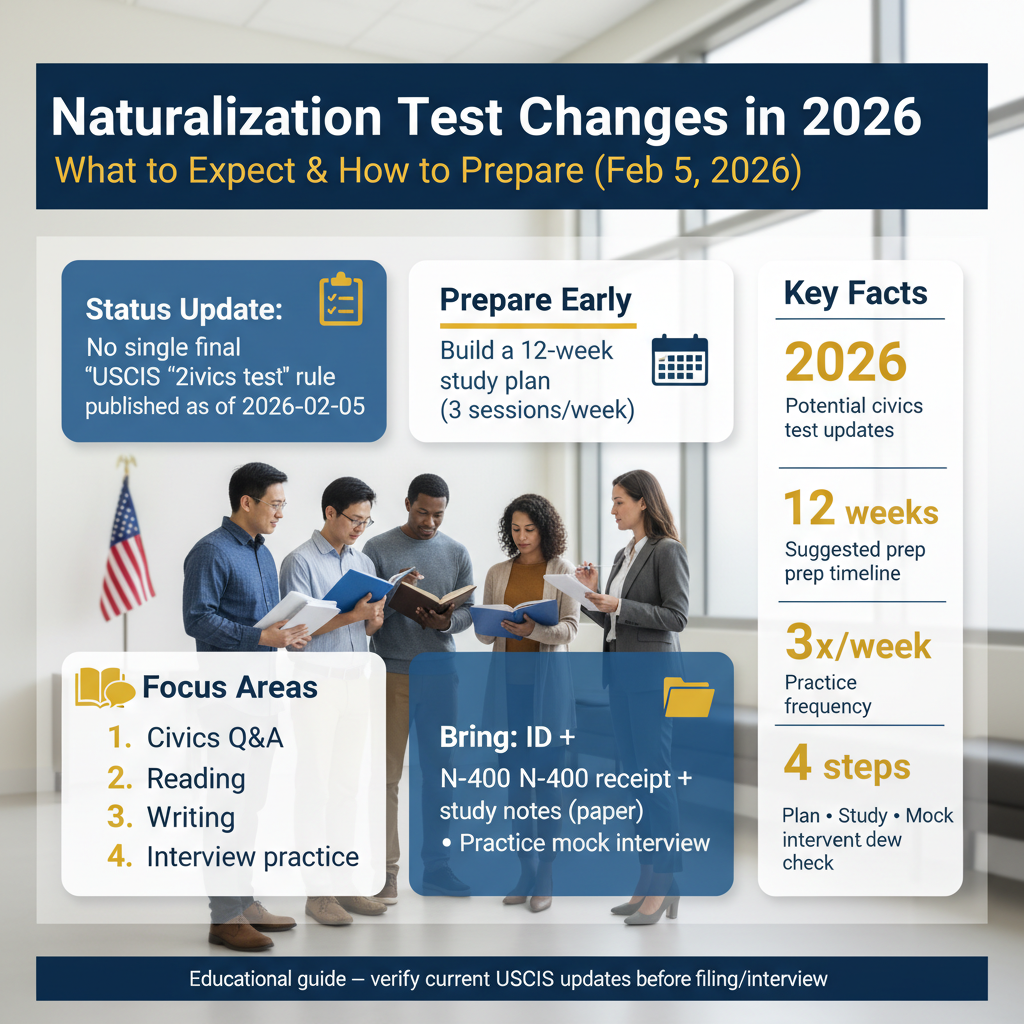
The reporting that sparked this guide: Naturalization Test Changes Coming in 2026 (Citizenship)
Important: As of today (2026-02-05), USCIS has not published a final, universally applicable “2026 civics test” rule in a single consolidated announcement on its main policy pages. What we do have is credible, widespread reporting about anticipated updates to the civics test questions and administration. This article explains what typically changes, how USCIS rolls out changes, and—most importantly—how to protect your naturalization timeline and avoid surprises if you are filing Form N-400 in 2026.
For official updates as they are released, monitor the USCIS official website and the USCIS naturalization and citizenship pages.
Need Help? Our Orlando immigration team is ready to assist. Call +1 786-791-3106 for a free consultation, or message us online. Se Habla Español.
What This News Means for Immigrants in Orlando and Across Florida
Why this news is showing up now
Naturalization testing is one of the most visible parts of the U.S. immigration system. Even small changes—like adding or rewording civics questions—can affect hundreds of thousands of applicants. “Test changes” tend to trend in the news for a few predictable reasons:
- USCIS periodically reviews the civics question bank to reflect updated civics education standards and current government structures.
- Policy transitions often trigger a review of prior versions of the test, interview procedures, and officer training.
- Implementation timelines matter: USCIS typically sets a transition window where some applicants take the “old” test and others take the “new” test depending on their filing date or interview date.
- Applicants plan months ahead. Many people study for 3–6 months before filing, so uncertainty creates anxiety and last-minute rush filing.
Reminder: The civics test is only one part of naturalization. You must still meet eligibility rules for continuous residence, physical presence, good moral character, English ability (unless exempt), and attachment to the U.S. Constitution.
How it can affect Florida residents
For Florida residents—especially in Central Florida—naturalization demand has been consistently high. If your case is in Orlando, you may interview at the Orlando USCIS Field Office, and your timeline can be influenced by local scheduling capacity and national backlogs.
Here’s how potential 2026 test changes can affect Florida applicants:
- Study strategy changes: A new question bank can require a different study plan, especially if questions become more detailed or require deeper understanding.
- Retest risk: If you fail the English or civics portion at the interview, USCIS generally schedules a re-examination within 90 days of the first interview (commonly 60–90 days). A new test could change what you need to prepare for that second chance.
- Filing date decisions: If USCIS announces a “new test applies to N-400 filed on/after X date,” that date becomes critical.
- Orlando-area scheduling: For Central Florida residents along the I-4 corridor (Orlando, Kissimmee, Sanford, Lake Mary, and surrounding Orange County communities), interview scheduling can fluctuate—making it harder to predict whether your interview will fall before or after a transition date.
Warning: Avoid filing “in a rush” without checking eligibility. A fast filing that triggers a denial can cost more time and money than waiting a few weeks to file correctly.
What Naturalization Test Changes Coming in 2026 Is (and Why It Matters)
A plain-English definition
“Naturalization test changes” usually means USCIS is updating one or more of the following:
- The civics test question bank (the list of possible questions an officer may ask).
- The format of how questions are asked or scored (for example, how many questions are asked, how many must be correct).
- The English test components (speaking, reading, writing) or the way officers evaluate them.
- The interview procedures tied to the N-400, including how officers document answers or request evidence.
In practical terms, this matters because applicants typically spend significant time preparing for the civics test—and uncertainty about what will be tested can create avoidable delays, failures, and rescheduled interviews.
Key terms you need to know
- Naturalization: The legal process of becoming a U.S. citizen after being a lawful permanent resident (green card holder) or qualifying through military service.
- Form N-400: The USCIS application for naturalization.
- Civics test: The portion of the naturalization interview where you answer questions about U.S. history and government.
- English test: The portion assessing your ability to speak (during the interview), read, and write basic English (unless you qualify for an exemption).
- 2008 civics test / 2020 civics test: Prior versions USCIS has used. Historically, USCIS has shifted between versions with transition rules.
- Transition rule: USCIS guidance saying who takes which test (often based on the date the N-400 is filed or the date of the interview).
- RFE (Request for Evidence): A USCIS request for more documents before making a decision.
- N-14: A notice USCIS may give at or after the interview requesting additional evidence or scheduling a continuation.
Important: News headlines often focus on civics questions, but many denials happen for reasons unrelated to the test—like travel history affecting continuous residence, tax issues, selective service concerns, or prior arrests.
Current Immigration Law: The Foundation
Even if the civics test changes in 2026, the legal foundation for naturalization remains largely the same. Naturalization is governed primarily by the Immigration and Nationality Act (INA) and implementing regulations.
Federal requirements
Key federal authorities include:
- INA § 316 (8 U.S.C. § 1427) — general naturalization requirements (residence, physical presence, good moral character, attachment to the Constitution).
- INA § 319 (8 U.S.C. § 1430) — naturalization through marriage to a U.S. citizen (3-year rule).
- 8 C.F.R. Part 316 — regulations on naturalization.
- 8 C.F.R. Part 312 — English and civics requirements, including exceptions and accommodations.
USCIS administers the process through Form N-400 and the naturalization interview. Official resources to keep open while preparing include:
- USCIS official website
- USCIS Forms
- USCIS Processing Times
- U.S. Department of State (helpful for passport steps after naturalization and some travel-related guidance)
- Executive Office for Immigration Review (relevant if you have removal proceedings history)
Reminder: While this article focuses on naturalization, many families also have pending petitions such as Form I-130 or applications like Form I-485 for Adjustment of Status. Those processes use concepts like Priority Date and may affect when a family member can become a permanent resident before later applying for citizenship.
Florida-specific considerations
Naturalization is federal law, so the eligibility rules do not change from state to state. However, Florida residents may face practical, location-specific issues:
- Local interview logistics: If your case is in Orlando, your interview may be scheduled at the Orlando USCIS Field Office. Travel time, parking, and rescheduling constraints matter—especially for families along the I-4 corridor.
- Name changes: Some applicants prefer a judicial oath ceremony to complete a legal name change. Scheduling and ceremony options can vary by field office and local court coordination.
- Disaster disruptions: Florida weather events can cause closures and rescheduling, which can push interviews across a test-transition date.
Warning: If you have any criminal history (including arrests that were dismissed), consult counsel before filing. Naturalization scrutiny can surface issues that did not affect your green card approval.
Need Help? Our Orlando immigration team is ready to assist. Call +1 786-791-3106 for a free consultation, or message us online. Se Habla Español.
How to Prepare for the 2026 Naturalization Test: A Complete Step-by-Step Guide
The safest approach is to prepare for naturalization in a way that works under either test version: master the fundamentals, document your eligibility cleanly, and plan your filing/interview timing. Below is a complete, practical roadmap.
1) Confirm you’re eligible before you start studying
Before you spend months memorizing civics answers, verify you meet the core legal requirements. Eligibility problems—not test performance—are a common reason for delays and denials.
- General 5-year rule: Most applicants must be a lawful permanent resident (LPR) for at least 5 years.
- 3-year rule: Some applicants can apply after 3 years as an LPR if married to and living with a U.S. citizen spouse and meeting other requirements under INA § 319.
- Continuous residence and physical presence: Excessive travel can disrupt eligibility.
- Good moral character: Taxes, criminal issues, and certain conduct can affect eligibility.
Documents to gather (eligibility check):
- Front and back copy of your green card
- All passports (current and expired) used during the statutory period
- Travel history list (dates out of the U.S.)
- Marriage certificate and spouse proof of U.S. citizenship (if applying under 3-year rule)
- Selective Service registration proof (if applicable)
- Tax transcripts (recommended)
- Court dispositions for any arrest/citation (even if dismissed)
Important: If you had a trip of 6 months or more, or multiple long trips, get legal advice before filing—these can trigger continuous residence problems.
2) Build a “test-change-proof” study plan
If USCIS introduces new civics questions in 2026, the best defense is a study plan that focuses on understanding—not just memorization.
A strong plan includes:
- Core civics concepts: Constitution, branches of government, federalism, rights and responsibilities, major historical events.
- Local facts: Your state’s U.S. Senators, your Representative, the Governor, and your capital. (These can change after elections or redistricting.)
- Practice under interview conditions: Short answers, spoken clearly, without long explanations.
Documents/materials to gather (study plan):
- USCIS civics study materials (current version at time of study)
- Notebook with missed questions and corrections
- Audio practice (for commuting along the I-4 corridor)
- Flashcards (paper or app)
Reminder: USCIS typically tests civics orally. Even if you “know” the answer, practice saying it out loud.
3) Prepare your English test strategy (or confirm your exemption)
Many applicants worry most about civics, but the English test can be the bigger obstacle—especially reading/writing under stress.
USCIS evaluates English in three ways:
- Speaking: During your N-400 interview (answering questions about your application).
- Reading: You read a sentence correctly.
- Writing: You write a sentence correctly.
Some applicants qualify for age/time-as-LPR exemptions (often called “50/20” or “55/15”) and may take the civics test in their preferred language with an interpreter, but must still meet civics requirements (with a modified format in some cases).
Documents to gather (English/exemption planning):
- Proof of age (passport, birth certificate)
- Green card issue date evidence (to calculate years as an LPR)
- Medical documentation if requesting a disability exception (N-648 strategy requires careful preparation)
Warning: Disability exceptions are highly scrutinized. If you think you may need one, get legal guidance before submitting anything.
4) File Form N-400 correctly and time it carefully
Filing timing may be critical if USCIS announces that a new test applies to cases filed on/after a certain date. Many applicants can file up to a 90-day window before meeting the continuous residence requirement (for example, filing 90 days before the 5-year anniversary as an LPR).
Filing correctly means:
- Accurate addresses and employment history
- Complete travel history
- Full disclosure of citations/arrests
- Correct fee payment and signature
- Uploading clear evidence if filing online
Documents to gather (N-400 filing):
- Green card copy (front/back)
- Marriage/divorce documents (if any)
- Proof of spouse’s U.S. citizenship (if 3-year rule)
- Certified court dispositions (if any law enforcement contact)
- Selective Service proof (if applicable)
- Tax transcripts (recommended; especially if you had payment plans or filing gaps)
- Proof of name change (if applicable)
Important: If you have pending family-based processes such as Form I-130 or are helping a relative with Form I-485 Adjustment of Status, your naturalization could later improve their options (for example, changing a category or reducing wait times tied to a Priority Date). But do not assume naturalization will “fix” a separate case without legal review.
5) Attend biometrics and prepare for interview evidence
After filing, USCIS typically schedules a biometrics appointment (or reuses biometrics). Then you’ll wait for the interview notice.
Documents to gather (biometrics/interview prep):
- Biometrics appointment notice (if issued)
- Government-issued photo ID
- Original green card
- All passports and travel documents
- Any updated evidence since filing (new trips, address changes, new job)
- Certified dispositions for any new citations/arrests after filing
Reminder: Keep your address updated with USCIS. Missing an interview notice can cause major delays.
6) Pass the interview—civics, English, and the N-400 review
The naturalization interview is not only a test. It is also a detailed review of your entire application and eligibility.
Your officer will typically:
- Verify identity and review your Form N-400 line-by-line
- Ask civics questions (from the applicable version for your case)
- Administer reading/writing tests (if required)
- Confirm you understand and are willing to take the Oath of Allegiance
Documents to bring (interview day):
- Interview notice
- Green card (original)
- State ID/driver’s license
- Passports (all) and travel documents
- Marriage certificate and proof of ongoing marriage (if applying under 3-year rule)
- Tax transcripts (recommended)
- Evidence of selective service registration (if applicable)
- Any requested documents from an RFE or N-14
Warning: If you do not understand a question, ask the officer to repeat it. Guessing can lead to inconsistent answers that create credibility concerns.
7) Oath ceremony, certificate review, and next steps (passport + voter registration)
If approved, you will attend an oath ceremony and receive your Certificate of Naturalization. Then you can apply for a U.S. passport and update records.
Documents to gather (after approval):
- Certificate of Naturalization (check for errors before leaving)
- Passport application materials (typically DS-11, photos, fees)
- Any name change order (if applicable)
For passport guidance, see the U.S. Department of State.
Need Help? Our Orlando immigration team is ready to assist. Call +1 786-791-3106 for a free consultation, or message us online. Se Habla Español.
Practical Steps You Can Take Today
If you’re worried about new civics test questions in 2026, your goal is to reduce uncertainty and protect your timeline. Here’s a practical checklist you can start today.
- 1) Check your earliest filing date using the 90-day window rule (if applicable). Filing at the correct time can determine which test version applies if USCIS uses a filing-date transition rule.
- 2) Create a travel log for the last 5 years (or 3 years). Include every departure/return date. This prevents mistakes that can trigger delays or credibility issues.
- 3) Order IRS tax transcripts for the statutory period. If there were payment plans or missed filings, address them before filing.
- 4) Study civics “by topic,” not only by question (Constitution, branches, elections, rights, history). This helps if questions are reworded in a new bank.
- 5) Practice English reading/writing 10 minutes a day. Consistency beats cramming.
- 6) Review your full immigration history (prior visas, entries, petitions). If you ever had issues, consult counsel before filing.
- 7) Track USCIS announcements and bookmark official resources: USCIS official website and USCIS Forms.
Timeline expectations (general): Naturalization can take many months from filing to oath, and timelines vary. Always check your local/national estimates at USCIS Processing Times. For Central Florida residents, interview scheduling at the Orlando USCIS Field Office can move faster or slower depending on workload.
Important: If USCIS announces a new test effective date, you may want to adjust your filing plan. But do not file with missing court dispositions, incomplete travel history, or unresolved tax issues just to “beat” a date.
How Imigrar Helps Immigrants in Orlando
At Imigrar (Orlando, Florida—serving clients nationwide), we help clients prepare strong, well-documented naturalization applications designed to withstand policy shifts, including civics test updates and interview procedure changes.
- Eligibility screening: We identify risks involving travel, taxes, selective service, prior immigration filings, and criminal history.
- Document strategy: We help you compile the right evidence—especially certified court records and corrections to travel/employment timelines.
- Interview preparation: We prepare you for the civics/English components and the N-400 review so you can answer confidently and consistently.
- Case support in Orlando and beyond: If your case is in Orlando, we help you plan for the Orlando USCIS Field Office process and logistics.
We offer a free consultation to discuss your goals and your timeline. Se Habla Español. Call +1 786-791-3106 or message us online.
Frequently Asked Questions
Q: Will the 2026 naturalization civics test be harder?
A: It depends on what USCIS ultimately implements. Historically, changes can make the test feel harder if the question bank expands, if questions require more detailed answers, or if the passing threshold changes. The best preparation is to learn civics concepts (not only memorize) and to practice answering out loud in short, accurate sentences. Watch the USCIS official website for the final question bank and transition rules.
Q: If I file my N-400 now, which test will I take?
A: USCIS typically decides which civics test version applies based on a transition rule—often tied to the date you file Form N-400, sometimes tied to the interview date, or a combination. If USCIS announces an effective date in 2026, applicants filing near that date should confirm the rule before submitting. If your case is in Orlando, interview scheduling at the Orlando USCIS Field Office could place your interview before or after a change, so timing matters.
Q: Do naturalization test changes affect my green card or immigration status?
A: Test changes do not change your underlying lawful permanent resident status. However, filing for naturalization can expose issues that may affect you if USCIS finds you were not eligible for the green card, committed fraud/misrepresentation, or have disqualifying criminal issues. If you have concerns, consult an attorney before filing. If you are also pursuing family cases like Form I-130 or Form I-485 for Adjustment of Status, coordinate strategy carefully because timelines and evidence can overlap.
Q: How long does the naturalization process take in Florida?
A: Processing times vary by workload and case complexity. Use USCIS Processing Times to check current estimates. For Central Florida residents, the Orlando USCIS Field Office’s scheduling capacity can influence how quickly interviews are set. Also, RFEs, missing court dispositions, and long travel histories can add months.
Q: What documents are most important for avoiding delays?
A: The most delay-preventing documents usually include: (1) certified court dispositions for any arrest/citation, (2) accurate travel history with passports, (3) IRS tax transcripts showing compliance, (4) proof of marital union and spouse citizenship for 3-year cases, and (5) selective service proof if required. Keep everything organized and consistent with your Form N-400 answers.
Q: How much does it cost to apply for naturalization?
A: USCIS fees can change, and the amount may depend on filing method and fee rules in effect at the time you submit. Always confirm the current fee and any fee waiver/reduction eligibility directly on the USCIS official website and the USCIS Forms page for Form N-400. In addition to filing fees, budget for passport photos, certified court records, and legal assistance if needed.
Q: What happens if I fail the civics or English test because of new questions?
A: If you fail the English or civics test at your first interview, USCIS generally gives you a second opportunity by scheduling a re-examination within 90 days of the initial interview. You typically only retake the part you failed. Use that time to practice intensively and address the specific weaknesses the officer noted. If you fail again, USCIS may deny the N-400, but you may have options to request a hearing (Form N-336) or reapply, depending on the reason for denial.
Q: What if my naturalization application is denied?
A: A denial can happen for many reasons: ineligibility, failure to meet continuous residence/physical presence, good moral character issues, failure of the tests after re-examination, or insufficient evidence. Depending on the reason, you may be able to file Form N-336 (Request for a Hearing on a Decision in Naturalization Proceedings) or you may need to refile later. If removal issues are involved, it may also intersect with immigration court processes under EOIR—see Executive Office for Immigration Review resources and consult counsel immediately.
Common Mistakes (and How to Avoid Them)
Mistake #1: Filing to “beat the new test” without confirming eligibility
Some applicants rush to file before a rumored effective date. If your travel history breaks continuous residence, if you have unresolved tax issues, or if you lack certified court dispositions, that rushed filing can lead to an RFE, delay, or denial.
How to avoid it: Do an eligibility audit first, then file confidently. If timing matters, plan around the 90-day window and gather documents early.
Mistake #2: Memorizing answers without understanding the concepts
If the 2026 update rewords questions or shifts emphasis, pure memorization can fail you—especially under interview stress.
How to avoid it: Study by topic and practice explaining concepts in simple sentences. Use official USCIS study tools and practice speaking out loud.
Mistake #3: Inconsistent travel and address history
Officers commonly compare your N-400 answers to passport stamps, prior immigration filings, and other records. Inconsistencies can trigger extended questioning or requests for evidence.
How to avoid it: Prepare a precise travel log and keep your addresses/employment timeline consistent across all forms. If you are missing dates, reconstruct them using emails, tickets, or entry records.
Need Help? Our Orlando immigration team is ready to assist. Call +1 786-791-3106 for a free consultation, or message us online. Se Habla Español.
Closing: Prepare now, file smart, and stay ready for 2026 updates
Naturalization test changes can feel stressful—especially when headlines suggest a brand-new civics question bank is coming in 2026. The good news is that most applicants can protect themselves by focusing on the fundamentals: confirm eligibility, document your case carefully, and study civics in a way that works even if questions are updated or reworded.
If your case is in Orlando or you live in Orange County or anywhere along the I-4 corridor, planning matters because interview scheduling can shift—and that can determine whether your interview falls under a transition rule. If you want a clear plan based on your timeline and risk factors, we can help.
Need help with your naturalization case? Call Imigrar at +1 786-791-3106 for a free consultation, or message us online. Se Habla Español. Our mission: Keep Families Together.


