


The reporting that sparked this guide
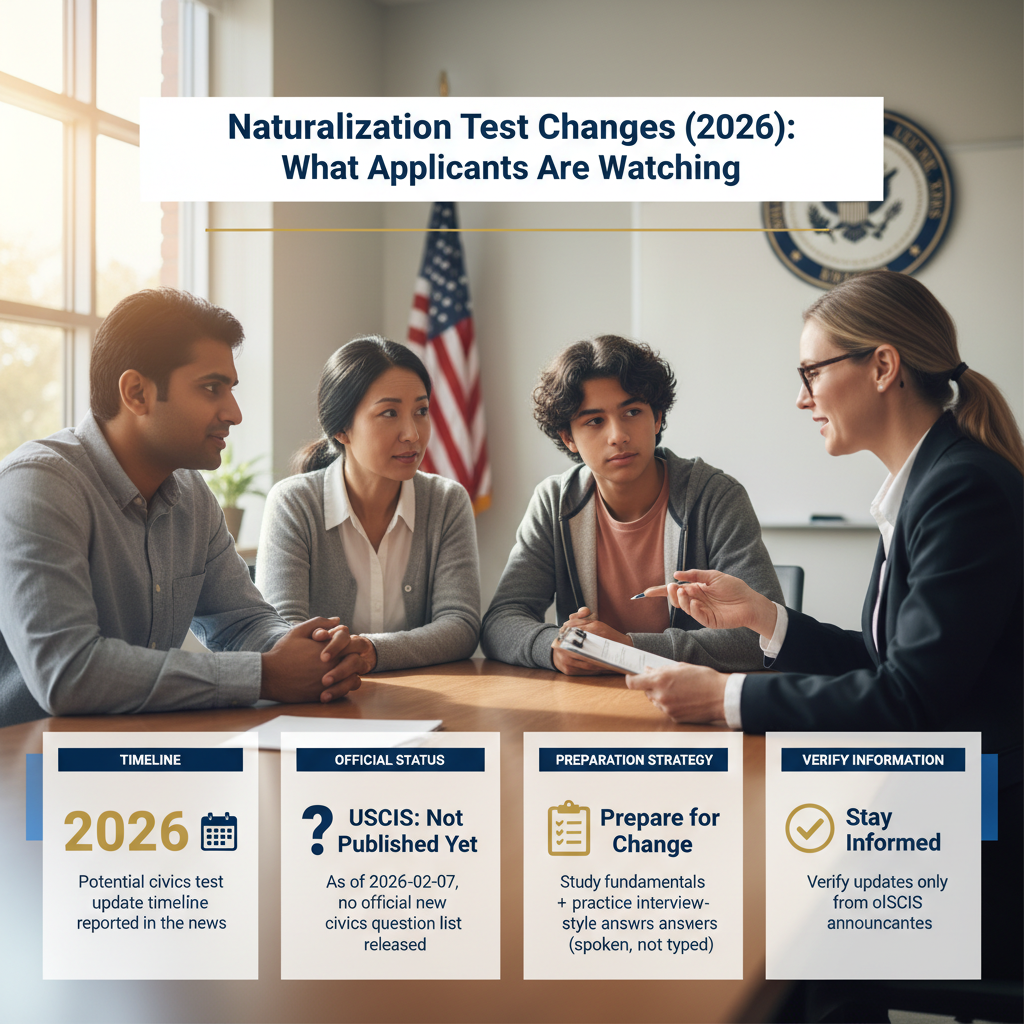
Immigration policy changes often move fast—and even “test updates” can create real anxiety for families preparing for U.S. citizenship. The reporting we’re tracking includes: Naturalization Test Changes Coming in 2026 (Citizenship)
Important: As of today (2026-02-07), USCIS has not published a single, final “one-page” rule that definitively answers every question about the 2026 civics test for every applicant category. What we can do—and what this guide is designed to do—is explain how the civics test works under current law, how USCIS typically rolls out test updates, what kinds of changes have been proposed or discussed publicly, and the most practical steps you can take right now to protect your timeline and your case.
Need Help? Our Orlando immigration team is ready to assist. Call +1 786-791-3106 for a free consultation, or message us online. Se Habla Español.
What This News Means for Immigrants in Orlando and Across Florida
Why this news is showing up now
The naturalization test (especially the civics portion) is one of the most visible parts of the U.S. citizenship process. When USCIS considers updates, it often happens in response to a mix of factors:
- Policy shifts after elections and leadership changes at DHS/USCIS.
- Ongoing debates about what “civics knowledge” should include and how it should be measured.
- Operational concerns (training officers, standardizing interviews, and reducing inconsistent outcomes).
- Modernization goals—USCIS periodically updates study materials, question banks, and guidance.
In past cycles, USCIS has previewed changes, accepted stakeholder feedback, updated training materials, and then implemented new testing rules with a transition period. That transition period is crucial: it often determines whether you’ll be tested under the “old” version or the “new” version based on your Form N-400 filing date or interview date.
How it can affect Florida residents
For Florida residents—especially in high-growth areas like Orlando, Orange County, and along the I-4 corridor—naturalization demand has been consistently strong. That means:
- You may face longer waits for interviews depending on staffing and case volume.
- Any new test requirement could affect how much time you need to study before your interview.
- Applicants who file close to a changeover date can feel uncertain about which test applies.
Reminder: If your case is in Orlando, your interview is typically handled through the Orlando USCIS Field Office (jurisdiction can vary by address). Planning ahead matters because your interview date—not just your filing date—can be impacted by local scheduling.
Need Help? Our Orlando immigration team is ready to assist. Call +1 786-791-3106 for a free consultation, or message us online. Se Habla Español.
What Naturalization Test Changes Coming in 2026 Is (and Why It Matters)
A plain-English definition
“Naturalization test changes” means USCIS may update the questions and/or scoring rules used during the citizenship interview to evaluate:
- English ability (speaking, reading, writing), and
- Civics knowledge (U.S. history and government).
The civics test is not like a school exam with a scantron. It’s typically an oral test during your interview. The officer asks questions from an official question bank, and you answer verbally. USCIS may change the question bank, the number of questions asked, the number you must answer correctly, or how the test is administered.
Why it matters: a change in format can change your study strategy, your timeline, and your risk of delays if you need a re-test.
Key terms you need to know
- Form N-400: Application for Naturalization—the main citizenship application.
- Naturalization interview: The in-person (or sometimes remote) appointment where USCIS reviews your eligibility and administers tests.
- Civics test: Questions about U.S. government/history asked during the interview.
- English test: Speaking is evaluated throughout; reading/writing are tested with short prompts unless you qualify for an exemption.
- Re-test: If you fail the English or civics portion, USCIS generally schedules a second chance within a set period.
- Policy guidance: USCIS manuals and memos that explain how officers apply rules in real cases.
- Warning: Not every applicant must take the English test—some qualify for age/time-in-residence exceptions or medical disability accommodations.
Even though this article is about the civics test, your case can still be denied for other reasons (good moral character issues, continuous residence problems, selective service, tax issues, or misrepresentation). So “test changes” are only one piece of naturalization readiness.
Current Immigration Law: The Foundation
Naturalization is governed primarily by the Immigration and Nationality Act (INA) and related federal regulations. The civics and English requirements are not just “USCIS preferences”—they are grounded in statute and implemented through agency rules and policy.
Federal requirements
Key legal authorities include:
- INA § 312 (8 U.S.C. § 1423): English and civics requirements for naturalization, including exceptions.
- INA § 316 (8 U.S.C. § 1427): General naturalization requirements (residence, physical presence, good moral character, attachment to the Constitution).
- INA § 319 (8 U.S.C. § 1430): Naturalization through marriage to a U.S. citizen (3-year rule in many cases).
- 8 C.F.R. Part 312: Regulations implementing English/civics testing and accommodations.
- USCIS Policy Manual: Practical interpretation and procedures used by officers.
The baseline process still centers on Form N-400, biometrics (if required), the interview, and the oath ceremony. You can verify official instructions and updates at the USCIS official website and find the latest forms at USCIS Forms.
Important: The government can update test content without changing the statute—because the statute requires a civics/English evaluation, but the agency controls the specific question bank and administration method (within legal limits).
Florida-specific considerations
Naturalization law is federal, so the legal requirements are the same in Florida as in any other state. However, Florida-specific realities can affect your case:
- High demand and scheduling: For Central Florida residents, interview availability at the Orlando field office can influence your timeline.
- Name changes: If you request a legal name change through naturalization, you may need a judicial oath ceremony, which can add time.
- Travel patterns: Florida residents often travel internationally (Caribbean/Latin America). Extended trips can raise continuous residence and physical presence questions.
Reminder: Naturalization is separate from family-based green card processes like Form I-130 and Form I-485. Still, your history with Adjustment of Status, your Priority Date, and prior filings can matter if there were inconsistencies or omissions.
Helpful government resources you may use during preparation:
- USCIS official website
- USCIS Processing Times
- USCIS Forms
- U.S. Department of State (passport and travel info; also useful for understanding travel documentation)
- Executive Office for Immigration Review (if you have removal proceedings or past immigration court history)
Need Help? Our Orlando immigration team is ready to assist. Call +1 786-791-3106 for a free consultation, or message us online. Se Habla Español.
How to Prepare for Naturalization Test Changes in 2026: A Complete Step-by-Step Guide
The safest strategy is to prepare for naturalization in a way that works under today’s rules and remains resilient if USCIS updates the civics test in 2026. Below is a complete, practical roadmap.
1) Confirm your eligibility and choose the best filing window
Before you study a single civics question, confirm that you qualify to file Form N-400 and that your timeline is optimized. Filing too early can lead to a denial; filing too late can delay voting and other benefits.
- General rule: Many applicants qualify after 5 years as a lawful permanent resident (LPR).
- 3-year rule: Some qualify after 3 years if married to and living with a U.S. citizen spouse (with additional requirements).
- 90-day window: USCIS generally allows you to file up to 90-day window before you meet the 3- or 5-year residence requirement.
Documents to gather for Step 1:
- Front/back copy of your green card
- State ID/driver’s license
- Marriage certificate/divorce decrees (if applicable)
- Travel history (dates of trips outside the U.S.)
- Selective Service registration proof (if applicable)
- Tax transcripts (recommended)
If your case is in Orlando, we also recommend checking local expectations for interview scheduling and planning study time accordingly.
2) Identify which English/civics rules apply to you (including exceptions)
Not everyone takes the same version of the English/civics test. Age and time as an LPR can change what you must do, and some applicants qualify for medical disability accommodations.
- 50/20 exception: Age 50+ and 20+ years as an LPR may allow civics test in your preferred language (with interpreter).
- 55/15 exception: Age 55+ and 15+ years as an LPR may allow civics test in your preferred language.
- 65/20 special consideration: Age 65+ and 20+ years as an LPR may receive simpler civics questions (USCIS provides a specific list).
- Medical disability: Certain applicants may request an exception via Form N-648 (Medical Certification for Disability Exceptions).
Warning: If you believe you qualify for a disability exception, the medical form must be completed correctly and consistently with your medical records. Poorly prepared Form N-648 can lead to delays, rejections, or denials.
Documents to gather for Step 2:
- Proof of date of birth (passport or birth certificate)
- Green card issue date documentation
- If requesting disability exception: medical records and draft Form N-648
- If using an interpreter: interpreter’s information and language preference notes
3) Build a “2026-proof” civics study plan
Because the news suggests “new civics test questions and requirements,” your goal should be to study in a way that survives likely changes. Historically, USCIS has tested core concepts—Constitution, branches of government, rights/responsibilities, major historical events—while updating the phrasing and list.
A practical “2026-proof” plan includes:
- Mastering the core civics concepts (not just memorizing one-liners).
- Studying from official USCIS materials first, then using reputable practice tools.
- Practicing oral answers out loud to build confidence for the interview setting.
Documents/items to gather for Step 3:
- Printed or saved USCIS civics study materials (current version)
- Notebook of “weak topics” and corrected answers
- Calendar plan for study sessions (e.g., 20–30 minutes/day)
- Audio practice recordings (optional but effective)
Reminder: Use official sources whenever possible. Start at the USCIS official website and verify any third-party materials against USCIS.
4) Prepare your full N-400 case file (not just the test)
Many applicants focus on civics questions and forget that the officer is also evaluating eligibility, credibility, and good moral character. A test change won’t matter if your case is delayed for missing documents or inconsistent answers.
Documents to gather for Step 4:
- All passports (current and expired) covering the statutory period
- Proof of residence (leases, mortgage statements, utility bills)
- Employment history documentation (W-2s, pay stubs, employer letters if needed)
- Certified court dispositions for any arrests/citations (even if charges were dropped)
- Tax transcripts (IRS) and proof of payment plans if any taxes owed
- Marriage and family documents if applying under INA § 319
Important: If you had any prior filings like Form I-130 or Form I-485, review them for consistency. Discrepancies can trigger additional questioning.
5) File Form N-400 correctly and track your case through the interview
Once your eligibility and documents are solid, file Form N-400 accurately. After filing, you’ll track biometrics (if scheduled), interview notices, and any Requests for Evidence (RFEs).
Documents/items to gather for Step 5:
- Completed Form N-400 (copy for your records)
- Filing fee proof (or fee waiver request if eligible)
- Evidence packet (organized and labeled)
- USCIS online account login info (if you file online)
- Address history confirmation (to avoid notice delivery problems)
Track your estimated timeline using USCIS Processing Times. Reminder: Processing times are estimates and can change quickly with local workload.
6) Prepare for the interview day (including a possible re-test window)
The interview is where English speaking is evaluated naturally and where civics questions are asked. If USCIS implements a new test in 2026, interview-day preparation becomes even more important—because the “version” you get may depend on USCIS’s implementation rules.
Documents/items to gather for Step 6:
- Interview notice (Form I-797)
- Green card
- State ID
- All passports/travel documents
- Updated evidence since filing (new trips, new address, new job, new marriage status)
- Interpreter (if permitted/needed under the exception rules)
Important: If you fail the English or civics test, USCIS typically provides one re-test opportunity within a set period (often within 90 days of the first interview, though exact scheduling varies). Plan your study calendar so you can intensify preparation if needed.
Practical Steps You Can Take Today
If you’re worried about “new civics questions and requirements” in 2026, the best move is to reduce uncertainty. Here’s an actionable checklist that helps whether the test changes or not.
- 1) File-timing check: Confirm you’re within the 90-day window (if applicable) and that your continuous residence is strong.
- 2) Build a travel log: List every trip outside the U.S. with exact dates. Keep boarding passes or stamps where possible.
- 3) Study the “core civics themes”: Branches of government, Constitution, Bill of Rights, elections, and major historical milestones.
- 4) Practice oral answers: Record yourself answering. The civics test is spoken; confidence and clarity matter.
- 5) Prepare for English reading/writing: Practice simple sentences daily (10 minutes/day can be enough).
- 6) Gather certified dispositions: If you ever had an arrest or citation, order certified court records now—this is a common delay point.
- 7) Check tax compliance: Obtain IRS transcripts and resolve any issues before the interview.
Document preparation guidance: Use a single folder (digital and paper) with tabs: Identity, Residence, Marriage/Family, Taxes, Travel, Court/Police, and USCIS Notices. If your case is in Orlando, bring originals and a clean copy set to your interview at the Orlando USCIS Field Office.
Timeline expectations: Many cases take months from filing to interview; local volume in Orange County and along the I-4 corridor can affect scheduling. If you want the best chance of being tested under a particular version of the civics test, earlier filing (when eligible) can reduce the risk of being caught in a changeover period.
How Imigrar Helps Immigrants in Orlando
At Imigrar, our mission is simple: Keep Families Together. Naturalization is often the final step after years of immigration filings, and it deserves the same care as a green card case.
Here’s how we help:
- Eligibility screening under INA § 316 and INA § 319 (including continuous residence and physical presence analysis).
- Document strategy to prevent RFEs and reduce interview-day surprises.
- Preparation for the civics and English portions with realistic mock interview practice.
- Support for complex histories (prior immigration filings, old arrests, removal proceedings, or extended travel).
- Guidance on disability exceptions using Form N-648 when appropriate.
We’re based in Orlando and serve clients nationwide. Se Habla Español. Call +1 786-791-3106 for a free consultation.
Need Help? Our Orlando immigration team is ready to assist. Call +1 786-791-3106 for a free consultation, or message us online. Se Habla Español.
Frequently Asked Questions
Q: Will the naturalization civics test definitely change in 2026?
A: USCIS can update the civics test question bank and administration rules, and news coverage suggests changes are being discussed for 2026. However, the exact scope and start date depend on USCIS’s official rollout. The safest approach is to (1) confirm eligibility, (2) file Form N-400 as soon as you qualify, and (3) study using official USCIS materials while building deeper understanding of core civics concepts.
Q: If I file now, will I be tested under the “old” civics questions?
A: Not always. In past transitions, USCIS has used the filing date, the interview date, or specific implementation guidance to determine which test applies. Because interviews can be scheduled months after filing, applicants near a changeover period may face uncertainty. If your case is in Orlando, local interview scheduling at the Orlando USCIS Field Office can also affect whether your interview occurs before or after a new test takes effect.
Q: Do civics test changes affect my immigration status or my green card?
A: A civics test update does not change your underlying lawful permanent resident status by itself. But failing the test can delay naturalization, and a denied Form N-400 can sometimes trigger closer review of your immigration history. Warning: If there are serious issues (fraud findings, certain crimes, abandonment of residence), USCIS could refer a case for further action. If you have concerns, speak with counsel before filing.
Q: What documents should I bring to the naturalization interview?
A: Bring your interview notice, green card, state ID, all passports, and originals of key civil documents (marriage/divorce, name change, court dispositions). Also bring updated evidence since filing (new address, new job, new trips). If you previously filed Form I-130 or Form I-485 through Adjustment of Status, it’s smart to bring copies in case the officer asks about prior statements or dates (including your Priority Date if relevant to your history).
Q: How long does the naturalization process take in Florida?
A: Timelines vary by workload and case complexity. Use USCIS Processing Times for estimates, but remember they can change. For Central Florida residents, local demand along the I-4 corridor can influence interview scheduling. Name changes and requests for additional evidence can add time.
Q: How much does it cost to apply for naturalization?
A: USCIS fees can change, so verify the current fee directly on the USCIS official website or via USCIS Forms before filing. Some applicants may qualify for a fee waiver or reduced fee depending on income and circumstances. We can help you evaluate whether a fee waiver is appropriate and how to document it correctly.
Q: What happens if my N-400 is denied after the interview?
A: USCIS will issue a written decision explaining the reason. Depending on the reason, you may be able to request a hearing on the denial (appeal) using the appropriate USCIS process, or you may be advised to reapply after fixing the problem (for example, insufficient continuous residence evidence). Important: If denial involves criminal or fraud allegations, get legal advice immediately before taking next steps—especially if there is any immigration court history (see Executive Office for Immigration Review for context on immigration court proceedings).
Q: I’m over 50 and have been a green card holder for many years—will the 2026 changes still apply to me?
A: You may qualify for an age/time exception that allows you to take the civics test in your preferred language (with an interpreter). The civics content could still be updated, but the language/English requirements may be different for you. If you are 65+ with 20+ years as an LPR, you may qualify for special consideration with a simplified civics list. We recommend confirming your exact eligibility before your interview.
Common Mistakes (and How to Avoid Them)
Mistake #1: Waiting to study until the interview notice arrives
Interview notices can arrive with limited lead time, and if the civics test changes in 2026, last-minute studying can be risky. Avoid this by starting a steady plan now—especially oral practice.
Mistake #2: Memorizing answers without understanding the concept
When question banks change, “rote memorization” breaks. Build understanding: what the Constitution does, how Congress differs from the President, why states matter, and what rights are protected. This makes you adaptable if the wording changes.
Mistake #3: Ignoring issues unrelated to the civics test
Applicants sometimes fail to bring certified court dispositions, forget trips abroad, or overlook tax issues. Any of these can delay or derail a case even if you pass civics. Reminder: Treat naturalization as a full legal filing, not just a test.
Naturalization Test Changes in 2026: What We Expect USCIS to Focus On
While USCIS has not finalized every detail in a single public announcement as of this writing, “new civics test questions and requirements” typically fall into a few predictable categories. Understanding these categories helps you prepare intelligently—without panic.
- Question bank updates: Reworded questions, updated civic facts (for example, current officials), and revised emphasis on foundational principles.
- Administration adjustments: Potential changes to how many questions are asked and how many must be answered correctly.
- Study resource revisions: New official flashcards, audio tools, and revised “lessons” for adult learners.
- Standardization: USCIS often aims to reduce uneven outcomes between field offices by tightening guidance and training.
Important: No matter what changes, the core eligibility requirements under INA § 316 and § 319 remain. If you have long trips abroad, complicated marital history, prior immigration filings (including Form I-130 or Form I-485), or any criminal history, those issues may matter more than the exact civics question bank.
If Your Case Is in Orlando: Local Planning Tips
If your case is in Orlando, consider local logistics as part of your preparation:
- The Orlando USCIS Field Office may have fluctuating appointment availability depending on staffing and demand.
- For Central Florida residents in Orange County and along the I-4 corridor, travel time, parking, and arrival timing can reduce stress on interview day.
- If you need an interpreter under an exception, confirm USCIS’s current interpreter procedures before your appointment.
Reminder: Keep your address updated with USCIS. Missing a notice can cause rescheduling delays and could complicate your timeline if USCIS implements a new civics test version during that period.
How to Reduce Risk During a Changeover Year
A “changeover year” (when rules or test versions transition) can create uncertainty. Here’s how to reduce risk:
- File as soon as eligible: Use the 90-day window when allowed.
- Over-prepare: Study beyond the minimum so you can handle reworded questions.
- Keep a clean record: Avoid new legal problems; resolve tickets and court matters promptly and keep documentation.
- Track processing: Monitor your case and compare with USCIS Processing Times.
- Get legal guidance early: Especially if there are past arrests, long absences, or prior misstatements.
Warning: If you are in removal proceedings or have an immigration court history, naturalization may be affected by jurisdictional rules. Consult counsel and review information related to immigration court at the Executive Office for Immigration Review.
Need Help? Our Orlando immigration team is ready to assist. Call +1 786-791-3106 for a free consultation, or message us online. Se Habla Español.
Final Thoughts: Prepare Smart, Not Scared
Naturalization is one of the most meaningful steps an immigrant can take—opening the door to voting, stronger protection from deportation in many scenarios, and the ability to petition family members more easily. Even if USCIS updates the civics test in 2026, you can protect your case by focusing on fundamentals: eligibility, truthful and consistent filings, strong documentation, and steady study.
Important: If you’re also working through family-based processes—such as Form I-130 petitions or Form I-485 Adjustment of Status filings—keep your records consistent across applications, including dates, addresses, and prior names. If you have a Priority Date from an earlier case, keep that paperwork organized as part of your immigration history file.
For travel planning while your naturalization is pending, consult the U.S. Department of State for general travel documentation guidance and ensure your trips won’t jeopardize continuous residence.
Closing: Talk to an Orlando Citizenship Attorney Before the Rules Shift
If you’re preparing for U.S. citizenship and concerned about the Naturalization Test Changes Coming in 2026, we can help you file strategically, prepare thoroughly, and walk into your interview with confidence.
Call Imigrar in Orlando at +1 786-791-3106 for a free consultation, or message us online. Se Habla Español. We serve clients across Florida and nationwide.


