

The reporting that sparked this guide
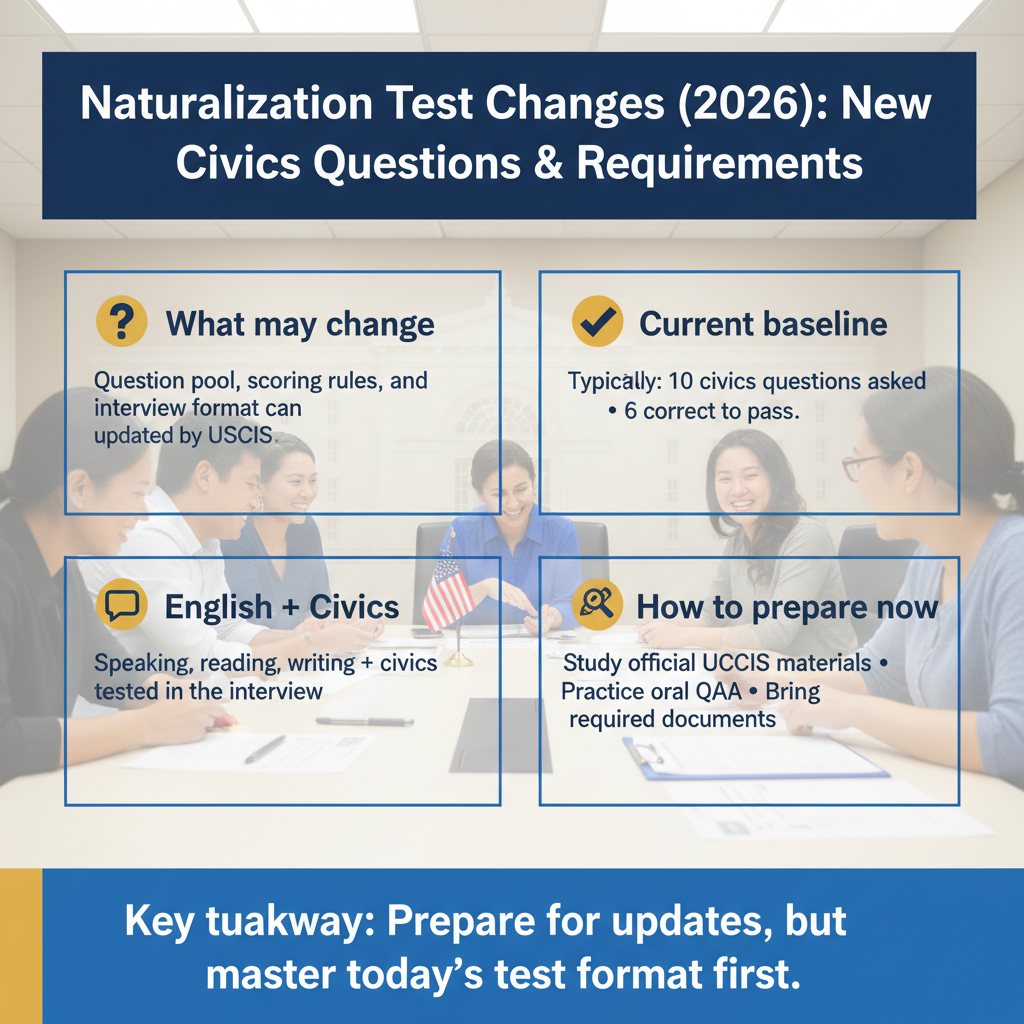
The reporting that prompted many questions from our clients is here: Naturalization Test Changes Coming in 2026 (Citizenship). This article is a practical, attorney-guided overview of what “new civics test questions and requirements” could mean, how naturalization testing works under current rules, and how to prepare strategically if you plan to file in 2026.
Important: As of today (2026-02-09), USCIS policy details can evolve quickly. Always verify updates on the USCIS official website and consider legal advice for your specific case.
Need Help? Our Orlando immigration team is ready to assist. Call +1 786-791-3106 for a free consultation, or message us online. Se Habla Español.
What This News Means for Immigrants in Orlando and Across Florida
Why this news is showing up now
Naturalization testing changes tend to appear in the news when USCIS signals that it may revise the civics component, update the question bank, adjust scoring rules, or change how English and civics are evaluated at the interview. These changes often happen after internal reviews, administration priorities, or feedback from stakeholders (educators, immigrant advocates, and field offices).
The civics test is not just a “study list.” It is a federally administered screening tool tied to statutory requirements for naturalization. Even modest changes—like adding questions, changing acceptable answers, or changing retesting procedures—can affect timelines, preparation strategies, and the risk of denial for otherwise eligible applicants.
Reminder: USCIS also sometimes adjusts forms, interview scripts, and officer guidance. That means “test changes” can include more than just new questions.
How it can affect Florida residents
For Central Florida residents—especially along the I-4 corridor (Orlando, Kissimmee, Sanford, and surrounding Orange County communities)—naturalization demand is consistently high. If USCIS introduces new civics questions or new requirements in 2026, Florida applicants may experience:
- Different study materials depending on your filing date and interview date
- Confusion about which test version applies (old vs. new) if you file around the transition period
- More preparation time needed for applicants with limited English proficiency who do not qualify for exceptions
- Higher risk of delays if more applicants fail and need re-exams, increasing local field office workload
If your case is in Orlando, the local interview typically takes place at the Orlando USCIS Field Office. A surge of N-400 filings around a test-change deadline can affect appointment availability and processing speed. You can track general trends using USCIS Processing Times, but local realities can vary.
What Naturalization Test Changes Coming in 2026 Is (and Why It Matters)
A plain-English definition
“Naturalization test changes” means USCIS may update what applicants must demonstrate at the citizenship interview to satisfy the English and civics requirements for U.S. citizenship. Most applicants must:
- Show an ability to read, write, and speak basic English (with some exceptions)
- Pass a civics test about U.S. history and government
If the civics test question bank changes in 2026, applicants may have to learn new questions, new acceptable answers, or follow a different testing format. Even if the law stays the same, the “operational” rules can change how easy or difficult it is to pass.
Key terms you need to know
- Naturalization: The process of becoming a U.S. citizen after being a lawful permanent resident (green card holder) (or through qualifying military service).
- N-400: The application for naturalization (USCIS Form N-400). It is not an “I-form,” but it is the key filing for citizenship.
- Civics test: The oral test portion where a USCIS officer asks questions from a published list.
- English test: Speaking is evaluated throughout the interview; reading and writing are tested with short prompts.
- Re-examination: If you fail English or civics, USCIS typically gives a second chance within a set timeframe.
- Good moral character: A legal requirement that can be affected by arrests, certain convictions, unpaid taxes, failure to support dependents, and more.
- Continuous residence / physical presence: Requirements based on how long you’ve lived in the U.S. and time spent outside.
- 90-day window: Many applicants can file up to 90-day window before completing the required permanent residence period (commonly 5 years, or 3 years for certain spouses of U.S. citizens).
Warning: Test changes can create “transition traps,” where applicants prepare for the wrong question set or misunderstand which standard applies to their interview date.
Need Help? Our Orlando immigration team is ready to assist. Call +1 786-791-3106 for a free consultation, or message us online. Se Habla Español.
Current Immigration Law: The Foundation
Even if USCIS updates the civics test question bank in 2026, the underlying legal authority for naturalization remains rooted in federal statutes and regulations. The “test” is how USCIS administers requirements that Congress created.
Federal requirements
Key federal authorities include:
- Immigration and Nationality Act (INA) § 312 (English and civics requirements, including exceptions)
- INA § 316 (general naturalization requirements, including continuous residence and good moral character)
- INA § 319 (naturalization through marriage to a U.S. citizen, including the 3-year rule)
- 8 C.F.R. Part 316 (regulations governing naturalization)
Practically, USCIS implements these requirements through:
- Form N-400 (Application for Naturalization)
- Form N-648 (Medical Certification for Disability Exceptions), when appropriate
- USCIS Policy Manual guidance (official agency interpretation)
You can confirm forms and instructions at USCIS Forms and general guidance at the USCIS official website.
Important: Many families first reach USCIS through family-based filings like Form I-130, and later pursue permanent residence through Form I-485 (Adjustment of Status) or consular processing. While those are separate steps, errors earlier in the immigration journey can surface during naturalization (for example, misrepresentations, missing divorce decrees, or unresolved prior petitions).
Also remember that immigrant visa processing abroad involves the U.S. Department of State, and immigration court matters involve the Executive Office for Immigration Review. Naturalization is primarily USCIS, but your history across agencies can matter.
Florida-specific considerations
Naturalization law is federal, so Florida does not set different citizenship requirements. However, Florida-specific realities can affect your case:
- Local field office practices: Interview scheduling and oath ceremony availability can vary by location. For Central Florida residents, the Orlando USCIS Field Office is often the key location.
- Name changes: If you request a legal name change through naturalization, your oath may be scheduled differently because some name changes require a judicial oath ceremony (practice can vary).
- Travel patterns: Florida residents often travel internationally (Caribbean, Latin America). Extended trips can jeopardize continuous residence and physical presence.
Reminder: If you have pending removal proceedings in immigration court, or a prior order, your path to naturalization may be blocked or require specialized legal strategy. EOIR information is here: Executive Office for Immigration Review.
How to Prepare for the 2026 Naturalization Test Update: A Complete Step-by-Step Guide
Below is a practical, “from planning to oath” roadmap designed for applicants concerned about new civics test questions and requirements in 2026. This guide assumes a typical lawful permanent resident applying through Form N-400.
1) Confirm your eligibility and your best filing date
Before you study a single civics question, confirm you are eligible and pick a filing strategy that reduces risk. Eligibility usually depends on:
- Length of permanent residence (often 5 years, or 3 years if married to and living with a U.S. citizen)
- Continuous residence and physical presence
- Good moral character during the statutory period
- Attachment to the Constitution and willingness to take the Oath
If you are trying to “beat” a test change, be careful: filing too early, filing with unresolved criminal issues, or filing with inaccurate travel dates can cause delays or denials that are worse than a harder civics test.
Documents to gather for Step 1:
- Green card (front and back)
- Passport(s) (current and expired) and travel history
- Marriage certificate/divorce decrees (if applicable)
- Selective Service registration proof (if applicable)
- Tax transcripts (recommended)
- Court dispositions for any arrests/citations (even if dismissed)
2) Map your “risk areas” before you file
USCIS officers review the entire N-400, not only civics. The most common risk areas we see at Imigrar include:
- Trips outside the U.S. that may break continuous residence
- Unreported arrests or missing certified dispositions
- Tax filing issues (owed taxes, “nonresident” filings, or failure to file)
- Prior immigration issues (misrepresentation, prior petitions, prior removal proceedings)
Warning: If something is complex, do not “guess” on the N-400. Inconsistent answers can create credibility issues and delays.
Documents to gather for Step 2:
- IRS tax transcripts (recommended for the last 5 years, or 3 years if applying under the 3-year rule)
- Certified court records for all criminal incidents
- Proof of child support payments or custody orders (if applicable)
- Evidence of marital union (if applying under 3-year rule)
3) File Form N-400 correctly and track your receipt
Once eligibility and risk are addressed, file Form N-400 with complete, consistent information. USCIS may reuse biometrics in some cases, but many applicants still receive a biometrics appointment.
Track your case through your USCIS online account and monitor general timeframes at USCIS Processing Times.
If your long-term plan includes bringing family members, remember that family-based immigration often starts with Form I-130, and some relatives inside the U.S. may later use Form I-485 for Adjustment of Status. Those processes involve a Priority Date in many categories—citizenship can improve options and shorten waits for certain relatives.
Documents to gather for Step 3:
- Completed Form N-400 and supporting evidence list
- Filing fee payment method (or fee waiver request if eligible)
- Two passport-style photos (only if required by filing method)
- Proof of legal name change (if applicable)
4) Prepare for the English and civics test—using the correct version
This is where 2026 changes matter most. USCIS generally publishes the civics test question set and acceptable answers. If a new version is introduced, USCIS usually provides transition guidance (for example, which test applies based on filing date).
Study strategy that works well for many applicants:
- Memorize answers exactly as USCIS lists them (when required)
- Practice orally (the civics test is spoken)
- Practice reading/writing daily for 15–20 minutes if English is a challenge
- Use official USCIS study resources when available
Important: If you qualify for an age/time exception (often called “50/20” or “55/15”), you may be able to take the civics test in your preferred language, but you still must pass civics unless exempt. If you may qualify for a medical exception, Form N-648 must be prepared carefully.
Documents to gather for Step 4:
- USCIS civics question list (current version)
- Any prior USCIS notices about your interview
- If requesting disability exception: completed Form N-648 with supporting medical documentation
- Interpreter plan (if eligible for language exception and bringing an interpreter)
5) Attend biometrics and the naturalization interview (Orlando-specific tips)
Biometrics (fingerprints/photo) may be scheduled at an Application Support Center. Your interview is typically at the Orlando USCIS Field Office if you live in the area.
For Central Florida residents, plan ahead:
- Arrive early; parking and security lines can be unpredictable
- Bring originals and copies in an organized folder
- Review your N-400 answers the day before
The officer will review your application, test English (speaking throughout, plus reading/writing), and administer the civics test. If the civics test has changed in 2026, the officer should use the correct version based on USCIS policy.
Documents to gather for Step 5:
- Interview notice
- Green card
- State ID/driver’s license
- All passports and travel documents
- Updated evidence of marriage/marital union (if applying under 3-year rule)
- Certified court dispositions (if any arrests)
- Tax transcripts and proof of payment plan (if owed taxes)
6) If you fail: prepare for re-examination and respond to USCIS requests
Many applicants don’t realize that failing English or civics is not always the end. USCIS typically offers a second opportunity (a re-exam) within a set period after the first interview. Use that time to focus on the exact areas you missed.
Also, USCIS may issue a Request for Evidence (RFE) or continue the case for documents. Respond on time and with the requested certified records.
Warning: Missing deadlines can result in denial. If USCIS gives you a deadline, treat it like a hard stop. While different notices can have different timelines, always read the notice carefully and ask counsel if unclear.
Documents to gather for Step 6:
- Any USCIS continuation sheet or re-exam notice
- Study plan and updated practice materials
- Requested documents listed in any RFE
- Proof of any corrections (tax payments, updated address, etc.)
7) Take the Oath of Allegiance and update your records
After approval, you will be scheduled for an oath ceremony. Once you take the oath, you become a U.S. citizen and can:
- Apply for a U.S. passport
- Update your Social Security record
- Register to vote (where eligible)
- Petition certain family members more quickly in some categories
Documents to gather for Step 7:
- Oath ceremony notice
- Green card (you will surrender it at the oath)
- Any USCIS-issued documents requested on the notice
- Plan for passport application documents (Certificate of Naturalization, photo ID, etc.)
Need Help? Our Orlando immigration team is ready to assist. Call +1 786-791-3106 for a free consultation, or message us online. Se Habla Español.
Practical Steps You Can Take Today
Whether USCIS rolls out a revised civics test in early 2026 or later, you can take concrete steps now that help under any version of the test.
- 1) Build a master timeline of travel (all trips outside the U.S.). Include dates, countries, and total days. This supports continuous residence and physical presence.
- 2) Request certified court dispositions for any arrest, charge, or citation. Do this early—some Florida clerks take weeks.
- 3) Get IRS tax transcripts and confirm you filed correctly. If you owe taxes, set up a payment plan and keep proof.
- 4) Study civics in the “USCIS style”: short oral answers, repeated practice, and focus on the official list. Don’t rely only on social media summaries.
- 5) Improve interview English by practicing everyday questions about your N-400 (addresses, employers, trips, marital history).
- 6) Check your address and mail reliability. Missed interview notices are a major cause of delays.
Timeline expectations: Naturalization timelines vary. Many cases take months from filing to interview, and then additional time to oath depending on ceremony availability. If your case is in Orlando, local scheduling at the Orlando USCIS Field Office and ceremony capacity can affect the final timeline. Use USCIS Processing Times as a reference point, not a guarantee.
Document preparation guidance: Create a single folder (physical and digital) containing:
- Green card copy and immigration history
- All passports and travel log
- Marriage/divorce records
- Taxes (transcripts)
- Certified dispositions (if any)
- Selective Service proof (if applicable)
Reminder: If you are still in the permanent residence stage (or helping a spouse/child), filings like Form I-130 and Form I-485 for Adjustment of Status can affect your long-term path to citizenship. Keep copies of everything you ever submitted—naturalization is often where missing paperwork becomes a problem.
How Imigrar Helps Immigrants in Orlando
At Imigrar, our mission is simple: Keep Families Together. We help clients in Orlando, across Central Florida, and nationwide prepare strong naturalization applications and avoid preventable delays—especially during periods of policy change like anticipated civics test updates in 2026.
Our support commonly includes:
- Eligibility screening and filing-date planning (including the 90-day window)
- Risk assessment for travel, taxes, and prior immigration history
- Criminal-record analysis and certified disposition checklists
- Interview preparation tailored to the Orlando field office experience
- Guidance on family-based strategies where citizenship improves options (including understanding Priority Date backlogs)
Se Habla Español. We offer a free consultation so you can understand your options before you file.
Frequently Asked Questions
Q: Will the new 2026 civics test apply to everyone?
A: Usually, when USCIS changes the civics test, it publishes transition rules (often tied to the date you file Form N-400 and/or the date of your interview). If you file near the change, confirm which test version applies using official USCIS announcements on the USCIS official website. If you’re unsure, legal guidance can prevent studying the wrong materials.
Q: I live in Orange County—will the Orlando office test me differently?
A: The legal standard is federal and should be consistent nationwide, including at the Orlando USCIS Field Office. However, local scheduling and interview pacing can vary. For Central Florida residents, the practical difference is often timing (how quickly interviews and oath ceremonies are scheduled), not different “rules.”
Q: Can naturalization test changes affect my immigration status if I fail?
A: Failing the civics/English test typically results in a re-exam opportunity, not an automatic loss of your green card. That said, the N-400 process can expose issues (criminal history, misrepresentation, abandonment of residence). Warning: If USCIS finds a serious problem, it can deny the N-400 and, in rare situations, refer a case for enforcement. Talk to counsel if you have any arrests, long trips abroad, or prior immigration complications.
Q: What documents should I bring to the naturalization interview in 2026?
A: Bring your interview notice, green card, government ID, all passports, and supporting documents for any “yes” answers on the N-400 (arrests, taxes, child support, prior marriages). If you’re applying under the 3-year marriage rule, bring updated proof of marital union (joint lease/mortgage, bank statements, insurance, children’s birth certificates). If you have any criminal history, bring certified dispositions—photocopies are often not enough.
Q: How much does it cost to apply for citizenship, and will costs change in 2026?
A: USCIS filing fees can change by regulation. Always confirm the current N-400 fee on USCIS Forms before filing. If cost is a concern, some applicants may qualify for a fee waiver or reduced fee depending on income and circumstances. We can help you evaluate eligibility and avoid a rejected filing for incorrect payment.
Q: How long will my N-400 take in Florida?
A: Processing times vary by field office workload and your case complexity. Use USCIS Processing Times to see estimates, but remember they are not guarantees. If your case is in Orlando, local interview and oath scheduling can shift with filing surges—especially if many people rush to file before a test change.
Q: What happens if my naturalization application is denied?
A: USCIS will issue a written decision explaining the reason. Depending on the denial basis, you may be able to file an administrative appeal/request a hearing (Form N-336) or reapply later. If the denial is tied to a correctable issue (missing documents, failure to pass the test), a re-exam or refiling may be possible. If it’s tied to a legal bar (certain crimes, continuous residence issues), you should consult an attorney before taking the next step.
Common Mistakes (and How to Avoid Them)
Mistake #1: Studying the wrong civics test version
During transition periods, applicants sometimes rely on outdated YouTube videos or third-party apps that haven’t updated their question banks. Avoid this by confirming the current test version and acceptable answers through USCIS materials and announcements on the USCIS official website.
Mistake #2: Filing Form N-400 without addressing travel, taxes, or arrests
The civics test is only one part of the interview. A “simple” N-400 can become complicated if you cannot prove you maintained continuous residence, if you owe taxes, or if you fail to disclose a prior arrest. Get certified dispositions and tax transcripts early.
Mistake #3: Missing deadlines or under-responding to USCIS requests
Applicants sometimes respond late or send incomplete evidence after an RFE or continuation. Important: Treat every USCIS notice like a strict deadline. If you have a short response window (sometimes as little as 180 days for certain follow-ups depending on the notice type), do not wait until the last minute—gather records immediately.
Need Help? Our Orlando immigration team is ready to assist. Call +1 786-791-3106 for a free consultation, or message us online. Se Habla Español.
Putting It All Together for 2026: A Smart Preparation Plan
If USCIS introduces new civics test questions and requirements in 2026, the best strategy is not panic—it’s planning. Here is a practical approach we recommend for many applicants:
- Decide your target filing month based on eligibility and risk, not fear of new questions.
- Lock down your documents (tax transcripts, travel log, certified dispositions).
- Study consistently—15 to 30 minutes per day is often more effective than cramming.
- Prepare for the interview conversation (your addresses, jobs, spouse’s information, and “yes/no” questions).
- Monitor USCIS announcements and confirm which test version applies to your filing.
If you are still helping a loved one become a permanent resident, remember how citizenship fits into the bigger family plan. Many families start with Form I-130, then use Form I-485 for Adjustment of Status if eligible, all while tracking the Priority Date when required. Naturalization can expand options and reduce waiting times for certain relatives.
Official Resources (Bookmark These)

Closing: Get a Personalized Naturalization Plan Before the Rules Shift
Naturalization test changes can feel stressful—especially if you’re already balancing work, family, and the pressure of an interview at the Orlando USCIS Field Office. The good news is that most applicants can prepare effectively with the right plan, correct documents, and reliable study materials.
Need help preparing for 2026? Imigrar is here to support you in Orlando, throughout Orange County, and across the I-4 corridor—and we serve clients nationwide.
Need Help? Our Orlando immigration team is ready to assist. Call +1 786-791-3106 for a free consultation, or message us online. Se Habla Español.


