The journey to U.S. citizenship is a profound and life-changing step, representing the culmination of years of dedication and aspiration. For many, it means finally being able to fully participate in American society, enjoy the rights and responsibilities of citizenship, and secure a lasting future for their families. A critical part of this journey is successfully passing the Naturalization Test, which assesses an applicant’s knowledge of U.S. history and government (civics) and their ability to read, write, and speak English.
As we navigate 2026, significant updates to this vital test are not just on the horizon – they are here. These changes promise to reshape the experience for thousands of aspiring citizens, demanding a more comprehensive and nuanced understanding of American civics. For immigrants across the nation, and particularly those in our vibrant community of Orlando and throughout Florida, understanding these shifts is paramount.
At Imigrar, our mission is to Keep Families Together, and that includes guiding you through every step of your immigration journey, especially when critical changes like these emerge. We are committed to providing clear, accurate, and actionable information to help you prepare effectively for what’s ahead.
Need Help? The upcoming Naturalization Test changes can be complex. Our Orlando immigration team is ready to assist you in preparing your application and understanding the new requirements. Call +1 786-791-3106 for a free consultation, or message us online. Se Habla Español.
NEWS SOURCE REFERENCE SECTION
The reporting that sparked this guide: Naturalization Test Changes Coming in 2026 (Citizenship)
What This News Means for Immigrants in Orlando and Across Florida
The announcement of significant changes to the U.S. Naturalization Test beginning in 2026 is a pivotal development for anyone planning to apply for U.S. citizenship. This isn't just a minor update; it's a re-evaluation of how aspiring citizens demonstrate their understanding of American civics and their commitment to the values of the nation. For the diverse population of immigrants residing in Orlando, Central Florida, and indeed, all corners of our state, these changes necessitate proactive preparation and informed decision-making.
Why this news is showing up now
The U.S. Citizenship and Immigration Services (USCIS) regularly reviews its naturalization process to ensure it remains relevant, fair, and effective. The discussion and implementation of the 2026 Naturalization Test changes are part of this ongoing commitment. The most recent comprehensive review of the civics test occurred in 2020, but due to various factors, including public feedback and administrative transitions, elements of that revision were modified or put on hold. The current changes coming in 2026 stem from a renewed effort by USCIS to develop a test that is more standardized, less susceptible to subjective interpretation, and better reflects a critical understanding of U.S. history, government, and civics principles. These updates have been in various stages of development, including pilot programs and public comment periods, ensuring a thoughtful approach to their finalization. As of mid-2026, the specific details and rollout plans are becoming concrete, making this a critical time for applicants to pay close attention.
How it can affect Florida residents
Florida is home to a vast and growing immigrant population, with significant communities in Orlando, Miami, Tampa, and other major cities. For those on the path to naturalization in the Sunshine State, these changes will directly impact their application process. The Orlando USCIS Field Office, like all others nationwide, will be implementing the new test format and questions. This means that if your naturalization interview is scheduled for 2026 or later, you will likely be taking the revised test. It's crucial for Central Florida residents, from Orange County to the communities along the I-4 corridor, to understand that the preparation strategies they might have heard about from friends or family who naturalized years ago may no longer be fully applicable. The new test is expected to include more scenario-based questions and a more interactive English speaking assessment, moving beyond simple memorization. This shift requires a deeper engagement with the material and potentially different study methods. Furthermore, any changes in processing times or required documentation at the federal level will directly affect applicants in Florida, making it essential to stay updated through reliable sources like Imigrar and the USCIS official website.
Important: While the core eligibility requirements for naturalization remain the same, the *method* of demonstrating your knowledge and English proficiency is evolving. This makes early preparation and professional guidance more important than ever.
What Naturalization Test Changes Are (and Why They Matter)
The Naturalization Test is a fundamental requirement for most individuals seeking to become U.S. citizens. It’s designed to ensure that new citizens have a basic understanding of the English language and of American history, principles, and government. The changes coming in 2026 are not merely cosmetic; they represent a significant shift in the *format* and *substance* of the civics portion of the test, and potentially the English assessment as well, aiming for a more robust evaluation of an applicant’s civic knowledge.
A plain-English definition
The Naturalization Test changes coming in 2026 refer to a planned revision of the U.S. citizenship examination administered by USCIS. Primarily, these changes will introduce new questions and potentially a new format for the civics portion of the test, which assesses an applicant's knowledge of U.S. history and government. There may also be modifications to how English proficiency is evaluated. The goal is to make the test more consistent, more comprehensive, and perhaps more interactive, moving away from simple rote memorization towards a more analytical understanding of American civics. For example, instead of just asking "Who is one of your state's U.S. Senators?", the new test might ask a scenario-based question that requires you to explain the *role* of a U.S. Senator in a given situation. These changes matter because they require aspiring citizens to adapt their study methods and deepen their understanding to successfully pass this critical hurdle on their path to citizenship.
Key terms you need to know
- Naturalization: The process by which U.S. citizenship is granted to a foreign citizen or national after he or she has fulfilled the requirements established by Congress in the Immigration and Nationality Act (INA).
- USCIS (U.S. Citizenship and Immigration Services): The government agency responsible for overseeing lawful immigration to the United States, including processing naturalization applications and administering the Naturalization Test.
- Civics Test: One of two main components of the Naturalization Test, it assesses an applicant's knowledge of U.S. history, government, and civics. This is the primary area undergoing significant changes.
- English Test: The second main component, which assesses an applicant's ability to read, write, and speak basic English. While the civics test is the main focus of the 2026 changes, the English speaking portion may also see modifications in its interactive format.
- Form N-400, Application for Naturalization: The official form filed by individuals seeking to become U.S. citizens. Successfully passing the Naturalization Test is a requirement for this application.
- Oath of Allegiance: The final step in the naturalization process, where applicants swear allegiance to the United States, officially becoming U.S. citizens.
- Good Moral Character: A legal requirement for naturalization, meaning an applicant must have adhered to certain standards of conduct during their statutory period of residency.
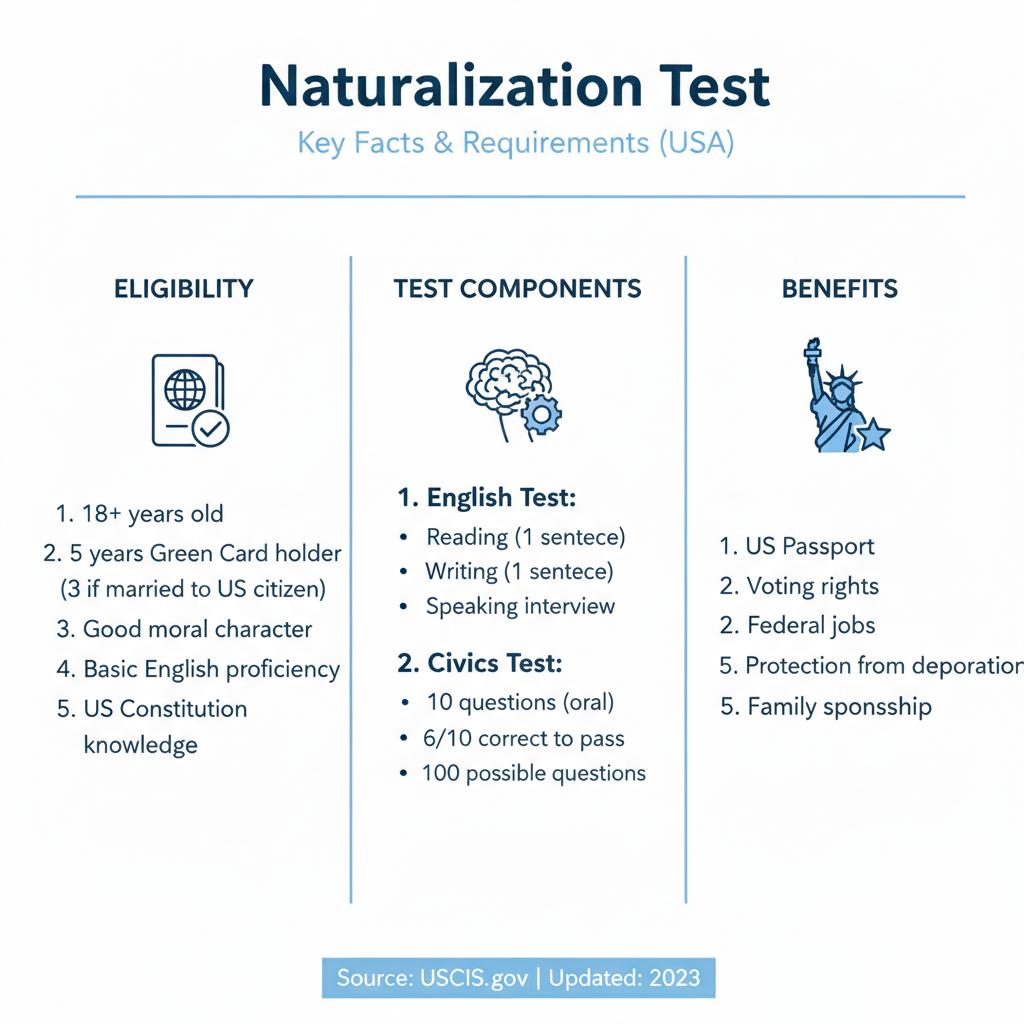
- Statutory Period: The specific period of continuous residence and physical presence in the U.S. required before applying for naturalization (typically 5 years, or 3 years for spouses of U.S. citizens).
Facing the New Naturalization Test? Don't navigate the changes alone. Imigrar's experienced immigration attorneys in Orlando can help you understand the new requirements and prepare effectively. Call us today at +1 786-791-3106 for a free consultation. Se Habla Español.
Current Naturalization Law: The Foundation
While the Naturalization Test is evolving, the fundamental legal framework governing U.S. citizenship remains steadfast. The process of naturalization is governed by federal law, primarily the Immigration and Nationality Act (INA). Understanding these foundational laws is crucial, as they define who is eligible for citizenship and what criteria must be met, regardless of the test format.
Federal requirements
The main federal requirements for naturalization are outlined in various sections of the INA, particularly INA Section 312 concerning English language and civics knowledge, and INA Section 316 for general eligibility. To be eligible for naturalization, most applicants must meet the following criteria:
- Age: Be at least 18 years old at the time of filing Form N-400, Application for Naturalization.
- Lawful Permanent Resident Status: Be a lawful permanent resident (Green Card holder) for at least 5 years (or 3 years if married to a U.S. citizen and meeting specific requirements).
- Continuous Residence and Physical Presence:
- Have resided continuously in the U.S. for at least 5 years (or 3 years if married to a U.S. citizen) immediately preceding the filing of Form N-400.
- Be physically present in the U.S. for at least half of that statutory period (e.g., 30 months out of 5 years, or 18 months out of 3 years).
- Reside for at least 3 months in the state or USCIS district where the application is filed. For Central Florida residents, this means residing in the jurisdiction of the Orlando USCIS Field Office.
- Good Moral Character: Demonstrate good moral character for the statutory period (3 or 5 years) leading up to the application and up to the time of naturalization. This includes having no serious criminal record and adhering to U.S. laws.
- Attachment to the Principles of the U.S. Constitution: Show a commitment to the principles and ideals of the U.S. Constitution.
- English Language Proficiency: Be able to read, write, and speak basic English. There are some exceptions for age and length of residence (e.g., the "50/20" and "55/15" rules, which refer to being 50 or 55 years old and having 20 or 15 years of permanent residency, respectively).
- Knowledge of U.S. History and Government (Civics): Demonstrate knowledge and understanding of the fundamentals of U.S. history, and of the principles and form of government of the United States. This is the part of the test undergoing the 2026 changes.
- Oath of Allegiance: Be willing to take the Oath of Allegiance to the United States.
For more detailed information on these requirements, always refer to the USCIS official website.
Florida-specific considerations
While the requirements for naturalization are federal, the application process is administered locally through USCIS Field Offices. For applicants residing in Central Florida, your interview will typically be conducted at the Orlando USCIS Field Office. It's important to understand that while there are no Florida-specific laws governing naturalization eligibility, the local office processes thousands of applications annually. Familiarity with local resources, such as community centers offering citizenship classes, and the general processing times for the Orlando office (which can be checked at USCIS Processing Times) can be beneficial. The staff at the Orlando office will be implementing the new test procedures, so staying informed about any local advisories is also wise. Our team at Imigrar, located in Orlando, is intimately familiar with the local USCIS procedures and can provide tailored advice for your application.
How to Apply for Naturalization: A Complete Step-by-Step Guide
The naturalization process can seem daunting, especially with upcoming test changes. However, by breaking it down into manageable steps, you can navigate it successfully. This guide outlines the typical process, highlighting where the 2026 changes will come into play.
1) Determine Your Eligibility
Before you even begin filling out forms, it’s crucial to confirm you meet all the fundamental eligibility requirements. This includes your age, length of lawful permanent residency, continuous residence and physical presence, and good moral character.
- Required Documents for Eligibility Assessment:
- Your Green Card (Form I-551)
- Proof of dates of entry/exit from the U.S. (travel records)
- Marriage certificate (if applying under the 3-year rule)
- Divorce decrees or death certificates for previous spouses (if applicable)
- Birth certificates of your children (if applicable)
Reminder: Carefully review the continuous residency rules. Absences from the U.S. for longer than 6 months but less than 1 year may break your continuous residency. Absences of 1 year or more automatically break it, requiring you to restart the statutory period (with some exceptions).
2) Prepare and File Form N-400, Application for Naturalization
This is the core application form. It’s extensive and requires detailed information about your personal history, residency, employment, family, and good moral character. Accuracy is paramount.
- Key Information and Documents for Form N-400:
- Personal information (name, address, date of birth)
- Residence history for the past 5 years (or 3 years)
- Employment history for the past 5 years (or 3 years)
- Travel history (all trips outside the U.S. for the past 5 years/3 years, including dates)
- Marital history and information about current/previous spouses
- Information about your children
- Criminal history (even minor offenses)
- Selective Service registration (for males who lived in the U.S. between ages 18-26)
- Copies of your Green Card (front and back)
- Two passport-style photos (if filing by mail; online applications may require digital photos later)
- Application fee (or fee waiver request on Form I-912)
Warning: Any inaccuracies or omissions can lead to delays or denial. It’s highly recommended to consult with an immigration attorney to ensure your Form N-400 is completed correctly and all necessary supporting documents are included. You can find the latest version of the form at USCIS Forms.
3) Attend Your Biometrics Appointment
After filing Form N-400, USCIS will send you an appointment notice (Form I-797C, Notice of Action) for a biometrics appointment at an Application Support Center (ASC). At this appointment, your fingerprints, photograph, and signature will be collected. These are used for background checks and to verify your identity.
- What to Bring:
- The original biometrics appointment notice
- A valid photo identification (e.g., Green Card, driver's license, passport)
Tip: Do not miss this appointment. If you have a valid reason to reschedule, follow the instructions on your notice immediately.
4) Prepare for the Naturalization Interview (English & Civics Test)
This is where the 2026 changes become critical. Your interview will include both an English test and a civics test.
- English Test: You will be assessed on your ability to:
- Speak English: The USCIS officer will evaluate your ability to speak English during your interview. The new test may incorporate more interactive elements here.
- Read English: You will need to read one out of three sentences correctly.
- Write English: You will need to write one out of three sentences correctly.
- Civics Test: This is the portion undergoing the most significant changes for 2026.
- Current Test (prior to 2026): You are asked up to 10 questions from a list of 100 civics questions. You must answer 6 correctly to pass.
- New Test (2026 and beyond): While the exact list of questions and format are still being finalized, expectations are that the new test will likely feature:
- More scenario-based questions that require critical thinking rather than simple recall. For example, instead of "What is the capital of your state?", you might be asked to describe how a bill becomes law, or the responsibilities of different branches of government in a hypothetical situation.
- A potentially expanded question bank.
- A more interactive approach to assessing understanding.
Important: Start studying early. Utilize official USCIS study materials, and for the new test, focus on understanding concepts rather than just memorizing answers. Websites like USCIS Study Materials are your best resource.
5) Attend Your Naturalization Interview
Your interview will be conducted by a USCIS officer. They will review your Form N-400, ask questions to verify your eligibility, conduct the English and Civics tests, and confirm your good moral character.
- What to Bring to the Interview:
- Your interview appointment notice
- Your Green Card
- Your passport and all travel documents
- State-issued identification (e.g., driver's license)
- Originals of all documents submitted with Form N-400 (e.g., marriage certificates, divorce decrees, birth certificates, tax returns, selective service letter, court disposition records)
- Any updated documents or information since filing your application
- Evidence of continuous residence and good moral character (e.g., utility bills, leases, tax transcripts for the statutory period)
Tip: Be honest, polite, and answer all questions truthfully. If you don't understand a question, ask the officer to rephrase it.
6) Receive a Decision and Attend the Oath Ceremony
After your interview, the officer will typically inform you whether your application is recommended for approval, continued, or denied.
- Approval: If approved, you will receive a "Notice of Oath of Allegiance Ceremony" (Form N-445).
- Continuation: If some information is missing or further review is needed, your case might be "continued." You may receive a Request for Evidence (RFE) or be asked to return for a second interview.
- Denial: If denied, you will receive a written explanation and information on how to appeal the decision (Form N-336, Request for a Hearing on a Decision in Naturalization Proceedings).
The Oath of Allegiance Ceremony is the final step. You will return your Green Card and receive your Certificate of Naturalization, officially becoming a U.S. citizen. For Central Florida residents, oath ceremonies are often held at the Orlando USCIS Field Office or other designated locations in the area.
Applying for Citizenship in Orlando? The team at Imigrar can provide comprehensive support, from initial eligibility assessment to preparing you for the new Naturalization Test. Call +1 786-791-3106 today for your free consultation. Se Habla Español.
Practical Steps You Can Take Today
With the 2026 Naturalization Test changes approaching, proactive preparation is key. Don't wait until the last minute to begin your journey to U.S. citizenship. Here are practical steps you can take right now to set yourself up for success:
Actionable Checklist:
- Review Eligibility Carefully: Double-check all naturalization requirements, especially your continuous residence and physical presence. Use a personal calendar or travel log to track all your entries and exits from the U.S. If you're unsure, seek legal advice immediately.
- Start Studying NOW for the Civics Test: Even if the exact new questions aren't fully released, begin by thoroughly understanding the current 100 civics questions. More importantly, focus on the *concepts* behind the answers. For example, don't just memorize "What are the two parts of the U.S. Congress?" but understand the *function* and *powers* of the Senate and House of Representatives. This deeper understanding will be invaluable for the new, scenario-based questions.
- Improve Your English Proficiency: The English test will remain a core component. Practice speaking, reading, and writing English daily. Watch English news, read English books/newspapers, and engage in conversations. Consider taking English as a Second Language (ESL) classes if needed.
- Gather All Required Documents: Start compiling originals and copies of every document listed in Step 2 of the guide. Organize them meticulously. This includes your Green Card, passports, marriage/divorce certificates, tax returns, and any court or police records.
- Consult with an Immigration Attorney: This is perhaps the most crucial step. An experienced attorney, especially one familiar with the Orlando USCIS Field Office, can assess your eligibility, help you correctly complete Form N-400, advise on potential issues (like travel absences or minor infractions), and guide you on preparing for the new test format.
- Check USCIS Processing Times: Regularly monitor the USCIS Processing Times for the Orlando Field Office to get an idea of how long your application might take. This helps manage expectations.
Document Preparation Guidance:
Organization is paramount. Create a dedicated folder or binder for your naturalization application. Label sections clearly for each type of document. Make sure to have both original documents (for your interview) and high-quality photocopies (to submit with your application). Do not staple documents unless specifically instructed by USCIS. When submitting your application, organize documents in the order specified in the Form N-400 instructions. Keep a complete copy of your entire application package for your records.
Timeline Expectations:
The naturalization process typically takes anywhere from 6 to 24 months, or even longer, from filing Form N-400 to attending the Oath Ceremony. Processing times vary based on the specific USCIS Field Office (e.g., Orlando vs. another city) and the current workload. With the 2026 test changes, there might be initial fluctuations as USCIS implements the new procedures. Applying sooner rather than later could mean you take the current test, but there's no guarantee if your interview falls within the transition period. Important: The 3-month residency requirement in the district where you apply means you should live in Central Florida for at least 90 days before filing your application with the Orlando USCIS Field Office.
How Imigrar Helps Immigrants in Orlando
Navigating the complexities of U.S. immigration law, especially with significant changes like the upcoming Naturalization Test revisions, requires expert guidance. At Imigrar, we are more than just legal advisors; we are dedicated advocates committed to helping families achieve their American dream. Based right here in Orlando, Florida, we serve clients not just in Central Florida, Orange County, and along the I-4 corridor, but nationwide, ensuring that every individual receives the personalized attention and strategic advice they deserve.
Our experience and expertise in naturalization cases are extensive. We understand the nuances of eligibility requirements, the intricacies of Form N-400, and the importance of meticulous document preparation. With the 2026 Naturalization Test changes, our team is staying abreast of all developments, ensuring our clients are fully prepared for the new civics questions and interactive assessment styles. We don't just help you fill out forms; we empower you with the knowledge and confidence to succeed.
From your initial eligibility assessment to preparing you for your interview at the Orlando USCIS Field Office, and even assisting with any post-interview requests, Imigrar is by your side. Our goal is to simplify the process, minimize stress, and maximize your chances of a successful outcome, always upholding our tagline: "Keep Families Together."
We believe that everyone deserves access to quality legal advice, which is why we offer a free consultation. This is your opportunity to discuss your unique situation, understand the implications of the new test, and learn how our dedicated team can support you. We are proud to offer our services in both English and Spanish, ensuring clear communication and comfortable interactions. Se Habla Español.
Don't let the upcoming changes deter you from your path to citizenship. Let Imigrar be your trusted partner. Call us today.