


The journey to U.S. citizenship is a momentous one, a testament to dedication, perseverance, and a deep commitment to the American dream. For many, the final hurdle is the naturalization test—a crucial step demonstrating an applicant’s understanding of U.S. history, government, and the English language. As of today, May 5, 2026, significant updates to this test are either already in effect or being rolled out, bringing new dimensions to the application process. At Imigrar, your trusted immigration law firm in Orlando, Florida, we are dedicated to providing you with the most current, accurate, and actionable information to help you navigate these changes successfully and keep families together.
Need Help? Our Orlando immigration team is ready to assist. Call +1 786-791-3106 for a free consultation, or message us online. Se Habla Español.
The reporting that sparked this guide
This comprehensive guide is prompted by recent discussions and official announcements regarding the evolution of the U.S. Naturalization Test. Staying informed is the first step toward successful naturalization. You can find more information through official government channels and news outlets covering these critical developments:
Naturalization Test Changes Coming in 2026 (Citizenship)
What This News Means for Immigrants in Orlando and Across Florida
For individuals and families across the nation, and particularly for the vibrant immigrant communities in Orlando and throughout Florida, the news of impending or recently implemented changes to the naturalization test carries significant weight. These updates are not merely procedural; they represent an evolution in how the U.S. government assesses an applicant's readiness for citizenship, demanding a more comprehensive and nuanced understanding of American civics.
Why this news is showing up now
The discussion and implementation of the 2026 Naturalization Test changes stem from a continuous effort by U.S. Citizenship and Immigration Services (USCIS) to modernize and enhance the naturalization process. Historically, the civics test has undergone periodic reviews and revisions to ensure its relevance and effectiveness. The 2020 civics test, which was later reverted, served as a precursor to the current changes, highlighting USCIS's interest in a more interactive and analytical assessment. The current iteration, rolling out in 2026, is the result of pilot programs and extensive research aimed at developing a test that measures a deeper understanding of civic principles rather than just rote memorization. USCIS has been transparent about its intentions to create a test that better reflects an applicant's ability to participate meaningfully in American civic life. The current timeline suggests that after extensive testing and feedback, these changes are now being formalized and integrated into the naturalization process, making them a pressing concern for anyone planning to apply for citizenship in the near future.
How it can affect Florida residents
For the diverse population of Florida, from the bustling metropolis of Miami to the family-friendly communities of Orlando and the Gulf Coast cities, these changes have direct implications. Florida is home to millions of immigrants, many of whom are on their path to becoming U.S. citizens.
- Increased Preparation Demand: The anticipated shift towards more interactive and scenario-based questions means that simply memorizing a list of facts will likely be insufficient. Applicants in Florida will need to engage with the material more deeply, understand the "why" behind government structures, and be able to apply their knowledge.
- Local Resource Utilization: Communities across Florida, including Orlando, offer various resources for naturalization preparation. With the new test format, the demand for updated study materials, classes, and legal guidance is expected to rise. The Orlando USCIS Field Office, like others across the state, will be administering this new test, making local preparation resources invaluable.
- Potential for Delays (Initially): As any new system rolls out, there can be initial adjustments. While USCIS strives for seamless transitions, applicants might experience temporary shifts in processing times as examiners become fully accustomed to the new test format. However, this is usually short-lived.
- Enhanced Attorney Role: The complexity of the new test structure further emphasizes the importance of legal counsel. An experienced immigration attorney, like those at Imigrar, can help Florida residents understand the nuances of the new test, identify potential challenges, and ensure their entire application package is robust and compliant.
Whether you reside in Orange County, along the I-4 corridor, or anywhere else in the Sunshine State, understanding these changes and preparing effectively is paramount to achieving your dream of U.S. citizenship.
What Naturalization Test Changes Are (and Why They Matter)
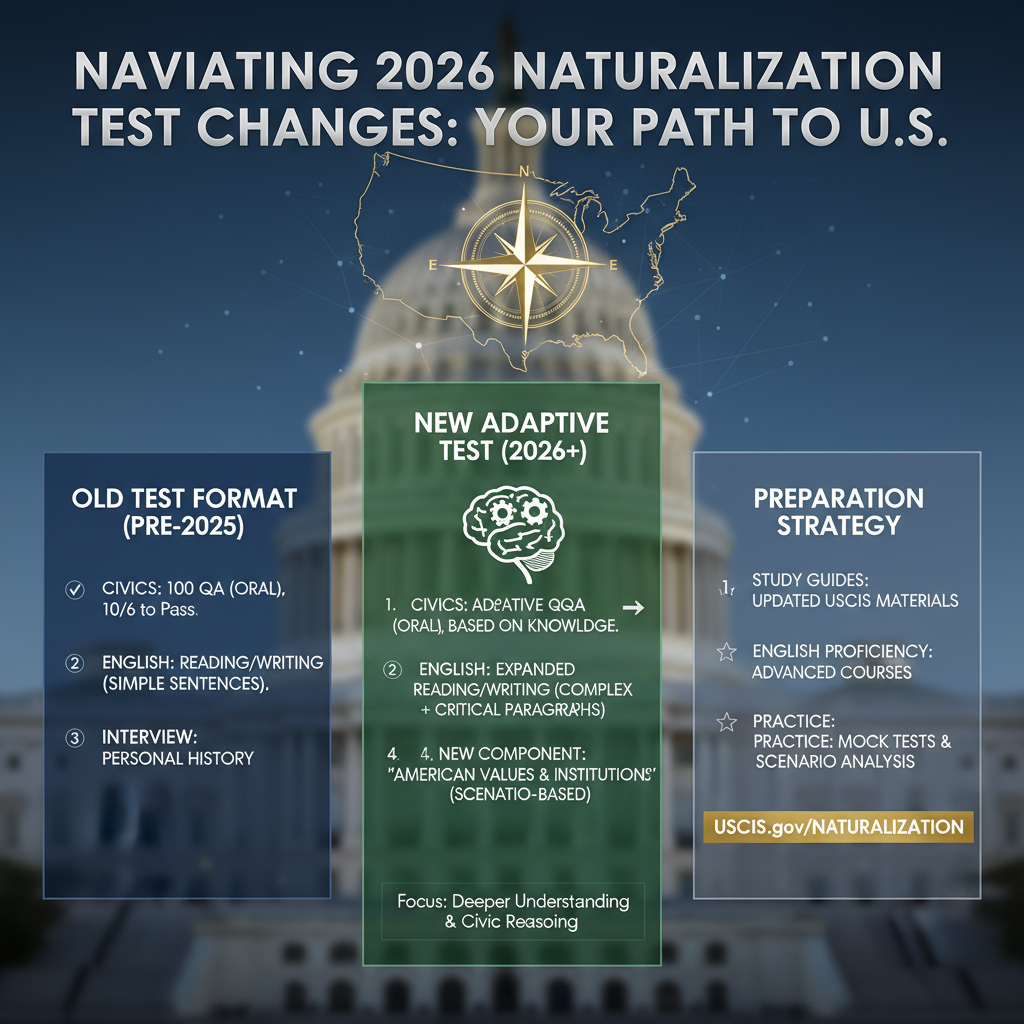
The naturalization test is a pivotal component of the journey to becoming a U.S. citizen. It assesses an applicant's proficiency in English and their knowledge of U.S. history and government (civics). The changes coming in 2026 primarily focus on enhancing the civics portion of the test, moving towards a more comprehensive and interactive assessment.
A plain-English definition
In simple terms, the "Naturalization Test Changes Coming in 2026" refers to updates in how USCIS evaluates whether an applicant for U.S. citizenship understands American civics and can communicate in English. For the civics part, instead of just asking questions that have one right answer, the new test is designed to be more like a conversation. It will likely include scenario-based questions where you'll be asked to explain your understanding of civics concepts and how they apply to real-world situations, rather than just reciting facts. For example, you might be shown images or given short scenarios and asked to identify the U.S. government principles they represent. The English test components (reading and writing) may also see adjustments, possibly incorporating more complex sentence structures or vocabulary to assess a deeper level of language proficiency. These changes matter because they require a different, more in-depth type of preparation from applicants, moving beyond simple memorization to a true comprehension of American principles.
Key terms you need to know
Navigating the naturalization process requires familiarity with specific terminology. Here are some key terms, especially relevant with the new test changes:
- Naturalization: The process by which U.S. citizenship is conferred upon a foreign citizen or national after he or she has fulfilled the requirements established by Congress in the Immigration and Nationality Act (INA).
- U.S. Citizenship: The legal status of being a citizen of the United States, granting rights such as voting, holding federal office, and protection under U.S. law.
- Civics Test: A component of the naturalization test that assesses an applicant's knowledge of U.S. history and government. The 2026 changes specifically target the format and depth of this portion.
- English Proficiency Test: Another component of the naturalization test that evaluates an applicant's ability to read, write, and speak basic English. While the primary focus of 2026 changes is civics, aspects of the English test may also be refined.
- USCIS: U.S. Citizenship and Immigration Services, the federal agency responsible for administering immigration and naturalization benefits.
- Form N-400: The Application for Naturalization, the primary form filed by individuals seeking U.S. citizenship.
- Oath of Allegiance: The final step in the naturalization process, where applicants swear loyalty to the United States and renounce allegiance to any foreign state or sovereignty.
- Continuous Residence: A requirement for naturalization, meaning the applicant has maintained residence in the U.S. for a specified period (typically 5 years, or 3 years if married to a U.S. citizen).
- Good Moral Character: A legal requirement for naturalization, meaning the applicant has adhered to certain moral standards during their period of continuous residence.
Understanding these terms is fundamental to comprehending the naturalization process and the impact of the upcoming changes.
Current Immigration Law: The Foundation for Naturalization
The process of naturalization is governed by federal law, primarily the Immigration and Nationality Act (INA). While the naturalization test is undergoing changes, the foundational legal requirements for eligibility remain largely consistent. Understanding these is critical before you even consider taking the test.
Federal requirements for Naturalization
To be eligible to apply for naturalization, applicants must meet several federal criteria outlined in the INA. These are universal across the United States, including for residents of Florida. The most common requirements under **INA Section 316** and **INA Section 319** include:
- Age: Be at least 18 years old at the time of filing **Form N-400**, Application for Naturalization.
- Lawful Permanent Resident (LPR) Status: Hold a Green Card for a specific period. Generally, this is 5 years. However, if you are married to a U.S. citizen and meet specific criteria, this period can be reduced to 3 years (**INA Section 319(a)**).
- Continuous Residence: Have resided continuously in the U.S. as an LPR for at least 5 years (or 3 years if married to a U.S. citizen) immediately preceding the date of filing **Form N-400**. You must also have resided for at least 3 months in the state or USCIS district where you apply.
- Physical Presence: Have been physically present in the U.S. for at least half of the required continuous residence period (e.g., 30 months for the 5-year period, or 18 months for the 3-year period).
- Good Moral Character: Demonstrate good moral character for the statutory period (5 or 3 years) leading up to your application and until you take the Oath of Allegiance. This involves reviewing your criminal record, tax compliance, and other aspects of your conduct.
- Attachment to the Constitution: Demonstrate an attachment to the principles of the U.S. Constitution and be willing to take the Oath of Allegiance.
- English and Civics Knowledge: Be able to read, write, and speak basic English, and possess knowledge and understanding of U.S. history and government. This is where the 2026 test changes specifically apply (**INA Section 312**). Certain exemptions apply for age and length of LPR status (e.g., individuals aged 50 or 55 with 20 or 15 years as an LPR, respectively, may be exempt from the English test; those aged 65 with 20 years as an LPR may take a simpler civics test).
All these requirements are meticulously reviewed by USCIS during the application process. For detailed information and official forms, always refer to the USCIS official website.
Florida-specific considerations
While the laws governing naturalization are federal, the practical aspects of applying can have local considerations, especially for residents of Florida:
- USCIS Field Offices: Florida is served by multiple USCIS Field Offices, including locations in Orlando, Miami, and Tampa. Your interview will typically be scheduled at the field office closest to your residence. For Central Florida residents, this will be the Orlando USCIS Field Office. The efficiency and scheduling at these offices can vary, impacting your overall timeline.
- Community Resources: Florida's diverse communities, including those in Orlando and surrounding Orange County, often have non-profit organizations and educational institutions that offer naturalization preparation classes. These resources can be particularly helpful for preparing for the new, more interactive civics test.
- Legal Support: Given Florida's large immigrant population, there are many legal professionals. Choosing an experienced immigration law firm like Imigrar, which understands both federal law and local practicalities, is crucial for navigating the process effectively, especially with the 2026 changes.
- Language Access: Florida is a bilingual state. Imigrar proudly offers services in both English and Spanish (Se Habla Español), ensuring that language is not a barrier to understanding your naturalization journey.
Understanding these local nuances can help you better prepare for your naturalization application and interview in Florida.
Is the new Naturalization Test making you anxious? Don't face it alone. Imigrar's experienced attorneys in Orlando are here to guide you through every step. Call +1 786-791-3106 today for a free consultation. Se Habla Español.
How to Navigate the New Naturalization Test: A Complete Step-by-Step Guide
The changes to the naturalization test in 2026 require a proactive and informed approach. This step-by-step guide will walk you through the process, with a special focus on preparing for the updated civics and potentially English components.
1) Determine Your Eligibility and Gather Initial Documents
Before you even begin filling out forms, confirm you meet all the fundamental eligibility requirements for naturalization. This initial assessment is crucial to avoid wasting time and resources.
- Check your Green Card status: Ensure you have been a Lawful Permanent Resident for the required period (generally 5 years, or 3 years if married to a U.S. citizen).
- Verify continuous residence and physical presence: Calculate your time spent inside and outside the U.S. to meet the statutory requirements.
- Assess your good moral character: Reflect on your history for any potential issues, such as criminal convictions, tax delinquencies, or failure to register for Selective Service (if applicable). It’s **Important:** to address any red flags proactively with legal counsel.
- Required Documents for Eligibility Check:
- Your Green Card (Form I-551)
- Passport(s) and travel history records
- Marriage certificate (if applying under the 3-year rule)
- Divorce decrees or death certificates for previous spouses (if applicable)
- Birth certificates of your children
- Tax returns for the past 5 (or 3) years
- Selective Service registration number (for males aged 18-26)
- Certified copies of any arrest records, court dispositions, or police reports (even if charges were dismissed or expunged).
2) Prepare and File Form N-400, Application for Naturalization
The **Form N-400** is the cornerstone of your naturalization application. Accuracy and completeness are paramount.
- Fill out the form meticulously: Answer every question truthfully and completely. Any omissions or errors can lead to delays or even denial. If a question doesn't apply, write "N/A."
- Review carefully: Double-check all dates, addresses, and personal information. It's highly recommended to have an immigration attorney review your form before submission.
- Pay the filing fee: As of May 2026, the fee for **Form N-400** is subject to change, so always check the latest fee schedule on the USCIS Forms page. If eligible, you may apply for a fee waiver using **Form I-912**.
- Submit supporting documents: Include copies of all required supporting documents. **Reminder:** Do not send original documents unless specifically requested by USCIS.
- Required Documents for N-400 Filing:
- Completed and signed **Form N-400**
- Two passport-style photos (if required; check latest instructions)
- Copy of your Green Card (front and back)
- Copy of your marriage certificate (if applicable)
- Copy of your divorce decrees or death certificates (if applicable)
- Payment for the filing fee or approved **Form I-912**
- Copies of any court documents related to arrests or convictions.
3) Attend Your Biometrics Appointment
After filing **Form N-400**, USCIS will send you an appointment notice for biometrics. This is a mandatory step for background checks.
- What happens: You will have your fingerprints, photograph, and signature taken. These are used to conduct criminal background checks and verify your identity.
- Be punctual: Arrive on time for your appointment.
- Required Documents for Biometrics:
- Your Biometrics Appointment Notice (Form I-797C)
- Valid photo identification (e.g., Green Card, state ID, passport)
4) Prepare for the Naturalization Interview and the New Civics Test
This is where the 2026 changes become most relevant. Effective preparation for the new, more interactive test format is crucial.
- Understand the New Civics Test Format: The 2026 civics test is expected to move beyond simple recall. Anticipate scenario-based questions where you'll need to explain concepts, connect historical events to current government functions, and demonstrate a deeper understanding of American democracy. For instance, instead of just naming a branch of government, you might be asked to describe its function and give an example of its power, possibly even in response to an image or short reading.
- Focus on Concepts, Not Just Facts: While knowing the 100 civics questions is still a foundation, the new test emphasizes comprehension. Study the "why" and "how" behind government structures, rights, and responsibilities.
- Practice English Comprehension and Expression: The English test components (reading and writing) may also be adjusted. Practice reading and understanding more complex sentences and writing coherent responses. Engage in conversations about U.S. history and government to improve your spoken English and ability to articulate your understanding.
- Utilize Official USCIS Study Materials: USCIS is expected to release updated study guides and practice tests that reflect the new format. These will be your primary and most reliable resources. Check the USCIS official website regularly for these updates.
- Seek Professional Guidance: An immigration attorney can provide tailored study strategies, conduct mock interviews specifically designed for the new test format, and help you understand complex civics concepts.
- Required Documents for Interview Preparation:
- All original documents submitted with your **Form N-400** (Green Card, passports, marriage certificates, court documents, etc.)
- Any updated documents (e.g., new passport, updated tax returns)
- Your **Form N-400** application (review it thoroughly)
- USCIS study materials for the new civics test
- Proof of any changes since filing (e.g., new address, recent travel, new employment).
5) Attend Your Naturalization Interview
The interview is your opportunity to demonstrate your eligibility and knowledge. Be prepared, polite, and honest.
- The Interview Process: The USCIS officer will review your **Form N-400** with you, ask questions about your background, and administer the English and civics tests. With the new civics test, be ready for a more interactive dialogue.
- English Test: You'll be asked to read one of three sentences correctly and write one of three sentences dictated by the officer.
- Civics Test: You will be asked up to 20 questions from the 100 civics questions list, but in the new interactive format. You must answer 12 correctly to pass. If you fail, you will be given a second opportunity.
- Be Truthful: Answer all questions honestly and to


