The landscape of immigration law is constantly evolving, and for Deferred Action for Childhood Arrivals (DACA) recipients, staying informed is not just important – it's critical. As of May 20, 2026, the DACA program continues to operate under significant legal scrutiny and injunctions, meaning that while renewals are generally being processed, new initial applications remain largely on hold. This comprehensive guide from Imigrar, your trusted immigration law firm in Orlando, Florida, is designed to provide DACA recipients and their families with the most up-to-date information, practical advice, and a clear roadmap for navigating the renewal process.
Our mission at Imigrar is to "Keep Families Together," and we understand the profound impact DACA has on hundreds of thousands of lives across the United States, including countless individuals and families right here in Central Florida. We are here to help you understand these complex updates and ensure your future is secure.
The reporting that sparked this guide
This guide is informed by the latest updates concerning the DACA program, which continues to be a prominent topic in immigration news. For ongoing developments and official announcements, we refer to reliable sources such as DACA Program Updates and Renewal Information (USCIS) and the official USCIS website.
What This News Means for Immigrants in Orlando and Across Florida
For the approximately 24,000 DACA recipients in Florida, and many more across the nation, staying current on program updates is paramount. The continuous legal challenges and administrative directives surrounding DACA create an environment of uncertainty, yet understanding the current operational status is key to maintaining your deferred action and work authorization.
Why this news is showing up now
The DACA program, established in 2012, has been a subject of intense legal and political debate for years. The "news" around DACA is often a reflection of ongoing court cases, such as Texas v. United States, which has imposed a nationwide injunction preventing USCIS from approving new initial DACA applications. While the program's legality is still being challenged, federal courts have generally allowed USCIS to continue processing DACA renewal applications for eligible individuals.
Periodic updates from USCIS or judicial rulings often clarify the scope of these injunctions, adjust processing guidelines, or reiterate existing policies. These updates are crucial because they dictate who can apply, what forms are required, and what protections are currently in place. For DACA recipients, any news related to the program's status directly impacts their ability to live and work in the U.S. without fear of deportation.
How it can affect Florida residents
Florida is home to a significant population of DACA recipients, many of whom contribute to our state's economy and vibrant communities. For these individuals, the constant state of flux surrounding DACA can be particularly stressful. Here’s how these updates can specifically affect Florida residents:
- Uncertainty and Planning: The ongoing legal battles mean DACA recipients live with a degree of uncertainty about the program's long-term future. This impacts critical life decisions, from educational pursuits to career planning and even purchasing a home.
- Driver's Licenses and State Benefits: Florida generally allows DACA recipients to obtain driver's licenses and state identification cards, but continued eligibility relies on maintaining valid DACA status and a current Employment Authorization Document (EAD). Any disruption to DACA renewals could jeopardize this.
- Employment Stability: DACA provides work authorization, which is vital for employment. Delays in renewal processing or potential program changes could lead to job loss or instability for DACA recipients and their families in Orlando and across the state.
- Educational Opportunities: While Florida has made some strides in providing in-state tuition opportunities for certain undocumented students, DACA status can still play a role in accessing financial aid and certain educational programs.
- Local Community Impact: DACA recipients are integral members of our Central Florida communities, contributing to local businesses, schools, and cultural life. The well-being of these individuals directly impacts the strength and diversity of places like Orlando, Kissimmee, and Orange County.
Understanding these impacts underscores the importance of prompt and accurate DACA renewal, and why seeking expert legal guidance from a firm like Imigrar is so essential.
Need Help Navigating DACA Renewal? Don't face the complexities alone. Our Orlando immigration team at Imigrar is ready to assist you every step of the way. Call +1 786-791-3106 for a free consultation, or message us online. Se Habla Español.
What DACA Is (and Why It Matters)
To fully grasp the implications of DACA updates, it's essential to understand the program itself. While often discussed, its specific details can be confusing for non-lawyers.
A plain-English definition
DACA stands for Deferred Action for Childhood Arrivals. It is a discretionary immigration policy established in 2012 by the Department of Homeland Security (DHS) under the Obama administration. DACA provides certain eligible young immigrants who came to the United States as children with two main benefits:
- Deferred Action: This means the government agrees to "defer" (postpone) any deportation action against you for a period, typically two years. It's not a grant of lawful status or a path to citizenship, but rather a temporary protection from removal.
- Work Authorization: Along with deferred action, DACA recipients are eligible to apply for an Employment Authorization Document (EAD), which allows them to legally work in the U.S. for the period of their deferred action.
Important: DACA does not provide a path to a green card or U.S. citizenship. It is a temporary, renewable benefit that offers stability and opportunities for those who qualify.
Key terms you need to know
Navigating DACA requires understanding specific terminology:
- Deferred Action: A form of prosecutorial discretion that allows an individual to remain in the U.S. for a set period without being subject to deportation. It does not confer legal status.
- Employment Authorization Document (EAD): Also known as a work permit, this card proves your authorization to work legally in the U.S. It is designated by Form I-766.
- Dreamers: A term commonly used to refer to young undocumented immigrants who were brought to the U.S. as children. Many DACA recipients are referred to as Dreamers, though the term also encompasses those who might qualify for the proposed DREAM Act legislation.
- Unlawful Presence: Being in the U.S. without authorization. DACA grants protection from accruing unlawful presence for the period of deferred action.
- Prosecutorial Discretion: The authority of an agency (like DHS/USCIS) to decide how to enforce the law, including whether to pursue deportation against an individual. DACA is an exercise of this discretion.
- Continuously Resided: A DACA eligibility requirement meaning you have maintained your residence in the U.S. for a specified period without significant breaks.
- Initial Application: The first time someone applies for DACA. As of 2026, USCIS is generally NOT processing new initial DACA applications due to court injunctions.
- Renewal Application: An application to extend existing DACA status and work authorization for another two-year period. These are currently being processed.
- Request for Evidence (RFE): A notice from USCIS requesting additional documents or information to support your application.
- Notice of Intent to Deny (NOID): A notice from USCIS indicating their intent to deny your application and giving you an opportunity to respond before a final decision is made.
Current Immigration Law: The Foundation
DACA operates within the broader framework of U.S. immigration law, primarily the Immigration and Nationality Act (INA). While DACA itself is a policy, not a statute, its implementation and challenges are deeply rooted in existing legal precedents and administrative authority.
The legal foundation for DACA rests on the concept of prosecutorial discretion, allowing the executive branch to prioritize enforcement efforts. However, this discretion has been challenged in court, most notably in Texas v. United States. In July 2021, a federal judge in the Southern District of Texas ruled DACA unlawful, halting new initial applications. This decision was upheld by the Fifth Circuit Court of Appeals in October 2022, and further appeals are ongoing. As of May 2026, this injunction remains in effect, meaning USCIS cannot approve new initial DACA requests for individuals who have never received DACA.
Reminder: This injunction specifically affects *new* DACA applications. USCIS continues to accept and process renewal requests for current DACA recipients. For the latest official guidance, always refer to the USCIS official website.
Federal requirements for DACA Renewal
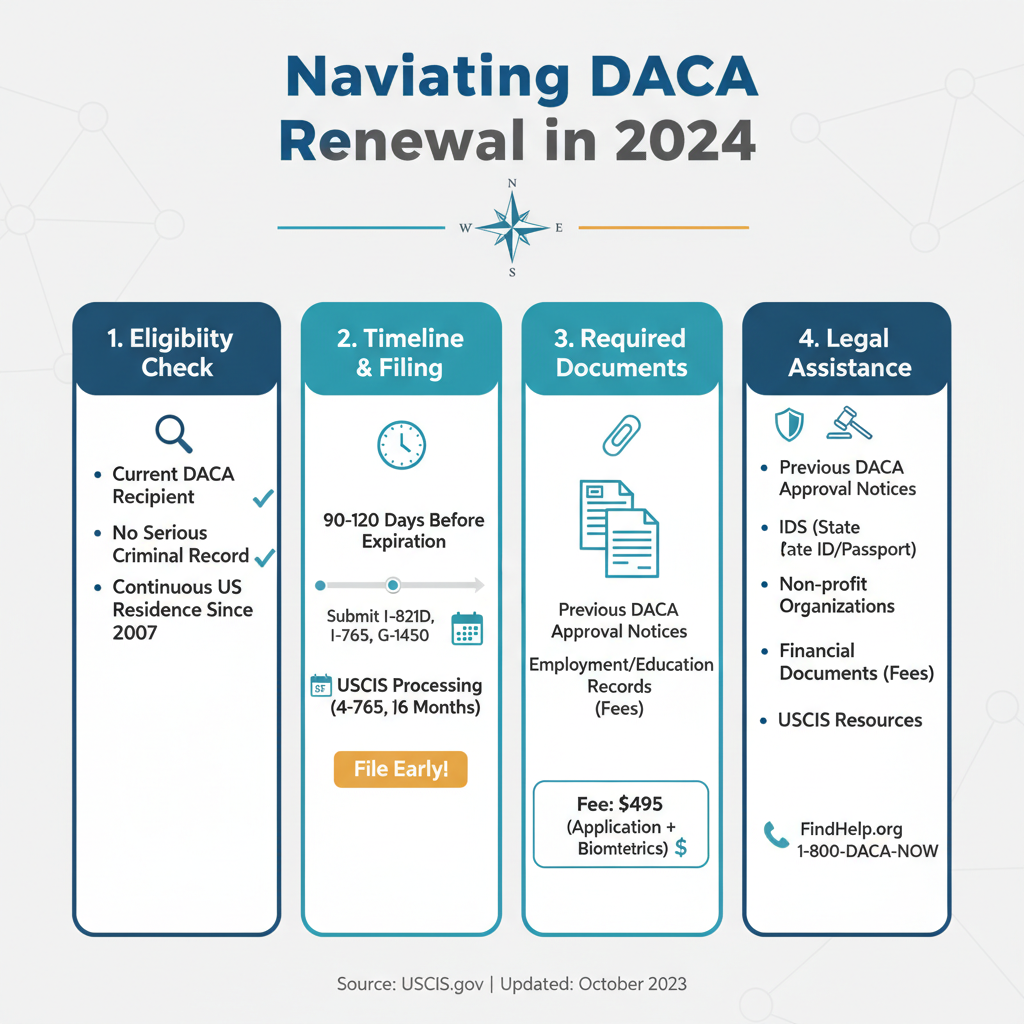
To renew DACA, you must generally meet the original DACA eligibility criteria and have continuously maintained your deferred action. The key federal requirements include:
- You must have received DACA previously.
- You must have continuously resided in the United States since you submitted your most recent DACA request that was approved.
- You must not have departed the United States on or after August 15, 2012, without advance parole.
- You must not have been convicted of a felony, a significant misdemeanor, or three or more other misdemeanors, and not otherwise pose a threat to national security or public safety.
- You must be physically present in the United States at the time of filing your renewal request and at the time of adjudication.
The forms required for renewal are Form I-821D, Consideration of Deferred Action for Childhood Arrivals; Form I-765, Application for Employment Authorization; and Form I-765 Worksheet. Ensure you are using the latest versions of these forms, available on the USCIS Forms page.
Florida-specific considerations
While DACA is a federal program, its impact can vary at the state level. In Florida, DACA recipients generally:
- Driver's Licenses: Can obtain a Florida driver's license by presenting their valid EAD (Form I-766) and other required identification. This is a critical benefit for mobility and employment, especially in sprawling areas like Central Florida.
- Higher Education: In 2014, Florida passed legislation allowing DACA recipients (and other undocumented students meeting specific residency requirements) to pay in-state tuition at public colleges and universities. This has opened significant educational doors for many Dreamers in Orlando and beyond.
- Professional Licenses: The ability to obtain certain professional licenses (e.g., in healthcare or other regulated fields) can vary by state and profession, often depending on the applicant's work authorization and social security number.
It's important to remember that state laws can change, and it's always advisable to consult with an attorney or relevant state agencies for the most current information regarding state-level benefits tied to DACA status.
How to Renew Your DACA: A Complete Step-by-Step Guide
Renewing your DACA is a meticulous process that requires attention to detail and timely submission. Here’s a complete step-by-step guide to help you navigate it.
1) Determine Your Eligibility for Renewal
Before gathering documents, confirm you meet the renewal criteria. You must have:
- Previously been granted DACA.
- Not departed the U.S. on or after August 15, 2012, without advance parole.
- Continuously resided in the U.S. since your most recent DACA approval.
- Not been convicted of a felony, a significant misdemeanor, or three or more other misdemeanors.
- Not otherwise pose a threat to national security or public safety.
Important: If you have any new arrests, charges, or convictions since your last DACA approval, even minor ones, consult with an immigration attorney immediately. These could affect your eligibility.
2) Gather Required Documents
Thorough documentation is crucial for a successful renewal. You will need:
- Copy of your most recent DACA approval notice (Form I-797).
- Copy of your most recent Employment Authorization Document (EAD, Form I-766).
- Proof of continuous residence since your last DACA approval:
- School transcripts or diplomas
- Employment records (pay stubs, W-2s, employment verification letters)
- Bank statements
- Rental agreements, utility bills
- Medical records
- Receipts, money order stubs, or other dated transactions
- Passport stamps or travel records (if you traveled with advance parole)
- Photos with dates, letters from friends/family (as supplemental evidence)
- Proof of identity: Copy of your passport, birth certificate, or state ID.
- Two passport-style photos: Taken within 30 days of filing, unmounted, color, full frontal view, white background. Write your name and A-number lightly on the back.
- Records of any criminal history (if applicable): Certified court dispositions and police reports for any arrests, charges, or convictions since your last DACA approval. Even if charges were dropped or expunged, you must disclose them.
Reminder: Make copies of all documents for your records before mailing the application. Do not send original documents unless specifically requested by USCIS.
3) Complete Required Forms
You must accurately complete three forms for DACA renewal:
- Form I-821D, Consideration of Deferred Action for Childhood Arrivals: This is the primary request for DACA. Fill out all sections carefully. Pay close attention to the criminal history section and the continuous residence section.
- Form I-765, Application for Employment Authorization: This requests your work permit. For DACA renewals, your eligibility category is usually (c)(33).
- Form I-765 Worksheet: This form provides supplemental information required for the I-765, specifically about your income, assets, and expenses.
Warning: Any inaccuracies or omissions on these forms can lead to delays or denial. If you don't understand a question, do not guess. Seek legal advice.
4) Pay the Filing Fees
As of May 2026, the combined filing fee for DACA renewal is $495. This includes:
- $85 for the biometrics services fee.
- $410 for the Employment Authorization Document (EAD) application (Form I-765).
There is no separate fee for Form I-821D. You must submit both fees together. Payment can be made by money order, personal check, cashier’s check, or by credit card using Form G-1450, Authorization for Credit Card Transactions. Make checks payable to "U.S. Department of Homeland Security." Do NOT abbreviate.
Important: Fee waivers for DACA renewal are extremely rare and generally not available. However, if you believe you qualify for an exceptional circumstance, consult with an attorney.
5) Prepare and Submit Your Application Package
Once all forms are completed, signed, and all supporting documents are gathered:
- Organize your package: Place the check/money order or Form G-1450 on top, followed by Form I-821D, Form I-765, Form I-765 Worksheet, two passport photos in a small envelope clipped to the I-765, and then your supporting documents. Use tabs for different sections if helpful.
- Mail your application: The mailing address depends on your state of residence. For Florida residents, you will typically mail your DACA renewal application to the USCIS Chicago Lockbox. Always double-check the "Where to File" section on the USCIS website for Forms I-821D and I-765, as addresses can change.
- Use certified mail: Send your package via Certified Mail with Return Receipt Requested. This provides proof that your application was sent and received by USCIS, which is crucial for tracking purposes.
Timeline Expectation: USCIS recommends filing your DACA renewal request 120 to 150 days before your current DACA and EAD expire. This window allows ample time for processing without a lapse in your work authorization.
6) Attend Biometrics Appointment (If Required)
After submitting your application, you will likely receive a biometrics appointment notice (Form I-797C) from USCIS. This appointment will take place at an Application Support Center (ASC), such as the one serving the Orlando area. At the appointment, USCIS will collect your fingerprints, photograph, and signature. Bring the appointment notice and a valid photo ID (e.g., your EAD, passport, or state ID).
Important: Do not miss your biometrics appointment. Failure to attend without rescheduling can lead to your application being denied.
7) Monitor Your Case and Respond to RFEs
Once your application is submitted, you can monitor its status online using the receipt number provided by USCIS. Visit USCIS Case Status Online.
- Request for Evidence (RFE): If USCIS needs more information or clarification, they will send you an RFE. It is critical to respond to an RFE fully and within the specified deadline. Failure to do so will almost certainly result in a denial.
- Notice of Intent to Deny (NOID): In some cases, USCIS might issue a NOID if they are considering denying your application. This gives you a final chance to present arguments or evidence against the denial.
If you receive an RFE or NOID, contact an experienced immigration attorney immediately. Responding correctly can be complex.
Confused about your DACA renewal? Imigrar provides clear, expert guidance. Our team in Orlando helps clients nationwide navigate complex immigration processes. Get your questions answered. Call +1 786-791-3106 for a free consultation. Se Habla Español.
Practical Steps You Can Take Today
Being proactive is key to a smooth DACA renewal process. Here are actionable steps you can take today:
Actionable Checklist:
- Check Your Expiration Date: Locate your current DACA approval notice (Form I-797) and EAD card (Form I-766) to find your expiration date. Mark your calendar for 120-150 days before expiration as your target filing window.
- Start Gathering Documents: Begin collecting all necessary documents, especially proof of continuous residence since your last approval. Don't wait until the last minute.
- Review Your Criminal History: Recall any arrests, citations, or convictions, no matter how minor, since your last DACA approval. Gather all relevant court documents.
- Save for Fees: The $495 filing fee can be a significant cost. Start saving now to avoid financial stress closer to your renewal date.
- Update Your Address: If you have moved since your last DACA application, ensure your address is updated with USCIS using their online change of address tool. Failing to do so can cause you to miss important notices.
- Consult an Immigration Attorney: Even if your case seems straightforward, an attorney can review your application, identify potential issues, and ensure everything is filed correctly and on time.
Document Preparation Guidance
- Be Organized: Create a folder specifically for your DACA renewal documents. Use dividers or tabs to separate different categories (forms, identity, continuous residence, criminal history).
- Make Copies: Always make a complete copy of your entire application package before mailing it. This serves as your personal record and can be invaluable if USCIS requests additional information or if your application is lost.
- Chronological Order: When providing proof of continuous residence, arrange documents in chronological order (e.g., from oldest to newest) to make it easy for the USCIS officer to review.
- Highlight Key Information: For documents like bank statements or utility bills, you might gently highlight your name, address, and dates to draw attention to the relevant information.
Timeline Expectations
While processing times can vary, here’s a general timeline:
- 120-150 days before expiration: Ideal window to mail your renewal application.
- 2-4 weeks after mailing: Expect to receive a receipt notice (Form I-797C) from USCIS confirming they received your application.
- 4-8 weeks after mailing: Expect to receive your biometrics appointment notice.
- 2-4 weeks after biometrics: Your biometrics appointment will typically take place.
- 3-6 months from filing: Typical processing time for DACA renewals. This can fluctuate. You can check current processing times for the Orlando USCIS Field Office and other centers on the USCIS Processing Times page.
- Important: If your DACA expires while your renewal is pending, you will temporarily lose your work authorization until the renewal is approved. Filing early helps minimize this gap.
How Imigrar Helps Immigrants in Orlando
At Imigrar, we understand the profound importance of DACA for our clients and the anxieties that come with its uncertain future. Our dedicated team of immigration attorneys in Orlando is committed to providing expert, compassionate, and comprehensive legal support to DACA recipients.
Our experience and expertise
We have extensive experience navigating the complexities of DACA applications and renewals, staying abreast of every legal challenge and administrative update. Our firm regularly assists individuals throughout Orlando, Central Florida, and across the nation with their immigration needs, ensuring that their applications are accurate, complete, and filed in a timely manner. We understand the specific nuances of DACA eligibility, including continuous residence requirements, criminal history assessments, and responding to RFEs or NOIDs. We are dedicated to helping you maintain your protected status and work authorization, allowing you to continue contributing to our community and keeping your family together.
Free consultation offer
We believe that access to legal information and guidance should be available to everyone. That's why Imigrar offers a free consultation for DACA recipients seeking to understand their options or needing assistance with the renewal process. During this consultation, we can:
- Review your specific situation and eligibility.
- Explain the current legal status of DACA and what it means for you.
- Outline the step-by-step renewal process.
- Address any concerns regarding criminal history or past immigration issues.
- Discuss potential pathways beyond DACA, if applicable.
Our goal is to provide you with clarity and peace of mind. We are here to answer your questions, alleviate your concerns, and provide a clear path forward.
Se Habla Español: Our team is fully bilingual, ensuring that language is never a barrier to accessing the legal help you need. We are proud to serve the diverse immigrant communities of Orlando and beyond in both English and Spanish.