

The landscape of immigration law is constantly shifting, and few programs encapsulate this dynamic better than Deferred Action for Childhood Arrivals (DACA). For hundreds of thousands of young people across the United States, including a vibrant community in Orlando and throughout Florida, DACA has provided a lifeline—offering protection from deportation and the ability to work legally. As an expert immigration law firm in Orlando, Imigrar is dedicated to helping you understand these changes and successfully navigate your DACA renewal.
Today, 2026-03-31, we bring you the latest insights into the DACA program, focusing on the essential steps for renewal and crucial updates that could impact your future. Our goal is to provide you with a comprehensive, actionable guide that keeps families together.
Need Help Renewing Your DACA? Our Orlando immigration team is ready to assist. Don't risk your status. Call +1 786-791-3106 for a free consultation, or message us online. Se Habla Español.
The reporting that sparked this guide:
DACA Program Updates and Renewal Information (USCIS)
What This News Means for Immigrants in Orlando and Across Florida
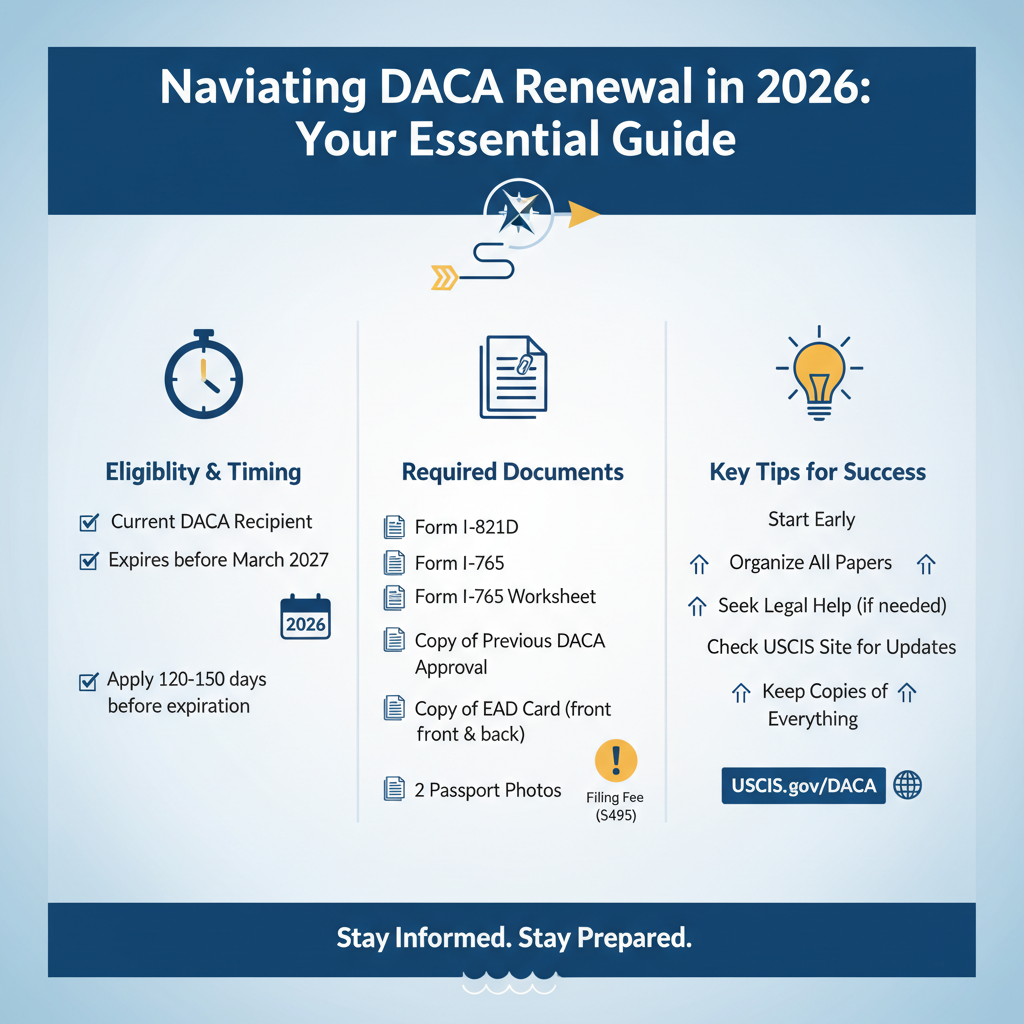
The news surrounding DACA is often a mix of legal challenges, policy debates, and the steadfast determination of its beneficiaries. While the program continues to face uncertainty in the courts and political arena, one critical fact remains: USCIS continues to accept and process DACA renewal applications. This ongoing ability to renew is paramount for the hundreds of thousands of DACA recipients, often referred to as "Dreamers," who rely on this program for their stability and ability to contribute to American society.
Why this news is showing up now
The DACA program has been embroiled in legal battles almost since its inception in 2012. These challenges have led to various injunctions, stays, and court orders that have shaped its current status. As of our current date, 2026-03-31, DACA remains in effect for renewals, but new initial applications are generally not being accepted due to ongoing litigation. The news cycle frequently highlights court decisions, legislative efforts (or lack thereof), and administrative guidance from agencies like USCIS. Each update, no matter how small, can cause significant anxiety and confusion among DACA recipients and their families.
For example, recent court rulings have affirmed the policy's existence for current recipients while maintaining the block on new applications. This creates a dual reality: continued protection for those already in the program, but no expansion for those who have since become eligible or were unable to apply previously. These legal back-and-forths are why DACA is consistently in the headlines, demanding that recipients stay vigilant and informed.
How it can affect Florida residents
Florida is home to a significant population of DACA recipients, with many residing in Central Florida, including Orlando, Tampa, and along the I-4 corridor. The program's stability directly impacts these communities. For Florida residents, DACA means:
- Work Authorization: The ability to legally work and contribute to Florida’s economy, especially in vital sectors like healthcare, education, and hospitality.
- Educational Opportunities: Access to in-state tuition at some Florida colleges and universities for DACA recipients, though specific policies can vary.
- Driver's Licenses: The ability to obtain a Florida driver's license, providing essential mobility for work, school, and family life in a state heavily reliant on personal transportation.
- Family Stability: Reduced fear of deportation, allowing families to remain together and plan for the future without constant apprehension.
- Community Engagement: Empowering young individuals to fully participate in their communities, from volunteering to civic engagement, without the shadow of uncertain immigration status.
Any changes to DACA, whether positive or negative, ripple through these aspects of life for thousands of Floridians. Understanding the renewal process is not just about paperwork; it's about preserving these critical protections and maintaining stability for individuals and their families across the state.
Concerned about DACA changes? Imigrar understands your worries. Our experienced team serves clients nationwide from our Orlando office. Call +1 786-791-3106 today for a free, confidential consultation. Se Habla Español.
What DACA Is (and Why It Matters)
The Deferred Action for Childhood Arrivals (DACA) program was established by the Department of Homeland Security (DHS) in 2012. It is a discretionary policy that provides certain eligible young undocumented immigrants with temporary relief from deportation and work authorization. It is crucial to understand that DACA is not a path to U.S. citizenship or lawful permanent residency (a green card). Instead, it offers a temporary, renewable two-year period of deferred action.
A plain-English definition
Imagine DACA as a temporary pause button on deportation. If you meet certain requirements, the government agrees not to pursue your deportation for a period of two years. During this time, you are also eligible to apply for a work permit, known as an Employment Authorization Document (EAD). This means you can legally work in the U.S. and often obtain a driver's license. While it doesn't change your long-term immigration status, it provides significant stability and opportunities for education, employment, and a sense of belonging in the only country many DACA recipients have ever known.
Key terms you need to know
- Deferred Action: This is the core of DACA. It means the government has chosen to defer, or delay, enforcement action (like deportation) against an individual for a specific period. It is a form of prosecutorial discretion, not an immigration status.
- DACA Recipient / Dreamer: Terms used to describe individuals who have been granted deferred action under the DACA program. "Dreamer" refers to the proposed "DREAM Act" legislation that inspired DACA.
- Employment Authorization Document (EAD): Also known as a work permit, this card allows DACA recipients to legally work in the United States. It is typically valid for two years, matching the DACA deferral period.
- Renewal: The process of reapplying for DACA and an EAD before the current period expires. This is essential to maintain protection from deportation and work authorization.
- Advance Parole: A travel document that allows certain non-citizens, including DACA recipients under specific circumstances, to travel outside the U.S. and lawfully return. Warning: Advance parole for DACA recipients is currently very limited and strictly scrutinized. Traveling without it can lead to severe immigration consequences. Always consult with an attorney before considering international travel.
- USCIS: U.S. Citizenship and Immigration Services, the government agency responsible for processing DACA applications and other immigration benefits.
- DHS: Department of Homeland Security, the overarching federal department under which USCIS operates.
Understanding these terms is vital for anyone navigating the DACA program, especially during the renewal process. They are the building blocks of communication with USCIS and your legal counsel.
Current Immigration Law: The Foundation
It's important to clarify that DACA is a policy created by executive action, not a federal statute passed by Congress. This is why it has been subject to continuous legal challenges. However, the policy operates within the framework of existing immigration law, primarily the Immigration and Nationality Act (INA), which grants the executive branch discretion in immigration enforcement.
The authority for DACA stems from the Department of Homeland Security's inherent discretion to prioritize enforcement actions. The current DACA policy, as most recently solidified, generally allows for renewals for those who have previously been granted DACA.
Federal requirements for DACA Renewal
To be eligible for DACA renewal, you must meet the following federal requirements, which largely mirror the initial criteria, with an emphasis on continuous eligibility:
- You must have previously been granted DACA.
- You must not have departed the United States on or after August 15, 2012, without advance parole.
- You must have continuously resided in the United States since the date you submitted your most recent DACA request that was approved.
- You must not have been convicted of a felony, a significant misdemeanor, or three or more other misdemeanors, and not otherwise pose a threat to national security or public safety.
- You must still meet the original criteria for DACA, including having been under the age of 31 as of June 15, 2012; having come to the U.S. before your 16th birthday; and having continuously resided in the U.S. since June 15, 2007.
The forms required for renewal are:
- Form I-821D, Consideration of Deferred Action for Childhood Arrivals
- Form I-765, Application for Employment Authorization
- Form I-765WS, Worksheet for Form I-765
These forms can be found on the USCIS Forms page. Always download the latest version to ensure you are using the correct form.
Florida-specific considerations
While DACA is a federal program, its impact is felt locally. For Florida residents, especially those in Orlando and the surrounding areas, certain state-level policies and resources are relevant:
- Driver's Licenses: DACA recipients in Florida are generally eligible to obtain a driver's license upon presentation of their valid Employment Authorization Document (EAD) and other required identification. This is a critical benefit for navigating Central Florida's spread-out communities.
- In-State Tuition: Florida has provisions allowing certain undocumented students, including some DACA recipients, to qualify for in-state tuition at public universities and colleges. However, eligibility can be complex and depends on specific residency requirements and legislative acts. It is advisable to check with individual institutions for their specific policies.
- Local Resources: Organizations in Orlando and across Florida offer support services, legal clinics, and educational resources for DACA recipients. These local networks can be invaluable for assistance, especially for those who may not have immediate access to legal counsel.
It is important to remember that state laws and policies can change, so staying updated on both federal and Florida-specific guidelines is essential. The USCIS official website is your primary source for federal updates, and local legal counsel can advise on state-specific impacts.
How to Renew Your DACA: A Complete Step-by-Step Guide
Renewing your DACA is a critical process that requires precision and attention to detail. Filing correctly and on time is paramount to maintaining your protection and work authorization. Here’s a complete step-by-step guide:
1) Determine Your Eligibility and Gather Previous Applications
Before anything else, confirm you still meet all DACA eligibility requirements. This includes continuous residence, absence of disqualifying criminal convictions, and no unauthorized departures from the U.S. since your last DACA grant. Gather all your previous DACA application materials, including:
- Your most recent DACA approval notice (Form I-797C, Notice of Action).
- Your current Employment Authorization Document (EAD).
- Copies of all previously submitted Form I-821D, Form I-765, and supporting documents.
- Any notices from USCIS regarding your DACA or EAD.
Important: USCIS recommends filing your DACA renewal application 120 to 150 days before your current DACA and EAD expire. This window allows for sufficient processing time and helps avoid gaps in your employment authorization. Filing too early (more than 150 days) may result in rejection, and filing too late risks an expired EAD and potential job loss.
2) Complete Required Forms (I-821D, I-765, I-765WS)
You must complete three forms for your DACA renewal. Always download the latest versions from the USCIS Forms page.
- Form I-821D, Consideration of Deferred Action for Childhood Arrivals: Fill out every section accurately. Pay close attention to questions about your travel history, continuous residence, and criminal record. Even minor infractions must be disclosed.
- Form I-765, Application for Employment Authorization: For DACA renewals, your eligibility category will be (c)(33). Ensure your name and address match your other forms exactly.
- Form I-765WS, Worksheet for Form I-765: This form requires you to explain your economic need for an EAD. Provide clear and concise reasons, such as supporting yourself, your family, or pursuing educational opportunities.
Reminder: Use black ink, write legibly, and answer all questions. If a question does not apply, write "N/A" (not applicable) or "None" as appropriate. Do not leave blank spaces.
3) Collect Supporting Documents
The supporting documents are crucial for proving your continued eligibility. A typical DACA renewal package includes:
- Two passport-style photos (taken within 30 days of filing, light background, no glasses unless medically necessary). Write your name and A-number lightly on the back of each photo.
- A copy of your current Employment Authorization Document (EAD) (front and back).
- A copy of your most recent Form I-797C, DACA Approval Notice.
- A copy of your previous Form I-821D and Form I-765 applications (highly recommended for consistency).
- Copy of your passport biographical page, birth certificate with photo ID, or other government-issued photo identification.
- If you have any new criminal history (even minor citations), provide certified court dispositions for each offense. Consult an attorney immediately if you have any criminal history.
- If you have obtained a new educational certificate, degree, or completed GED since your last DACA application, include copies.
Important: Do not send original documents unless specifically requested by USCIS. Always send copies.
4) Calculate and Prepare Fees
The total fee for a DACA renewal application is $495 (as of 2026-03-31). This includes the $410 fee for Form I-765 and the $85 biometrics services fee. There is no fee for Form I-821D.
- Payment Method: You can pay by money order, personal check, cashier’s check, or by credit card using Form G-1450, Authorization for Credit Card Transactions.
- Payable To: Make checks or money orders payable to "U.S. Department of Homeland Security." Do not use abbreviations.
- Single Payment: Send one combined payment for both fees.
Warning: Fee waivers are generally not available for DACA renewals. Ensure you have the correct fee amount to avoid rejection of your application.
5) Assemble and Mail Your Application Package
Organization is key. Assemble your application package in the following order:
- Payment (check, money order, or Form G-1450) on top.
- Form I-821D
- Form I-765
- Form I-765WS
- Supporting documents (photos, EAD copy, approval notices, etc.)
- Any additional evidence (e.g., criminal dispositions, educational certificates).
Mailing Address: Send your application to the USCIS Lockbox facility designated for your state of residence. For Florida residents, you will typically mail to the USCIS Chicago Lockbox. Check the USCIS website for DACA filing addresses to confirm the current address, as these can change.
Recommendation: Always use a mailing service that provides tracking, such as USPS Certified Mail with a return receipt, FedEx, or UPS. This provides proof of mailing and delivery.
6) Attend Biometrics Appointment (if required)
After USCIS accepts your application, you will usually receive a biometrics appointment notice (Form I-797C) within a few weeks. This appointment will be at an Application Support Center (ASC), such as the one in Orlando. At the appointment, your fingerprints, photograph, and signature will be taken. These are used for background checks.
- What to bring: Your appointment notice, a valid photo ID (like your passport or driver's license), and any other documents requested.
- Punctuality: Arrive on time for your appointment.
Reminder: Missing your biometrics appointment without rescheduling can lead to delays or denial of your application.
7) Monitor Your Case and Receive Decision
Once your application is filed, you can monitor its progress using the receipt number provided on your Form I-797C, Notice of Action. You can check your case status online at USCIS Case Status Online and also check USCIS Processing Times for an estimate of how long your application might take.
Eventually, you will receive a decision notice:
- Approval: If approved, you will receive a new Form I-797C and your new EAD card in the mail. Keep these documents safe.
- Request for Evidence (RFE): USCIS may send an RFE if they need more information or documents. Respond promptly and thoroughly to avoid denial.
- Denial: If your application is denied, USCIS will provide a reason. It is crucial to consult with an immigration attorney immediately to understand your options, which may include filing a motion to reopen or reconsider, or addressing the issue that led to denial.
The entire process, from mailing to receiving your new EAD, can take several months. Starting early is the best defense against gaps in coverage.
Practical Steps You Can Take Today
Staying organized and proactive is key to a successful DACA renewal. Here are practical steps you can take starting today:
- Check Your Expiration Date: Locate your current EAD card and DACA approval notice. Note down the exact expiration date. Mark your calendar for 150 days prior to that date – this is your target window to mail your renewal application.
- Create a DACA Folder: Designate a physical and/or digital folder specifically for your DACA documents. Include copies of all past applications, approval notices, EADs, and any correspondence from USCIS.
- Review Your History: Think back to your last DACA application. Have there been any changes in your residence, travel history, or interactions with law enforcement (even minor traffic tickets)? Document everything.
- Gather Personal Documents: Ensure you have easy access to your birth certificate, passport, state ID, and previous EAD cards. These are vital for completing forms and serving as supporting evidence.
- Budget for Fees: The $495 renewal fee is a significant expense. Start saving now to ensure you have the funds ready when it's time to file.
- Update Contact Information: If you've moved since your last DACA application, update your address with USCIS immediately using their online change of address form. This ensures you receive all important notices.
- Seek Legal Advice: If you have any doubts about your eligibility, new criminal history (even expunged records), or if your previous DACA was approved with an RFE, consult with an immigration attorney. Don't guess; protect your status.
- Make Copies of Everything: Before mailing your application, make a complete copy of the entire package for your records. This includes forms, supporting documents, and your payment method.
- Stay Informed: Regularly check the USCIS website and reputable immigration news sources for any policy changes or legal updates concerning DACA.
Document preparation guidance
- Clarity and Completeness: Ensure all forms are filled out legibly and completely. Incomplete applications are often rejected or delayed.
- Accuracy: Double-check all dates, names, and addresses. Even small errors can cause issues.
- Organize Methodically: Use tabs or dividers to separate different sections of your application (e.g., "Forms," "EAD Copy," "Photos"). This helps USCIS officers process your application efficiently.
- Proofread: Have someone else review your application for errors before mailing.
Timeline expectations
While USCIS aims for efficiency, DACA renewal processing times can vary. Here's a general timeline:
- Application Mailing: 120-150 days before EAD expiration.
- Receipt Notice (Form I-797C): Within 2-4 weeks after mailing.
- Biometrics Appointment Notice: Within 3-6 weeks after mailing.
- Biometrics Appointment: Usually 4-8 weeks after mailing.
- Decision/New EAD Card: Can take anywhere from 3-8 months from the date USCIS receives your application. Check USCIS Processing Times for the most current estimates for your service center.
Warning: These are estimates. Individual cases can take longer, especially if an RFE is issued. The best strategy is to apply as early as possible within the recommended window.

How Imigrar Helps Immigrants in Orlando
Navigating the DACA renewal process, especially with its evolving legal landscape, can be overwhelming. At Imigrar, our mission is to "Keep Families Together" by providing expert, compassionate, and effective legal representation to immigrants in Orlando and across the nation.
Our experienced immigration attorneys understand the nuances of DACA and the unique challenges faced by Dreamers in Central Florida. We stay abreast of all legal developments, court decisions, and USCIS policy changes to ensure our clients receive the most accurate and up-to-date advice. Whether you are renewing for the first time or the fifth, we provide comprehensive assistance:
- Eligibility Assessment: We thoroughly review your case to confirm your continued eligibility and identify any potential issues that could arise during the renewal process.
- Application Preparation: We assist with the meticulous completion of all required forms (Form I-821D, Form I-765, Form I-765WS), ensuring accuracy and completeness.
- Document Compilation: We guide you in gathering all necessary supporting documents, ensuring your application is robust and well-


