


The ability to work legally in the United States is a cornerstone of stability and independence for countless immigrants. For many, this ability hinges on obtaining an Employment Authorization Document, commonly known as an EAD or work permit. Recent updates from U.S. Citizenship and Immigration Services (USCIS) regarding EAD application and renewal processing have significant implications for individuals and families across the nation, including our vibrant immigrant communities here in Orlando and throughout Florida.
At Imigrar, we understand the critical importance of these documents. Our mission, "Keep Families Together," extends to ensuring that individuals can support themselves and their loved ones while pursuing their American dreams. This comprehensive guide, informed by the latest developments as of April 12, 2026, aims to demystify the EAD process, offering clarity, practical advice, and actionable steps.
Whether you are applying for your first EAD, seeking to renew an expiring one, or simply trying to understand the current landscape of immigration processing, this resource is designed to empower you with the knowledge you need. We'll cover everything from eligibility and required documentation to common pitfalls and how professional legal assistance can make a crucial difference.
The reporting that sparked this guide
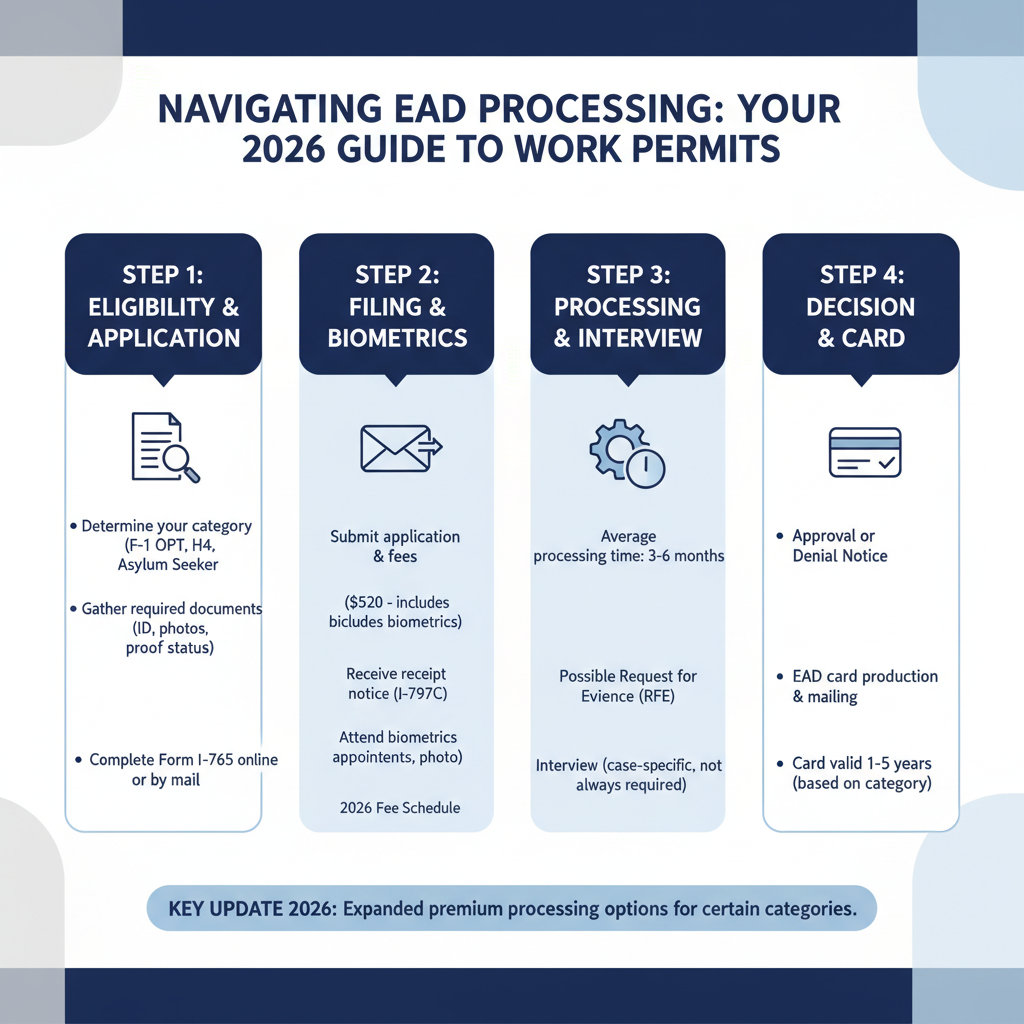
Our focus today is driven by ongoing news and official communications from USCIS regarding the processing of Employment Authorization Documents. These updates, often found in policy alerts, press releases, and evolving processing times, reflect the agency's continuous efforts to manage caseloads, implement new technologies, and adapt to changing immigration priorities. For the latest information and official announcements, we always recommend consulting the Employment Authorization Document Processing (USCIS) updates directly from official sources.
What This News Means for Immigrants in Orlando and Across Florida
Recent developments in USCIS processing of Employment Authorization Documents (EADs) are more than just bureaucratic updates; they represent real-world impacts on the lives, livelihoods, and stability of immigrants. For those living in Orlando, Central Florida, and beyond, understanding these changes is paramount to navigating your immigration journey successfully.
Why this news is showing up now
The immigration landscape is dynamic, and USCIS continually adjusts its policies and procedures to address various challenges, including fluctuating application volumes, resource allocation, and legislative mandates. Over the past few years, USCIS has faced unprecedented backlogs across many application types, including Form I-765, Application for Employment Authorization. In response, the agency has been implementing various strategies aimed at improving efficiency, reducing processing times, and providing relief to applicants.
These strategies have included temporary final rules extending the validity period for certain EADs, policy guidance on automatic EAD extensions, and internal operational shifts to prioritize specific case types. The news surfacing now often reflects the ongoing adjustments to these policies, the results of these efficiency drives, and sometimes, new challenges that emerge. As of 2026, USCIS continues to refine its approach to EAD processing, striving for a balance between thorough vetting and timely adjudication. This means applicants might see changes in processing timelines, eligibility for automatic extensions, or even specific filing instructions, which is why staying informed is critical.
How it can affect Florida residents
For immigrants residing in Florida, particularly in bustling metropolitan areas like Orlando, these USCIS updates have direct and tangible effects. Florida is home to a vast and diverse immigrant population, contributing significantly to the state's economy and cultural fabric. The ability to work legally is not just a personal right but a necessity for supporting families, paying taxes, and integrating into the community.
If you are an immigrant in Orlando, Orange County, or anywhere along the I-4 corridor, changes in EAD processing can impact:
- Employment Stability: Delays in EAD renewals can lead to job loss or inability to start new employment, creating significant financial hardship. Conversely, positive changes, like expanded automatic extensions, can provide crucial peace of mind and continuity of work.
- Economic Contribution: When immigrants can work lawfully, they contribute to Florida's economy through consumer spending, business creation, and tax payments. Efficient EAD processing supports this vital economic engine.
- Family Well-being: The income derived from lawful employment directly supports families, allowing them to afford housing, food, education, and healthcare. EAD processing directly impacts the stability and unity of families.
- Driving and State IDs: An EAD is often a primary document used to obtain or renew a Florida driver's license or state identification card. Delays can therefore affect mobility and access to essential services.
- Planning and Uncertainty: For those awaiting an EAD, the uncertainty of processing times can make long-term planning difficult. Being informed helps mitigate some of this stress and allows for proactive measures.
The Orlando USCIS Field Office and service centers that process applications from Florida are directly impacted by national policy changes. Keeping abreast of these updates ensures that residents of Central Florida can properly prepare their applications, understand their rights, and anticipate potential challenges or benefits. Our firm, Imigrar, is deeply rooted in the Orlando community and is dedicated to helping our neighbors navigate these complexities.
Need Help? Our Orlando immigration team is ready to assist. Call +1 786-791-3106 for a free consultation, or message us online. Se Habla Español.
What Employment Authorization Documents (EADs) Are (and Why They Matter)
For many non-citizens in the United States, the ability to work legally is not automatic. It requires specific authorization from the U.S. government. This authorization comes in the form of an Employment Authorization Document (EAD), often referred to simply as a "work permit." Understanding what an EAD is, who needs one, and why it's so important is the first step in navigating this critical aspect of immigration law.
A plain-English definition
An Employment Authorization Document (EAD) is a photo identification card issued by USCIS that proves you are authorized to work in the United States for a specific period. It looks similar to a driver's license, containing your photo, name, date of birth, country of birth, fingerprint, and a validity date. The EAD card allows you to apply for a Social Security number and present it to employers as proof of your eligibility to work. Without a valid EAD (or another form of work authorization, such as a green card or certain nonimmigrant visas), it is illegal to work in the U.S.
The need for an EAD typically arises when an individual is in the U.S. under an immigration status that does not inherently grant work authorization, but where working is permissible under specific circumstances. This includes, but is not limited to, individuals with pending applications for Adjustment of Status to lawful permanent resident, asylum seekers, DACA recipients, certain nonimmigrant visa holders (like F-1 students with Optional Practical Training or spouses of E/L visa holders), and those with Temporary Protected Status (TPS).
Key terms you need to know
Navigating the EAD process involves understanding several specific terms that are frequently used by USCIS and immigration professionals:
- Form I-765: This is the official application form, titled "Application for Employment Authorization," that you must file with USCIS to obtain an EAD. It's the central piece of your EAD application package.
- EAD Category: On Form I-765, you must specify an eligibility category (e.g., (c)(9) for Adjustment of Status applicants, (c)(3)(C) for F-1 OPT, (c)(8) for asylum applicants). Your eligibility category determines what documents you need to submit and how your application is processed.
- Lawful Presence: This term refers to an individual's presence in the U.S. with a valid, unexpired visa or other authorization, or by operation of law (e.g., asylum applicant whose application is pending). Many EAD categories require maintaining lawful presence.
- Adjustment of Status (AOS): This is the process for eligible individuals to apply for lawful permanent resident status (a green card) without having to leave the U.S. If you have a pending Form I-485, Application to Register Permanent Residence or Adjust Status, you are typically eligible for an EAD under category (c)(9).
- Automatic EAD Extension: Certain EAD categories are eligible for an automatic extension of their expiring EAD for a specific period (e.g., 180 days or 540 days, depending on the current policy) if they file a timely renewal application. This is a crucial provision to prevent gaps in employment authorization.
- Biometrics Appointment: After filing certain applications, including Form I-765 in some cases, USCIS may require you to attend an appointment at an Application Support Center (ASC) to provide fingerprints, photographs, and a signature. This data is used for background checks.
- Request for Evidence (RFE): If USCIS determines that your application is missing required information or documentation, they will send you an RFE. You must respond by the deadline provided, or your application may be denied.
Understanding these terms is vital for accurately completing your application, responding to USCIS communications, and generally comprehending the process. An EAD is more than just a card; it's a gateway to self-sufficiency and stability, enabling individuals to build lives and contribute fully to their communities while their long-term immigration cases are pending.
Current Immigration Law: The Foundation of EAD Eligibility
The ability to obtain an Employment Authorization Document (EAD) is rooted deeply in federal immigration law, primarily the Immigration and Nationality Act (INA) and its corresponding regulations. While the application process itself is managed by USCIS, the eligibility criteria are defined by these foundational legal frameworks. As of April 12, 2026, understanding these laws is crucial for determining your eligibility and preparing a successful application.
Federal requirements
Under federal law, specifically 8 CFR § 274a.12, various categories of non-citizens are eligible to apply for employment authorization. These categories are not arbitrary; they are tied to a person's current immigration status or the nature of their pending immigration application. It is important to note that simply being present in the U.S. does not automatically confer eligibility for an EAD.
Key federal requirements and common eligibility categories include:
- Applicants for Adjustment of Status (AOS): Individuals who have filed Form I-485, Application to Register Permanent Residence or Adjust Status, are generally eligible for an EAD under category (c)(9). This is one of the most common EAD categories, allowing individuals to work while they wait for their green card application to be processed. Often, the Form I-765 can be filed concurrently with Form I-485, and sometimes with Form I-131, Application for Travel Document (for advance parole).
- Asylum Applicants and Asylees: Individuals who have filed Form I-589, Application for Asylum and for Withholding of Removal, and whose application has been pending for at least 180 days (without delays attributable to the applicant), are eligible for an EAD under category (c)(8). Once asylum is granted, they are eligible under category (a)(5).
- Refugees: Individuals granted refugee status are authorized to work incident to their status and can apply for an EAD under category (a)(3).
- DACA Recipients: Individuals granted Deferred Action for Childhood Arrivals (DACA) are eligible for EADs, typically renewed every two years, under category (c)(33).
- Nonimmigrant Spouses: Certain nonimmigrant visa holders, such as spouses of E-1/E-2 treaty traders/investors (E-1S/E-2S), L-1A intracompany transferees (L-2S), and H-4 spouses of H-1B visa holders (H-4 EADs), are eligible for employment authorization.
- Students with Optional Practical Training (OPT): F-1 students who have completed or are completing their degree programs can apply for OPT to gain work experience in their field of study. They are eligible for an EAD under category (c)(3)(A), (c)(3)(B), or (c)(3)(C) (for STEM OPT extension).
- Temporary Protected Status (TPS): Individuals granted TPS are authorized to work in the U.S. and can apply for an EAD under category (a)(12) or (c)(19).
- Parolees: Certain individuals granted parole into the U.S. may be eligible for an EAD, depending on the terms of their parole.
Important: Eligibility requirements can be complex and are subject to change. It is critical to confirm your specific eligibility category and the most current requirements directly through USCIS official website or with an experienced immigration attorney. Using the incorrect category or failing to meet all requirements can lead to delays or denial.
Florida-specific considerations
While EAD eligibility is determined by federal immigration law, there are some Florida-specific considerations that bear mentioning, primarily regarding the practical implications of holding an EAD in the state.
- Driver's License and State ID: A valid EAD card is typically required to apply for or renew a Florida driver's license or state identification card. The validity period of your EAD will dictate the expiration date of your Florida ID. Delays in EAD renewal can therefore impact your ability to drive legally in the state. The Florida Department of Highway Safety and Motor Vehicles (FLHSMV) coordinates with federal databases to verify immigration status.
- Employment Opportunities: Florida's diverse economy, especially in regions like Orlando and Central Florida, offers numerous employment opportunities. An EAD allows you to legally access these jobs, contributing to the local workforce in sectors such as tourism, healthcare, technology, and agriculture.
- Community Resources: Various non-profit organizations and community centers in Orlando and across Florida provide support services to immigrants. While they don't determine EAD eligibility, they can offer assistance with document translation, notary services, and referrals to legal aid.
It's crucial for Florida residents to understand that while state laws don't create or negate EAD eligibility, they do shape the practical day-to-day experience of immigrants holding these documents. Ensuring your EAD is current and valid is essential not just for employment, but for full participation in life in the Sunshine State.
Need Help? Our Orlando immigration team is ready to assist. Call +1 786-791-3106 for a free consultation, or message us online. Se Habla Español.

How to Apply for or Renew Your EAD: A Complete Step-by-Step Guide
Applying for or renewing an Employment Authorization Document (EAD) can seem daunting, but by following a structured, step-by-step approach, you can navigate the process effectively. This guide provides a detailed roadmap for immigrants in Orlando, across Florida, and nationwide, ensuring you cover all essential aspects of the application.
1) Determine Your EAD Eligibility Category
Before you even touch Form I-765, you must accurately identify your eligibility category. This is the foundation of your entire application. Your category depends on your current immigration status or the immigration benefit you are seeking.
- Self-Assessment: Review the USCIS instructions for Form I-765 and the list of eligibility categories (e.g., (c)(9) for Adjustment of Status applicants, (c)(8) for asylum applicants, (c)(33) for DACA).
- Consultation: If you are unsure, consult with an experienced immigration attorney. An incorrect category can lead to delays or denial.
- Renewal vs. Initial: The category remains the same for renewals, but the process may have slight variations (e.g., eligibility for automatic extensions).
2) Gather Required Documents and Evidence
Once your eligibility category is determined, you'll need to collect all necessary supporting documents. This is a critical step, as incomplete applications are a leading cause of delays and RFEs.
General Required Documents (for most EAD applications):
- Two passport-style photos (taken within 30 days of filing).
- Copy of your last EAD (if renewing) or previous EADs.
- Copy of government-issued identification (e.g., passport bio page, birth certificate with photo ID).
- Copy of Form I-94, Arrival/Departure Record (or electronic printout from CBP website).
- Copy of your visa (if applicable).
- Copy of the biographical page of your passport.
- Evidence of your eligibility category (specific documents vary widely by category).
Category-Specific Evidence Examples:
- For (c)(9) - Adjustment of Status Applicants:
- Copy of your Form I-485 receipt notice or a copy of the filed Form I-485.
- Copy of your birth certificate.
- Copy of Form I-130 (if applicable) and receipt notice.
- Proof of valid nonimmigrant status (if applicable) until Form I-485 was filed.
- For (c)(8) - Asylum Applicants:
- Copy of your Form I-589 receipt notice.
- Proof that your asylum application has been pending for at least 180 days.
- For (c)(3)(C) - STEM OPT Extension:
- Copy of your previous EAD for post-completion OPT.
- Copy of your diploma or official transcript.
- Copy of your Form I-20 endorsed for STEM OPT.
- Copy of your employer's E-Verify company name and E-Verify Company Identification Number.
- Completed and signed Form I-983, Training Plan for STEM OPT Students.
Reminder: Always check the "What to File" section on the USCIS website for Form I-765 specific to your eligibility category. Gather originals to make copies, but *never* send original documents to USCIS unless specifically requested.
3) Complete Form I-765, Application for Employment Authorization
This is the core of your application. Accuracy and completeness are paramount.
- Download the Latest Form: Always download the most current version of Form I-765 from the USCIS Forms page. Versions can change frequently.
- Read Instructions Carefully: Thoroughly read the instructions provided with the form.
- Fill Out Electronically or Legibly: Type your answers directly into the PDF form or write them very clearly in black ink. Ensure all questions are answered. If a question doesn't apply, write "N/A" (Not Applicable).
- EAD Category: Double-check that you enter the correct eligibility category (e.g., (c)(9), (c)(8), (c)(33)) in Part 2, Item 27.
- Signature: Do not forget to sign the application in black ink. Unsigned forms will be rejected.
4) Prepare Your Application Package
Organizing your documents correctly prevents delays and ensures USCIS can process your application efficiently.
- Assemble in Order: Typically, the application package should be assembled in the following order:
- Payment (check or money order, or Form G-1450 for credit card) on top.
- Form I-765.
- Two passport-style photos in a small envelope stapled to the upper left corner of Form I-765.
- Copies of all supporting documents, grouped by type or relevance.
- Any required translations (certified).
- Make Copies: Make a complete copy of the entire application package for your records before mailing. This is an absolute must!
- Cover Letter (Optional but Recommended): A simple cover letter listing the contents of the package can be helpful.
5) File Your Application with USCIS
The filing location depends on your eligibility category and sometimes on other concurrently filed forms.
- Check Filing Addresses: Refer to the "Where to File" section for Form I-765 on the USCIS website. This can be a lockbox facility or a service center.
- Payment: Include the correct filing fee (check the USCIS Form I-765 page for current fees). Some categories are exempt from fees, or you may qualify for a fee waiver (Form I-912, Request for Fee Waiver).
- Mail Safely: Use a reputable mail service (USPS Certified Mail, FedEx, UPS) that provides tracking and delivery confirmation. This is your proof of filing.
- Online Filing: For certain categories, USCIS allows online filing of Form I-765. If eligible, this can sometimes expedite the process and provide immediate receipt confirmation. Check the USCIS website to see if your category qualifies for online filing.
6) Attend Biometrics Appointment (If Required)
After filing, USCIS may send you an appointment notice for biometrics.
- Notice: You will receive Form I-797C, Notice of Action, with the date, time, and location of your appointment.
- Attend Promptly: Attend the appointment as scheduled at your local Application Support Center (ASC). For Central Florida residents, this might be the Orlando ASC.
- Bring Documents: Bring the appointment notice, a valid photo ID (e.g., passport, driver's license), and your receipt notice


