


For countless families in Orlando, throughout Florida, and across the United States, the dream of reuniting with loved ones is a powerful motivator. Family-based immigration petitions offer a pathway to bring spouses, children, parents, and siblings to the U.S. and keep families together. This process, while rewarding, can be complex and filled with intricate legal requirements. At Imigrar, we understand the emotional and practical challenges involved, and we are dedicated to guiding you through every step.
The reporting that sparked this guide:
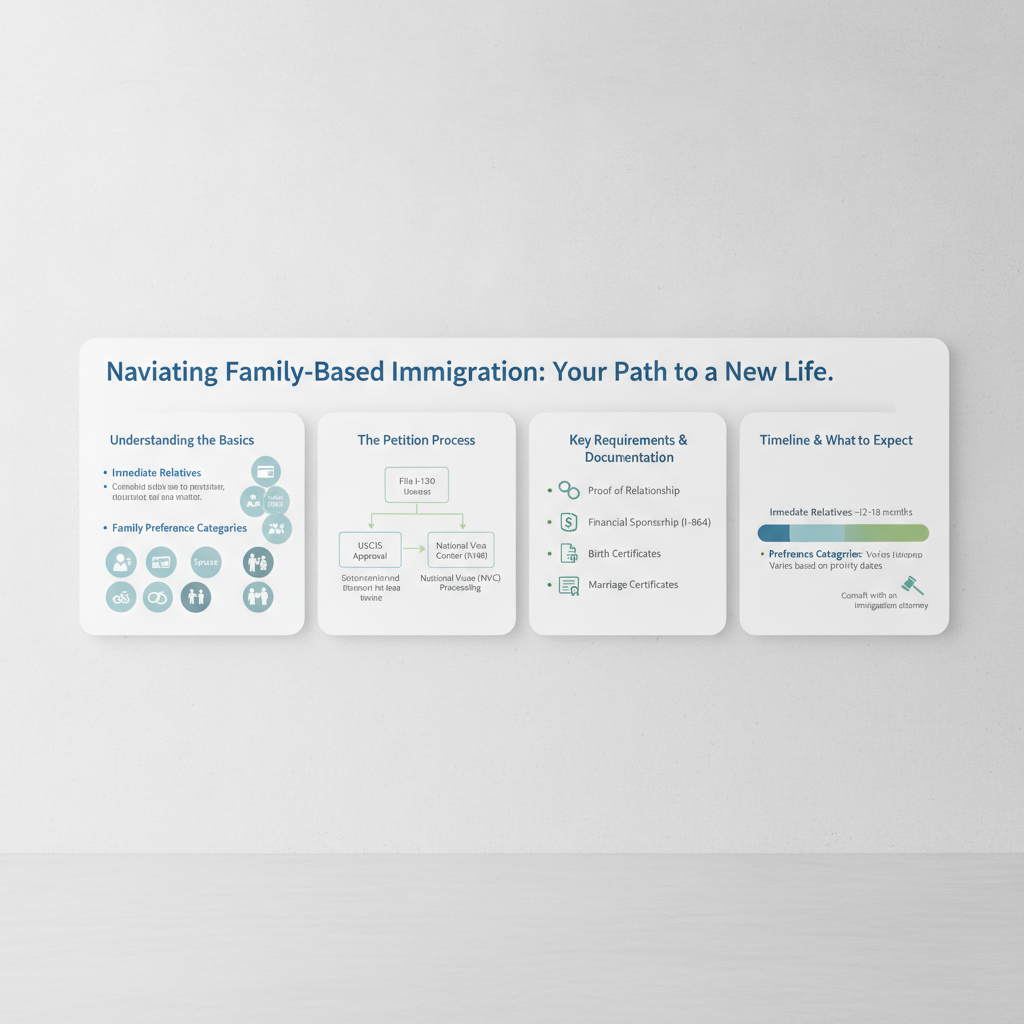
Recent discussions and inquiries surrounding family immigration processes highlight the ongoing need for clear, accessible information. The increasing interest in straightforward guides demonstrates a desire among immigrants and their families to understand the pathways available to them. This article is inspired by the continuous public interest in Family-Based Immigration Petition Guide (Immigration), aiming to demystify the process and provide actionable insights.
What This News Means for Immigrants in Orlando and Across Florida
The consistent focus on family-based immigration in news and public discourse underscores its fundamental role in U.S. immigration policy. For individuals and families residing in or looking to move to Orlando and other parts of Florida, understanding this vital pathway is not just beneficial—it's essential for planning their future.
Why this news is showing up now
Family unity has always been a cornerstone of U.S. immigration law. While the laws themselves don't change daily, the practical implications, processing times, and interpretations by immigration agencies like USCIS (U.S. Citizenship and Immigration Services) can evolve. Furthermore, economic shifts, global events, and policy adjustments can influence the volume of applications and the overall immigration landscape. The continuous news coverage often reflects a renewed focus on humanitarian aspects of immigration, policy debates, or simply a consistent demand for information from a large, diverse immigrant population seeking to navigate the system.
How it can affect Florida residents
Florida is a state with a vibrant and diverse immigrant population, particularly in areas like Orlando, Miami, and Tampa. For many Central Florida residents, family reunification is a primary goal. This means:
- Increased Awareness: News about family petitions can prompt more Florida residents to explore their options, leading to an increase in inquiries to immigration attorneys and government agencies.
- Local Impact: The Orlando USCIS Field Office, along with others across Florida, processes a significant number of family-based petitions. Understanding the process can help local residents prepare more effectively, potentially reducing errors and delays.
- Community Support: A well-informed community can better support its members through the immigration journey, sharing resources and advice (though always emphasizing professional legal counsel).
- Economic and Social Integration: Successful family reunification strengthens Florida communities, bringing in new talent, contributing to the economy, and enriching the social fabric of cities along the I-4 corridor and beyond.
Navigating these pathways successfully requires accurate information and often, expert legal guidance. Imigrar is here to provide that support to families in Orlando and nationwide.
Considering a Family Petition? Don't navigate the complexities alone. Our Orlando immigration team is ready to assist. Call +1 786-791-3106 for a free consultation, or message us online. Se Habla Español.
What Family-Based Immigration Is (and Why It Matters)
Family-based immigration is one of the primary avenues for foreign nationals to obtain lawful permanent resident status (a "green card") in the United States. It allows U.S. citizens and lawful permanent residents (LPRs) to sponsor certain eligible relatives to come live permanently in the U.S.
A plain-English definition
Simply put, family-based immigration is the process where a U.S. citizen or green card holder asks the government to allow a close family member from another country to come and live permanently in the United States. This "asking" is done by filing a petition with USCIS, proving the family relationship. If approved, the family member can then apply for a green card, either by adjusting their status if they are already in the U.S. or by going through consular processing if they are abroad.
This pathway matters immensely because it upholds the fundamental principle of family unity. It allows families separated by international borders to reunite, build lives together, and contribute to American society. For many, it's the only hope of being with their loved ones in a safe and stable environment.
Key terms you need to know
Understanding these terms will help you navigate the process:
- Petitioner: The U.S. citizen or lawful permanent resident who files the immigration petition for their relative.
- Beneficiary: The foreign national family member for whom the petition is filed.
- Immediate Relatives (IR): This category includes spouses of U.S. citizens, unmarried children under 21 of U.S. citizens, and parents of U.S. citizens (if the U.S. citizen is 21 or older). There are an unlimited number of visas available for Immediate Relatives, meaning they do not have to wait for a visa number to become available based on a quota.
- Family Preference Categories: These are other family relationships that are subject to annual numerical limits, meaning there can be significant waiting times. They include:
- First Preference (F1): Unmarried sons and daughters (21 or older) of U.S. citizens.
- Second Preference (F2A): Spouses and unmarried children (under 21) of lawful permanent residents.
- Second Preference (F2B): Unmarried sons and daughters (21 or older) of lawful permanent residents.
- Third Preference (F3): Married sons and daughters of U.S. citizens.
- Fourth Preference (F4): Brothers and sisters of U.S. citizens (if the U.S. citizen is 21 or older).
- Form I-130, Petition for Alien Relative: The initial form filed by the petitioner to establish the qualifying family relationship. This is the cornerstone of the family-based immigration process.
- Priority Date: The date USCIS receives your Form I-130 petition. This date is crucial for Family Preference categories, as it determines your place in the visa queue.
- Visa Bulletin: A monthly publication by the U.S. Department of State that shows which Priority Dates are current for each Family Preference category and country of chargeability. A "current" date means a visa number is available.
- Adjustment of Status (AOS): The process of applying for a green card while physically present in the United States. This is typically done by filing Form I-485, Application to Register Permanent Residence or Adjust Status.
- Consular Processing: The process of applying for an immigrant visa at a U.S. embassy or consulate abroad. This is for beneficiaries who are outside the U.S. or ineligible for Adjustment of Status.
- Affidavit of Support (Form I-864): A legally binding document signed by the petitioner (and sometimes a joint sponsor) promising to financially support the beneficiary to prevent them from becoming a public charge.
- Public Charge: A person who is likely to become primarily dependent on the government for subsistence, as demonstrated by receiving certain public cash assistance or long-term institutionalization at government expense.
Current Immigration Law: The Foundation
The legal framework for family-based immigration is primarily established by the Immigration and Nationality Act (INA). The INA, specifically sections 201, 203, and 204, dictates who can be sponsored, the categories of relatives, and the procedures for petitioning.
Federal requirements
At the federal level, the requirements are consistent across the nation, overseen by agencies such as USCIS and the U.S. Department of State. Key aspects include:
- Qualifying Relationship: The petitioner must prove a legitimate family relationship with the beneficiary that falls into one of the Immediate Relative or Family Preference categories. This requires submitting extensive documentation such as birth certificates, marriage certificates, and divorce decrees.
- Petitioner Status: The petitioner must be either a U.S. citizen or a lawful permanent resident. The type of relative they can sponsor depends on their status (e.g., LPRs cannot sponsor parents or siblings).
- Financial Sponsorship: The petitioner must demonstrate the ability to financially support the beneficiary at 125% of the federal poverty guidelines by filing Form I-864, Affidavit of Support. If the petitioner's income is insufficient, a joint sponsor may be required.
- Admissibility: The beneficiary must be admissible to the U.S., meaning they must not have any grounds of inadmissibility (e.g., certain criminal convictions, health issues, prior immigration violations). Waivers may be available for some grounds.
- Proper Forms and Fees: All required forms must be accurately completed and submitted with the correct filing fees to USCIS or the National Visa Center (NVC).
You can find all necessary forms and detailed instructions on the USCIS Forms page.
Florida-specific considerations
While the core immigration laws are federal, practical considerations in Florida can influence the process:
- Orlando USCIS Field Office: If you are applying for Adjustment of Status in Orlando, your interview will likely be scheduled at the Orlando USCIS Field Office. Familiarity with local office procedures and common interview questions can be beneficial.
- Volume of Cases: Florida, being a high-population state with a large immigrant community, often experiences significant volumes of immigration applications. This can sometimes lead to longer processing times compared to less populated areas. You can check current processing times on the USCIS Processing Times website.
- Legal Support: Access to experienced immigration attorneys in Orlando and across Florida is crucial. Local attorneys understand regional nuances and can provide tailored advice.
- Community Resources: Florida has numerous non-profit organizations and community groups that offer support to immigrant families, providing language assistance, cultural integration programs, and sometimes, legal referrals.
Overwhelmed by Immigration Law? Imigrar serves clients nationwide from our Orlando office. We speak your language – Se Habla Español. Call +1 786-791-3106 for expert guidance or contact us online.
How to File a Family-Based Immigration Petition: A Complete Step-by-Step Guide
The process of sponsoring a family member for a green card involves several critical stages. While the exact steps can vary slightly depending on whether the beneficiary is an Immediate Relative or in a Family Preference Category, and whether they are applying from within the U.S. (Adjustment of Status) or from abroad (Consular Processing), the core framework remains the same.
1) File Form I-130, Petition for Alien Relative
This is the foundational step. The U.S. citizen or LPR (petitioner) files Form I-130 with USCIS to prove the qualifying family relationship with the foreign national (beneficiary).
- Who Files: The U.S. citizen or LPR petitioner.
- Purpose: To establish that a legitimate family relationship exists between the petitioner and the beneficiary, which qualifies the beneficiary for an immigrant visa.
- Required Documents (for Petitioner):
- Proof of U.S. citizenship (e.g., U.S. birth certificate, naturalization certificate, U.S. passport) OR proof of LPR status (e.g., green card - Form I-551).
- Proof of relationship to the beneficiary (e.g., marriage certificate for spouses, birth certificate for parent-child relationship, birth certificates for siblings).
- Proof of legal termination of any prior marriages for both petitioner and beneficiary (e.g., divorce decrees, death certificates), if applicable.
- Passport-style photos for the petitioner and beneficiary (specific requirements apply).
- Copy of beneficiary's birth certificate and passport biographic page.
- Any other evidence requested by USCIS to prove the bona fides of the relationship (e.g., for spouses: joint bank accounts, lease agreements, photos together, affidavits from friends/family).
- Filing fee for Form I-130 (check USCIS website for current fees).
- Submission: Mail the completed Form I-130 and supporting documents to the appropriate USCIS Lockbox facility. For Central Florida residents, this will typically be one of the national lockbox addresses.
- What Happens Next: USCIS will send a receipt notice (Form I-797C, Notice of Action) confirming they received your petition. Then, they will review the petition.
Timeline Expectation: Processing times for Form I-130 can vary significantly based on the service center and relationship category, ranging from a few months to over a year. Check USCIS Processing Times for current estimates.
2) Wait for I-130 Approval and Priority Date to Become Current (if applicable)
Once USCIS reviews your petition, they will make a decision. If approved, you will receive an approval notice (Form I-797, Notice of Action).
- For Immediate Relatives: Since there are unlimited visas, once the Form I-130 is approved, the beneficiary can move directly to the next step (Adjustment of Status or Consular Processing) without waiting for a visa number to become available.
- For Family Preference Categories: This is where the Priority Date and Visa Bulletin come into play. Your Priority Date is established when USCIS receives your Form I-130. You must wait for your Priority Date to become "current" in the Visa Bulletin before you can proceed. This waiting period can range from several years to over a decade, depending on the category and the beneficiary's country of birth.
Important: Keep your I-130 approval notice safe. It's proof that your relationship has been recognized by USCIS.
3) National Visa Center (NVC) Processing OR Adjustment of Status (Concurrent Filing)
Once the I-130 is approved and a visa number is available (or immediately for Immediate Relatives), the process diverges based on the beneficiary's location.
Option A: Consular Processing (for beneficiaries outside the U.S.)
If the beneficiary is outside the U.S., their approved petition is sent to the National Visa Center (NVC), a division of the U.S. Department of State.
- NVC Fees: Pay the NVC's Immigrant Visa Application Processing Fee and the Affidavit of Support Fee.
- Form DS-260: The beneficiary completes and submits Form DS-260, Immigrant Visa Application, online.
- Submit Documents: The petitioner and beneficiary submit all required civil documents (birth certificates, marriage certificates, police certificates, etc.) and the Form I-864, Affidavit of Support, with supporting financial documents to the NVC.
- Required Documents (NVC Stage):
- Financial documents for Form I-864: Federal income tax returns and W-2s/1099s for the most recent tax year, pay stubs, employment verification letter.
- Beneficiary's civil documents: Birth certificate, marriage certificate (if applicable), police certificates from countries lived in for more than 6 months, military records (if applicable), court and prison records (if applicable).
- Passport-style photos for the beneficiary.
- Copy of beneficiary's passport biographic page.
- Review: The NVC reviews the submitted documents. Once all documents are accepted ("documentarily qualified"), the NVC will schedule an interview at the appropriate U.S. embassy or consulate abroad.
Option B: Adjustment of Status (for beneficiaries in the U.S.)
If the beneficiary is already in the U.S. and entered legally, they may be eligible to apply for Adjustment of Status without leaving the country. This involves filing Form I-485, often concurrently with Form I-130 if they are an Immediate Relative and a visa is immediately available.
- Forms to File:
- Form I-485, Application to Register Permanent Residence or Adjust Status.
- Form I-864, Affidavit of Support (filed by the petitioner).
- Form I-765, Application for Employment Authorization (optional, allows work permit while I-485 is pending).
- Form I-131, Application for Travel Document (optional, allows advance parole for travel outside the U.S. while I-485 is pending).
- Form I-693, Report of Medical Examination and Vaccination Record (completed by a USCIS-approved civil surgeon).
- Required Documents (AOS Stage):
- Copies of beneficiary's passport, visa, and I-94 arrival record.
- Copies of beneficiary's birth certificate.
- Copies of marriage certificate (if applicable).
- Copies of all previous immigration applications and approval notices.
- Two passport-style photos for the beneficiary.
- Financial documents for Form I-864 (same as NVC stage).
- Medical exam results (Form I-693).
- Filing fees for all forms (I-485, I-864, etc.). Important: Fees for I-765 and I-131 are often waived if filed concurrently with I-485.
- Submission: Mail the complete package to the appropriate USCIS Lockbox facility.
- What Happens Next: USCIS will send receipt notices. The beneficiary will receive an appointment notice for biometrics (fingerprints and photos). If I-765 and I-131 were filed, they might receive an Employment Authorization Document (EAD) and Advance Parole document.
Warning: Traveling outside the U.S. while an Adjustment of Status application is pending without an Advance Parole document can lead to the abandonment of your application.
4) Attend the Interview
This is a crucial step for both consular processing and Adjustment of Status.
- Consular Processing: The beneficiary attends an interview at the U.S. embassy or consulate in their home country. A consular officer will review their application, ask questions about their relationship to the petitioner, and determine their admissibility.
- Adjustment of Status: The petitioner and beneficiary typically attend an interview together at a USCIS Field Office (e.g., the Orlando USCIS Field Office for Central Florida residents). An immigration officer will verify the information on the forms and ask questions to confirm the bona fides of the relationship and the beneficiary's eligibility for a green card.
- Documents to Bring:
- Originals of ALL documents submitted with the petition and application.
- Any new evidence of the relationship or financial support.
- Additional photos, if applicable.
- For spouses, be prepared to answer questions about your daily life, shared experiences, and future plans.
Tip: Be honest, consistent, and polite during the interview. If you don't understand a question, ask for clarification. If you don't know an answer, say so.
5) Receive a Decision
Following the interview, the immigration officer or consular officer will make a decision.
- Approval:
- Consular Processing: If approved, the beneficiary will receive an immigrant visa stamp in their passport. They must then travel to the U.S. before the visa expires. Upon entry, they will be granted LPR status, and their physical green card will be mailed to them.
- Adjustment of Status: If approved, the beneficiary will receive an approval notice, and their physical green card will be mailed to the address on file.
- Request for Evidence (RFE) or Notice of Intent to Deny (NOID): Sometimes, the officer may need more information. An RFE will ask for specific additional documents. A NOID indicates that USCIS intends to deny the application unless you provide compelling evidence to overcome the grounds for denial. Responding promptly and thoroughly to these notices is critical.
- Denial: If the petition or application is denied, the notice will state the reasons for denial and whether there is an option to appeal or refile.
Reminder: The green card is typically valid for 10 years. For spouses whose marriage is less than two years old at the time of green card approval, a conditional green card (valid for 2 years) will be issued. They will need to file Form I-751, Petition to Remove Conditions on Residence, within the 90-day window before the conditional green card expires.
Facing a Complex Immigration Process? Our legal team at Imigrar specializes in family petitions. Get the personalized support you need. Call +1 786-791-3106 for a free consultation. Se Habla Español.
Practical Steps You Can Take Today
Preparing for a family-based immigration petition can feel daunting, but proactive steps can significantly improve your chances of a smooth process. Here’s an actionable checklist:
Actionable checklist with 5+ items
- Gather Core Documents: Start collecting birth certificates, marriage certificates, divorce decrees, passports, and any other identity or relationship documents for both the petitioner and beneficiary. Ensure they are current and translated if necessary.
- Assess Financial Eligibility: Review the petitioner's income and assets. Download the latest Poverty Guidelines from the USCIS official website to see if you meet the 125% threshold. If not, start thinking about potential joint sponsors.
- Understand Your Category: Determine if the beneficiary falls under an Immediate Relative category or a Family Preference Category. This will dictate potential waiting times and application pathways.
- Check Visa Bulletin (if applicable): If the beneficiary is in a Family Preference Category, regularly check the Visa Bulletin to monitor the progress of your Priority Date.
- Organize Evidence of Relationship: For spousal petitions, start compiling evidence of a bona fide marriage: joint bank statements, utility bills, lease agreements, photos, travel itineraries, and affidavits from friends/family.
- Consult with an Immigration Attorney: This is arguably the most crucial step. An experienced attorney can assess your unique situation, identify potential issues, and guide you through the entire process, minimizing errors.
Document preparation guidance
- Accuracy is Key: Ensure all information on forms is accurate and consistent with your supporting documents. Discrepancies can lead to delays or denials.
- Translations: Any document not in English must be accompanied by a certified English translation. The translator must provide a certification that they are competent to translate and that the translation is accurate.
- Copies vs. Originals: Generally, USCIS requests copies of documents unless specifically asking for originals. Always keep your original documents safe. Bring originals to any interview.
- Organization: Assemble your petition package neatly. Use tabs, cover sheets, and clearly label each section. This helps the officer review your case efficiently.
- Photographs: Follow USCIS photo specifications precisely. Incorrect photos are a common reason for RFE.
Timeline expectations
The timeline for family-based petitions can vary wildly. While Immediate Relatives generally have a faster track, even their process can take 1-2 years from start to finish. For Family Preference Categories, the wait can be much longer due to visa backlogs. Factors influencing timelines include:
- Relationship Category: Immediate Relatives (no visa quota) vs. Family Preference (visa quota).
- Country of Beneficiary's Birth: Some countries have longer backlogs in certain preference categories.
- USCIS Service Center Load: Different service centers have varying processing times.
- Completeness of Application: RFEs or missing documents will cause significant delays.
- Interview Scheduling: The availability of interview slots at USCIS Field Offices (like Orlando) or consulates abroad.
Continuously check the USCIS Processing Times website and the Visa Bulletin for the most up-to-date information.
How Imigrar Helps Immigrants in Orlando
At Imigrar, we understand that navigating U.S. immigration law can be one of the most significant challenges a family faces. Based in Orlando, Florida, we proudly serve clients nationwide, offering compassionate and expert legal guidance to keep families together.
Our experience and expertise cover all facets of family-based immigration. From preparing and filing the initial Form I-130 petition to guiding you through the NVC stage, assisting with Adjustment of Status applications, or preparing for consular interviews, our dedicated team is here for you. We meticulously review every document, ensure compliance with all federal requirements, and help you anticipate potential challenges.
We believe that everyone deserves clear, honest, and effective legal representation. Our attorneys work tirelessly to streamline your process, minimize delays, and advocate for your family's best interests. We pride ourselves on clear communication, ensuring you are informed and confident at every step.
Don't let the complexity of immigration law deter you from reuniting with your loved ones. We offer a free consultation to discuss your specific situation, assess your eligibility, and outline a strategic path forward. Our team is fluent in both English and Spanish, ensuring that language is never a barrier to quality legal advice. Se Habla Español.
Frequently Asked Questions
Q: Who is eligible to be a petitioner for a family-based green card?
A: To be a petitioner, you must be either


