


The H-1B visa program is a cornerstone of U.S. immigration, enabling American companies to hire skilled foreign workers in specialty occupations. Each year, demand far outstrips supply, leading to a highly competitive lottery system. For Fiscal Year 2027 (FY2027), the H-1B lottery process saw significant changes fully implemented, aimed at enhancing integrity and fairness. As an immigration law firm dedicated to keeping families together, Imigrar is here to break down what these crucial updates mean for you.
Feeling overwhelmed by H-1B changes? Our Orlando immigration team is ready to assist. Call +1 786-791-3106 for a free consultation, or message us online. Se Habla Español.
The reporting that sparked this guide
The information and analysis presented in this guide are directly informed by recent developments and official announcements concerning the H-1B visa program, particularly the changes implemented for the FY2027 lottery cycle. For ongoing updates and comprehensive legal news, we recommend consulting reputable sources:
H-1B Visa Lottery Changes for FY2027 (Legal News)
What This News Means for Immigrants in Orlando and Across Florida
The H-1B visa lottery changes for FY2027 represent a pivotal shift in how employers and prospective beneficiaries approach this highly coveted visa. These aren't minor tweaks; they are fundamental alterations designed to curb fraud and ensure a more equitable selection process. For individuals and businesses alike, understanding these changes is not just beneficial—it's absolutely essential for successful navigation.
Why this news is showing up now
As of May 21, 2026, the FY2027 H-1B lottery registration period (which typically runs in March) has concluded, and selections have already been made and announced (usually by late March or early April). The "news" now centers on the
How it can affect Florida residents
Florida is a vibrant hub for many industries that rely heavily on H-1B workers, including technology, healthcare, aerospace, tourism, and advanced manufacturing. Cities like Orlando, Tampa, Miami, and Jacksonville consistently rank among the top destinations for skilled professionals and the companies that employ them. For Florida residents—whether they are international students graduating from universities like UCF, UF, or FIU, or skilled professionals already working on other visas—these H-1B changes have direct and significant implications:
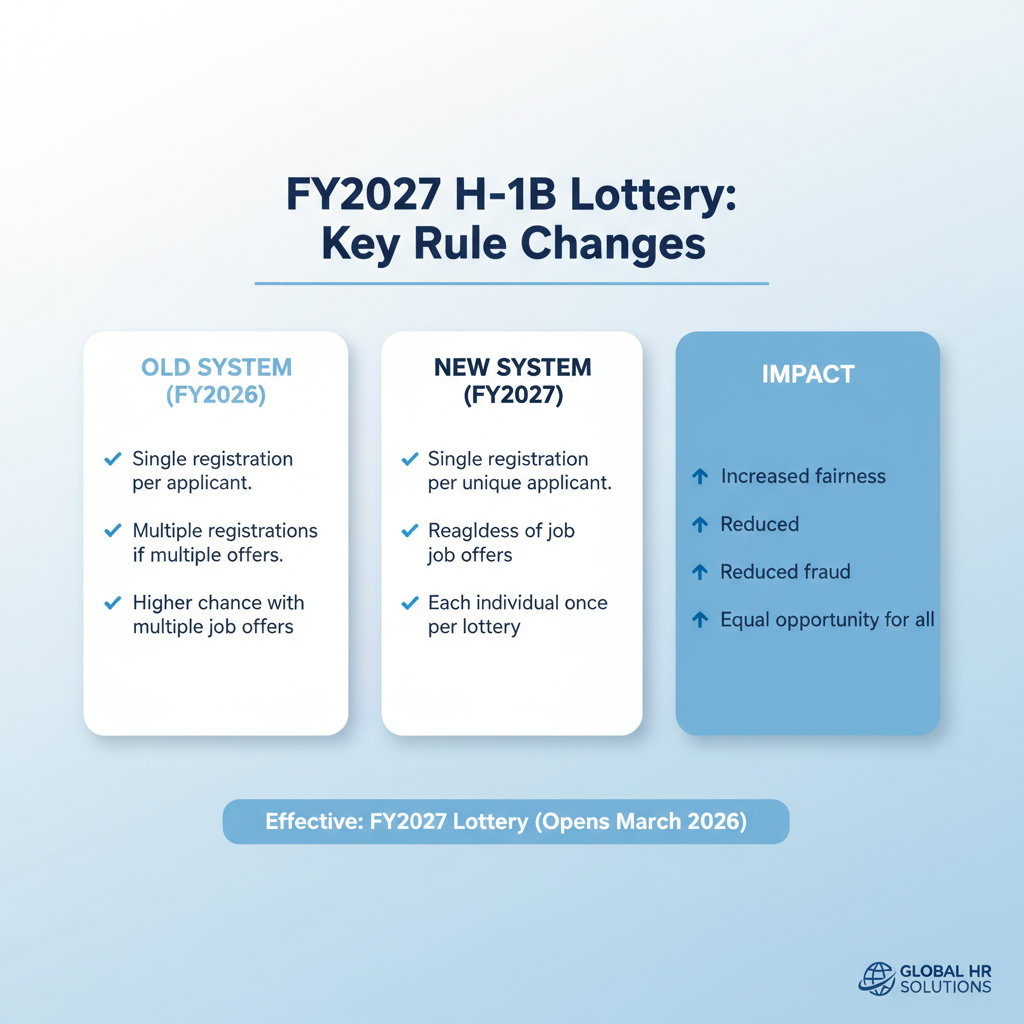
- Increased Integrity, Potentially Higher Odds: The new beneficiary-centric selection process aims to prevent multiple registrations for the same individual, which previously inflated lottery numbers. While this doesn't guarantee selection, it is intended to create a fairer playing field, potentially increasing the genuine odds for a single, legitimate registration. This is particularly good news for those in Orlando's growing tech sector and the I-4 corridor's innovation clusters.
- Financial Considerations: The increased H-1B registration fee (from $10 to $215) and other associated filing fees mean a higher upfront investment for employers. While this cost is typically borne by the employer, it can influence their willingness or capacity to sponsor, especially for smaller businesses in Central Florida.
- Employer Compliance: Florida employers must now be hyper-vigilant about complying with the new rules, particularly the attestation requirement that they will not collude to submit multiple registrations for the same beneficiary. Non-compliance can lead to severe penalties, impacting their ability to hire skilled foreign talent crucial for the state's economic growth.
- Planning for the Future: For those who were not selected in the FY2027 lottery, or for students still completing their education in Florida, understanding these established rules is vital for strategic planning for future H-1B cycles. Early preparation, including securing legitimate job offers and understanding eligibility, becomes even more critical.
For individuals and businesses in Orlando and across Florida, staying informed and working with experienced legal counsel like Imigrar is paramount to navigating these complex changes successfully. Our commitment is to ensure that deserving families can stay together and contribute to our community.
What H-1B Visa Lottery Changes Are (and Why They Matter)
The H-1B visa program is a cornerstone of U.S. immigration policy, designed to allow U.S. employers to temporarily employ foreign workers in specialty occupations. These occupations generally require a bachelor's degree or higher in a specific specialty. Given the annual cap on H-1B visas, the demand often far exceeds the available supply, necessitating a lottery system. The changes for FY2027 are significant because they directly address issues of fairness and integrity within this highly competitive process.
A plain-English definition
Think of the H-1B visa as a special work permit for highly skilled professionals. If a U.S. company wants to hire someone from another country for a job that requires a specific college degree (like an engineer, IT specialist, doctor, or architect), they can sponsor that person for an H-1B visa. However, there's a limit to how many H-1B visas are given out each year (a "cap"). Because many more people apply than there are visas available, USCIS runs a computer-generated lottery to pick who gets a chance to apply. The "changes" for FY2027 primarily mean that USCIS has cracked down on a past problem where some individuals had multiple companies register them in the lottery, unfairly increasing their chances. Now, the system focuses on the individual applicant (the "beneficiary"), ensuring that each person has only one legitimate chance, no matter how many companies want to sponsor them. There are also higher fees for entering this lottery.
Key terms you need to know
Navigating the H-1B landscape requires familiarity with specific terminology:
- H-1B Visa: A non-immigrant visa that allows U.S. employers to temporarily employ foreign workers in specialty occupations.
- Specialty Occupation: An occupation that requires theoretical and practical application of a body of highly specialized knowledge and a bachelor's or higher degree in the specific specialty (or its equivalent) as a minimum for entry into the occupation in the United States.
- Cap-Subject: Refers to H-1B petitions that are subject to the annual statutory cap of 65,000 visas, plus an additional 20,000 for those with a U.S. master's degree or higher. Most H-1B petitions fall into this category.
- Cap-Exempt: Certain employers are exempt from the annual cap, such as institutions of higher education, non-profit organizations affiliated with higher education, and non-profit research organizations or governmental research organizations.
- Beneficiary: The foreign national worker whom the employer wishes to sponsor for the H-1B visa.
- Petitioner: The U.S. employer who files the H-1B petition on behalf of the foreign worker.
- LCA (Labor Condition Application): Form ETA-9035/9035E. This is a form that the employer must file with the U.S. Department of Labor (DOL) before filing an H-1B petition. It attests to prevailing wages and working conditions.
- Registration Period: The specific window (usually in March) during which employers electronically register beneficiaries for the H-1B lottery.
- Selection Process (Beneficiary-Centric): The new method for the lottery where selections are based on each unique beneficiary, regardless of the number of registrations submitted on their behalf. If a beneficiary is selected, all employers who registered that beneficiary are notified, and only one employer can then proceed with filing the petition. This is a critical change for FY2027.
- Premium Processing: An optional service offered by USCIS that guarantees processing of certain petitions (including H-1B) within a specific timeframe (currently 15 calendar days) for an additional fee. This uses Form I-907.
- Form I-129: The Petition for a Nonimmigrant Worker, which is the primary form filed by the employer once a beneficiary is selected in the lottery.
These changes matter immensely because they aim to restore integrity to a system that was previously exploited. By focusing on the beneficiary, USCIS hopes to ensure that every qualified individual has a fair and equal chance, rather than allowing those with multiple job offers to disproportionately dominate the selection pool. This directly impacts the hopes and plans of countless individuals and the hiring strategies of companies across Florida and the nation.
Current Immigration Law: The Foundation
The H-1B visa program operates under the broad framework of the Immigration and Nationality Act (INA). Specifically, the H-1B nonimmigrant classification is defined under Section 101(a)(15)(H)(i)(b) of the INA, which is codified at 8 U.S.C. § 1101(a)(15)(H)(i)(b). The regulations governing the H-1B program are found in 8 CFR Part 214.2(h).
These foundational laws and regulations dictate who is eligible, what constitutes a specialty occupation, the annual caps, and the procedural requirements for both employers and beneficiaries. The recent changes to the lottery process, particularly the beneficiary-centric selection, were implemented under USCIS's authority to manage the H-1B cap and ensure program integrity, as outlined in these existing statutes and regulations.
Federal requirements
To qualify for an H-1B visa, both the employer (petitioner) and the foreign worker (beneficiary) must meet specific federal requirements:
- For the Employer (Petitioner):
- Bona Fide Job Offer: The employer must offer a real, specialty occupation position.
- Specialty Occupation: The job must genuinely require a bachelor's degree or higher in a specific field.
- Employer-Employee Relationship: A valid employer-employee relationship must exist between the petitioner and the beneficiary.
- Labor Condition Application (LCA): The employer must file and obtain a certified Form ETA-9035/9035E from the Department of Labor (DOL), attesting to paying the prevailing wage and providing working conditions that will not adversely affect U.S. workers.
- H-1B Cap: The position must generally be subject to the annual H-1B cap (65,000 regular, plus 20,000 for U.S. master's degrees), unless the employer is cap-exempt.
- Attestation of Non-Collusion: Under the new rules for FY2027, the employer must attest that they have not worked with other employers to submit multiple registrations for the same beneficiary. This is a critical integrity measure.
- For the Foreign Worker (Beneficiary):
- Specialty Occupation Qualification: The beneficiary must possess the required qualifications for the specialty occupation, typically a bachelor's degree or its equivalent in a related field. Professional licenses may also be required for certain professions (e.g., doctors, nurses, engineers).
- Work Experience: In some cases, extensive work experience can be considered equivalent to a bachelor's degree.
- Non-Immigrant Intent: While H-1B is a "dual intent" visa, meaning you can eventually seek permanent residency, the initial application is for temporary employment.
The annual cap is a major hurdle. For FY2027, the demand again far outstripped the 85,000 available visas, making the lottery selection a matter of chance. Understanding the nuances of these federal requirements is critical for any successful H-1B application.
For more detailed information on H-1B requirements and forms, visit the USCIS official website.
Florida-specific considerations
While there are no specific Florida state laws governing the H-1B visa program (it's a federal program), the economic landscape and professional environment in Florida significantly influence its impact:
- High Demand Industries: Florida boasts thriving sectors like tourism, hospitality, healthcare, aerospace, defense, and information technology. Cities like Orlando, with its burgeoning tech scene and theme park industries, and Miami, a hub for international business and finance, generate substantial demand for H-1B talent. Many companies along the I-4 corridor, from Tampa to Orlando, actively seek H-1B workers.
- University Graduates: Florida is home to numerous top-tier universities, attracting international students who often seek H-1B sponsorship after completing their degrees. The competition for these visas is particularly fierce among graduates from institutions like the University of Central Florida (UCF) in Orlando, Florida.
- Local Economy Impact: The H-1B program significantly contributes to Florida's economy by bringing in specialized skills, fostering innovation, and creating jobs for U.S. workers. The integrity of the lottery process directly impacts the ability of Florida businesses to access this vital talent pool.
- Orlando USCIS Field Office: While the H-1B petition is processed by USCIS service centers, residents of Orlando and Central Florida may interact with the Orlando USCIS Field Office for other immigration matters, such as adjustment of status if an H-1B worker later pursues a green card.
For employers and beneficiaries in Florida, especially in areas like Orange County, understanding how these federal changes intersect with local economic realities is key. Imigrar, based in Orlando, has extensive experience assisting clients throughout Florida with their H-1B needs.
Need expert guidance on H-1B visa requirements? Contact Imigrar today for a free consultation. Our Orlando team can clarify the new rules and help you prepare. Call +1 786-791-3106 or reach out online. Se Habla Español.

How to Navigate the FY2027 H-1B Lottery Under New Rules: A Complete Step-by-Step Guide
The H-1B lottery process, particularly with the new beneficiary-centric selection and increased fees for FY2027, demands meticulous planning and adherence to strict guidelines. Here’s a comprehensive step-by-step guide for both employers and beneficiaries.
1) Understand Eligibility & New Rules (Pre-Registration Phase)
Before any filing, both the employer and the prospective H-1B worker must confirm their eligibility and thoroughly understand the recent changes.
- Employer Requirements:
- Ensure the job offered qualifies as a specialty occupation. This means it requires at least a bachelor's degree in a specific field.
- Confirm a legitimate employer-employee relationship will exist.
- Be prepared to pay the prevailing wage for the occupation in the specific geographic area (e.g., Orlando, Florida).
- Crucially, understand and commit to the **beneficiary-centric selection process**. This means the employer must attest that they have not collaborated with other employers to submit multiple registrations for the same beneficiary. A beneficiary can only be entered once into the lottery.
- Beneficiary Requirements:
- Possess a U.S. bachelor's degree or its foreign equivalent, or a license in a specialty occupation field, or work experience equivalent to a bachelor's degree.
- For the U.S. master's cap, hold a master's or higher degree from a U.S. institution.
- Ensure all educational credentials are properly evaluated and translated if obtained outside the U.S.
- Required Documents (for assessment):
- Detailed job description outlining duties and requirements.
- Beneficiary's resume/CV.
- Beneficiary's academic transcripts and diplomas (with certified English translations if applicable).
- Foreign degree evaluations (if applicable).
- Professional licenses (if applicable).
Important: Start this assessment early. The new rules penalize attempts to circumvent the single-beneficiary registration, so absolute clarity and integrity are paramount.
2) Employer Files Labor Condition Application (LCA)
The employer must obtain a certified Labor Condition Application (LCA), Form ETA-9035/9035E, from the Department of Labor (DOL) before filing the H-1B petition. This step is usually completed before the lottery registration, though it can sometimes overlap.
- Purpose: The LCA ensures that the employer is offering the H-1B worker at least the prevailing wage for the occupation in the area of intended employment and that working conditions will not adversely affect U.S. workers.
- Process: The employer, or their attorney, submits the LCA electronically to the DOL. The DOL reviews the application for completeness and accuracy.
- Timeline: LCA certification typically takes 7-10 business days. It’s vital to initiate this well in advance of the H-1B registration period.
- Required Documents:
- Employer's Federal Employer Identification Number (FEIN).
- Job title and duties.
- Proposed salary.
- Worksite location (e.g., Orlando, Florida).
- Prevailing wage determination (often obtained from DOL's Foreign Labor Certification Data Center).
3) H-1B Electronic Registration (The Lottery Entry)
This is the critical step where the employer formally enters the beneficiary into the H-1B lottery. For FY2027, the process was entirely electronic via the myUSCIS online portal.
- Registration Period: Typically occurs in March each year. For FY2027, this period has already passed (March 2026).
- Registration Fee: The fee for each registration significantly increased for FY2027 from $10 to $215. This fee is non-refundable.
- Beneficiary-Centric Selection: The employer must provide the beneficiary's passport information (or other valid travel document information). The system now identifies unique beneficiaries. If multiple registrations are submitted for the same beneficiary by different employers, USCIS will consider all such registrations invalid and potentially deny the subsequent H-1B petition.
- Employer Attestation: The employer must make an attestation that the registration is for a bona fide job offer and that they have not colluded with other employers to gain an unfair advantage.
- Required Information:
- Employer's legal name, FEIN, and address.
- Employer's authorized signatory information.
- Beneficiary's full name, date of birth, country of birth, country of citizenship.
- Beneficiary's passport number (or other travel document number).
- Whether the beneficiary holds a U.S. master's or higher degree.
- Attorney or representative information (if applicable).
Warning: Any attempt to submit multiple registrations for the same beneficiary is a serious violation and will result in disqualification and potential fraud investigations. This is the most significant change to heed for FY2027 and beyond.
4) Lottery Selection & Notification
After the registration period closes, USCIS conducts the electronic lottery. The selection process typically prioritizes the U.S. master's cap first, then the regular cap.
- Notification: USCIS typically announces selection results in late March or early


