


The landscape of U.S. immigration law is constantly evolving, and for those seeking to work in a specialty occupation, few changes are as impactful as those affecting the H-1B visa program. As an immigration law firm deeply committed to our tagline, "Keep Families Together," Imigrar understands the immense significance of the H-1B visa for professionals and their loved ones in Orlando, across Florida, and throughout the nation.
Feeling overwhelmed by H-1B changes? Our Orlando immigration team provides clarity and expert support. Call +1 786-791-3106 for a free consultation, or message us online. Se Habla Español.
Today, we delve into the significant updates surrounding the H-1B Visa Lottery Changes for Fiscal Year 2027 (FY2027), a development that will reshape how thousands of aspiring professionals and their employers approach the upcoming H-1B season. These new rules, effective for the FY2027 cap season, are designed to enhance fairness, reduce fraud, and streamline the selection process, but they introduce critical new considerations for all involved parties.
At Imigrar, we believe that informed individuals are empowered individuals. This comprehensive guide will break down the latest changes, explain their implications, and provide actionable steps to help you navigate this complex process successfully. Whether you are a prospective H-1B beneficiary, an employer, or a family member, understanding these updates is paramount.
Don't let H-1B changes derail your career goals. Imigrar's experienced attorneys are here to guide you. Contact us today at +1 786-791-3106 for a free consultation. Se Habla Español.
The reporting that sparked this guide
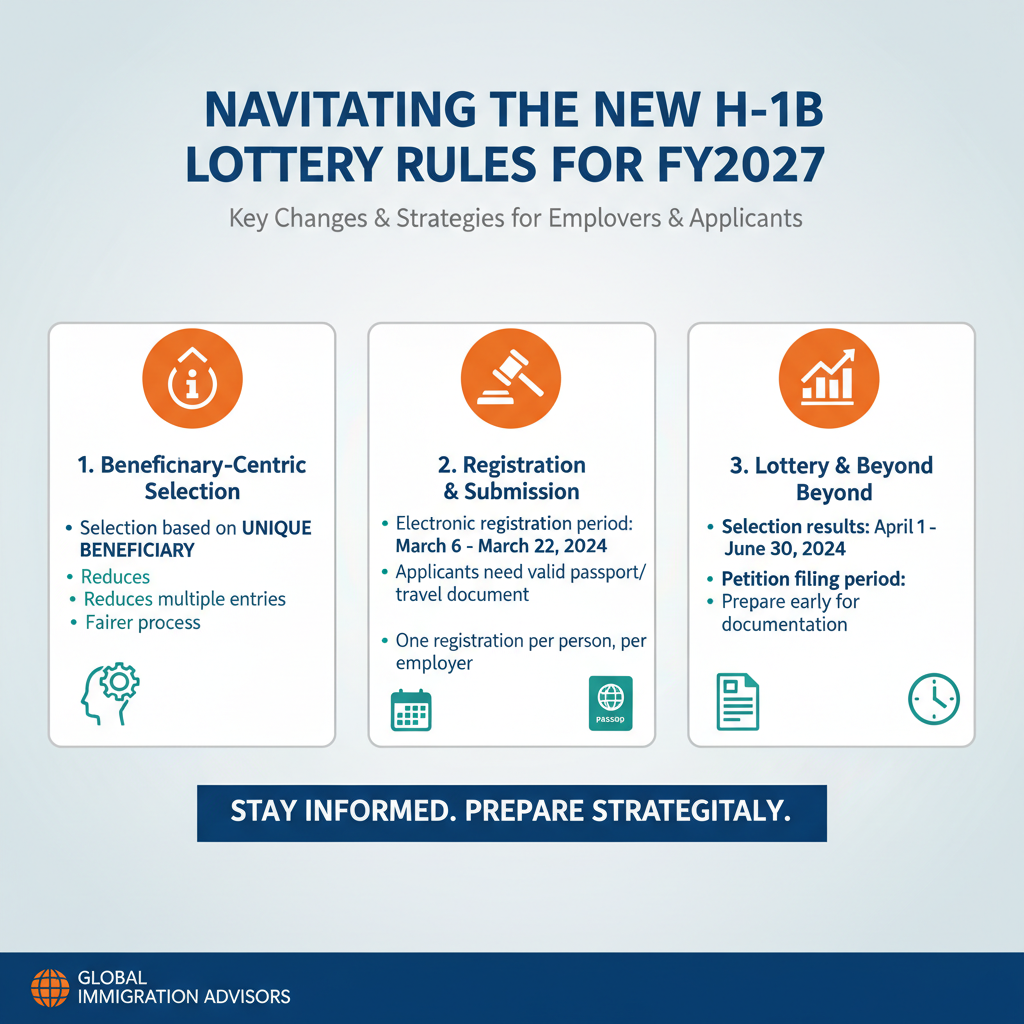
The information and guidance in this article are informed by recent updates and discussions in legal news regarding the H-1B visa program, specifically concerning the changes implemented by U.S. Citizenship and Immigration Services (USCIS) for the FY2027 H-1B cap lottery. These changes aim to combat fraud and improve the integrity of the lottery process.
H-1B Visa Lottery Changes for FY2027 (Legal News)
What This News Means for Immigrants in Orlando and Across Florida
The H-1B visa program is a cornerstone for many specialty occupation professionals seeking to live and work in the U.S. The latest changes for the FY2027 H-1B cap season are not merely procedural tweaks; they represent a fundamental shift in how the lottery will be conducted, with significant implications for individuals and businesses alike.
Why this news is showing up now
U.S. Citizenship and Immigration Services (USCIS) has been actively working to address concerns regarding widespread fraud within the H-1B lottery system, particularly the practice of multiple employers submitting registrations for the same beneficiary to increase their chances of selection. This practice undermined the integrity of the lottery and unfairly disadvantaged legitimate petitioners. The new rules, finalized in late 2023 and early 2024, are a direct response to these issues and are set to be fully implemented for the upcoming FY2027 cap season, which typically kicks off with the registration period in March 2026. The timing of this news is crucial because it gives employers and prospective beneficiaries ample time to understand and adapt to the new requirements before the next registration window opens. It reflects USCIS's commitment to ensuring a fairer and more transparent selection process.
How it can affect Florida residents
Florida, especially the Orlando metropolitan area, is a vibrant hub for industries heavily reliant on H-1B talent, including technology, tourism, aerospace, healthcare, and finance. For immigrants residing in Central Florida or those hoping to secure a specialty occupation here, these changes have several key impacts:
- Increased Fairness for Legitimate Applicants: The primary goal of the new "beneficiary-centric" selection process is to level the playing field. If you are a legitimate candidate with genuine job offers, these changes are designed to improve your chances of selection by eliminating fraudulent multiple registrations. This is especially good news for those with strong qualifications looking to work for tech companies along the I-4 corridor or in the burgeoning medical and simulation industries in Orlando.
- Employer Responsibility: Florida-based employers, from large corporations to startups in Orange County, must now ensure they understand and comply with the new rules. Any employer submitting multiple registrations for the same beneficiary will see all registrations for that individual rejected. This places a greater burden on employers to verify the legitimacy of their candidates and the exclusivity of their registrations.
- Reduced "Noise" in the Lottery: For every legitimate H-1B hopeful in Florida, the previous system meant competing against inflated numbers due to fraud. The new system aims to reduce this "noise," potentially leading to more realistic selection rates and a more predictable process for those genuinely seeking to contribute to Florida's economy.
- Strategic Planning: Both individuals and companies in Florida will need to adjust their strategies. Beneficiaries must now be more discerning about which employer they allow to register them, as only one selection will count. Employers must prioritize genuine hiring needs and ensure their internal processes prevent accidental or intentional multiple registrations for the same individual.
What H-1B Visa Lottery Changes for FY2027 Is (and Why It Matters)
The H-1B visa is a nonimmigrant visa that allows U.S. employers to temporarily employ foreign workers in specialty occupations. These occupations generally require a bachelor's degree or higher in a specific field. Due to high demand and a statutory annual cap of 65,000 visas (plus an additional 20,000 for those with a U.S. master's degree or higher), USCIS conducts a lottery to select petitions from among the submitted registrations.
A plain-English definition
The H-1B Visa Lottery Changes for FY2027 essentially mean that USCIS is changing *how* they pick who gets a chance to apply for an H-1B visa. Before, multiple companies could register the same person, and each registration had an equal chance in the lottery. This led to fraud, where people would get many registrations from different companies (sometimes fake ones) just to increase their odds. Now, USCIS will select based on the *person* (the beneficiary), not on each registration. If a person has multiple registrations from different employers, they will still only be counted once in the lottery, and if selected, only one employer's registration will be chosen. This makes the lottery fairer and reduces the incentive for fraud.
Key terms you need to know
Understanding the following terms is crucial for navigating the H-1B process, especially with the new changes:
- H-1B Visa: A nonimmigrant visa that permits U.S. employers to temporarily employ foreign workers in specialty occupations.
- Specialty Occupation: An occupation that requires a theoretical and practical application of a body of highly specialized knowledge, and a bachelor's or higher degree in the specific specialty (or its equivalent) as a minimum for entry into the occupation in the U.S.
- Cap-Subject: Refers to H-1B petitions that are subject to the annual statutory limit (cap) of 65,000 visas, plus 20,000 for those with a U.S. master's degree or higher. Most H-1B petitions fall under this category.
- Cap-Exempt: Certain H-1B petitions are exempt from the annual cap. This typically includes employees of institutions of higher education, non-profit organizations affiliated with institutions of higher education, or non-profit research organizations, and government research organizations.
- Beneficiary: The foreign national worker who is the subject of the H-1B petition. Under the new rules, the lottery selection is now "beneficiary-centric."
- Petitioner: The U.S. employer filing the H-1B petition on behalf of the beneficiary.
- H-1B Registration Period: The annual period, typically in March, when employers must electronically register prospective H-1B beneficiaries with USCIS to be included in the lottery.
- Lottery/Selection Process: The random selection process conducted by USCIS when the number of registrations exceeds the annual cap. For FY2027, this process is now beneficiary-centric.
- Form I-129, Petition for a Nonimmigrant Worker: The primary form filed by a U.S. employer to petition for a nonimmigrant worker, including H-1B visas.
- LCA (Labor Condition Application): A form (Form ETA 9035) filed by an employer with the U.S. Department of Labor (DOL) before filing an H-1B petition. It attests that the employer will pay the H-1B worker the prevailing wage or the actual wage paid to other employees with similar experience and qualifications, whichever is higher, and will provide working conditions that will not adversely affect the working conditions of U.S. workers similarly employed.
- DHS (Department of Homeland Security): The overarching federal department under which USCIS operates.
- USCIS (U.S. Citizenship and Immigration Services): The government agency responsible for administering the country's immigration and naturalization system, including H-1B petitions. You can find official information at the USCIS official website.
- FY (Fiscal Year): The U.S. government's fiscal year runs from October 1st to September 30th. H-1B visas selected in the lottery become available on October 1st of the relevant fiscal year (e.g., FY2027 begins October 1, 2026).
- Beneficiary-Centric Selection: The core of the new FY2027 lottery rules. Instead of each registration being entered into the lottery, each unique beneficiary is entered once, regardless of how many employers registered them. If a beneficiary is selected, USCIS will then choose *one* of the employers who registered that beneficiary to proceed with filing the Form I-129 petition.
- Integrity Measures: USCIS's efforts to prevent fraud, including stricter rules on multiple registrations and potential investigations into suspicious patterns.
These changes are critical because they directly impact the fairness and transparency of the H-1B lottery. By focusing selection on the beneficiary, USCIS aims to eliminate the unfair advantage gained by fraudulent multiple registrations, thereby making the lottery more equitable for all legitimate applicants and employers.
Confused by the H-1B terminology? Let Imigrar simplify it for you. Schedule a free consultation with our knowledgeable team by calling +1 786-791-3106. Se Habla Español.
Current Immigration Law: The Foundation of the H-1B Program
The H-1B visa program is rooted in the Immigration and Nationality Act (INA), specifically under INA § 101(a)(15)(H)(i)(b) and its implementing regulations at 8 CFR Part 214.2(h). These laws and regulations define who is eligible, what constitutes a specialty occupation, the employer's responsibilities, and the overall framework for the program. The recent changes to the lottery process are procedural adjustments within this existing legal framework, aimed at improving its administration.
Federal requirements
To qualify for an H-1B visa, both the beneficiary and the petitioning employer must meet specific federal requirements:
For the Beneficiary:
- Education: Hold a U.S. bachelor's degree or its equivalent, or a higher degree required by the specialty occupation, or possess an unrestricted state license, or have work experience equivalent to a bachelor's degree. Generally, three years of progressive work experience in the specialty field can substitute for one year of college education.
- Specialty Occupation: The job itself must qualify as a specialty occupation, meaning it typically requires a bachelor's degree or higher in a specific field.
- Employer Offer: Have a genuine job offer from a U.S. employer in a specialty occupation.
For the Petitioning Employer:
- Legitimate Job Offer: Offer a position that meets the definition of a specialty occupation.
- LCA Approval: Obtain a certified Labor Condition Application (Form ETA 9035) from the U.S. Department of Labor (DOL) before filing the H-1B petition. This attests to prevailing wage compliance and working conditions.
- Wage Requirements: Pay the H-1B worker at least the prevailing wage for the occupational classification in the area of employment, or the actual wage paid by the employer to all other individuals with similar experience and qualifications for the specific employment in question, whichever is higher.
- Compliance: Adhere to all federal regulations regarding H-1B employment, including non-displacement of U.S. workers and proper record-keeping.
- Registration: Electronically register the prospective beneficiary during the designated H-1B Registration Period with USCIS.
The primary form used for an H-1B petition is Form I-129, Petition for a Nonimmigrant Worker, along with the appropriate H-1B supplement and supporting documentation. All official forms and detailed instructions are available on the USCIS Forms page.
Florida-specific considerations
While H-1B laws are federal, their application can have unique considerations based on local economic conditions and employer needs. In Florida:
- Diverse Industries: Florida's economy, particularly in areas like Orlando, Tampa, and Miami, spans technology, aerospace, healthcare, hospitality management, and international business. This broad demand means H-1B workers are sought across a wide range of specialty occupations, from software engineers to theme park designers, medical researchers, and financial analysts.
- Prevailing Wage Impact: The prevailing wage requirements for H-1B visas are location-specific. Employers in high-cost-of-living areas like certain parts of South Florida or rapidly growing tech hubs in Orlando may face higher prevailing wage obligations compared to rural areas. This is calculated by the DOL based on the occupation and geographic area.
- Local USCIS Offices: While H-1B petitions are filed centrally, local USCIS field offices, such as the Orlando USCIS Field Office, handle certain aspects of immigration matters. While they don't process H-1B petitions directly, understanding the local immigration landscape is always beneficial.
- State University System: Florida boasts a robust state university system, including the University of Central Florida (UCF) in Orlando. Graduates from these institutions, particularly those with advanced degrees, are prime candidates for H-1B visas, and the universities themselves are often cap-exempt H-1B employers.
Staying informed about federal requirements and how they intersect with Florida's unique economic environment is key to a successful H-1B application.
Navigating H-1B laws requires precision. Our Orlando immigration attorneys have the expertise. Call us at +1 786-791-3106 for a free consultation. Se Habla Español.
How to Navigate the New H-1B Lottery System: A Complete Step-by-Step Guide
The H-1B lottery process, especially with the new beneficiary-centric selection rules for FY2027, demands meticulous attention to detail from both the employer and the beneficiary. Here's a comprehensive step-by-step guide:
1) Employer & Beneficiary Prepare for Registration
This initial phase is critical for ensuring a smooth and compliant registration under the new rules. The emphasis is on accuracy and verifying the legitimacy of the job offer and the beneficiary’s qualifications.
- Employer Actions:
- Identify Need: Determine a genuine need for a specialty occupation worker.
- Assess Beneficiary: Evaluate the prospective employee's qualifications (education, experience) to ensure they meet H-1B specialty occupation criteria.
- Wage Determination: Begin research into the prevailing wage for the specific occupation and geographic location (e.g., Orlando, FL) to ensure compliance with DOL requirements for the future LCA.
- Legal Counsel: Engage an experienced immigration attorney, like Imigrar, to review the job offer, beneficiary qualifications, and ensure readiness for the new lottery rules.
- Beneficiary Actions:
- Gather Documents: Compile all academic transcripts, degrees, diplomas, and any professional licenses or certifications. If degrees are from outside the U.S., consider obtaining an educational credential evaluation.
- Passport & Resume: Ensure your passport is valid and up-to-date. Prepare an updated resume detailing your work experience relevant to the specialty occupation.
- Communicate with Employer: Maintain open communication with your prospective employer to provide necessary information and understand their registration strategy, especially considering the beneficiary-centric selection.
Required Documents (Preparation Phase): * Beneficiary's valid passport * Beneficiary's academic degrees/diplomas and transcripts (original or certified copies) * Educational credential evaluations (if applicable, for foreign degrees) * Beneficiary's detailed resume/CV * Professional licenses or certifications (if applicable) * Employer's FEIN (Federal Employer Identification Number)
2) Employer Creates USCIS Online Account & Registers Beneficiary
This is the official start of the H-1B lottery process. The employer (or their authorized representative, like an attorney) must create or access a USCIS online account to submit the electronic registration.
- Account Creation: Employers (or their attorneys) must create a "registrant" account on the USCIS online portal.
- Enter Beneficiary Information: For each prospective beneficiary, the employer must provide accurate biographical information, including their full name, date of birth, country of birth, country of citizenship, passport number, gender, and highest level of education.
- Employer Information: Provide the employer's legal name, Federal Employer Identification Number (FEIN), address, and the name and title of the authorized signatory.
- Certification: The employer must attest, under penalty of perjury, that the information provided is true and correct, and that they intend to employ the beneficiary in a specialty occupation. This includes acknowledging the new rules against multiple beneficiary registrations.
- Pay Fee: Pay the non-refundable $10 H-1B registration fee for each beneficiary.
Important: Under the new rules, each unique beneficiary should only have *one* selection opportunity, even if multiple employers submit registrations on their behalf. If USCIS identifies multiple registrations for the same beneficiary by related entities, or by unrelated entities in a fraudulent scheme, all registrations for that beneficiary may be deemed invalid. Ensure your employer understands this critical change.
Required Documents (Registration Phase): * Beneficiary's full legal name, date of birth, country of birth, country of citizenship, passport number, gender * Beneficiary's highest level of education * Employer's legal name, FEIN, address * Name and title of authorized signatory
3) USCIS Conducts the Lottery & Notifies Selections
Once the registration period closes, USCIS conducts the lottery. The significant change here is the beneficiary-centric selection process.
- Lottery Conducted: USCIS runs the random selection process. For FY2027, the selection is based on unique beneficiaries. If a beneficiary has multiple eligible registrations submitted by different employers, they are still only entered into the lottery once.
- Selection Notification: USCIS notifies selected registrants (employers) through their online accounts. This typically occurs by the end of March. The notification will indicate whether a registration has been selected, not selected, or denied (if deemed invalid due to fraud or multiple submissions for the same beneficiary).
- One Selection Per Beneficiary: If a beneficiary is selected, and they had multiple employers register them, USCIS will randomly select *one* of those employers' registrations to proceed. The other employers who registered the same beneficiary will be notified that their registration was "Not Selected."
Reminder: Being selected in the lottery does not guarantee H-1B approval; it merely grants the employer permission to file the full Form I-129 petition.
4) Selected Employers File Form I-129 Petition
If your registration is selected, the petitioning employer must file the complete H-1B petition package within the designated filing window, which is usually 90 days from the selection notification date (e.g., April 1st to June 30th). This is a complex step that often requires legal expertise.
- Labor Condition Application (LCA): Before filing Form I-129, the employer must file and obtain a certified Form ETA 9035 (LCA) from the U.S. Department of Labor. This process typically takes 7-10 business days.
- Prepare Form I-129: Complete Form I-129, Petition for a Nonimmigrant Worker, along with the H-1B supplement. Ensure all sections are accurately filled out and consistent with the registration information.
- Compile Supporting Documents: Gather all required supporting evidence.
- Fees: Include all necessary filing fees:
- Form I-129 filing fee: $460 (as of 2024, subject to change)
- American Competitiveness and Workforce Improvement Act (ACWIA) fee: $750 (for employers with 1-25 full-time equivalent employees) or $1,500 (for employers with 26 or more full-time equivalent employees)
- Fraud Prevention and Detection Fee: $500
- Public Law 114-113 Fee (for employers with 50 or more employees, with more than 50% H-1B or L-1 status): $4,000
- Optional Premium Processing Fee: $2,805 (as of 2024, subject to change for 15-day processing)
- Mail Petition: File the complete petition package with the correct USCIS service center.
Warning: The filing window is strict. Missing this deadline will result in the rejection of your petition.
Required Documents (Petition Filing Phase): * Certified Form ETA 9035 (LCA) * Completed and signed Form I-129 and H-1B supplement * Company letter of support/offer letter * Beneficiary's educational documents (degrees, transcripts, evaluations) * Beneficiary's resume/CV * Evidence of beneficiary's professional experience (e.g., employment letters, pay stubs) * Employer's financial statements, tax returns, and business licenses to prove ability to pay wages * Organizational chart (if applicable) * Copies of beneficiary's passport, visa, I-94 record (if already in the U.S.) * Photos of the beneficiary (passport-style) * Checks for all USCIS filing fees
5) USCIS Processes Petition & Issues Decision
After filing, USCIS reviews the petition. Processing times can vary significantly, so it's essential to monitor the status.
- Regular Processing: USCIS will process the petition in the order it was received. Current processing times can be checked on the USCIS Processing Times page.
- Premium Processing: If the employer paid the additional fee, USCIS guarantees a decision within 15 calendar days.
- Request for Evidence (RFE): USCIS may issue an RFE if they require additional documentation or clarification. Responding promptly and thoroughly to an RFE is crucial.
- Decision: USCIS will issue an approval, denial, or request for more information. An approval notice (Form I-797) will be sent.


