


Breaking: Expanded U.S. Travel Ban Takes Effect January 1, 2026
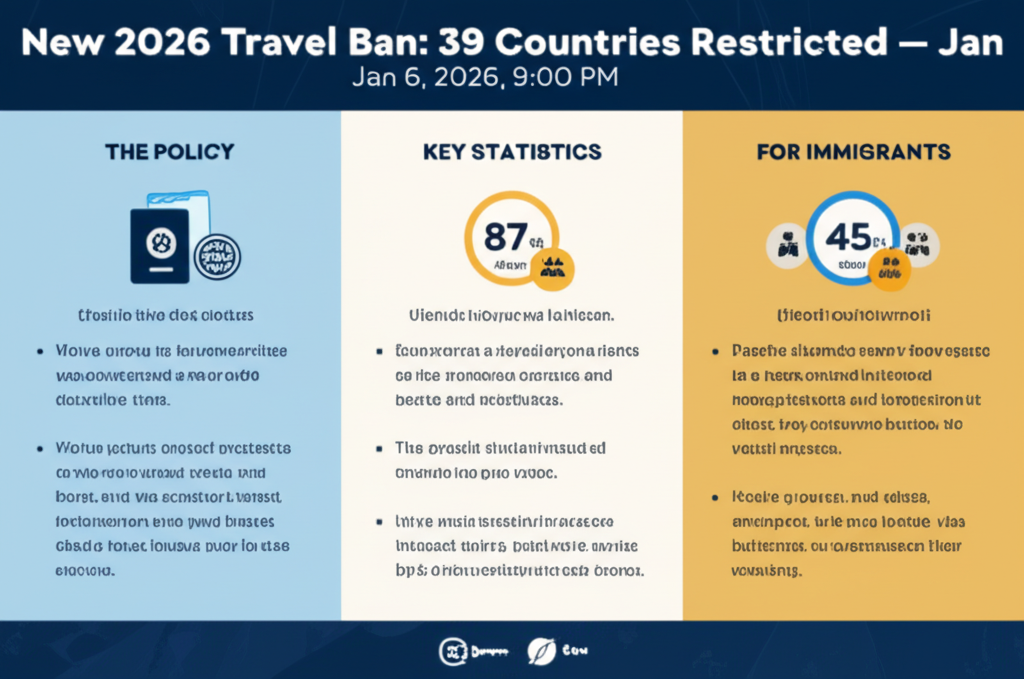
On December 16, 2025, the White House issued Presidential Proclamation 10998, dramatically expanding travel and visa restrictions under Section 212(f) of the Immigration and Nationality Act (INA). This proclamation more than doubles the number of affected countries from 19 to 39, imposing full entry bans on immigrant and nonimmigrant visas for nationals of designated countries who are outside the United States on January 1, 2026, without a valid U.S. visa.[1][2][3][4][7]
The ban cites national security, public safety, and vetting deficiencies as justifications, building on the June 2025 Proclamation 10949. Effective at 12:01 a.m. EST on January 1, it targets foreign nationals from additional sub-Saharan African, Caribbean, and other nations, severely impacting family-based immigration, employment petitions, and student programs.[2][3][4]
What the New Travel Ban Covers: Full and Partial Restrictions
The proclamation introduces full entry bans for 19 countries with deficient vetting systems, suspending both immigrant (e.g., green cards) and nonimmigrant visas (e.g., H-1B, F-1 student, B-1/B-2 tourist). An additional 20 countries face partial restrictions on specific categories like business or student visas.[1][4]
- Full Bans (19 countries): Complete suspension of entry for nationals lacking valid visas as of January 1, 2026.[4]
- Partial Bans (20 countries): Limits on nonimmigrant visas; immigrant visas may still be processed with heightened scrutiny.[2]
- New Additions: Includes nations issuing Palestinian Authority documents; prior exemptions eliminated for immediate relatives of U.S. citizens, adoptions, and Afghan Special Immigrant Visas (SIVs).[2][4]
Notably, the ban adds restrictions on individuals with Palestinian Authority-issued documents, regardless of nationality.[2] Enforcement considers passport nationality, birthplace, or travel history, broadening its scope.[1]
Who Is Affected?
Primarily foreign nationals outside the U.S. on January 1, 2026, without a valid visa. Key impacted groups include:[3]
- Family members seeking immigrant visas (spouses, children, parents of U.S. citizens/permanent residents).
- H-1B workers, L-1 executives, and other employment-based applicants needing visa stamps abroad.
- Students (F/M visas) and exchange visitors (J visas) from listed countries.
- Anyone with expired visas planning to renew overseas.[1][4]
Key Exceptions: Who Can Still Enter
Not all are barred. Exemptions include:[2][4]
- Lawful Permanent Residents (Green Card Holders) – Unaffected regardless of nationality.
- Dual nationals traveling on non-designated country passports.
- World Cup athletes, coaches, support staff, and immediate relatives (2026 event-specific).
- Diplomats, certain U.S. government employees, and persecuted minorities (e.g., from Iran).
- Refugees, asylees already in the U.S., and Convention Against Torture (CAT) protections – though new grants face re-review.[4]
Waivers remain possible on a case-by-case basis if the Secretary of State deems entry serves U.S. national interest, but approvals are discretionary and rare.[2]
Legal Implications: Broader Immigration Overhaul
This proclamation signals a comprehensive 2026 immigration tightening. Beyond the ban, recent announcements compound challenges:[1]
1. Expanded Social Media Vetting for H-1B and H-4 Visas
On December 3, 2025, the U.S. State Department extended "online presence review" to H-1B workers and H-4 dependents, requiring disclosure of social media identifiers with accounts set to public. USCIS launched a Vetting Center on December 5 for centralized screening of security threats and fraud.[1]
Implications: Inconsistent or private social media can trigger denials. Approved benefits for Proclamation 10949 countries post-January 20, 2021, face re-review, including interviews.[4]
2. Shorter EAD Validity and Enhanced Screening
USCIS's December 4 announcement caps certain Employment Authorization Documents (EADs) at 18 months and mandates thorough re-screening across benefit categories.[1]
Implications: Delays in work authorization for pending green card applicants; heightened deportation risks for those with criminal history or fraud flags.
3. Visa Bulletin Updates and SR Visa Deadline
The January 2026 Visa Bulletin maintains family-based priorities (e.g., F2A for spouses/children of permanent residents) but notes H.R. 5371 extends Special Religious Worker (SR) visas only until January 29, 2026. No issuances after midnight that date.[6]
These align with INA Section 212(f), historically upheld (e.g., Trump v. Hawaii, 585 U.S. 667 (2018), affirming presidential authority).[4]
Actionable Guidance: Steps for Affected Individuals
With the ban mere days away (as of early January 2026), act urgently. Imigrar recommends:[1][2][3]
Immediate Travel Assessments
- Review Status: Confirm if you're from a listed country, your location on January 1, and visa validity.
- Return Before Deadline: Nationals outside the U.S. without visas should enter by December 31, 2025, using existing visas.
- Postpone Non-Essential Travel: Avoid consular processing abroad; build buffer time into 2026 schedules.[1]
Visa and Application Strategies
- Secure Visas Now: Schedule stamping appointments immediately if eligible.
- Social Media Prep: Disclose all handles accurately; set profiles public; avoid deletions – consistency matters.[1]
- Family Petitions: File I-130s promptly; consider adjustment of status inside U.S. for eligibles to bypass consular bans.
- Employment-Based: Explore premium processing for H-1B extensions; cap-gap for students transitioning to work.[1]
Deportation Defense and Compliance
- Re-Review Alerts: If from affected countries and entered post-2021, prepare for USCIS scrutiny.
- Criminal History: Seek vacatur of convictions via California SB 281-style advisements if applicable.[5]
- Waiver Pursuit: Gather evidence of U.S. ties, skills, or hardships for national interest arguments.
| Scenario | Recommended Action | Timeline |
|---|---|---|
| Outside U.S., no visa | Enter by Dec 31 or apply for waiver | Immediate |
| H-1B needing stamp | Postpone travel; review social media | Before Jan 1 |
| Green card pending abroad | Consult for expedite/INA 245(i) | Now |
| Inside U.S. on visa | Extend/Adjust before expiration | 60-90 days prior |
Why This Matters for Florida Families and Businesses
In Orlando, home to diverse communities, this ban disrupts H-1B tech workers, family reunifications, and tourism. Employers must audit international staff travel; families face prolonged separations.[1][2]
Legal challenges may emerge, echoing past litigation, but Trump v. Hawaii sets a high bar. Monitor USCIS and State Department for clarifications.[4]
Contact Imigrar for Expert Help
Don't navigate this alone. Imigrar's Orlando immigration attorneys specialize in travel ban waivers, visa strategies, and deportation defense. Schedule a consultation today to protect your status amid 2026 changes.
Disclaimer: This article summarizes public sources as of January 2026; immigration law evolves rapidly. Seek personalized counsel.


