


Understanding the Expanded US Travel Ban Effective January 1, 2026
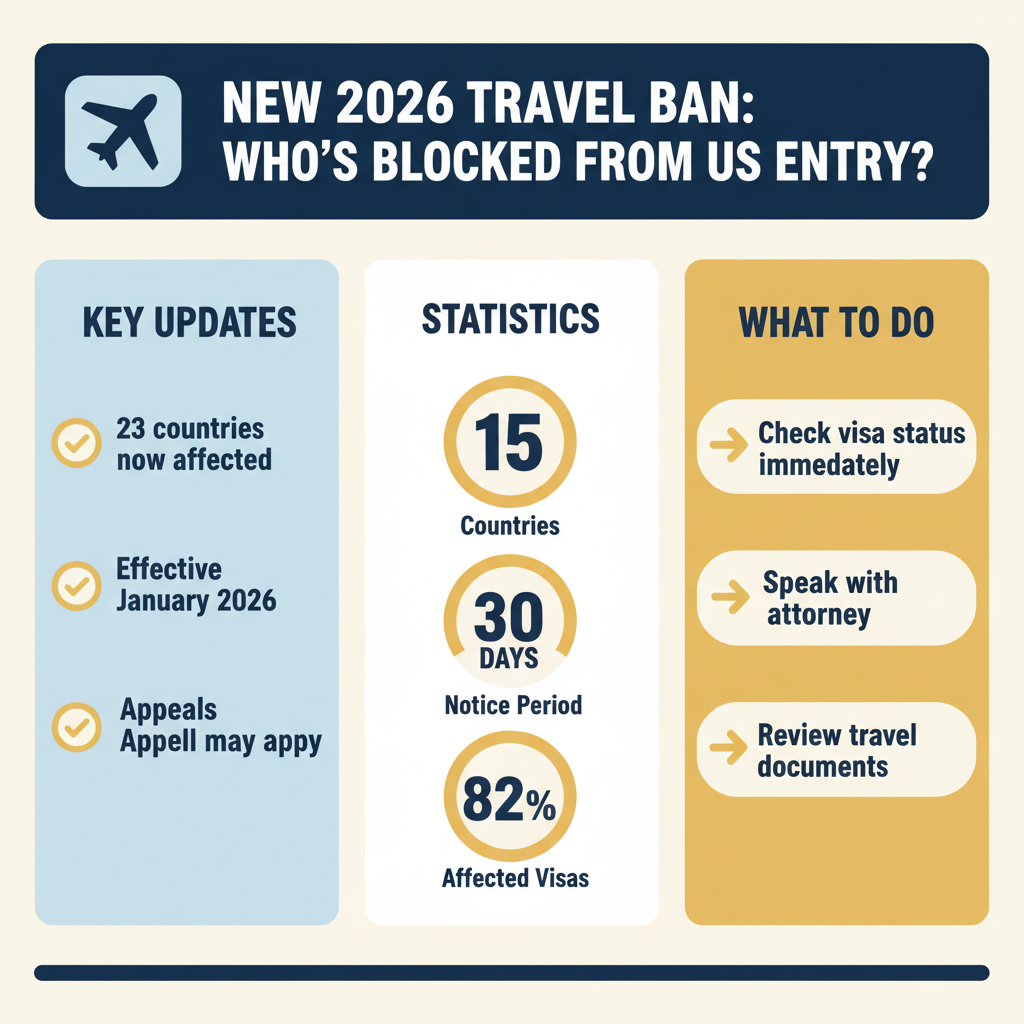
Presidential Proclamation 10998, issued on December 16, 2025, significantly broadens US entry restrictions under Section 212(f) of the Immigration and Nationality Act (INA). This proclamation adds 21 countries to existing bans, creating full entry suspensions for nationals from 19 high-risk nations and partial restrictions for others, effective 12:01 a.m. EST on January 1, 2026.[1][2][3][8]
The policy cites national security, deficient vetting cooperation, and public safety threats as justifications, expanding on Proclamation 10949 from June 2025. It targets foreign nationals outside the US without valid visas on the effective date, impacting immigrant and nonimmigrant visa categories.[2][3]
Key Provisions of Proclamation 10998
- Full Entry Bans: Complete suspension of entry for nationals of 19 countries with inadequate security screening, including several sub-Saharan African and Caribbean nations.[1][3]
- Partial Restrictions: Limits on specific visa types (e.g., certain nonimmigrant categories) for additional listed countries.[2]
- Applicability: Affects individuals outside the US on January 1, 2026, lacking a valid US visa; pre-existing valid visas remain usable.[2][3][8]
- No Retroactive Impact: Those already in the US or holding visas issued before January 1 are generally exempt from new bans.[2]
Who Is Affected and Who Is Exempt?
The ban does not apply universally but hinges on nationality, location, and visa status. Foreign nationals from designated countries outside the US without valid visas face entry denial.[2][3]
Affected Individuals
- Nationals of the 21 newly added countries seeking new visas post-January 1.[2]
- Those requiring visa stamps abroad after travel, even with prior approvals.[1]
- Applicants in restricted categories like immigrant visas or certain nonimmigrant visas from partial-ban countries.[3]
Exemptions and Exceptions
Critical carve-outs preserve access for many:
- Valid US visas issued before January 1, 2026.[2][3][8]
- US lawful permanent residents (green card holders).[2]
- US citizens, dual nationals using US passports.[2]
- Certain diplomatic, official, or UN-related visas.[3]
- Aircrew members, athletes in competitions, and specific short-term visitors.[3]
Note: Some prior exceptions from Proclamation 10949—such as immediate family immigrant visas, adoptions, asylum/CAT protections, and refugees—are eliminated under the new rules.[3]
Legal Implications for Immigration Processes
This expansion invokes broad presidential authority under INA § 212(f), allowing suspension of entry when deemed detrimental to US interests. Courts have historically upheld similar proclamations, though challenges may arise citing due process or discrimination.[2][3]
For visa applications, expect intensified scrutiny: The US State Department now requires H-1B and H-4 applicants to disclose social media identifiers with public account visibility, effective from December 3, 2025 announcements.[1] USCIS launched a Vetting Center on December 5 for centralized screening of threats, fraud, and criminal activity.[1]
Additional ripple effects include:
- Reduced Employment Authorization Document (EAD) validity to 18 months maximum, announced December 4.[1]
- A $100,000 fee for new H-1B petitions of workers outside the US, per September 2025 proclamation.[4]
- Re-review of post-January 20, 2021 approvals for nationals from restricted countries, including potential re-interviews.[3]
- Indefinite pause on asylum adjudications and frozen benefits for 20 high-risk countries.[4]
January 2026 Visa Bulletin shows movement in family-sponsored categories like F2A (spouses/children of permanent residents) but maintains per-country limits at 7% (25,620 visas).[5] Diversity Visa (DV-2026) limit reduced to ~52,000; SR religious worker visas expire January 30, 2026.[5]
Actionable Guidance: Steps for Affected Individuals and Employers
With the ban activating in days (as of early January 2026 context), immediate action is essential. Imigrar immigration attorneys in Orlando recommend the following prioritized steps.[1][2]
For International Travelers and Visa Holders
- Assess Your Status Now: Confirm nationality against listed countries; check visa validity expiration. If outside US without valid visa, entry is suspended.[2][8]
- Return Before January 1 if Possible: Nationals from banned countries abroad should enter US prior to effective date using existing visas.[1][3]
- Build Buffer into Travel Plans: Postpone non-essential trips in late December 2025–January 2026; add 2–4 weeks for re-entry delays.[1]
- Prepare Social Media: For H-1B/H-4, disclose all identifiers accurately; set profiles public during adjudication—avoid deletions to prevent fraud flags.[1]
- Monitor Visa Bulletin: EB and family categories show progress; file adjustments if priority dates current.[5][6]
For Employers Sponsoring H-1B, Green Cards, or Other Visas
- Identify at-risk employees/dependents by nationality, birthplace, travel history.[1]
- Avoid new H-1B filings for those abroad due to $100k fee and vetting hurdles; prioritize extensions for in-country workers.[1][4]
- Review approved cases from 2021+ for re-vetting risks; prepare documentation for interviews.[3]
- Counsel on EAD renewals before 18-month cap bites; explore STEM OPT extensions for F-1 transitions.[1][6]
Deportation Defense and Citizenship Pathways
In-country individuals face low direct risk from the ban but heightened enforcement via re-reviews. Those with pending green cards or naturalization should expedite via premium processing where available. Asylum seekers note USCIS's indefinite pause—consult counsel for alternatives like withholding or CAT.[4]
For deportation defense, the ban indirectly bolsters removal priorities for high-risk nationals. Maintain compliance to avoid triggering INA inadmissibility grounds.[3]
Case Citations and Official Sources
Anchor your strategy in primary authorities:
- Presidential Proclamation 10998 (Dec 16, 2025): Official White House text detailing country lists, effective date, and INA § 212(f) basis.[2][3]
- INA § 212(f): Codified at 8 U.S.C. § 1182(f); upheld in Trump v. Hawaii, 585 U.S. 667 (2018) for similar bans.
- USCIS Vetting Center Announcement (Dec 5, 2025): Centralizes threat screening.[1]
- State Department Social Media Policy (Dec 3, 2025): H-1B/H-4 requirements.[1]
- Visa Bulletin January 2026: State.gov; tracks EB/family availability.[5]
- H.R. 5371 (Nov 12, 2025): Extends SR visas to Jan 30, 2026.[5]
Why This Matters for Florida Families and Businesses
Orlando's diverse communities—home to Caribbean and African diaspora—face outsized impacts from added countries. Employers in tech, healthcare, and hospitality reliant on H-1B/green cards must adapt swiftly to avoid talent gaps.[4][6]
Stay ahead: Schedule a consultation with Imigrar for personalized audits. Our team tracks daily updates, including AILA clips from January 5, 2026, ensuring compliance amid flux.[7]
Long-Term Outlook and Opportunities
While restrictions tighten, Visa Bulletin advancements signal filing windows for EB-3 skilled workers and family reunification.[5][6] F-1/STEM transitions remain viable for high-demand fields.[6]
Proactive planning mitigates risks. Imigrar guides clients through vetting, waivers, and alternatives like O-1 or EB-1 for exceptional talent.
(Word count: 1,728)


